Connecticut
Exclusive: CT Attorney General files lawsuit against Sunrun


HARTFORD, CT (WFSB) – Connecticut Attorney General William Tong is suing Sunrun, one the biggest solar companies in the country. The lawsuit also lists Sunrun’s affiliated marketing companies and two of its sales representatives.
Sunrun is a company the I-Team has highlighted before.
Since then, the I-Team has heard from 4 additional Connecticut homeowners unhappy with their Sunrun experience, including Lincoln Parker in Vernon.
Parker signed a contract with Sunrun in October 2023, and more than 30 panels were installed on his home shortly thereafter. By Thanksgiving, he started to notice something was wrong.
“Within a month my house was leaking, and then I had to argue with them for months and months for them to actually come out and repair the damages,” said Parker.
In April 2024, contractors came out to remove the solar panels and fix the roof. However, before the work could be finished, Parker received a ‘stop work’ order from the Town of Vernon. The letter said proper permits had never been pulled. The solar panels that were removed are still sitting under Parker’s back porch.
“I do not trust them to re-install my panels, and they are saying I cannot back out of the contract,” said Parker.
So far in 2024, the Connecticut Attorney General’s office has received 17 complaints about Sunrun.
“These are all very serious allegations and I had to act,” said Tong.
On July 15th, the state of Connecticut filed a lawsuit against Sunrun, Sunrun installation services inc., Bright Planet Solar, Elevate Solar Solutions LLC, Dakota Grumet and Sierra Howes.
The lawsuit alleges deceptive, unfair and otherwise unlawful sales practices. The 26-page complaint outlines a number of issues, including allegations of salespeople forging homeowners’ signatures.
“In one of these cases, it appears the salespeople actually forged this person’s voice using I don’t know how they did it, AI or some kind of computer-assisted forgery and actually forged this person’s voice,” said Tong.
Tong has previously sued Solar Wolf and Vision Solar. This new lawsuit is the third solar company the state has sued in the past 2 years.
“I’m disheartened to say it doesn’t say very good things about the industry,” said Tong. “All of these things make it really hard for people to trust the solar industry.”
Department of Consumer Protection Commissioner Bryan Cafferelli provided the below statement about the lawsuit:
“As more people consider solar power, it is critical that the companies that sell, finance, and install solar panels are acting ethically and fairly to consumers. We have received many complaints related to SunRun and other solar company actions. Thank you to the team at DCP that continues to work on this issue, and to the Attorney General’s office for taking on this case.”
DCP and the AG’s office work together when receiving complaints about solar companies. You can file a complaint with DCP online.
After the I-Team reached out, Sunrun called Lincoln Parker and agreed to terminate his contract.
“My experience with Sunrun is they just care about your money, and they don’t care about the quality,” said Parker
A Sunrun representative provided the below statement:
At Sunrun, we highly value each of our customers and pride ourselves on leading the industry in customer experience. Unfortunately, Mr. Parker has requested the cancellation and removal of his solar system, which we have agreed to.
Regarding the Attorney General’s lawsuit, the sales representatives and installation crews involved were not Sunrun employees. While Sunrun has in-house sales and installation teams, we also work with a network of experienced partners and subcontractors who have access to sell and install our products and services. We require all our partners to adhere to our strict code of conduct and high-quality standards. In these instances, the sales representatives and installation crews allegedly did not meet our expectations, which we are addressing through the lawsuit and otherwise. We are also actively working to resolve any remaining issues directly with the customers involved.
The I-Team put together a half hour special, “Going Solar”, looking into what you should know before signing up for solar energy. You can watch the full special here.
Copyright 2024 WFSB. All rights reserved.



TORRINGTON, Conn. (WFSB) – Mayor Molly Spino declared a local state of emergency in Torrington on Sunday after severe storms swept through Connecticut overnight, leaving thousands without power and causing widespread damage across the state.
Neighborhoods across Connecticut are dealing with the aftermath of the storms, which brought golf ball-sized hail, downed trees, and downed wires.
Eversource and United Illuminating customers across the state remain without power.
Torrington among hardest hit
The damage on Domain Avenue is hard to miss — two trees came down on top of a home, nearly hiding the structure underneath. The family who lives there said six trees fell on their property overnight.
Overnight, about 2,000 customers were without power in Torrington neighborhoods including Winthrop, Newfield, Pine Ridge, Laurel Hill Road, Hillside, and New Harwinton Road.
By morning, that number had more than doubled to more than 4,700 outages across the city.
Eversource, emergency crews, and the street department are working in Torrington.
Police said they are working to clear roads, assess damage, and respond to service calls.
Roads remain blocked
Downed trees, power lines, and debris are making travel difficult in several areas of Torrington. Several road closures remain in effect.
Drivers are reminded that any traffic light that is out should be treated as a four-way stop.
Police are urging residents to stay home if possible, slow down, and use extra caution.
Residents are also encouraged to check on elderly neighbors who may need assistance.
State of emergency declared
Mayor Spino’s declaration took effect immediately and remains in effect until terminated in writing by the mayor or acting mayor.
All emergency services personnel, public works crews, and essential city staff have been activated, and additional resources have been requested through the state of Connecticut.
No further details were released.
Eyewitness News will provide more details as soon as they become available.
Copyright 2026 WFSB. All rights reserved.


As Hartford celebrated America’s 250th birthday Saturday, one of the city’s oldest attractions welcomed visitors for one of the few days each year when admission is free.
The Bushnell Park Carousel opened its doors at no cost as part of the city’s Independence Day festivities, giving families a chance to experience a piece of Hartford history while escaping the summer heat.
“It’s one of the most incredible pieces that we have here in downtown Hartford,” said Morgan Fippinger, executive director of the Bushnell Park Conservancy.
The carousel itself is older than many visitors realize.
“It is a 1914, so it’s a true antique carousel,” Fippinger said.
For many Hartford residents, the carousel has long been a fixture in Bushnell Park. For others, including newcomers to the city, it offered a chance to experience one of Hartford’s most recognizable landmarks for the first time.
Fippinger said the free ride day is one of the conservancy’s ways of participating in Hartford’s celebration of America’s 250th birthday.
“The free days when we have thousands of people in the park, it can be a lot,” Fippinger said. “It’s a lot of impact on the park and the infrastructure of the park. But also it’s an amazing time for so many people that are not necessarily always from Hartford, get to come in and see the amazing resources that Hartford has.”
While the Bushnell Park Conservancy cares for much more than the carousel, Fippinger said the attraction often serves as an introduction to the city’s rich history.
“There’s an amazing amount of history here, resources here,” Fippinger said. “And, you know, so we are kind of the eyes and ears for the City of Hartford.”
The air-conditioned carousel building also offered visitors a chance to cool off as temperatures climbed during the holiday celebration.
“We do want to make sure that everybody stays hydrated,” Fippinger said. “And the carousel building is air conditioned. So if people are feeling hot or feeling like they need to get cool, they can come in and take a ride. Plus, when you’re on the ride, it feels amazing.”
-

 Health11 seconds ago
‘Tanmaxxing’ trend could come at a dangerous cost, skin cancer experts warn
-

 Sports5 minutes ago
Belgium ‘considering all possible options’ after FIFA clears Team USA’s Folarin Balogun
-

 Technology12 minutes ago
Hi Mom text scam: How to spot fake emergency texts
-
 Business15 minutes ago
‘Minions & Monsters’ tops the box office, but with a lower-than-expected haul
-
 Entertainment20 minutes ago
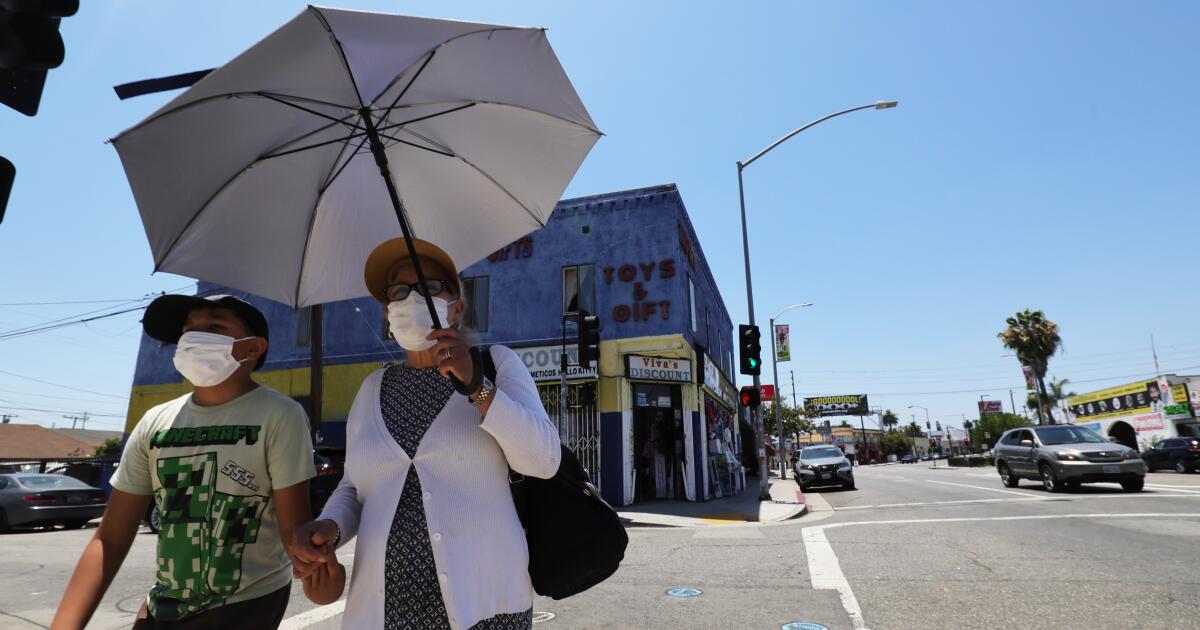
L.A. County heat advisory: When will high temperatures peak in SoCal?
-
 Politics30 minutes ago
Inside the California ICE detention boycott over $18 coffee grounds, $21 tampon boxes
-
 Sports42 minutes ago
‘It just feels right.’ Folarin Balogun can play in World Cup round of 16 after red card suspended
-

 World50 minutes ago
Thousands gather in Tirana in major ‘Pink Flamingo’ protests

