Plus special access to select articles and other premium content with your account – free of charge.
By entering your email and pushing continue, you are agreeing to Fox News’ Terms of Use and Privacy Policy, which includes our Notice of Financial Incentive.
Please enter a valid email address.
Democrats are hinging their hopes of retaining the Senate majority on voters’ disdain for so-called “carpetbaggers.”
As Senate Democrats fight to keep several vulnerable incumbents from losing tough races in swing states across the country, their campaign arm and state parties are homing in on Republican candidates’ traits and biographies over policies.
Advertisement
“It’s a time-honored direction for campaigns to go, but it isn’t always effective,” said Republican strategist Doug Heye. “Given the overwhelming concerns about rising prices, the border and the general direction of the country, it may be tough for this to break through.”
GOP SHORES UP MICHIGAN EFFORT AS DEMS LOSE SENATE INCUMBENT ADVANTAGE
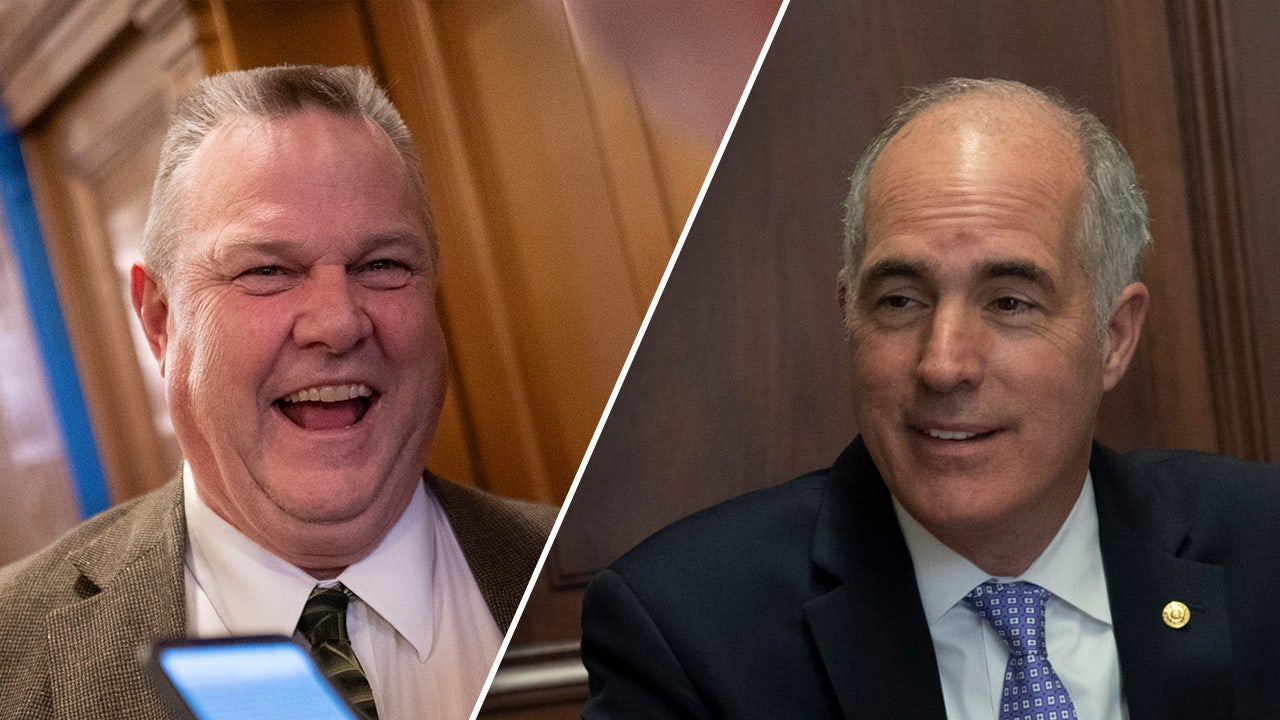
Democrats are hoping claims of carpetbagging against Republican candidates can save their vulnerable incumbents in swing states, like Sens. Jon Tester, left, and Bob Casey, right.(Getty Images)
Historically, carpetbaggers were northerners who traveled to the South during the Reconstruction era following the Civil War with the goal of profiting off of the weakened region. In modern politics, it refers to politicians that move to a new area in order to run for office.
Five Democratic incumbent senators are embroiled in highly competitive reelection battles in Ohio, Montana, Nevada, Wisconsin, and Pennsylvania, as the party faces a uniquely disadvantageous Senate election map.
Advertisement
“Senate Republicans’ roster of recruits is full of carpetbaggers who don’t know the first thing about the states they’re running in and candidates who bring enough financial scandals and baggage to fill a bank vault,” Democratic Senatorial Campaign Committee (DSCC) spokesperson Tommy Garcia said in a statement earlier this year.
SCHUMER JUSTIFIES CONGRESSIONAL INVITE TO NETANYAHU AMID LIBERAL OUTRAGE
Sens. Jon Tester, Jacky Rosen, Sherrod Brown, Tammy Baldwin, Bob Casey(Getty Images: Anna Moneymaker, Drew Angerer, Ethan Miller, Sarah Silbiger)
Kyle Kondik, managing editor of Sabato’s Crystal Ball at the University of Virginia Center for Politics, explained, “After Democrats used this attack, successfully in my view, against Mehmet Oz in Pennsylvania last cycle, I think it’s just become kind of an ‘in vogue’ kind of attack, although it’s also by no mean a new strategy.”
Both national and state level Democratic Party entities have parroted the argument, particularly in reference to the Republican Senate candidate in Montana, former Navy SEAL Tim Sheehy, as well as Pennsylvania Republican nominee Dave McCormick.
Advertisement
“Democrats can’t run on their steadfast support for Joe Biden’s agenda of reckless spending, open borders, and chaos around the globe, so they are lying about our candidates and refusing to discuss the pressing issues facing the American people,” National Republican Senatorial Committee (NRCS) spokesperson Mike Berg said in a statement.
Montana is expected to see one of the closest Senate races of the cycle between Sen. Jon Tester, D-Mont., and Sheehy, and the former’s campaign has fully adopted the term “carpetbagger” to describe his opponent. The attack has similarly been picked up by the state’s Democratic Party.
BIDEN ADMIN ACCUSED OF PLAYING POLITICS WITH FLORIDA FUNDING IN PRO-UNION PUSH
Following the state’s primaries last week, Tester’s campaign amplified his insinuation during a TV interview that Sheehy was “trying to buy Montana,” while emphasizing his own roots.
“I think it’s a very potent argument in Montana,” said Democratic strategist Brad Bannon.
Advertisement
Sheehy is originally from Minnesota and moved to Montana in 2014 before starting his company there.
“Let’s face it, Tester’s trying to reach a conservative audience,” Bannon said, noting that references to his generational roots are “conservative” by nature.
Sen. Jon Tester, left, and Republican Montana Senate candidate Tim Sheehy, right.(Kevin Dietsch/Louise Johns)
“Montana has an insider vs. outsider dynamic in politics, in part because of a lot of new transplants from other places,” Kondik said.
In a statement to Fox News Digital, a spokesperson for Sheehy’s campaign said, “After Tim left the Navy and Carmen left the Marines, they chose to make Montana home to raise their family and build their businesses because it was a place consistent with their values and the way they wanted to live.”
Advertisement
“Tim is proud to have founded Bridger Aerospace in his barn with all his savings, an all-veteran team, and created over 200 Montana jobs. Tim is proud to have founded Little Belt Cattle Company, where they raise, finish, and process premium beef 100% in Montana,” the statement continued.
“Tim and his wife, Carmen, and their four kids are proud Montanans, and it’s truly a shame that Jon Tester and the Democrats would call a combat veteran a carpetbagger when he was deployed to Afghanistan and Iraq fighting for our freedoms all while Tester was becoming a multimillionaire and getting six times richer as a career politician in Washington D.C. While we know Tester will never understand what it’s like to put on a uniform and serve our great nation, the veterans in Montana sure do and will vote Tester out this November,” the spokesperson concluded.
McCormick, who is running for Senate as a Republican again after seeking the GOP nod in 2022, was notably born and raised in Pennsylvania, also starting his business in the state. Carpetbagger claims were initiated when it was reported that he owned a Connecticut home, in addition to his Pittsburgh property.
“I also think it’s effective in Pennsylvania, because the Casey name is as synonymous with Pennsylvania as cheesesteaks are to Philadelphia,” claimed Bannon, referencing Democratic Pennsylvania Sen. Bob Casey’s family and its long history in the state’s politics.
TRUMP VP CONTENDER LEADS GOP EFFORT TO REACH BLACK VOTERS AS BIDEN LOSES GRIP
Advertisement
Kondik remarked, “In the Industrial North, the percentage of residents born in state is higher than it is in the Sun Belt. So maybe these attacks have more resonance — or at least Democrats hope they have more resonance — because of some local specifics, too.”
McCormick campaign spokesperson Elizabeth Gregory said in a statement to Fox News Digital, “Pennsylvanians from across the commonwealth are joining Dave’s movement to send a 7th-generation Pennsylvanian, combat veteran, West Point graduate, and PA job creator to the Senate to deliver new leadership and fresh ideas.”
McCormick previously ran for the GOP nomination in 2022. (Jeff Swensen/Getty Images)
“Career politician and habitual liar Bob Casey votes for Joe Biden’s failing agenda 98% of the time, fueling a border crisis that has killed over 4,000 Pennsylvanians from fentanyl, violent crime, record inflation and regulations that are killing the commonwealth’s energy sector. On November 5, Pennsylvania will retire empty suit Bob Casey and send Dave McCormick to the Senate,” she added.
Per Republican strategist Erin Perrine, “Democrats know they are struggling to connect with voters on policy positions, as polling shows they are underwater on top voter concerns like immigration and the economy.” This forces the party to “make an emotional appeal to voters, arguing that they can represent them because they are one of them,” she said.
Advertisement
Bannon claimed that Democrats’ focus on these carpetbagging accusations is motivated by the independent voters they are going after. “The independents who are two up for grabs, they’re more likely to focus on personal traits in the last stage of the election than the voters who’ve made up their mind already,” he explained.
The strategy additionally “plays into a larger, familiar narrative in which Democrats attack Republicans as being wealthy and out-of-touch. It’s one part of a larger argument,” Kondik emphasized.
But according to Perrine, “A homegrown emotional appeal usually isn’t a winning strategy in a general election, when voters show up on Election Day about what matters most to them every day, not where someone is from.”
The fifth World Cup match in Foxborough features two strong teams and two of the best strikers in the world.
Kylian Mbappé leads France against Erling Haaland and Norway in the final group-stage game being played in Foxborough. On Monday, Germany will take on a yet-to-be-determined opponent in a Round of 32 elimination game, and Foxborough’s final match will be a quarterfinal on July 9.
Here are scenes from Friday’s game from Globe photographers.
France superstar Kylian Mbappé (right) screams after one of teammate Ousmane Dembele’s goals.Christian Kantosky for The Boston Globe
France’s Jules Kounde (left) defends against Norway forward Andreas Schjelderup.Lane Turner/Globe Staff
France forward Ousmane Dembele celebrates after scoring one of his three first-half goals.Christian Kantosky for The Boston Globe
Erik Lunde, from California, attended the Group I match between France and Norway in Foxborough.Finn Gomez for The Boston Globe
Norway striker Erling Haaland, who did not start, warms up before the World Cup match against France.Christian Kantosky for The Boston Globe
Norway fans are fired up before the game against France.Lane Turner/Globe Staff
France forward Rayan Cherki (left) and Norway’s Erling Haaland, teammates at Manchester City, embrace before the start of the game.Lane Turner/Globe Staff
A Norway fan wore face paint and a Viking helmet for the game.Christian Kantosky for The Boston Globe
Norway fans filled the stands in Foxborough.Christian Kantosky for The Boston Globe
A France fan, complete with rooster headwear, waits for the start of the game.Lane Turner/Globe Staff
Robert Branchaud of Tewksbury is prepared for the Group I match between France and Norway.Finn Gomez for The Boston Globe
Fans begin to enter the stadium for the match between France and Norway.Finn Gomez for The Boston Globe
Howard Carlsson and Christian Loset of Drammen, Norway, pose for a photo before the game.Finn Gomez for The Boston Globe
Lane Turner can be reached at lane.turner@globe.com. Finn Gomez can be reached at finn.gomez@globe.com. Christian Kantosky can be reached at christian.kantosky@globe.com. Follow him on Instagram at @ckantoskyphoto.
A proposal to earmark some future tax revenue to Golden Triangle developments was met Thursday with stiff opposition from residents.
“Right now, it seems like this approach is aimed more for developers than the benefit of the citizens of Pittsburgh,” Tim Stevens, founder of the Black Political Empowerment Project, told City Council members during a public hearing.
City officials are contemplating creating a special district that would allow 75% of new tax revenue from developments Downtown and parts of the North Shore and Strip District to go back into improving Downtown.
That money could fund transit upgrades, business district projects, economic development initiatives or new housing, according to Tom Link, the Urban Redevelopment Authority’s chief development officer.
Advertisement
The area, known as a Transit Revitalization District, would not cut into property taxes already being generated in the area. Allegheny County and Pittsburgh Public Schools would also need to vote on whether to allow their portions of property taxes there to be invested in the program.
The tax diversion could be worth up to $200 million, officials estimated. It would last 40 years.
Pittsburghers on Thursday urged council to reject the proposal.
They argued that the new tax revenue created by any Downtown developments should be equitably distributed throughout the city, not focused on Downtown. Several questioned whether it was appropriate for private developers to receive any cash from the effort.
“This is literally a project to grab money and rob people in the city for four decades, masquerading as a TRID,” said Andrew Hussein.
Advertisement
Danielle Wenner, of Polish Hill, said she’d rather see new tax revenue go towards replacing deteriorating bridges or buying new city vehicles instead of supporting Downtown developers.
“The tax revenue generated by development belongs to the entire city and its population,” she said.
Several people questioned how the district would benefit all of Pittsburgh’s 90 neighborhoods.
“That money rightly belongs to all city residents,” Greenfield resident Matthew Cartier said.
Some council members, however, argued that the Golden Triangle needs to do well for the city as a whole to be financially stable. About 25% of the city’s real estate tax revenue comes from Downtown, Councilman Bobby Wilson, D-North Side, pointed out.
Advertisement
“If we don’t have a strong Downtown, we can’t do anything anywhere else,” Councilman Bob Charland, D-South Side, said. “For me, anything we can do to stop the bleed in Downtown means that we don’t have to raise taxes on folks that live in Allentown, folks that live in Knoxville. We want a healthy Downtown that we can tax. This is a way to create a healthy Downtown for the future.”
Since the covid-19 pandemic shifted people out of Downtown offices, officials have been concerned about plummeting property tax revenue in the area. Mayor Corey O’Connor suggested the district as a way to spur economic growth in the Golden Triangle.
The city faces serious financial challenges and is on track to end the year with a deficit of roughly $24 million. Some council members during a preliminary discussion on the special district earlier this month questioned if the city could afford to divert tax revenue when money is tight.
“This is diverting 75% of tax revenue in a huge part of the city,” Councilwoman Deb Gross, D-Highland Park, said.
Councilwoman Erika Strassburger, D-Squirrel Hill, said the district would be “a lot of money we are not reaping as various bodies of government,” but she pointed out that money could fund much-needed projects like affordable housing.
Advertisement
“We’re being asked to give up income for the city of Pittsburgh at a time when we’re struggling to produce a balanced budget,” Councilman Anthony Coghill, D-Beechview, said.
Council scheduled a meeting to further discuss the proposal next Wednesday.
Last week, Yankee Institute proposed the Expenditure Records and Information Notification Act, or ERIN’s Act, a reform requiring executive branch agencies to publish purchasing-card transactions in a centralized, searchable online […]