Northeast
Anti-ICE law set to take effect in Maine as governor faces increased criticism for allowing it amid Senate run

NEWYou can now listen to Fox News articles!
As anti-ICE protests continue to erupt across the country, a new Maine law restricting cooperation between state law enforcement and federal immigration authorities is set to take effect after Democratic Gov. Janet Mills declined to veto or delay the measure, drawing renewed criticism over her progressive record as she runs for Senate.
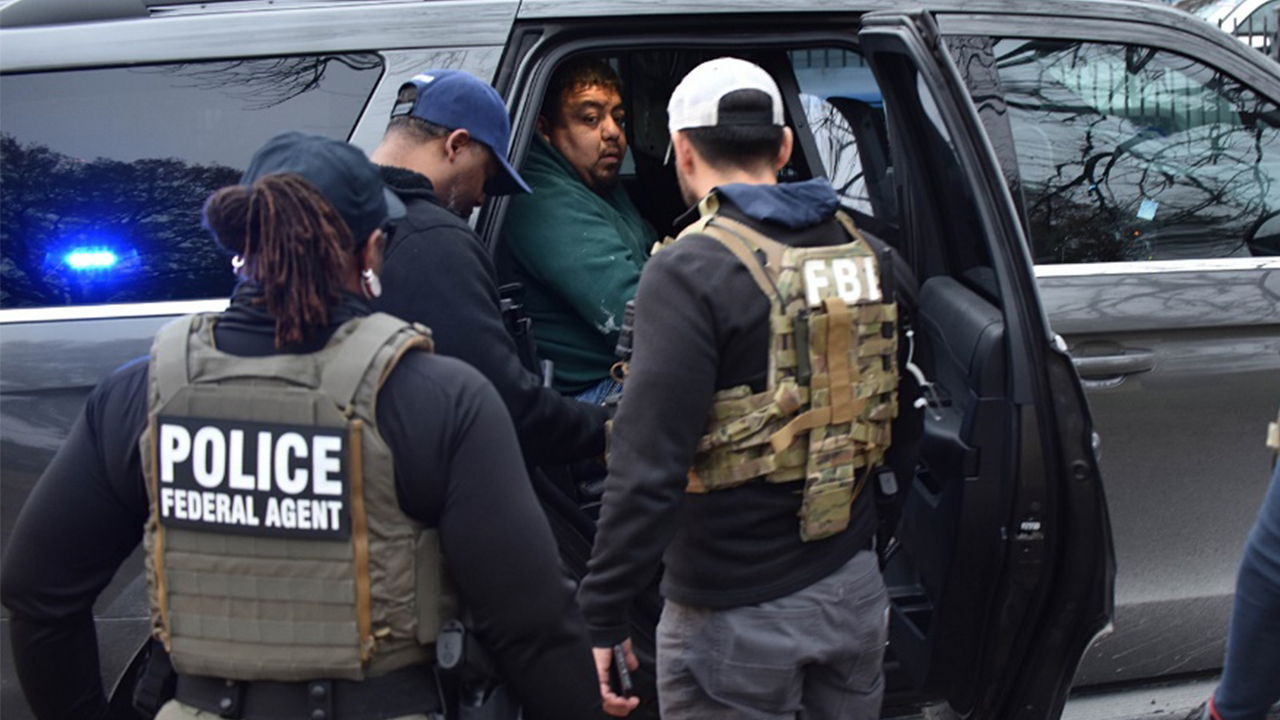
The law, passed by Maine’s Democrat-controlled legislature late last year, will soon take effect after the current legislative session ends and bars state and local law enforcement from assisting U.S. Immigration and Customs Enforcement in a wide range of civil immigration matters.
Even though the law has not officially taken effect, Mills, who declined to veto or sign the law, which will take effect without her signature, has already ordered Maine State Police to begin enforcing its provisions, according to a report from the Portland Press Herald.
The legislation passed the Maine legislature by just one vote last year.
ICE LAUNCHES NEW OPERATION IN MAINE AMID TRUMP’S BROADER ILLEGAL IMMIGRANT CRACKDOWN AROUND THE US
ICE’s federal law enforcement officers take a suspect into custody. (ICE)
Mills, who is running for Senate in the Democratic primary to unseat moderate Republican Sen. Susan Collins, has recently called ICE “secret police” and said their “reckless actions” have “no place here.”
As ICE ramps up activity in Maine, including over 50 arrests in one day last week, Republicans in the state have pushed back against the ICE rhetoric coming from Mills.
“Let me be very clear: ICE agents are federal law enforcement officers,” Assistant House Republican Leader Katrina Smith said last week. “They take an oath. They operate under federal authority. And they show up to work knowing that rhetoric alone can make them a target. You can oppose immigration policy without turning the people enforcing the law into enemies.”
Mills released a statement on Saturday, shortly after federal immigration agents shot and killed an armed man in Minneapolis, demanding a meeting with President Trump and for him to remove ICE from Maine.
The immigration law is the latest in a series of high-profile decisions that critics say underscore Mills’ liberal record as Maine prepares for her State of the State address later this month.
Since taking office, Mills has expanded eligibility for MaineCare, the state’s Medicaid program, to include non-citizens regardless of immigration status. The policy allows taxpayer-funded health care for non-citizen children and pregnant individuals, a move Republicans say has driven up costs for working Mainers. State records show Maine has spent hundreds of thousands of dollars on health care for individual illegal immigrants in recent years.
DEM GOVERNOR DROPS F-BOMB WHEN TROLLED FOR ALLEGED COCAINE USE
Democrat Gov. Janet Mills (Kevin Dietsch/Getty Images)
MaineWire reported last month on a photo from a Maine city bus advertising how MaineCare is now being offered to “pregnant people and children under 21, with or without proof of citizenship” which prompted criticism of Mills from the National Republican Senatorial Committee.
Mills has also repeatedly clashed with Trump, most notably over transgender policies. Last year, she publicly confronted the president over federal funding threats tied to allowing transgender athletes to compete in women’s sports, vowing to sue the administration if funding was withheld.
Her administration has signed and defended a slate of laws expanding access to gender-affirming care, including protections for minors to receive certain treatments even if parents object, mandates requiring insurance coverage for such care, and measures shielding providers from out-of-state legal action.
On abortion, Mills has signed legislation expanding who can perform abortions, removed criminal penalties tied to reproductive care, and strengthened protections for providers and patients traveling to Maine from other states.
CLICK HERE TO DOWNLOAD THE FOX NEWS APP
AN ICE agent seen standing in front of a house in a residential area. (Victor J. Blue/Bloomberg via Getty Images)
Ultimately, the NRSC told Fox News Digital it believes Mills is more focused on a “progressive agenda” than she is on results for the state.
“Janet Mills has spent her time as Governor expanding transgender rights, offering taxpayer-funded healthcare to illegal aliens, and combating the Trump administration every chance she gets,” NRSC Regional Press Secretary Samantha Cantrell told Fox News Digital.
“Mainers deserve a Senator who is focused on delivering real results, not Janet Mills who is more concerned with pushing her progressive agenda on Maine.”
Fox News Digital reached out to Mills’ campaign for comment.
Read the full article from Here



Rhode Island
More complaints against former RI private school coach accused of exploiting underage girl – The Boston Globe

The girl told the state police and Barrington police that Cassidy, who’d been her coach, became fixated on her since the summer of 2025 and won her trust. She told police that Cassidy had given her lingerie and alcohol and requested explicit photos of her under the guise of training her for a “secret section of the FBI” to help children who are sex trafficked.
The small private Christian school fired Cassidy after his arrest on June 1. State police said they expected to bring more charges and asked for other witnesses to come forward.
Since then, Barrington Police Chief Michael E. Correia said, four more students from Barrington Christian Academy and a young woman who encountered Cassidy at the Pawtucket YMCA have made complaints.
“All of their stories are clearly inappropriate behavior from a teacher-coach,” Correia said on Wednesday. “However, we don’t believe [the allegations] at this time amounts to a criminal offense.”
Correia declined to describe the specific accusations. The new reports have been referred to the State Police Internet Crimes Against Children Task Force, which is leading the investigation. State Police Major Kenneth Moriarty did not respond to questions on Wednesday.
A 19-year-old woman who attended Barrington Christian Academy in the 2020-2021 school year was the first to come forward. She spoke to Barrington police on June 3, shortly after the state police announced Cassidy’s arrest, and described “inappropriate behavior,” Correia said.
Then, a 12-year-old girl and 15-year-old girl, both of whom are student-athletes at the school, spoke with Barrington police on June 8. A mother brought her 12-year-old daughter, who is also a student, to speak with police on June 9.
A 23-year-old woman contacted the Barrington police on June 17 about Cassidy. She said she encountered him at the Pawtucket YMCA when she was about 14 years old, and she also complained about “inappropriate behavior,” Correia said.
Kate Messier, the vice president of development at the Pawtucket YMCA, confirmed on Wednesday that Cassidy was employed there until 2018. She did not comment on his role at the YMCA or answer questions about whether the organization had received any complaints about Cassidy at the time.
“Child protection is foundational to how the YMCA of Pawtucket operates, and we maintain extensive safeguards that are reviewed and reinforced on an ongoing basis,” Messier said in the statement. “Those safeguards include thorough staff screening and background checks, mandatory child abuse prevention training, program environments structured to maintain supervision and eliminate unsupervised one-on-one situations, and clear procedures for reporting any concern.”
The 14-year-old girl whose allegations led the state police to arrest Cassidy said that she learned that he had allowed juveniles from unstable homes live in his house in Pawtucket while he was working at the YMCA, according to court documents. The girl also told investigators that Cassidy had housed foreign exchange students associated with Barrington Christian Academy.
Correia said that the private school has been “very cooperative” with the Barrington police. The head of school, Michael Skazinski, did not respond to questions from the Globe on Wednesday.
Cassidy’s lawyer, Melissa Larsen, declined comment on Wednesday.
The state police have searched Cassidy’s home in Pawtucket, his pickup truck, and his office at the school, and have seized numerous electronic devices, including iPads, tablets, and thumb drives, according to court records. The affidavits accompanying the search warrants detailed the allegations that the 14-year-old girl made against Cassidy.
He had been coaching her in different sports at the school, and their families became close. She told the state police that she grew to trust Cassidy and would spend time with him and his family at their home. Then, she said, he began telling her stories about how he was special — and so was she.
She said Cassidy told her he was working for a “secret section of the FBI.” She said he claimed that he had “special DNA,” so the FBI and state troopers had him assist in raids to save children from being sex trafficked. She said that Cassidy told her that there were “off-worlders” or aliens that posed as humans on earth, and some of those children being sex trafficked were actually aliens.
She said that Cassidy assigned various “challenges” or “missions” to make her comfortable in uncomfortable situations, according to the affidavits.
“She was also advised to learn to get comfortable with wearing less clothing and ultimately nudity because it would be required later on for ‘missions,’” the affidavits said. “Cassidy claimed that aliens did not believe in the ‘construct of clothes.’”
She said Cassidy emailed her from his personal Gmail account, calling himself “Casper,” the affidavits said. She said he also claimed that two other girls were using his email to talk to her about the “special” training, and she was told to email with a person named “Kevin” on another email address who would talk to her about her feelings, the affidavits said.
She said she was instructed to take explicit photographs of herself and send them to his private email. She came to realize that all of the personas were actually Cassidy.
On May 28, the girl received an email from Cassidy’s personal Gmail account offering her three “flirt options,” all of which involved her taking off her clothes in front of him. She believed she needed to follow through; she told police that Cassidy said “bad things” could happen to her if she failed.
That night, her parents discovered what was going on, and they contacted the Barrington police, who called in the state police.
The State Police are continuing to investigate and ask anyone with information about Cassidy or potential victims to contact the task force at 401-921-1170, or the Barrington Police Department at 401-437-3935.
Amanda Milkovits can be reached at amanda.milkovits@globe.com. Follow her @AmandaMilkovits.
Vermont
Vermont Attorney General will not prosecute state trooper who fatally shot unarmed Putney man – VTDigger

Vermont Attorney General Charity Clark declined Tuesday to prosecute a state police officer who shot and killed an unarmed man who was experiencing a mental health crisis last year.
Vermont State Police Trooper Peter Romeo fatally shot 55-year-old Scott Garvey in his Putney home on July 7, 2025. Romeo opened fire on Garvey after police entered the man’s house, in which he had barricaded himself for more than four hours, according to a Tuesday press release from the Vermont Attorney General’s office.
Clark, the state’s top law enforcement officer, determined that police officers involved in the shooting did not violate state law by fatally shooting Garvey, the press release said.
Forty nine people have been shot by police officers in Vermont since 1977, when the state began keeping track. None of those officers has been criminally prosecuted for their use of force, according to Vermont State Police data.
The Vermont State Police — whose officers were involved in the shooting — investigated the incident. Clark’s office reviewed the materials in the investigation before declining to press charges, according to the press release.
Shawn Garvey, Scott’s brother, said in an interview Wednesday that he believed his brother’s death was preventable and that police officers involved in the shooting made the wrong judgment calls.
“Is the state going to hold anyone accountable at all? Or is this just a free ride, a free pass?” Shawn Garvey said.
Across the U.S., a quarter of police shootings between 2015 and 2020 involved someone with a mental illness, according to the National Alliance on Mental Illness.
The press release from Clark’s office sheds light on the timeline of events leading up to the fatal shooting.
The night of July 6, 2025, the day before Garvey was killed, neighbors called the police to report seeing smoke coming from his apartment, the release said. Neighbors told police they believed he was trying to kill himself, according to the release.
When firefighters and emergency medical personnel responded, they reported that the smoke had come from a fire extinguisher. Garvey was alone in the apartment and not a threat, they said.
The next morning, at about 7:15 a.m., Garvey called police and reported he had been in an altercation with a neighbor the day before and he believed the neighbor had a firearm.
“Mr. Garvey voiced concern that people were in the woods with guns, and that someone had tried to break into his house with a gun a few nights before, but he had stacked boxes in front of the door and fought them off,” the press release said, detailing Garvey’s phone call.
Later that morning, a neighbor of Garvey’s called police to report that a man was banging on the windows and “stating that the voices are telling him to kill everyone.”
The press release said police officers and a mental health clinician arrived at Garvey’s house at about 11:30 a.m. that morning. After talking to neighbors who witnessed Garvey’s behavior and said they were scared, police spoke with Garvey through his front door. Officers determined they had probable cause to arrest Garvey, but he wouldn’t let them in.
“The embedded mental health clinician relayed that Mr. Garvey ‘said he had a gun’ and ‘if he came out, you would have your guns drawn, and he would have his as well,’” the press release said.
Police officers and the mental health clinician spent about four and a half hours communicating with Garvey, trying to de-escalate the situation, the press release said, adding that officers were aware that Garvey had a history of schizophrenia.
“Throughout, Mr. Garvey never denied that he was in possession of a firearm while in the apartment,” the press release said.
Officers were eventually granted a warrant to enter the house and entered it at about 4:30 p.m. But when three troopers tried to enter the house, they encountered a barricade. Trooper Romeo saw Garvey holding an object that he wasn’t able to identify but suspected was a rifle, the press release said.
“When asked what he had seen by Sergeant Hughes, Trooper Romeo responded ‘I don’t know,’” the release said.
Then police ordered Garvey multiple times to drop the object, but he did not, according to the press release. It said Garvey then raised the object like it was a rifle and pointed it at officers. Romeo fired seven shots, three of which hit Garvey, the release said.
The object was not a rifle — it was a metal pole, the press release said. Garvey used the pole as a cane, his brother Shawn said.
In the interview, Shawn said that he thinks police officers escalated the situation by entering the house.
“My brother wasn’t hanging out the window with a weapon, he wasn’t threatening neighbors through their walls, he didn’t, you know, say he had a bomb,” he said.
Shawn said he wasn’t surprised that the case wasn’t getting prosecuted, but it was difficult news to receive.
After his brother’s death, Shawn said, he returned to his brother’s house to find a gruesome crime scene. He said the walls were filled with bullet holes and a pool of blood remained on the floor. Cleaning up the house, which his mother also lived in, cost about $20,000, he added.
Then his family had to pay the state nearly $2,000 for his brother’s remains, he said.
“We’ve been living in a sort of purgatory for 351 days,” awaiting the results of the investigation, Shawn said.
In response to Shawn’s comments about officer conduct, Clark said in an emailed statement to VTDigger that “This event was a tragedy. We cannot imagine the pain that the Garvey family has endured and continues to experience, and our hearts go out to them during this time.”
Before the attorney general made the public announcement, Shawn said, he and his family members spent about four hours talking with police about the events leading up to his brother’s death.
“I came out more convinced than ever that my brother should still be alive today,” Shawn said.
-

 North Carolina11 minutes ago
Great horned owl kills 1 of NC Wildlife’s famous barn owlets: officials
-

 North Dakota14 minutes ago
NCAA Set to Change Unpopular Football Rule Just in Time for North Dakota State’s FBS Jump
-

 Ohio19 minutes ago
Ohio lawsuit alleges new NCAA rule unfairly denies high school Class of ’22 athletes a 5th season
-

 Oklahoma26 minutes ago
Fire Crews respond to commercial fire in SW Oklahoma City Wednesday afternoon
-

 Oregon29 minutes ago
Liu makes two! 2nd red panda joins Oregon Zoo family
-

 Pennsylvania34 minutes ago
Pa. measles cases jump, spread to Northumberland County
-

 South-Carolina39 minutes ago
South Carolina governor’s race set as Wilson, Johnson turn to general election
-

 Rhode Island41 minutes ago
More complaints against former RI private school coach accused of exploiting underage girl – The Boston Globe

