Northeast
2.9 magnitude earthquake strikes New Jersey

Magnitude 4.8 earthquake felt across New Jersey, New York
Fox Weathers Adam Klotz provides details on the N.J. earthquake. Weston Observatory professor John Ebel discusses the possibility of aftershocks and explains why the magnitude estimate fluctuated in the minutes following the initial earthquake.
A small 2.9 magnitude earthquake rattled New Jersey on Saturday morning, just three weeks after a more forceful 4.8 quake hit the Garden State and surrounding regions.
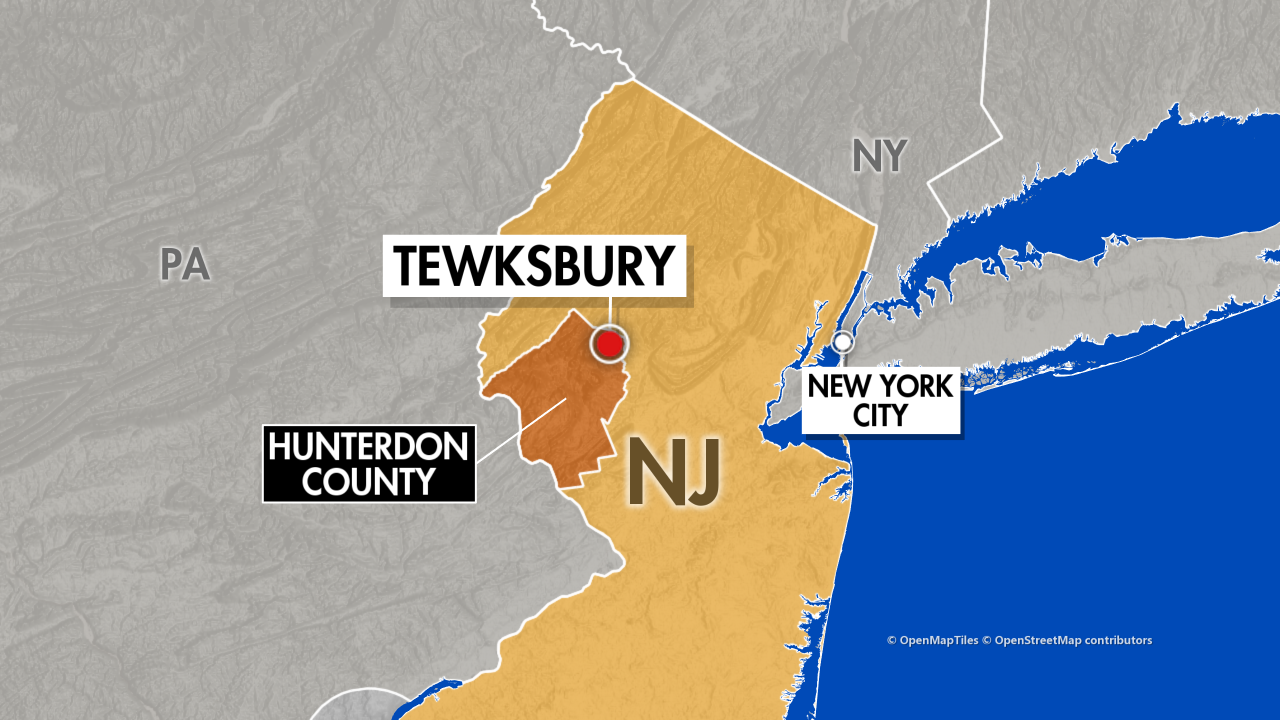
The natural phenomenon hit near Tewksbury this morning at around 9:49 a.m., according to the U.S. Geological Survey. Tewksbury is located in Hunterdon County, which is about 35 miles west of New York City.
It is unclear if the seismic activity was an aftershock from the April 5 earthquake. That event was centered near Whitehouse Station, which is about five miles south of Tewksbury, and was felt from Washington D.C. to Maine, according to the USGS.
IS THE EAST COAST ON THE BRINK OF A MAJOR EARTHQUAKE — AND ARE WE PREPARED?
A small 2.9 magnitude earthquake rattled New Jersey Saturday morning, just three weeks after a more forceful 4.8 quake hit the Garden State and surrounding regions.
Ashley Papa, a Fox News Digital editor living in New Jersey, says she felt Saturday’s quake rock her home.
“I was in the kitchen with my toddler and all of a sudden we started feeling the house shake pretty strongly and we heard that same rumbling sound from the day of the [April 5] earthquake,” Papa said.
More than 130 aftershocks have been recorded in the region since the April 5 rattler, which was estimated to have been felt by more than 42 million people in 14 states.
“I’d have to say it was the strongest aftershock since that day except this time I knew what I was feeling, unlike that Friday when I had no idea what was going on,” Papa said.
Two employees of Bourbon Street Wine and Sprits hold back shelves full of liquor in New Jersey during the April 5 earthquake. (Chris Beardly)
4.8 MAGNITUDE EARTHQUAKE STRIKES NEW JERSEY, SHAKING BUILDINGS IN SURROUNDING STATES
“I think we’re all just in shock that this is still going on. I figured we would never feel anything like this again for another hundred years and here we are about a month later still feeling strong aftershocks, it just makes us wonder what is going on? And of course, our dog is terrified and will likely never be the same again.”
Earthquakes are rare along the East Coast, with the most powerful one in the last 100 years hitting in August 2011, clocking 5.8 on the Richter scale. It was centered in Virginia and felt from Washington, D.C. to Boston.
The recent quakes follow a 1.7 magnitude earthquake in New York City on Jan. 2.
People walk through lower Manhattan moments after New York City and parts of New Jersey experienced a 4.8 magnitude earthquake on April 05, 2024 (Earthquake East Coast)
Professor John Ebel, a seismologist in the Department of Earth and Environmental Sciences at Boston College, told Fox News Digital recently that a quake above 5.0 on the Richter scale generally strikes once every 120 years.
“The question is, can we have something bigger? And in my opinion, yes we can,” he said. “We can’t predict earthquakes, and we don’t know when the next one is going to occur, but we do have a low, not insignificant probability of a damaging earthquake at some point.”
Ebel said that the April 5 earthquake has left seismologists baffled since it didn’t occur on the Ramapo Fault zone, highlighting just how hard it is to predict the phenomenon from occurring.
The Ramapo Fault zone is a series of small fault lines that runs through New York, New Jersey and Pennsylvania. Spanning more than 185 miles, it was formed about 200 million years ago.
Read the full article from Here


Listen to this article
Estimated 4 minutes
The audio version of this article is generated by AI-based technology. Mispronunciations can occur. We are working with our partners to continually review and improve the results.
Equipment at Woodland Pulp in Maine roared back to life in mid-December after a 60 day pause in operations, and now one of the state’s largest mills is again accepting wood from New Brunswick producers.
“On Monday, we restarted purchasing fibre for the mill,” company spokesperson Scott Beal said.
“We’re back in the market. We are bringing in some fibre from suppliers in Canada, hardwood and chips.”
The general manager of the Carleton Victoria Forest Products Marketing Board says the news is welcome but not nearly enough to help embattled private woodlot owners in the province.

“Everything is good news at this point, but it is not as good as it could be,” Kim Jensen said. “We’re not back where we were.”
With sales down by about two-thirds from last year, Jensen said some woodlot owners are deciding to pack it up, while others struggle on.
“We have had some older ones who’ve left, they’ve just, they’ve had enough and they’ve left,” she said.
“The people who have invested in the business, have bought processors and forwarders, they have to stay in business. And if you have $1,000,000 worth of equipment there, your payments are $40,000 to $60,000 a month and you have to work. You can’t just go somewhere else and get a job.”

Duty rates on New Brunswick wood were set at 35 per cent in September, when U.S. President Donald Trump announced an additional 10 per cent tariff on lumber imports.
The sudden increase was too much for Woodland Pulp to bear. The mill relied on New Brunswick wood for about a third of its supply prior to October.
“It certainly adds cost to the business and, you know, like other wood users, I mean we’re always looking and hoping and trying to source fibre at the least cost,” Beal told CBC News in October.
The Baileyville-based mill has rehired all of the 144 people laid off during its two month shut-down, and Beal said it will likely take some time to ramp up to accept the amount of wood it previously did.
And with the difficult and uncertain tariff environment, Beal said, it’s hard to say how long the mill would be able to continue purchasing Canadian wood.
“It’s a very challenging pulp market,” he said.
“The tariffs remain in place. That hasn’t changed. So it’s not reasonable to think that that won’t be a headwind for the business.”
The federal government did create a $1.25 billion fund to help the industry survive, but Jensen says that hasn’t meant support for individual private woodlot owners.
In October, Jensen told CBC News that sales of timber by the marketing board’s members totalled about $1 million for all of 2024. They have fallen to about $200,000 over the past 12 months.
And the cost of cross-border business has continued to rise.
Before Woodland Pulp stopped taking Canadian timber, the company had a lumberyard in Florenceville ,where producers could drop off wood. Woodland would then take responsibility for shipping it the rest of the way to the mill.
Now it’s up to individual producers to source transportation and to arrange a broker to help meet cross-border requirements. That’s adding between $60 and $100 per load of timber heading to the U.S.
“The markets are tightening up, and the prices are going down, and you can only go down so far before it’s just done,” Jensen said.
“A mill can stop and start up, maybe. But a private guy who loses his equipment, he’s lost everything. He’s not coming back.”

A Massachusetts police department is mourning the death of one of its own after an officer was struck and killed while attempting to assist a broken-down driver on a highway.
The Uxbridge Police Department has hung black bunting above its main entrance as it receives condolences from across the Bay State following the incident early Wednesday morning.
The crash unfolded at about 12:45 a.m., when the officer was trying to help a motorist in the northbound lanes of Route 146, a main artery in the Worcester County town that borders Rhode Island.
Authorities identified the fallen officer on Wednesday afternoon as Stephen Laporta, 43, of Uxbridge. The Massachusetts State Police is investigating the crash.
“This is a devastating loss for our department and our community,” Police Chief Marc Montminy said in a statement. “Our thoughts and prayers are with the officer’s family, loved ones, and fellow officers during this incredibly difficult time.”
Gov. Maura Healey has ordered flags to be flown at half-staff at all state buildings in honor of LaPorta.
“I am heartbroken over the news of Officer Stephen LaPorta’s passing,” the governor said in a statement Wednesday afternoon. “He knew he was headed into a dangerous situation when he responded to the scene of a multi-vehicle crash, but like all of our officers do day in and day out, he put the public’s safety first – and he tragically made the ultimate sacrifice.”
Authorities closed Route 146 for hours after the crash, with investigators working the scene. The icy, frozen road reopened around 10 a.m.
Uxbridge First Holy Night, a community organization, offered its condolences to the department via social media, saying the loss is also felt “across our entire town.”
“Our officers are more than public servants — they are neighbors, friends, parents, children, and family,” the group stated. “When one of our own falls, we all grieve together.”
“Uxbridge is a close-knit community,” it added, “and in moments like this, we lean on one another. May we surround this family and our police department with compassion, strength, and support in the days ahead.”
Police departments from across the region sent cruisers to participate in a procession that accompanied a vehicle carrying LaPorta’s body to a medical examiner’s office before daybreak.
The Boston Police Patrolmen’s Association described the officer as a “fallen hero” and the death as “heartbreaking news.”
“Another police officer killed in the line of duty. This time in Uxbridge,” the association stated in a social media post. “The officer was involved in a motor vehicle crash while attempting to assist a motorist on Rte. 146 early this morning. Our thoughts and prayers are with the officer’s family and the entire Uxbridge Police Department during this incredibly difficult time.”
State Rep. Mike Soter, whose Central Massachusetts district includes Uxbridge, said his “heart sank” when learning of the death.
“This is so close to home,” he said in a Facebook post. “May GOD watch over this officer’s family and his fellow officers today as they need our strength as a community. May the officer’s memory be eternal always!”
In June 2024, the Uxbridge Police Department celebrated LaPorta’s promotion to full-time patrolman.
“He may seem familiar to you all because Ofc. LaPorta has already been actively serving our wonderful town as a full-time Dispatcher and working part-time patrol shifts,” the department stated in a Facebook post. “He has put in the work to switch his role up and come to the patrol side full time! Let’s give him a warm congrats Uxy!”

On January 3, the United States military carried out what the administration called a “large-scale strike” in Caracas, Venezuela’s capital, amid several reported explosions and aerial bombardment.
Tune in to Civics 101 during Here & Now on Thursday, January 8 for a special edition breaking down one of the most unprecedented events in recent international affairs. This segment begins at 1:40 p.m. EST.
Listen to NHPR on your radio, stream us online, or just ask your smart speaker to “play NHPR.” You can also listen to this special episode of Civics 101 on demand.
In this episode, hosts Hannah McCarthy and Nick Capodice break down the history, context, and legality of what’s unfolding now — and what it could mean for Venezuela, the United States, and international law.

Delaware announces plan to tackle climate warming emissions

Penn State OG TJ Stranahan commits to Florida Gators

Georgia Republicans move to scrap state income tax by 2032 despite concerns

Healthier Hawaii: How to protect your hearing; head and neck warning signs you shouldn’t ignore

PUC takes comments on Idaho Power fire mitigation plan | Capital Press

Florida High School Football Rankings: Top 25 teams – Oct. 21

Cleary's 21 help Le Moyne down Central Connecticut State 69-64 in OT

How old is Bo Nix? What to know about Oregon quarterback ahead of 2024 NFL Draft

99th annual Pony Swim held in Virginia

Video: ‘It Didn’t Have to Happen This Way:’ U.Va. Faculty Call for Review of Police Response to Protests

San Diego sues to stop border barrier construction

How Ukraine is shaping Europe’s response to Trump’s Greenland threats

GOP gearing up to face tough midterms. And, Pentagon reviews women in ground combat

Wyoming Supreme Court rules laws restricting abortion violate state constitution

How strong are Latin America’s military forces, as they face US threats?
-

 World1 week ago
Hamas builds new terror regime in Gaza, recruiting teens amid problematic election
-
 News1 week ago
For those who help the poor, 2025 goes down as a year of chaos
-

 Science1 week ago
We Asked for Environmental Fixes in Your State. You Sent In Thousands.
-
 Business1 week ago
A tale of two Ralphs — Lauren and the supermarket — shows the reality of a K-shaped economy
-

 Detroit, MI4 days ago
2 hospitalized after shooting on Lodge Freeway in Detroit
-
 Politics1 week ago
Commentary: America tried something new in 2025. It’s not going well
-

 Politics1 week ago
Marjorie Taylor Greene criticizes Trump’s meetings with Zelenskyy, Netanyahu: ‘Can we just do America?’
-

 Health1 week ago
Record-breaking flu numbers reported in New York state, sparking warnings from officials