News
US deploying THAAD missile defence system, troops to Israel


The United States is sending an advanced anti-missile system to Israel, the Pentagon has announced, as President Joe Biden’s administration continues to provide “ironclad” support for one of its top allies amid mounting tensions with Iran.
The US Department of Defense said on Sunday that Pentagon chief Lloyd Austin had authorised the deployment of a Terminal High Altitude Area Defense (THAAD) “battery and associated crew of US military personnel to Israel” to help boost the country’s air defences.
“The THAAD Battery will augment Israel’s integrated air defense system. This action underscores the United States’ ironclad commitment to the defense of Israel, and to defend Americans in Israel, from any further ballistic missile attacks by Iran,” the Pentagon said in a statement.
The announcement comes less than two weeks after Iran fired a barrage of missiles at Israel on October 1 in retaliation for the assassinations of Hamas and Hezbollah leaders and an Iranian general.
Israeli leaders, including Prime Minister Benjamin Netanyahu, have vowed to retaliate — spurring fears that the Middle East could be dragged into an all-out regional war.
Earlier this month, Biden suggested that Israel should refrain from striking Iran’s nuclear facilities or oilfields, but the Israeli government has repeatedly defied the US president’s public warnings in the past.
It is unclear when exactly the US’s THAAD system will be deployed to Israel. An unnamed US official told CBS News that “around 100 troops” will go to the country.
Earlier on Sunday, Iranian Foreign Minister Abbas Araghchi warned that Washington was “putting [the] lives of its troops at risk by deploying them to operate US missile systems in Israel”.
“While we have made tremendous efforts in recent days to contain an all-out war in our region, I say it clearly that we have no red lines in defending our people and interests,” Araghchi wrote on social media.
While the US has said it favours diplomacy and a de-escalation in the region, critics have noted that Washington offers Israel unwavering military and diplomatic support.
The US provides Israel with at least $3.8bn in military aid annually, and the Biden administration has authorised $14bn in further assistance to its ally since the Israeli military began its war on the Gaza Strip in October of last year.
Israel also recently expanded its bombing campaign in Lebanon, after exchanging fire with Lebanese group Hezbollah across the Israel-Lebanon border for months.
Yet despite growing concerns over a widening war, the Biden administration has rebuffed calls to suspend weapons transfers to Israel to pressure the country to end the wars in Gaza and Lebanon.
Marwan Bishara, Al Jazeera’s senior political analyst, said “there is no doubt” that Washington’s THAAD system announcement on Sunday would further escalate regional tensions.
“I am not sure if President Biden is sleep-walking his way into another regional war … or [if] he has his eyes wide open as he escalates the war,” Bishara said.
Israel already uses three integrated missile defence systems to intercept incoming rockets and missiles fired towards the country.
But the THAAD system that the US will deploy to Israel has a greater range than other systems and marks a “step up”, Al Jazeera’s Mike Hanna reported from Washington, DC.
“The important point, too, is that the [THAAD] systems are so complex that it requires a crew of 94 to operate — a trained crew of 94 — and these will be US soldiers,” Hanna said.
“This is a system being put in place and it is a significant step up of the US support for Israel as this crisis continues.”
Speaking to Al Jazeera, military analyst Elijah Magnier said he believed the THAAD system announcement meant that the expected Israeli attack on Iran is “not imminent”, as Israel would want the missile defence system to be in place before any attack, which will likely be followed by another Iranian attack on Israel.
The US previously deployed a THAAD battery to Israel in 2019 for training and an air defence exercise, the Pentagon said on Sunday.
Biden also directed the military to send one to the Middle East “to defend American troops and interests in the region” after last year’s October 7 attacks by Hamas on southern Israel.



President Trump has submitted plans plans to paint the Eisenhower Executive Office Building white to a group that advises on architecture in Washington, D.C.
The French Second Empire-style, slate-gray building houses office space for members of the president’s team, including the National Security Council.
The building sits across a driveway from the West Wing and was completed in 1888. The plans submitted by the president say that the Eisenhower Executive Office Building is an eyesore that has long been criticized and has fallen into disrepair since its completion. The plans say “the color, design, and massing of the existing structure does not align visually with the surrounding architecture and lacks any symbolic cohesion with the White House.” The plan points to examples of cracks and poor exterior maintenance and argues, “The benefit to painting the stone is that it is repeatable.”
“The inability to bring the stone facade back to a baseline color has plagued the maintenance of the [Executive Office Building] in the past, and and will continue to plague it if not addressed,” the plan says.
The plans included renderings of what the building would look like if it’s painted white.

The Executive Office of the President submitted a design proposal to the Commission of Fine Arts, a panel of Trump appointees who advise on public architecture and design in the nation’s capital.
The CFA will hear a presentation on the plan on April 16.

The Labor Department says the vast majority of new jobs created over the last year went to women, most of them in health care.
melitas
hide caption
toggle caption
melitas
In December 2016, as Donald Trump was headed to the White House for the first time, Betsey Stevenson offered the incoming president some economic advice.
Stevenson, a professor of public policy and economics at the University of Michigan, argued in an op-ed that it would be a disservice to encourage men “to cling to work that isn’t coming back.” She cited Trump’s promise to bring an iPhone factory to the U.S.
“If Trump really wants to get more Americans working,” she wrote at the time, “he’ll have to do something out of his comfort zone: make girly jobs appeal to manly men.”

It’s a message she believes is even more relevant today.
For decades, the focus has been on getting more women into male-dominated fields. Some efforts have been more successful than others. But now, with the vast majority of new jobs going to women, it’s clear that men need help, too.
“This is happening at a time where it’s become verboten to talk about diversity, equity and inclusion,” Stevenson says. “And yet the people we need to be talking about right now are men.”
17 times as many jobs filled by women
In the mid-1970s, women held about 40% of jobs in the U.S, not including farm work or self employment. By the early 2000s, women’s share of jobs had grown to just under half. It’s hovered around there since, crossing the 50% threshold just a few times, including during the Great Recession, just before COVID, and now.
That parity masks the significant gains women have recently made in the labor market. Of the 369,000 jobs the Labor Department says were created since the start of Trump’s second term, nearly all — 348,000 of them — went to women, with only 21,000 going to men. That’s nearly 17 times as many jobs filled by women as by men.
The lopsidedness was driven by huge growth in health care, where women hold nearly 80% of jobs. Over the past 12 months, health care alone added 390,000 jobs, more than in the economy overall, making up for job losses elsewhere.
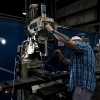
“If we want to see job growth that’s as robust for men as it is for women, we’re going to have to see men embracing those kinds of jobs,” says Stevenson.
So far, that hasn’t happened in any meaningful way. Stevenson believes it’s because men are more likely than women to have an identity tied to a particular occupation, making it harder for them to find work outside that field, much less in one dominated by women.
Meanwhile, in his second term, Trump has not strayed from his message that manufacturing will make the country strong. It’s something he emphasized in his second inaugural address, declaring that “America will be a manufacturing nation once again,” and in his repeated promises that tariffs would “bring factories roaring back.”
When manufacturers added 15,000 jobs in March, the White House called it proof that “the best days for American workers, manufacturers, and families are still ahead,” despite the fact that the sector is still down 82,000 jobs from when Trump took office.
“We have seen a year of a president absolutely fixated [on] growing the manufacturing sector,” Stevenson says. “There’s not enough of those jobs for men as a whole to thrive.”

A push for policies to open doors for men
What’s happening now in the labor market comes as no surprise to Richard Reeves, president of the American Institute for Boys and Men, a nonpartisan think tank.
He says not enough attention has been paid to the scarcity of men in certain professions, and now we’re seeing the consequences.
“There is no cause for panic here,” says Reeves, who’s been studying the decades-long decline in labor force participation among men. “But I do think we should be alert to signs that the labor market might be moving even more quickly in directions that are leaving too many men behind.”
Reeves notes that for years, the country has embraced policies and programs aimed at getting more women into science, technology, engineering and math, and the share of women in STEM jobs has grown.
“But that didn’t happen by itself. It happened as a result of concerted efforts to break down gender stereotypes,” he says.
Still, gaps remain, and some of those efforts have seen their government funding cut under Trump.

Now Reeves says what’s needed are policies and programs to draw male workers into fields such as nursing, teaching and social work.
“Those are occupations that serve people, and they should look like the people that they serve,” he says. “And it’s good for men because it means they won’t lose out on those jobs if that’s where the growth is coming from.”
Framing jobs as more masculine
Stevenson has been thinking about ways to make the fastest-growing sectors of the economy more welcoming to men.
“I think there are ways for us to talk about those jobs as being particularly masculine,” she says.
For instance, many health care jobs could be framed as roles requiring the strength to lift people. Preschools could highlight the need for teachers who serve as positive male role models.
“Kids love to be rough and tumble and build things,” she says.
Stevenson knows some people will be offended by such gender stereotyping.
“But I do want to encourage us to realize that we have to help men understand that they can do caregiving roles and stay masculine,” she says.
Ongoing challenges for women and men
What Stevenson doesn’t want people to conclude is that everything is okay now that women are leading on jobs.
“We know that there is still discrimination that holds people back,” she says.

For women, she says, that discrimination might be preventing them from getting the promotion that they deserve, contributing to the widening gender pay gap. For men, it may mean sitting on the sidelines because they don’t think there’s a role for them in the economy.
“I think we can use this moment to realize that discrimination, occupational segregation… these are things that harm all of us, not just one narrow group,” she says.

new video loaded: How Trump’s Advisers Felt About Going to War With Iran
By Maggie Haberman, Jonathan Swan, Christina Shaman, John Pappas and Ray Whitehouse
April 9, 2026

Full-length Replay: Oregon at Maryland

Zoning limits bills prompt cities and towns to fight Michigan lawmakers

Developer of Massachusetts offshore wind farm sues to stop turbine manufacturer from walking away

Minnesota Duluth’s Max Plante wins men’s college hockey’s Hobey Baker Award

Forrest General Hospital raises flag for Mississippi Organ Recovery Association

Florida High School Football Rankings: Top 25 teams – Oct. 21

How old is Bo Nix? What to know about Oregon quarterback ahead of 2024 NFL Draft

Cleary's 21 help Le Moyne down Central Connecticut State 69-64 in OT

99th annual Pony Swim held in Virginia

Indiana Members Credit Union announced as new anchor tenant at Bottleworks District

Swalwell’s former female staffer drops bombshell allegations of sexual assault, exposing himself: report

NASA’s Artemis II prepares for splashdown on Earth

Trump proposes painting executive office building white

Rep Randy Fine joins House Freedom Caucus: ‘Strongest group of conservative patriots in Congress’

Trump issues NATO ultimatum to reopen Strait of Hormuz ‘within days’
-

 Atlanta, GA6 days ago
1 teenage girl killed, another injured in shooting at Piedmont Park, police say
-

 Education1 week ago
Video: YouTube’s C.E.O. on the Rise of Video and the Decline of Reading
-

 Movie Reviews1 week ago
Vaazha 2 first half review: Hashir anchors a lively, chaos-filled teen tale
-

 Georgia3 days ago
Georgia House Special Runoff Election 2026 Live Results
-

 Education1 week ago
Video: Toy Testing with a Discerning Bodega Cat
-

 Pennsylvania4 days ago
Parents charged after toddler injured by wolf at Pennsylvania zoo
-
 Milwaukee, WI4 days ago
Potawatomi Casino Hotel evacuated after fire breaks out in rooftop HVAC system
-
 Entertainment1 week ago
Inside Ye’s first comeback show at SoFi Stadium