Connect with us

News

Turkey in talks with ExxonMobil over multibillion-dollar LNG deal

Published

on

Turkey in talks with ExxonMobil over multibillion-dollar LNG deal

Unlock the Editor’s Digest for free

Turkey is in talks with US energy supermajor ExxonMobil over a multibillion-dollar deal to buy liquefied natural gas as Ankara seeks to curb its dependence on Russian energy. 

The country, which imports nearly all of its natural gas, is seeking to build a “new supply portfolio” that will make it less reliant on any single partner, Turkish energy minister Alparslan Bayraktar said in an interview with the Financial Times. 

The talks come amid improving relations between Turkey and the US after Ankara dropped its veto on Sweden joining the Nato military alliance and Washington agreed to sell Turkey billions of dollars worth of F-16 fighter jets. They also come as Turkey is seeking to reposition itself as a regional energy hub. 

Advertisement

Turkey would secure up to 2.5mn tonnes of LNG a year through the long-term deal under discussion with Exxon, Bayraktar said, adding that the pact could last for a decade.

Bayraktar said the commercial terms of the Exxon deal were still under discussion, but 2.5mn tonnes of LNG shipped to Turkey would currently cost about $1.1bn, according to pricing assessments by data agency Argus.

The 2.5mn tonnes of LNG under discussion would be enough to cover roughly 7 per cent of Turkey’s natural gas consumption last year, according to FT calculations based on data from the Energy Market Regulatory Authority. Last year, Turkey imported 5mn tonnes of LNG from the US on the “spot” market where energy is bought and sold for imminent delivery, Bayraktar said.

Exxon has ambitious plans to expand its LNG portfolio to 40mn tonnes a year by 2030, about double what it was in 2020.

The company owns a 30 per cent stake in Golden Pass LNG, a new export terminal on the US Gulf coast that it is building with partner QatarEnergy. It has a capacity exceeding 18mn tonnes a year and is due to begin producing LNG in the first half of 2025. Exxon is also pursuing LNG projects in Papua New Guinea and Mozambique. 

Advertisement

Exxon said it had initial discussions with the Turkish government regarding potential LNG opportunities but would not comment on the details of its commercial strategy.

Ankara, which had also enquired with other US natural gas producers about LNG deals, is seeking to “diversify” its natural gas supplies before some of its long-term contracts with Russia expire in 2025 and those with Iran expire the following year, Bayraktar said. 

Turkey relies heavily on natural gas for power generation and industry. Households also benefit from large and costly gas subsidies through state gas company Botaş.

Russia is by far Turkey’s biggest natural gas supplier, accounting for more than 40 per cent of its consumption last year, which mostly arrived by pipelines. Ankara currently has long-term LNG supply deals with Algeria and Oman. 

Turkey has retained strong trade, economic and tourist ties with Russia even after Turkey’s Nato allies shunned Moscow after it launched a full-scale invasion of Ukraine in 2022. 

Advertisement

Moscow is also Turkey’s top oil supplier and will own and operate the country’s first nuclear power plant, currently under construction, on the Mediterranean coast. Russia, along with South Korea, both have “serious interest” in a similar nuclear project on the Black Sea, Bayraktar said.

Bayraktar defended his country’s relations with Russia, saying that “competitive” energy deals with Russia have helped Turkey to avoid the energy crisis that gripped major European countries after the war began. 

“For security of supply, we need to get gas from somewhere. It could be from Russia, it could be from Azerbaijan, it could be Iran, or LNG options,” Bayraktar said, adding that “we need to look at the competitiveness edge; which gas is cheaper?”

Bayraktar added that Turkey had made a concerted effort to expand its infrastructure for receiving and storing LNG. About 30 per cent of Turkish natural gas imports last year were LNG from 15 per cent in 2014.

Turkey has also been launching its own exploration and production operations, including a large gas site in the Black Sea and oil drilling in the country’s south-east. The country may later this year begin exploring for oil in the Black Sea as well, Bayraktar said. 

Advertisement

While local projects covered only a tiny fraction of Turkey’s energy needs currently, they had the potential to be “quite a game-changer for us,” Bayraktar said.

Additional reporting by Shotaro Tani in London

News

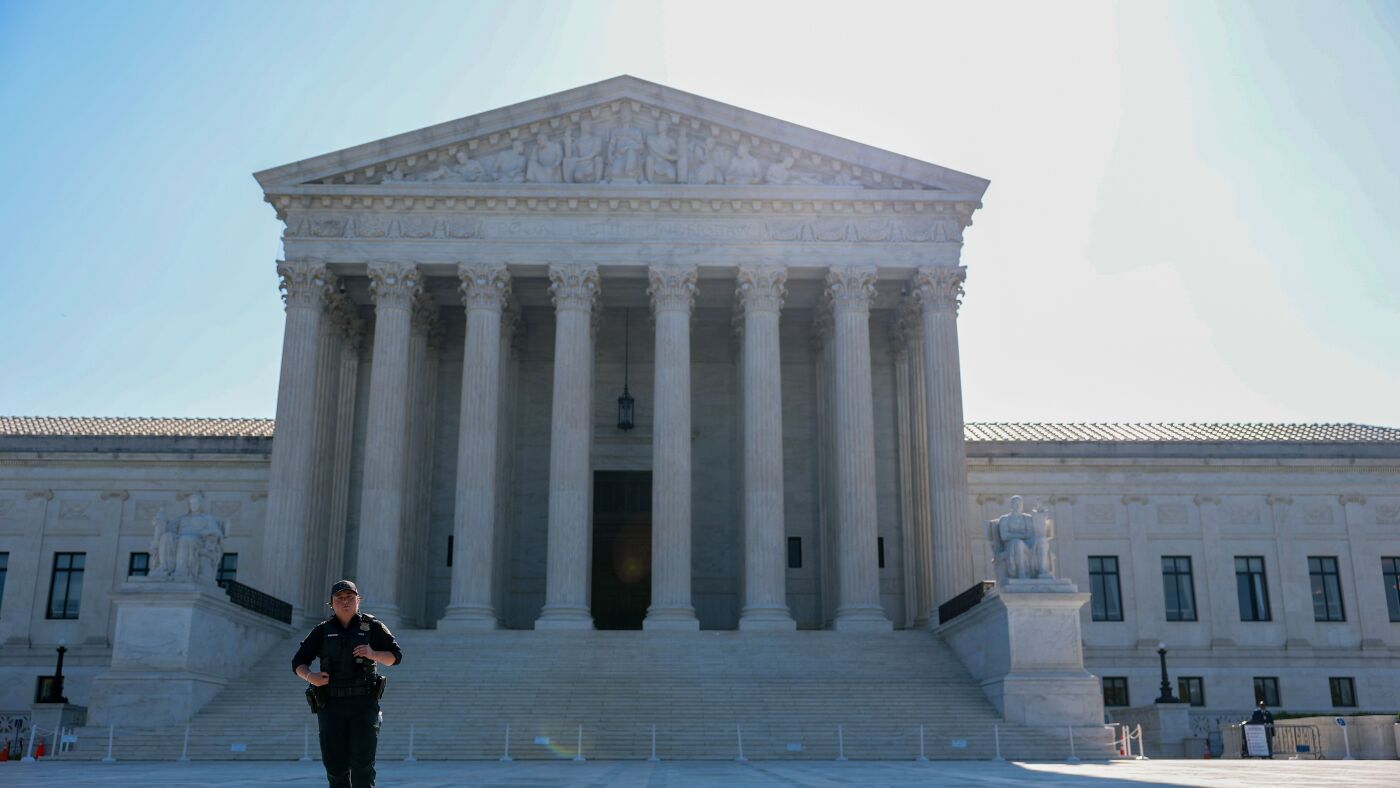
Supreme Court blocks redrawing of New York congressional map, dealing a win for GOP

Published

on

Supreme Court blocks redrawing of New York congressional map, dealing a win for GOP

The Supreme Court

Win McNamee/Getty Images


hide caption

toggle caption

Advertisement

Win McNamee/Getty Images

The Supreme Court on Monday intervened in New York’s redistricting process, blocking a lower court decision that would likely have flipped a Republican congressional district into a Democratic district.    
  
At issue is the midterm redrawing of New York’s 11th congressional district, including Staten Island and a small part of Brooklyn. The district is currently held by a Republican, but on Jan. 21, a state Supreme Court judge ruled that the current district dilutes the power of Black and Latino voters in violation of the state constitution.  
  
GOP Rep. Nicole Malliotakis, who represents the district, and the Republican co-chair of the state Board of Elections promptly appealed to the U.S. Supreme Court, asking the justices to block the redrawing as an unconstitutional “racial gerrymander.” New York’s congressional election cycle was set to officially begin Feb. 24, the opening day for candidates to seek placement on the ballot.  
  
As in this year’s prior mid-decade redistricting fights — in Texas and California — the Trump administration backed the Republicans.   
 
Voters and the State of New York contended it’s too soon for the Supreme Court to wade into this dispute. New York’s highest state court has not issued a final judgment, so the voters asserted that if the Supreme Court grants relief now “future stay applicants will see little purpose in waiting for state court rulings before coming to this Court” and “be rewarded for such gamesmanship.” The state argues this is an issue for “New York courts, not federal courts” to resolve, and there is sufficient time for the dispute to be resolved on the merits. 
  
The court majority explained the decision to intervene in 101 words, which the three dissenting liberal justices  summarized as “Rules for thee, but not for me.” 
 
The unsigned majority order does not explain the Court’s rationale. It says only how long the stay will last, until the case moves through the New York State appeals courts. If, however, the losing party petitions and the court agrees to hear the challenge, the stay extends until the final opinion is announced. 
 
Dissenting from the decision were Justices Sonia Sotomayor, Elena Kagan, and Ketanji Brown Jackson. Writing for the three, Sotomayor  said that  if nonfinal decisions of a state trial court can be brought to highest court, “then every decision from any court is now fair game.” More immediately, she noted, “By granting these applications, the Court thrusts itself into the middle of every election-law dispute around the country, even as many States redraw their congressional maps ahead of the 2026 election.” 

Monday’s Supreme Court action deviates from the court’s hands-off pattern in these mid-term redistricting fights this year. In two previous cases — from Texas and California — the court refused to intervene, allowing newly drawn maps to stay in effect.  
  
Requests for Supreme Court intervention on redistricting issues has been a recurring theme this term, a trend that is likely to grow.  Earlier last month  the high court allowed California to use a voter-approved, Democratic-friendly map.  California’s redistricting came in response to a GOP-friendly redistricting plan in Texas that the Supreme Court also permitted to move forward. These redistricting efforts are expected to offset one another.     
   
But the high court itself has yet to rule on a challenge to Louisiana’s voting map, which was drawn by the state legislature after the decennial census in order to create a second majority-Black district.  Since the drawing of that second majority-black district, the state has backed away from that map, hoping to return to a plan that provides for only one majority-minority district.    
     
The Supreme Court’s consideration of the Louisiana case has stretched across two terms. The justices failed to resolve the case last term and chose to order a second round of arguments this term adding a new question: Does the state’s intentional creation of a second majority-minority district violate the constitution’s Fourteenth and Fifteenth Amendments’ guarantee of the right to vote and the authority of Congress to enforce that mandate?    
Following the addition of the new question, the state of Louisiana flipped positions to oppose the map it had just drawn and defended in court. Whether the Supreme Court follows suit remains to be seen. But the tone of the October argument suggested that the court’s conservative supermajority is likely to continue undercutting the 1965 Voting Rights Act.   

Advertisement
Continue Reading

News

Map: Earthquake Shakes Central California

Published

on

Map: Earthquake Shakes Central California

Note: Map shows the area with a shake intensity of 3 or greater, which U.S.G.S. defines as “weak,” though the earthquake may be felt outside the areas shown.  All times on the map are Pacific time. The New York Times

A minor earthquake with a preliminary magnitude of 3.5 struck in Central California on Monday, according to the United States Geological Survey.

The temblor happened at 7:17 a.m. Pacific time about 6 miles northwest of Pinnacles, Calif., data from the agency shows.

As seismologists review available data, they may revise the earthquake’s reported magnitude. Additional information collected about the earthquake may also prompt U.S.G.S. scientists to update the shake-severity map.

Source: United States Geological Survey | Notes: Shaking categories are based on the Modified Mercalli Intensity scale. When aftershock data is available, the corresponding maps and charts include earthquakes within 100 miles and seven days of the initial quake. All times above are Pacific time. Shake data is as of Monday, March 2 at 10:20 a.m. Eastern. Aftershocks data is as of Monday, March 2 at 11:18 a.m. Eastern.

Advertisement
Continue Reading

News

US says Kuwait accidentally shot down 3 American jets

Published

on

US says Kuwait accidentally shot down 3 American jets

The U.S. and Israel have been conducting strikes against targets in Iran since Saturday morning, with the aim of toppling Tehran’s clerical regime. Iran has fired back, with retaliatory assaults featuring missiles and drones targeting several Gulf countries and American bases in the Middle East.

“All six aircrew ejected safely, have been safely recovered, and are in stable condition. Kuwait has acknowledged this incident, and we are grateful for the efforts of the Kuwaiti defense forces and their support in this ongoing operation,” Central Command said.

“The cause of the incident is under investigation. Additional information will be released as it becomes available,” it added.

In a separate statement later Monday, Central Command said that American forces had been killed during combat since the strikes began.

“As of 7:30 am ET, March 2, four U.S. service members have been killed in action. The fourth service member, who was seriously wounded during Iran’s initial attacks, eventually succumbed to their injuries,” it said.

Advertisement

Major combat operations continue and our response effort is ongoing. The identities of the fallen are being withheld until 24 hours after next of kin notification,” Central Command added.

This story has been updated.

Continue Reading

Trending