News
Theater Ceiling Collapses During ‘Captain America’ Screening in Washington State


Two people watching “Captain America: Brave New World” alone in a movie theater in Wenatchee, Wash., on Tuesday night began hearing strange creaking and moaning. In a film where an absurd amount of furniture is smashed, dramatic final breaths abound and fighters grunt through mortal combat, the sounds fit right in.
But at some point, perhaps during a quieter scene like when [redacted for spoilers], the moviegoers looked up and watched as part of the ceiling toward the front of the theater began to shift, according to Brian Brett, the chief of the Wenatchee Valley Fire Department, which responded to a collapse at Liberty Cinema a little after 8 p.m. local time.
“They started to move away from what was falling from the ceiling,” Chief Brett said in a phone call on Thursday. “A very large section of framed-in area underneath the roof came loose and dropped into about the first three rows of seats in the old historic theater.”
One of the viewers was “struck by some debris” but was not injured, and the other person avoided the debris altogether, Chief Brett said. The two viewers declined to be interviewed or identified.
Photographs from the scene showed plaster, drywall and pink insulation blanketing the front rows of the theater. Wires hung from the roof like streamers.
The cause of the collapse was not immediately clear. The building is old, and asbestos might have been exposed by the collapse, Chief Brett said. Emergency responders wore full-face masks connected to air tanks to avoid breathing the air inside the theater, he added.
Liberty Cinema was closed indefinitely for inspections. It is managed by Sun Basin Theatres in Wenatchee, a city of about 35,000 people nestled between the foothills of the Cascade Range and the Columbia River, about 90 miles east of Seattle.
“This location is very near and dear to our hearts and it’s been a pleasure serving up popcorn to you all from this location over the decades,” Sun Basin Theatres said on Facebook. “That’s why we’re taking the time to properly sort this out.”
Chief Brett said he had not experienced something like this in the town’s history. He was glad the two moviegoers were OK and worried about what would have happened had the theater been more crowded.



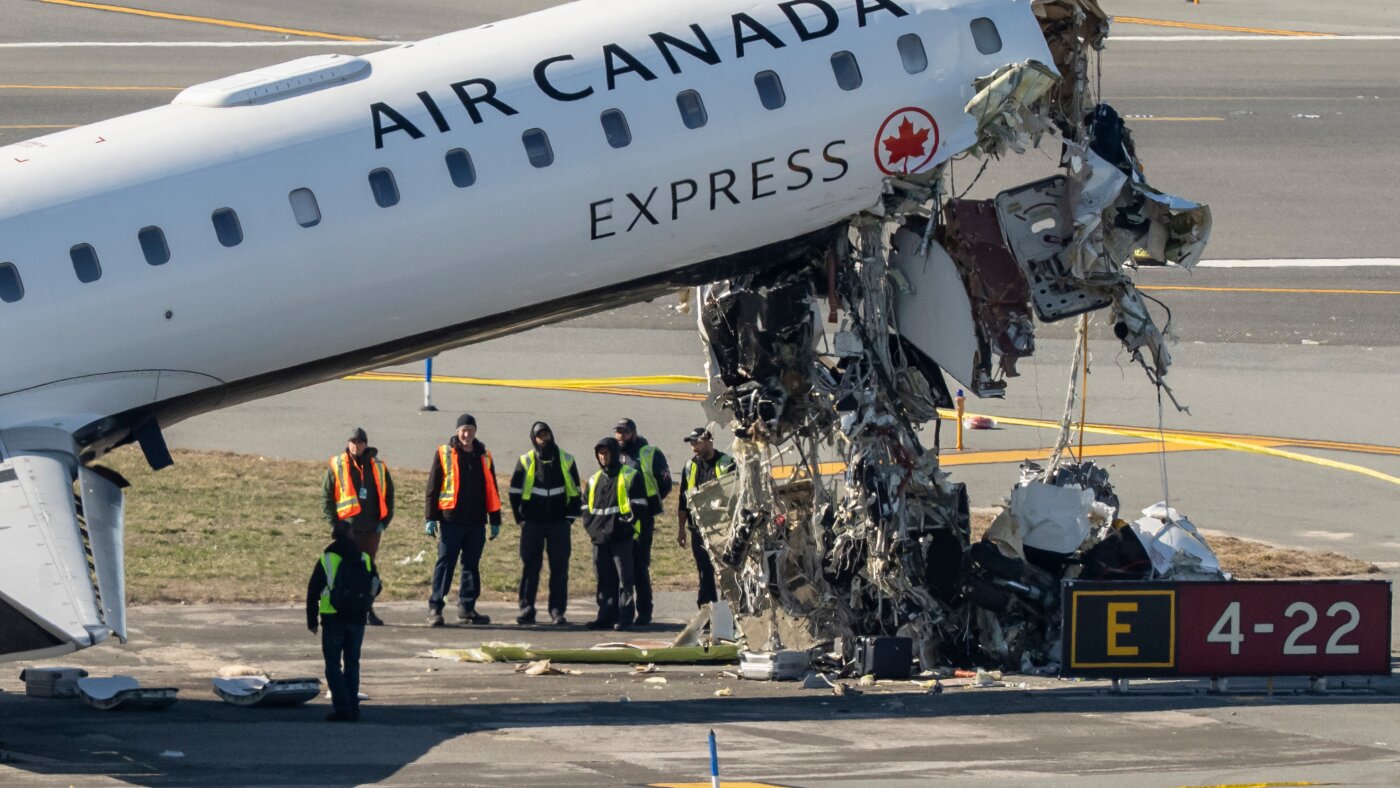
Aircraft maintenance workers inspect the wreckage of an Air Canada Express jet, Tuesday, March 24, 2026, just off the runway where it collided with a Port Authority fire truck Sunday night at LaGuardia Airport in New York.
Yuki Iwamura/AP
hide caption
toggle caption
Yuki Iwamura/AP
The National Transportation Safety Board has raised concerns about staffing procedures related to the plane crash at LaGuardia Airport in New York that left two pilots dead Sunday night.
The NTSB’s investigation has so far revealed there were two air traffic controllers in the tower at the time an Air Canada plane crashed into a fire truck, and at least one of them was doing several jobs, according to NTSB chair Jennifer Homendy. But Homendy focused on systemic issues, rather than individual failings, at a Tuesday press conference.
“I would caution pointing fingers at controllers and saying distraction was involved. This is a heavy workload environment,” she said.
Here’s what else to know.
The NTSB have flagged their concerns several times
Homendy said it is often standard during the midnight shift for two controllers to carry out the duties of several controllers. But, given LaGuardia’s busy airspace, Homendy questioned the use of the practice there.
“That’s certainly something we will look at as part of this investigation: Would that make sense? Why would that make sense at LaGuardia?” she said.

A local controller and a controller in charge were in the tower at the time of the accident.
The local controller is responsible for managing active runways and the airport’s immediate airspace, while the controller in charge oversees all safety operations. However, the controller in charge was also acting as the clearance delivery controller, who gives pilots permission to depart, Homendy said.
Homendy said the NTSB has conflicting information on whether the local controller or the controller in charge was also serving as the ground controller, who manages vehicle activity on taxiways, Homendy said.
“Certainly I can tell you that our air traffic control team has stated this is a concern for them for years,” she said.
Both controllers were working the overnight shift, Homendy noted.
“The midnight shift, as a reminder, is one that we have, many times at the NTSB, raised concerns about, with respect to fatigue,” Homendy said. “We have no indication that was a factor here but it is a shift that we have been focused on in past investigations.”
During a Monday press conference, Transportation Secretary Sean Duffy said LaGuardia’s air traffic control is relatively well staffed. The airport wants 37 controllers working there. Duffy said Monday there were 33 controllers, with seven more in training.
What happened in the final 3 minutes of the cockpit recording
The NTSB recovered the cockpit voice recorder Monday, and sent it to the NTSB’s lab in Washington, D.C. for analysis. NTSB senior aviation accident investigator Doug Brazy summarized what happened in the last three minutes of the recording.
Brazy said as the plane approached the runway, the flight crew had completed their landing checklist and alerts were sent out that the plane was getting closer to the ground.
After the landing checklist was complete, an unknown airport vehicle called into the control tower, but the audio was “stepped on,” or interrupted, by another transmission, Brazy said.
The tower received a transmission from the firefighters that they wanted to cross the runway. The firefighters were responding to reports of fumes coming from a United Airlines plane. The controllers granted the request, Brazy said.
The tower controllers instructed the truck to stop nine seconds before the recording ended. However, there was no transponder, or radio receiver and transmitter, in the truck, Homendy said.
Tower controllers may use an Airport Surface Detection System, Model X (ASDE-X) to track surface movement of planes. However, the system did not send an alert in this instance, Homendy said.
She read the NTSB tech center’s analysis of the failing at the press conference: “ASDE-X did not generate an alert due to the close proximity of vehicles merging and unmerging near the runway, resulting in the inability to create a track of high confidence.”
Eight seconds before the cockpit recording ends, it sounds like the plane lands, Brazy said. Six seconds out, the first officer transferred control of the plane to the captain. Four seconds out, the tower controllers told the firefighters to stop again.
What NTSB still doesn’t know
Homendy has stressed that while the NTSB has a lot of information, it is preliminary and needs to be verified. Some information may also change, she said.

She said the NTSB still does not know who made the radio transmission that was stepped on, why one of the controllers was still on duty after the crash, or if the firefighters heard the directives to stop. Investigators also do not know whether the pilots saw the truck or if there was any confusion in the cockpit.
“We rarely, if ever, investigate a major accident where it was one failure,” Homendy said. “Our aviation system is incredibly safe because there are multiple, multiple layers of defense built in to prevent an accident. So when something goes wrong, that means many, many things went wrong.”

new video loaded: Passengers Wait in Long Security Lines at LaGuardia After Deadly Crash

By Cynthia Silva
March 24, 2026

An Air Canada jet collided with a fire truck at LaGuardia Airport in Queens on Sunday night, killing two people and injuring dozens. The fire truck was responding to an unrelated incident when the crash happened.
Audio from air traffic control, flight data and imagery of the aftermath provide clues as to how the collision unfolded.
Before the crash
After multiple attempts at takeoff and reporting an issue with an odor, a United Airlines plane on the east side of the airport requested assistance. A Port Authority Aircraft Rescue and Firefighting truck responded and began traveling across the airport toward the United plane.
At the same time, around 11:36 p.m. an Air Canada Express Flight 8646 approached Runway 4 at about 150 miles per hour, according to flight data.
Fire truck cleared to cross runway
About 30 seconds before the collision, which was around 11:37 p.m., the fire truck requested permission from air traffic control to cross Runway 4 at crossing “D.” An air traffic controller promptly granted access, responding “Truck 1 and company, cross 4 at delta.”
Ten seconds after granting permission and about 10 seconds before the collision, the same controller is heard saying, “Stop, stop, stop, stop, Truck 1, stop, stop, stop.”
Flight data shows that the Air Canada plane touched down on the runway about 15 seconds before the collision with the fire truck.
About 10 seconds before the crash, the controller said, “Stop, Truck 1, stop!”
In the six seconds between when the controller told Truck 1 to stop the first time and the second time, the United flight covered approximately 1,000 feet, traveling about 200 feet per second, or 130 miles per hour, according to analysis of the flight data.
Moment of crash
Surveillance footage reviewed by The New York Times shows the Air Canada flight traveling down the runway and approaching the intersection where the fire truck had requested permission to cross. As the fire truck made a left turn onto Runway 4, the plane collided into the back half of the truck around 11:37 p.m.
Before the crash, one passenger, Rebecca Liquori, 35, said that there was turbulence as the flight prepared to land and that a flight attendant gave a warning about what to do in case of a possible emergency landing.
Using the length of the plane as a reference scale, The Times estimated the speed of the plane in the video footage to be about 110 miles per hour right before impact.
After the crash, the plane traveled about an additional 600 feet down the runway before coming to a stop off to the side of the runway. The fire truck was knocked onto its side and also slid down the runway before coming to a halt on a grassy median.
The diagram below shows what a Bombardier CRJ-900 jet looks like compared with a typical airport fire truck.
Aftermath
Images and video of the aftermath show that a large portion of the front of the airplane, including most of its cockpit, was torn off or crushed by the impact. Both the pilots died in the collision. A flight attendant, Solange Tremblay, was ejected from the plane while still strapped into her seat, sustaining a fractured leg.
An air traffic controller was juggling extra roles during the LaGuardia plane crash

Video: LaGuardia Crash Survivors Recount Ordeal

Michigan ‘adventure seekers’ take flight at new experiential venues

Barricaded suspect in standoff with police in San Francisco’s Tenderloin neighborhood

Jack Hughes scores twice as Devils beat Stars 6-4, end Dallas streak with four-goal first period

Florida High School Football Rankings: Top 25 teams – Oct. 21

How old is Bo Nix? What to know about Oregon quarterback ahead of 2024 NFL Draft

Cleary's 21 help Le Moyne down Central Connecticut State 69-64 in OT

99th annual Pony Swim held in Virginia

Indiana Members Credit Union announced as new anchor tenant at Bottleworks District
An air traffic controller was juggling extra roles during the LaGuardia plane crash

Iran War: Pentagon set to send thousands of elite 82nd Airborne troops to region | BBC News

Video: Passengers Wait in Long Security Lines at LaGuardia After Deadly Crash

King Charles to address Congress in historic first state visit to Washington

Iran names successor to security chief killed in US-Israeli attack
-

 Detroit, MI6 days ago
Drummer Brian Pastoria, longtime Detroit music advocate, dies at 68
-

 Georgia1 week ago
How ICE plans for a detention warehouse pushed a Georgia town to fight back | CNN Politics
-

 Movie Reviews6 days ago
‘Youth’ Twitter review: Ken Karunaas impresses audiences; Suraj Venjaramoodu adds charm; music wins praise | – The Times of India
-

 Alaska1 week ago
Police looking for man considered ‘armed and dangerous’
-

 Education1 week ago
Video: Turning Point USA Clubs Expand to High Schools Across America
-

 Sports3 days ago
IOC addresses execution of 19-year-old Iranian wrestler Saleh Mohammadi
-
 Science1 week ago
Industrial chemicals have reached the middle of the oceans, new study shows
-

 New Mexico2 days ago
Clovis shooting leaves one dead, four injured