News
'The big one': Researchers gain clearest picture yet of fault that threatens the Pacific Northwest


A silent colossus lurks off the Pacific coast, threatening hundreds of miles of coastline with tsunamis and devastating earthquakes.
For decades, scientists have warned about the potential of the Cascadia Subduction Zone, a megathrust fault that runs offshore along the coast from northern Vancouver Island to Cape Mendocino, California. When the fault — or even a portion of it — next snaps, it will reshape life in Oregon, Washington and Northern California.
Of particular concern are signals of massive earthquakes in the region’s geologic history. Many researchers have chased clues of the last “big one”: an 8.7-magnitude earthquake in 1700. They’ve pieced together the event’s history using centuries-old records of tsunamis, Native American oral histories, physical evidence in ghost forests drowned by saltwater and limited maps of the fault.
But no one had mapped the fault structure comprehensively — until now. A study published Friday in the journal Science Advances describes data gathered during a 41-day research voyage in which a vessel trailed a miles-long cable along the fault to listen to the seafloor and piece together an image.
The team completed a detailed map of more than 550 miles of the subduction zone, down to the Oregon-California border.
Their work will give modelers a sharper view of the possible impacts of a megathrust earthquake there — the term for a quake that occurs in a subduction zone, where one tectonic plate is thrust under another. It will also provide planners a closer, localized look at risks to communities along the Pacific Northwest coast and could help redefine earthquake building standards.
“It’s like having coke-bottle glasses on and then you remove the glasses and you have the right prescription,” said Suzanne Carbotte, a lead author of the paper and a marine geophysicist and research professor at Columbia University’s Lamont-Doherty Earth Observatory. “We had a very fuzzy low-resolution view before.”
The scientists found that the subduction zone is much more complex than they previously understood: It is divided into four segments that the researchers believe could rupture independently of one another or together all at once. The segments have different types of rock and varying seismic characteristics — meaning some could be more dangerous than others.
Earthquake and tsunami modelers are beginning to assess how the new data affects earthquake scenarios for the Pacific Northwest.
Kelin Wang, a research scientist at the Geological Survey of Canada who was not involved in the study, said his team, which focuses on earthquake hazard and tsunami risk, is already using the data to inform projections.
“The accuracy and this resolution is truly unprecedented. And it’s an amazing data set,” said Wang, who is also an adjunct professor at the University of Victoria in British Columbia. “It just allows us to do a better job to assess the risk and have information for the building codes and zoning.”
Harold Tobin, a co-author of the paper and the director of the Pacific Northwest Seismic Network, said that although the data will help fine-tune projections, it doesn’t change a tough-to-swallow reality of living in the Pacific Northwest.
“We have the potential for earthquakes and tsunamis as large as the biggest ones we’ve experienced on the planet,” said Tobin, who is also a University of Washington professor. “Cascadia seems capable of generating a magnitude 9 or a little smaller or a little bigger.”
A quake that powerful could cause shaking that lasts about five minutes and generate tsunami waves up to 80 feet tall. It would damage well over half a million buildings, according to emergency planning documents.
Neither Oregon nor Washington is sufficiently prepared.
To map the subduction zone, researchers at sea performed active source seismic imaging, a technique that sends sound to the ocean floor and then processes the echoes that return. The method is often used for oil and gas exploration.
They towed a 9-plus-mile-long cable, called a streamer, behind the boat, which used 1,200 hydrophones to capture returning echoes.
“That gives us a picture of what the subsurface looks like,” Carbotte said.
Trained marine mammal observers alerted the crew to any sign of whales or other animals; the sound generated with this kind of technology can be disruptive and harm marine creatures.
Carbotte said the new research makes it more clear that the entire Cascadia fault might not rupture at once.
“The next earthquake that happens at Cascadia could be rupturing just one of these segments or it could be rupturing the whole margin,” Carbotte said, adding that several individual segments are thought to be capable of producing at least magnitude-8 earthquakes.
Over the past century, scientists have only observed five magnitude-9.0 or higher earthquakes — all megathrust temblors like the one predicted for the Cascadia Subduction Zone.
Scientists pieced together an understanding of the last such Cascadia quake, in 1700, in part via Japanese records of an unusual orphan tsunami that was not preceded by shaking there.
“It requires an 8.7 to get a tsunami all the way to Japan,” Tobin said.
The people who recorded the incident in Japan couldn’t have known that the ground had shaken an ocean away, in the present-day United States.
Today, the Cascadia Subduction Zone remains eerily quiet. In other subduction zones, scientists often observe small earthquakes frequently, which makes the area easier to map, according to Carbotte. That’s not the case here.
Scientists have a handful of theories about why: Wang said the zone may be becoming quieter as the fault accumulates stress. And now, we’re probably nearing due.
“The recurrent interval for this subduction zone for big events is on the order of 500 years,” Wang said. “It’s hard to know exactly when it will happen, but certainly if you compare this to other subduction zones, it is quite late.”


A man sings a spirtual song during a voting rally, Saturday, May 16, 2026, in Montgomery, Ala.
Mike Stewart/AP
hide caption
toggle caption
Mike Stewart/AP
MONTGOMERY, Ala.— In 1965, Black Americans peacefully demonstrated for voting rights and were beaten by Alabama state troopers before returning two weeks later to complete their march under federal protection. Keith Odom was a toddler then.
Now 62 years old, the union man and grandfather of three retraced some of their final steps. On Saturday, he came from Aiken, South Carolina, to Atlanta, where he joined several dozen other activists on two buses to Montgomery, Alabama. A few hours later, he stepped off his bus and onto Dexter Avenue, where the original march concluded.
“The history here — being a part of it, seeing it, feeling it,” said Odom, who is Black.

His voice trailed off as he saw the Alabama Capitol and a stage that sat roughly where the Rev. Martin Luther King Jr. concluded the original march.
Odom lamented that he and his fellow bus riders were not simply commemorating that seminal day in the Civil Rights Movement. Instead they came to renew the fight. The 1965 effort helped push Congress to send the Voting Rights Act to Democratic President Lyndon B. Johnson to sign, securing and expanding political power for Black and other nonwhite voters for more than a half-century.
Saturday’s “All Roads Lead to the South” rally was the first mass organizing response after a U.S. Supreme Court ruling that severely diminished that landmark law. Striking down a majority Black congressional district in Louisiana, the justices concluded in a 6-3 ruling that considering race when drawing political lines is in itself discriminatory. That spurred multiple states, including Alabama, to redraw U.S. House districts in ways that make it harder for Black voters, who lean overwhelmingly Democratic, to elect lawmakers of their choice.
“I’m not trying to live a life that’s going backwards,” Odom said. “I want to go forward, for my grandchildren to be able to go forward.”
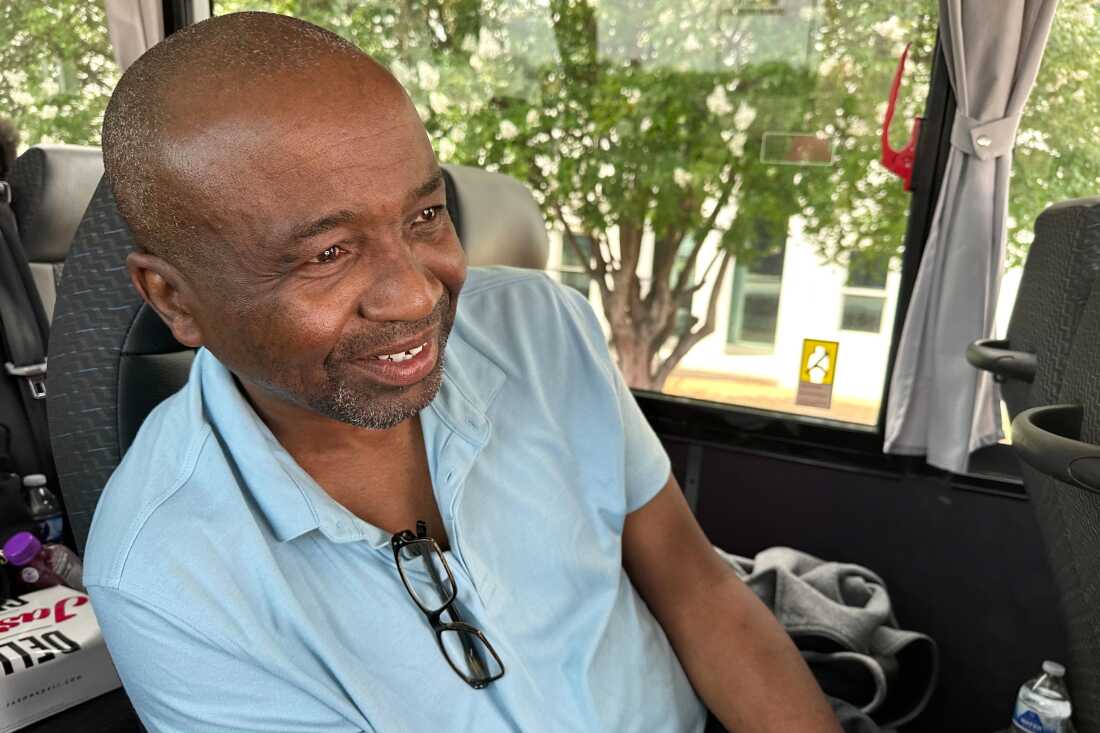
Keith Odom, a forklift driver from Aiken, S.C., looks out from his bus seat as he arrives in Montgomery, Ala., for a voting rights rally Saturday, May 16, 2026.
Bill Barrow/AP
hide caption
toggle caption
Bill Barrow/AP
An old political battle is new again
The passenger rosters and the scene when riders arrived in Montgomery sounded the echoes and rhymes of past and present.
“I talked to my grandmother before I came, and she was so excited,” said Justice Washington, a Kennesaw State University student named because her mother and grandmother had faith in the American system. “My grandmother told me she did her part, and now it’s time for me to do mine.”
No one on the Atlanta buses had reached voting age when the Voting Rights Act became law. The youngest attendee was born as Democrat Barack Obama was elected the first Black president in 2008.
Kobe Chernushin is 18, white and just graduated high school in Atlanta’s northern suburbs. He is an organizer with the Georgia Youth Justice Coalition and spent the day filming Khayla Doby, a 29-year-old executive for the organization, doing standups for the group’s followers on social media.
“I believe in the power of showing up,” he said.

The buses launched from the congressional district in Georgia once represented by John Lewis, bloodied on the Edmund Pettus Bridge in Selma, Alabama, when he was 25. Lewis died in 2020, but some on the buses Saturday celebrated that a proposed federal election overhaul is named for him. If some Democrats get their way, the bill would override the U.S. Supreme Court, reinvigorate the Voting Rights Act and outlaw the kind of gerrymandering competition that Republican President Donald Trump has instigated.
“I’m here because of the same forces that pulled on John Lewis when he was a student,” said Darrin Owens, 27. He has worked for former Vice President Kamala Harris and now trains Democratic candidates.
“Political activism is personal,” Owens said, explaining that he attended Saturday as a citizen, not a political professional. “Sometimes those lines are blurred, and as a Black person in America, a Black person living in a Southern state, I’m committed to action that stops what I consider to be un-American, this possibility that the person who represents me is someone who is not from my community and does not understand me or my community.”
When he arrived, Owens saw no federal authorities on Montgomery’s streets. A wounded, recovering Lewis did during the second march in 1965.
This time many of the Alabama troopers and local officers who walked the area were Black.
The buses and sandwich lunches had been arranged by Fair Fight Action, a legacy of the political network built by Georgia Democrat Stacey Abrams, who became a national figure in her unsuccessful runs in 2018 and 2022 to become the first Black woman elected governor in U.S. history. No Black woman has yet achieved that feat.

Bee Nguyen, left, talks to Carole Burton, center, and Tondalaire Ashford at a voting rights rally Saturday, May 16, 2026, in Montgomery, Ala.
Bill Barrow/AP
hide caption
toggle caption
Bill Barrow/AP
Different generations share their stories
At different points, Montgomery has branded itself as the cradle of the Confederacy and the cradle of the modern Civil Rights Movement.
“It feels like our country is stuck in this pattern of making progress, then there’s a huge backlash, and then people have to go through the same battle again just to get to where we were,” said Phi Nguyen, the 41-year-old daughter of Vietnamese refugees. She is now a civil rights lawyer in Atlanta.
She stood across from the church where a young King led the Montgomery Bus Boycott in 1955 and not far from where Jefferson Davis took the oath of office in 1861 as the slavery-defending Confederate president.
Nguyen and her sister Bee, a 44-year-old who served in the Georgia General Assembly and ran for statewide office, met two other women as they walked. Carole Burton and Tondalaire Ashford are 72-year-old Montgomery residents who have been friends since they were in a segregated junior high school and then newly desegregated Sidney Lanier High School.
“I don’t call it ‘integration,’” Ashford said, pointing at her dark skin. “It was never real integration, and it’s not like we can ever just blend in.”

Burton described them as being “in the second wave” of Black students. “It wasn’t easy,” she said. “And we had to support each other.”
They remember their parents not being able to vote in the era of poll taxes, literacy tests and other racist restrictions that the Voting Rights Act eventually outlawed. But they smiled as they swapped family histories with the Nguyens.
Burton said immigrants, descendants of enslaved persons and Native Americans have different but overlapping paths. “We just want to be treated like people with the same rights and opportunities the country has promised us,” she said. “They’ve never fully lived up to it.”

Aaron McGuire sings a spirtual song during a voting rally, Saturday, May 16, 2026, in Montgomery, Ala.
Mike Stewart/AP
hide caption
toggle caption
Mike Stewart/AP
Conflicting legacies are at stake
To Odom, who had begun his journey Saturday in South Carolina, the current U.S. Supreme Court reinforced that history by refusing to see some race-conscious election policy as a way to ensure fair representation, not simply the “technical right to vote.”
He recalls decades of his life being represented by Strom Thurmond, a segregationist Democratic governor who became a “Dixiecrat” presidential candidate and U.S. senator — by now as a Republican — into the 21st century. Odom said he fears his state losing U.S. Rep. Jim Clyburn, a senior member of the Congressional Black Caucus, through redistricting.
“They want to take away that legacy when we’re still living with Strom’s?” Odom said.
Odom said he is also worried that the young people who participated Saturday are not a vanguard but outliers.
“I was talking to a 20-year-old co-worker about this trip,” he said. “She told me she supported me but didn’t want to do it or work for anybody” running for office. “She wondered what any of them are going to do for her.”
Nonetheless, he said on the way home, “I’m still going to tell her what I saw and what I heard.”

One observer of the current Senate race in Louisiana noted that Sen. Bill Cassidy could lose his reelection bid.
Annie Flanagan for NPR
hide caption
toggle caption
Annie Flanagan for NPR
Sen. Bill Cassidy lost Saturday’s Louisiana Republican primary according to a race call by the Associated Press.
Cassidy, who served two terms in the Senate, was one of seven Republican senators who voted to convict President Trump after the January 6th insurrection at the Capitol. That vote put him at odds with Trump and his MAGA coalition, ultimately leading Trump to push Rep. Julia Letlow to run against Cassidy.
Cassidy’s bid for a third term was viewed as a test of Trump’s grip on the party–and of what voters want from their representatives in Washington. The primary pitted Cassidy, a veteran lawmaker, former physician and chair of the powerful Senate health committee, against Letlow, a political newcomer and a millennial MAGA loyalist.

A detailed view of a hat that reads, Run Julia Run, is seen at a campaign event for Rep. Julia Letlow (R-LA) on May 6, 2026 in Franklinton, Louisiana.
Tyler Kaufman/Getty Images
hide caption
toggle caption
Tyler Kaufman/Getty Images
A former college administrator, Letlow won a special election in 2021 for the House seat her late husband, Luke, was set to assume before he died from COVID in 2020.
In Congress, Letlow sponsored a bill to collect oral histories from the pandemic and has focused on education and children. She introduced the “Parents Bill of Rights Act,” which would allow parents to review classroom materials like library books and require schools to notify parents if their child requests different pronouns, locker rooms or sports teams.
She also serves on the powerful appropriations committee and has embraced Trump’s agenda.
Letlow, who came first in Saturday’s primary, will face Louisiana state Treasurer John Fleming in the runoff on June 27. Cassidy came in third.
The election result is a victory for President Trump who has put Republican loyalty to the test on the ballot so far this year in Indiana state senate primaries and in Cassidy’s race.
Another major test of Trump’s influence comes in Kentucky’s primary on Tuesday when Republican Rep. Thomas Massie, who has found himself at odds with the president, faces a challenger endorsed by Trump.
News
Brass bands in Beijing make way for sticker shock at home as Trump returns to escalating inflation

WASHINGTON (AP) — President Donald Trump returned from the spectacle of a Chinese state visit to a less than welcoming U.S. economy — with the military band and garden tour in Beijing giving way to pressure over how to fix America’s escalating inflation rate.
Consumer inflation in the United States increased to 3.8% annually in April, higher than what he inherited as the Iran war and the Republican president’s own tariffs have pushed up prices. Inflation is now outpacing wage gains and effectively making workers poorer. The Cleveland Federal Reserve estimates that annual inflation could reach 4.2% in May as the war has kept oil and gasoline prices high.
Trump’s time with Chinese leader Xi Jinping appears unlikely to help the U.S. economy much, despite Trump’s claims of coming trade deals. The trip occurred as many people are voting in primaries leading into the November general election while having to absorb the rising costs of gasoline, groceries, utility bills, jewelry, women’s clothing, airplane tickets and delivery services. Democrats see the moment as a political opportunity.
“He’s returning to a dumpster fire,” said Lindsay Owens, executive director of Groundwork Collaborative, a liberal think tank focused on economic issues. “The president will not have the faith and confidence of the American people — the economy is their top issue and the president is saying, ‘You’re on your own.’”
The president’s trip to Beijing and his recent comments that indicated a tone-deafness to voters’ concerns about rising prices have suggested his focus is not on the American public and have undermined Republicans who had intended to campaign on last year’s tax cuts as helping families.
Trump described the trip as a victory, saying on social media that Xi “congratulated me on so many tremendous successes,” as the U.S. president has praised their relationship.
Trump told reporters that Boeing would be selling 200 aircraft — and maybe even 750 “if they do a good job” — to the Chinese. He said American farmers would be “very happy” because China would be “buying billions of dollars of soybeans.”
“We had an amazing time,” Trump said as he flew home on Air Force One, and told Fox News’ Bret Baier in an interview that gasoline prices were just some “short-term pain” and would “drop like a rock” once the war ends.
Inflationary pain is not a factor in how Trump handles Iran
Trump departed from the White House for China by saying the negotiations over the Iran war depended on stopping Tehran from developing nuclear weapons. “I don’t think about Americans’ financial situation. I don’t think about anybody. I think about one thing: We cannot let Iran have a nuclear weapon,” Trump said.
That remark prompted blowback because it suggested to some that Trump cared more about challenging Iran than fighting inflation at home. Trump defended his words, telling Fox News: “That’s a perfect statement. I’d make it again.”
The White House has since stressed that Trump is focused on inflation.
Asked later about the president’s words, Vice President JD Vance said there had been a “misrepresentation” of the remarks. White House spokesman Kush Desai said the “administration remains laser-focused on delivering growth and affordability on the homefront” while indicating actions would be taken on grocery prices.
But as Trump appeared alongside Xi, new reports back home showed inflation rising for businesses and interest rates climbing on U.S. government debt.
His comments that Boeing would sell 200 jets to China caused the company’s stock price to fall because investors had expected a larger number. There was little concrete information offered about any trade agreements reached during the summit, including Chinese purchases of U.S. exports such as liquefied natural gas and beef.
“Foreign policy wins can matter politically, but only if voters feel stability and affordability in their daily lives,” said Brittany Martinez, a former Republican congressional aide who is the executive director of Principles First, a center-right advocacy group focused on democracy issues.
“Midterms are almost always a referendum on cost of living and public frustration, and Republicans are not immune from the same inflation and affordability pressures that hurt Democrats in recent cycles,” she added.
Democrats see Trump as vulnerable
Democratic lawmakers are seizing on Trump’s comments before his trip as proof of his indifference to lowering costs. There is potential staying power of his remarks as Americans head into Memorial Day weekend facing rising prices for the hamburgers and hot dogs to be grilled.
“What Americans do not see is any sympathy, any support, or any plan from Trump and congressional Republicans to lower costs – in fact, they see the opposite,” Senate Democratic leader Chuck Schumer of New York said Thursday.
Vance faulted the Biden administration for the inflation problem even though the inflation rate is now higher than it was when Trump returned to the White House in January 2025 with a specific mandate to fix it.
“The inflation number last month was not great,” Vance said Wednesday, but he then stressed, “We’re not seeing anything like what we saw under the Biden administration.”
Inflation peaked at 9.1% in June 2022 under Biden, a Democrat. By the time Trump took the oath of office, it was a far more modest 3%.
Trump’s inflation challenge could get harder
The data tells a different story as higher inflation is spreading into the cost of servicing the national debt.
Over the past week, the interest rate charged on 10-year U.S. government debt jumped from 4.36% to 4.6%, an increase that implies higher costs for auto loans and mortgages.
“My fear is that the layers of supply shocks that are affecting the U.S. economy will only further feed into inflationary pressures,” said Gregory Daco, chief economist at EY-Parthenon.
Daco noted that last year’s tariff increases were now translating into higher clothing prices. With the Supreme Court ruling against Trump’s ability to impose tariffs by declaring an economic emergency, his administration is preparing a new set of import taxes for this summer.
Daco stressed that there have been a series of supply shocks. First, tariffs cut into the supply of imports. In addition, Trump’s immigration crackdown cut into the supply of foreign-born workers. Now, the effective closure of the Strait of Hormuz has cut off the vital waterway used to ship 20% of global oil supplies.
“We’re seeing an erosion of growth,” Daco said.
-

 Politics13 minutes ago
Video: Cassidy Loses Primary After Drawing Trump’s Ire
-

 Lifestyle49 minutes ago
Sunday Puzzle: Between the lines
-

 Technology1 hour ago
Revamped Siri will reportedly offer auto-deleting chats
-

 World1 hour ago
NATO ally Poland warns Russia, Belarus pushing illegal migrants toward alliance — and the US
-

 Politics1 hour ago
Trump warns Iran’s ‘clock is ticking’: Move ‘fast’ or ‘there won’t be anything left’
-

 Health1 hour ago
Fitness influencer says one simple habit can help anyone get back in shape
-

 Sports1 hour ago
Pro wrestling star learns what ‘land of opportunity’ means in US as he details journey from Italy to America
-

 Technology2 hours ago
FCC robocall crackdown could change phone privacy

