Connect with us

News

Tesla loses bid to restore Elon Musk’s record $56bn pay package

Published

on

Tesla loses bid to restore Elon Musk’s record bn pay package

Unlock the Editor’s Digest for free

A judge in Delaware has rebuffed Tesla’s attempt to revive a $56bn pay package for Elon Musk, saying that shareholders’ overwhelming reapproval was not enough to override her previous rejection of the package.

Monday’s decision is a stinging rebuke of the world’s most valuable carmaker and chief executive Musk, the richest man in the world who has been riding high since Donald Trump was elected for a second term as US president a month ago.

Judge Kathaleen McCormick concluded that Tesla’s unprecedented effort to push the 2018 pay package through a second time, four months after she first voided it, was “creative”. But the board “had no procedural ground for flipping the outcome of an adverse post-trial decision based on evidence they created after trial”, she wrote on Monday.

Advertisement

Tesla vowed to appeal against the decision. “This ruling, if not overturned, means that judges and plaintiffs’ lawyers run Delaware companies rather than their rightful owners — the shareholders,” it said. “Absolute corruption,” Musk wrote on X, his social media platform.

An appeal would leave it to the state’s Supreme Court to decide how much weight the decision by Tesla’s shareholders to reapprove the pay package has at a moment when Musk’s social and political power is at its peak.

Musk has gained the ear of Trump after spending more than $100mn on his political campaign. In return, Musk has sway over crucial cabinet appointments and been made co-head of an advisory body that has vowed to dramatically shrink the federal budget.

Musk’s pay package of just over 300mn Tesla shares was directly linked to the company’s performance, requiring it to hit a series of ambitious stock price and operational targets to unlock the award. He receives no salary from the carmaker.

Tesla stock has surged 44 per cent this year, much of that coming after Trump’s election victory on November 5. That means Musk’s stock options have soared in value from $56bn when voided in January to more than $100bn today, helping push his overall wealth to $343bn when his stakes in SpaceX, social media platform X and xAI are included.

Advertisement

The board has argued that awarding Musk a new package of the same size could trigger an accounting charge of $25bn due to Tesla’s substantially higher valuation, which could be one factor behind its vow to appeal.

If it is ultimately granted, the package would increase his ownership of Tesla from just under 13 per cent to more than 20 per cent. Musk has previously said that unless his control over Tesla is increased, his attention will shift elsewhere, in particular his efforts to develop artificial intelligence.

McCormick, in her original ruling in February, said the Tesla board that approved the package six years ago was too cosy with Musk, and that her analysis of the grant — described as “largest executive compensation award in the history of public markets” — showed it could not be justified on any reasonable metric.

After McCormick struck down Musk’s pay package the first time, Tesla put the original package — with enhanced disclosures — to a shareholder vote in June. It passed with 72 per cent support.

But McCormick wrote that if companies were permitted to fix breaches of fiduciary duty after unfavourable court decisions, “lawsuits would become interminable”.

Advertisement

Even as Tesla said it tried to address the court’s issues with the board approval process this year, McCormick wrote on Monday that the most recent proxy statement sent to shareholders remained “materially false or misleading”. The filings incorrectly said the latest shareholder vote would be enough to override her February decision, she said.

Musk’s public ire has thrown a harsh spotlight on Delaware’s status as the premier destination for public companies’ legal domiciles. Since the February decision, he has loudly complained about the Delaware corporate law court and has moved all of his companies’ incorporations to either Nevada or Texas.

In June, Tesla shareholders approved a plan to reincorporate the company from Delaware, where the vast majority of big public US companies are listed, to Texas.

Last month, Musk posted on his social media platform X: “When there are egregiously wrong legal judgments in a single state that substantially harm American citizens in all other 49 states, the Federal government should take immediate corrective action.”

Tesla’s lawyers did win one concession. McCormick sided with them in finding the “eye-popping” $5.6bn in Tesla stock requested by law firm Bernstein Litowitz, which had represented the Tesla shareholder who brought the suit, was too much. They were awarded $345mn in fees instead.

Advertisement

While conceding that “their methodology for calculating [the] figure is sound”, McCormick concluded: “In a case about excessive compensation, that was a bold ask”.

The lower amount of $345mn, payable in cash or Tesla stock, was calculated by estimating that the value returned to shareholders was closer to $2.3bn, pointing to an accounting charge it took in 2018.

Bernstein Litowitz said in a statement that it hoped the “well-reasoned decision will end this matter for the shareholders of Tesla”. The firm added that it looked forward to defending the ruling on appeal.

“None of this is over,” said Ann Lipton, a law professor at Tulane University. “The difficulty for that court is [that] Musk’s unsubtle threat to use his new political power to retaliate against Delaware makes it very difficult for that court to rule in his favour without looking like it was cowed.”
Advertisement

News

With the white nationalist group Patriot Front, what you see is not what you get

Published

on

With the white nationalist group Patriot Front, what you see is not what you get

Members of the group Patriot Front ride the subway as a commuter looks on, in Washington, D.C., on July 4.

Cheney Orr/Reuters


hide caption


toggle caption

Advertisement

Cheney Orr/Reuters

The sight of hundreds of masked men roaming the streets of Washington, D.C., on July Fourth weekend, wearing khakis, blue shirts and uniform patches, was chilling to some of the city’s residents.

For many Americans, it was the first they heard about Patriot Front, a white nationalist organization that was born out of the deadly 2017 Unite the Right rally in Charlottesville, Va. A now-viral Reuters photo prompted reflections on the experience of a lone African American woman who was photographed in a Metro subway car, surrounded by white supremacists.

The planned demonstration of force was timed to bring a fringe group of extremists into public view as the nation marked 250 years of its independence. Indeed, the stunt succeeded in earning the group media coverage across mainstream outlets, amplifying its brand and potential to reach new recruits. On this occasion, the members refrained from engaging in violence and property damage, projecting an image of law-abiding, orderly activism.

Advertisement

But those who are closely familiar with Patriot Front’s history and operations warn: Don’t believe what you see.

“That is not who they are in private,” said Len Kamdang, director of the Criminal Justice Project at the Lawyers’ Committee for Civil Rights Under Law. “Although they were on their best behavior [last] weekend, this is a dangerous group that commits acts of violence all over the country.”

Patriot Front’s history of violence and property damage

Kamdang’s organization sued members of Patriot Front for vandalizing a public mural dedicated to the tennis legend and Black activist Arthur Ashe in Richmond, Va., in 2021. Ashe, who was inducted into the International Tennis Hall of Fame in 1985, was born in Richmond and his legacy is a continuing source of pride to members of that community.

“A couple of Patriot Front members showed up under cover of night and vandalized the mural,” Kamdang said. “They painted white stencils all over. … They literally tried to whitewash him and they put their symbols of hate all over — their stencils, their slogans. And all the while they were caught on video. And that video leaked using some of the most horrible language that you can imagine.”

In many jurisdictions, law enforcement can seek additional hate crime charges or sentencing enhancements in cases where illegal acts appear to have been motivated by racial bias. But in this case, Kamdang said, Patriot Front members faced no criminal charges and their identities were only revealed when online activists later infiltrated the group and leaked internal records.

Advertisement
Continue Reading

News

Graham Platner makes it official in Maine, submitting paperwork to leave Senate race

Published

on

Graham Platner makes it official in Maine, submitting paperwork to leave Senate race

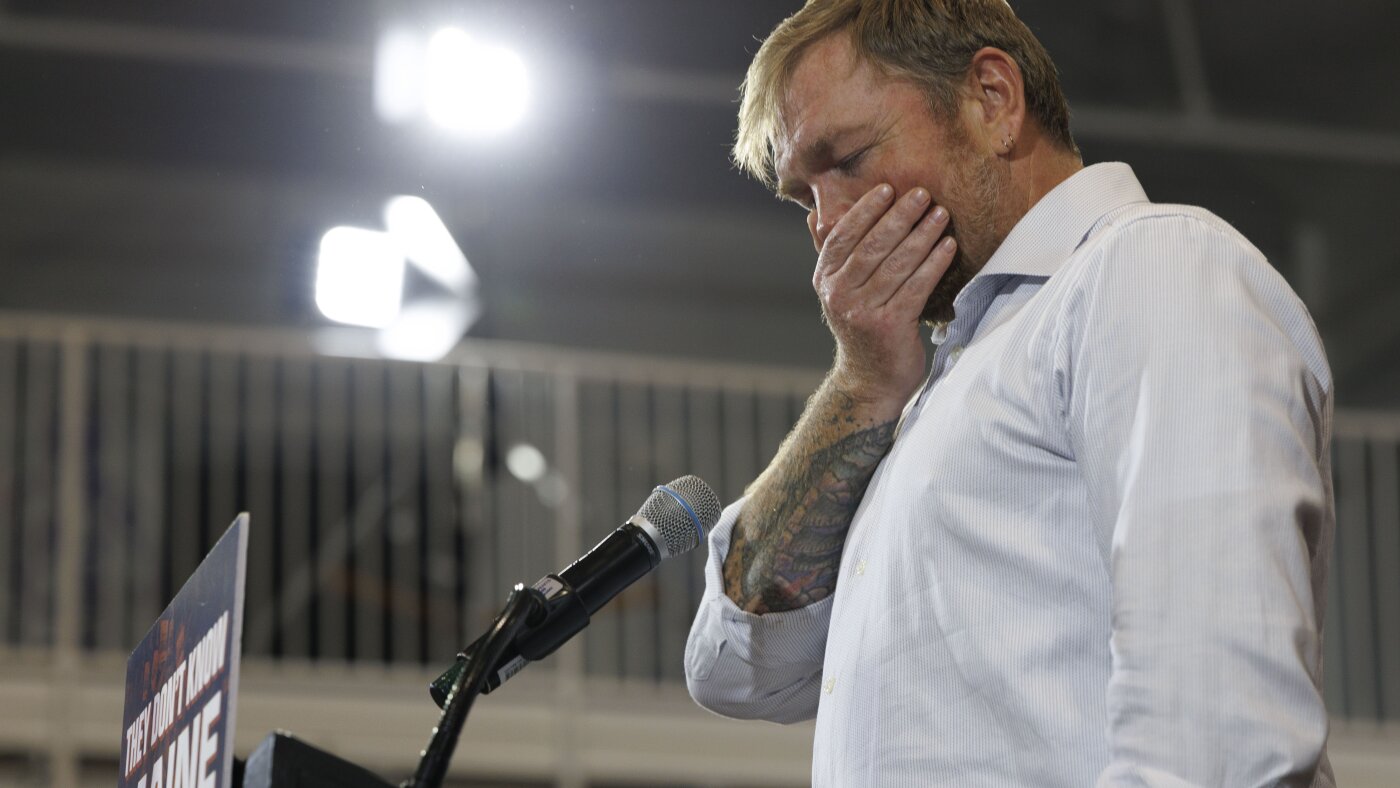
Now-former Democratic Senate candidate Graham Platner speaks at his primary election night event on June 9 in Blue Hill, Maine. Platner officially dropped out of the race July 10 following rape allegations from a former romantic partner that he denies.

CJ Gunther/Getty Images


hide caption


toggle caption

Advertisement

CJ Gunther/Getty Images

Graham Platner, Maine’s Democratic nominee for Senate, is officially out of the race.

The Maine Secretary of State said Platner filed the necessary paperwork to withdraw his candidacy two days after he announced he planned to do so following an accusation of rape by a former romantic partner. Platner denies the allegation.

The Maine Democratic Party has until July 27 to pick Platner’s replacement.

Advertisement

In his withdrawal notice, Platner said “people are desperate for change” and that’s why they voted “for a new kind of politics” by making him the Democratic nominee. He expressed gratitude for those who supported his campaign and said that he will continue to fight for “the movement we have built together and the future we believe in.”

He ended his notice with a strong statement aligned with the progressive platform.

“F*ck ICE. Free Palestine. Up the Hearts.”

Platner announced his plan to withdraw from the race in an 11-minute video he posted to social media on July 8. He said he had no choice but to suspend his campaign, citing it was no longer viable financially.

Advertisement

“We are going to lose our ability to fundraise. We are going to lose our ability to access voter data. We are going to lose all of the things that any campaign needs on the basic level simply to function,” he said.

Platner added that dropping out was not an admission of guilt. Rather, the decision, he said, is to keep the progressive movement in Maine alive to defeat Republican Sen. Susan Collins in November. Platner blamed the “political establishment” for his downfall and argued the goal was to force him out of the race.

“We built a campaign. We engaged in electoral politics. We motivated people. We banded together. We did it the way that we were told we are supposed to make change and we won. And now they are not going to let us have it. Not if it’s me,” he said.

Continue Reading

News

Waymo called the cops on teen riders, raising privacy concerns

Published

on

Waymo called the cops on teen riders, raising privacy concerns

A Waymo robotaxi drives in San Francisco’s North Beach neighborhood this week.

Heather Diehl/Getty Images


hide caption


toggle caption

Advertisement

Heather Diehl/Getty Images

Police in San Mateo, Calif., posted Monday on social media that they had apprehended a pair of teenagers from a Waymo driverless robotaxi after the company alerted authorities to suspected criminal activity. It’s the latest incident involving video surveillance of passengers and others by autonomous vehicles — raising questions about the limits of privacy in such vehicles.

The Facebook post by the San Mateo County Police said: “Parents do you know where your teens are? @waymo does!”

The 15-year-olds were allegedly drinking alcohol and shooting toy guns from the car, according to the police. They said Waymo’s systems detected behavior that then triggered a safety response, after which the company disabled the vehicle and contacted police.

Advertisement

Waymo’s cars, equipped with an array of cameras, microphones and other sensors to monitor passengers and other nearby vehicles, are becoming more common in cities across the United States. Experts say the detention of the two teens in San Mateo highlights a potential — but not inevitable — trade-off between privacy and convenience. It also questions the extent to which companies similar to Waymo are required to hand over private data, including audio and video of passengers, in situations where a crime is suspected.

NPR reached out to Waymo, which is owned by Alphabet, the parent company of Google, for comment on the details of the San Mateo incident and how the company responded, but did not hear back. But on its website, the company says that as many as 29 cameras in its autonomous cars provide an all-around view and “are designed with high dynamic range and thermal stability, to see in both daylight and low-light conditions, and tackle more complex environments.”

“There already exist laws that govern duty to report or even duty to protect” for carriers such as Waymo, according to Alessandro Acquisti, a professor of information technology at the MIT Sloan School of Management. “The privacy problems arise when and if driverless carrier companies used such laws or ethical obligations as a pretext for blanket, indiscriminate accumulation of identifiable data for unspecified future purposes.”

That includes not just monitoring people inside the cars, but outside too. Take, for example, a hit-and-run investigation last year in Los Angeles. Media reported that the police inquiry was aided by video captured by a Waymo taxi that had a clear view of the crime. Critics suggested at the time that authorities were using the company’s vehicles as a mobile surveillance platform. And during 2025 protests in Los Angeles against Immigration and Customs Enforcement crackdowns, demonstrators vandalized Waymos, apparently angry that video recorded by the vehicles could be used by police, although there is no evidence that happened.

Continue Reading
Advertisement

Trending