News
‘Should I Fire Him?’ Inside Trump’s Deliberations Over the Fate of Michael Waltz


For much of this week, President Trump was consumed by a single question. What should he do about his national security adviser, Michael Waltz?
“Should I fire him?” he asked aides and allies as the fallout continued over the stunning leak of a Signal group chat set up by Mr. Waltz, who had inadvertently added a journalist to the thread about an upcoming military strike in Yemen.
In public, Mr. Trump’s default position has been to defend Mr. Waltz and attack the media. On Tuesday, the day after Jeffrey Goldberg of The Atlantic broke the story about being included in the chat, the president said Mr. Waltz was a “good man” who had nothing to apologize for.
But behind the scenes, Mr. Trump has been asking people inside and outside the administration what they thought he should do.
He told allies that he was unhappy with the press coverage but that he did not want to be seen as caving to a media swarm, according to several people briefed on his comments. And he said he was reluctant to fire people in the senior ranks so early in his second term.
But for Mr. Trump, the real problem did not appear to be his national security adviser’s carelessness about discussing military plans on a commercial app, the people said. It was that Mr. Waltz may have had some kind of connection to Mr. Goldberg, a Washington journalist whom Mr. Trump loathes. The president expressed displeasure about how Mr. Waltz had Mr. Goldberg’s number in his phone.
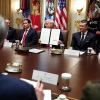
On Wednesday evening, Mr. Trump met with Vice President JD Vance; the White House chief of staff, Susie Wiles; the White House personnel chief, Sergio Gor; his Mideast envoy, Steve Witkoff, and others about whether to stick with Mr. Waltz.
Late Thursday, as the controversy swirled, Mr. Trump summoned Mr. Waltz to the Oval Office. By the next morning, the president signaled to people around him that he was willing to stick with Mr. Waltz, three people with knowledge of the president’s thinking said.
People close to Mr. Trump say Mr. Waltz has been able to hang on in part because some in the administration still support him, and because Mr. Trump has wanted to avoid comparisons to the chaotic staffing of his first term, which had the highest turnover of top aides of any presidential administration in modern history.
And while Mr. Trump can always change his mind, the episode shows Mr. Trump’s willingness to disregard external pressures in his second term, while also grappling with the limits of the loyalty tests he imposed for staff across the administration.
Even before the Signal leak, Mr. Waltz was on shaky footing, viewed as too hawkish by some of the president’s advisers and too eager to advocate for military action against Iran when the president himself has made clear he prefers to make a deal.
An association with Mr. Goldberg, however hazy, gave Mr. Waltz’s opponents more fuel to feed the skepticism.
Some of Mr. Trump closest allies have questioned whether Mr. Waltz, a former George W. Bush administration official, was compatible with the president’s foreign policy. Mr. Waltz had gotten crosswise with Mr. Vance and Ms. Wiles in policy discussions, particularly regarding Iran, according to several people briefed on the matter.
In a statement, the White House press secretary, Karoline Leavitt, said Mr. Trump has a team whose members debate each other but know that he is the “ultimate decision maker.” “When he makes a decision, everyone rows in the same direction to execute,” she added.
Weeks ago, a discussion arose among some aides about whether Mr. Waltz was ideologically aligned with the president. Mr. Trump, who has at times been effusive in private about Mr. Waltz, made clear he did not want to start the cycle of dismissals so early in his second administration, according to two people briefed on the conversation. Mr. Trump, who regretted pushing out his first national security adviser, Michael T. Flynn, after less than a month in 2017, believed it would feed a narrative that he engenders chaos.
After the Signal thread leaked, someone shared on X a snippet of a 2016 video of Mr. Waltz, produced by a group primarily funded by the billionaire Koch brothers. Speaking as a military veteran, Mr. Waltz looked directly into the camera as he condemned Mr. Trump as a draft-dodger and said, “Stop Trump now.” That snippet drew attention from Mr. Waltz’s critics.
By contrast, Defense Secretary Pete Hegseth’s job appears to be safe, even though he shared detailed information about strike times for the attack on Houthi militants in Yemen in the Signal thread. MAGA stalwarts like Charlie Kirk have defended him online.
Mr. Hegseth “had nothing to do with this,” the president said on Wednesday.
Mr. Hegseth survived a bruising confirmation process in the Senate after being pushed through with help from Mr. Vance, and he has a solid relationship with Mr. Trump.
While Mr. Waltz may keep his job, the controversy has reminded Mr. Trump’s aides that the president’s strategy of crisis management — doubling down and denying, no matter how problematic the facts are — does not seem to work as well for them as it has over the years for Mr. Trump.
When the Atlantic story broke, Mr. Waltz denied meeting, knowing or communicating with Mr. Goldberg. But that claim was quickly called into question by photos that surfaced from a 2021 event at the French Embassy in Washington, where Mr. Goldberg and Mr. Waltz were pictured standing next to one another. Mr. Waltz’s allies dismissed the idea that the photo suggested the two men knew each other.
But the reality is that while Mr. Trump has demanded loyalty from his staff, some top officials are longtime Washington hands who have relationships, past experiences and contacts with people whom Mr. Trump despises.
“I would say the principle of getting a bunch of yes men and yes women around him is the guiding principle, a foundation of which is not having, or renouncing, any past that may be proof to the contrary,” said John R. Bolton, who worked as Mr. Trump’s third of four national security advisers and then wrote a revealing book about his time in the White House.
“Anybody who’s been around Washington 10 years, 15 years, has all kinds of backgrounds,” Mr. Bolton said.
In Greenland on Friday, Mr. Vance, who was traveling with Mr. Waltz on a visit to try to apply pressure for the United States to take over the territory, made clear that Mr. Waltz was at fault for adding Mr. Goldberg to the Signal thread.
But Mr. Vance, who was also in the group chat and has defended Mr. Waltz internally in the past, made a point of doing so again. It was a sign that Mr. Trump was ready to move on, for now.
“If you think you’re going to force the president of the United States to fire anybody, you’ve got another think coming,” he said. “President Trump has said it on Monday, on Tuesday, on Wednesday, on Thursday, and I’m the vice president saying it here on Friday, we are standing behind our entire national security team.”



An Air Canada jet collided with a fire truck at LaGuardia Airport in Queens on Sunday night, killing two people and injuring dozens. The fire truck was responding to an unrelated incident when the crash happened.
Audio from air traffic control, flight data and imagery of the aftermath provide clues as to how the collision unfolded.
Before the crash
After multiple attempts at takeoff and reporting an issue with an odor, a United Airlines plane on the east side of the airport requested assistance. A Port Authority Aircraft Rescue and Firefighting truck responded and began traveling across the airport toward the United plane.
At the same time, around 11:36 p.m. an Air Canada Express Flight 8646 approached Runway 4 at about 150 miles per hour, according to flight data.
Fire truck cleared to cross runway
About 30 seconds before the collision, which was around 11:37 p.m., the fire truck requested permission from air traffic control to cross Runway 4 at crossing “D.” An air traffic controller promptly granted access, responding “Truck 1 and company, cross 4 at delta.”
Ten seconds after granting permission and about 10 seconds before the collision, the same controller is heard saying, “Stop, stop, stop, stop, Truck 1, stop, stop, stop.”
Flight data shows that the Air Canada plane touched down on the runway about 15 seconds before the collision with the fire truck.
About 10 seconds before the crash, the controller said, “Stop, Truck 1, stop!”
In the six seconds between when the controller told Truck 1 to stop the first time and the second time, the United flight covered approximately 1,000 feet, traveling about 200 feet per second, or 130 miles per hour, according to analysis of the flight data.
Moment of crash
Surveillance footage reviewed by The New York Times shows the Air Canada flight traveling down the runway and approaching the intersection where the fire truck had requested permission to cross. As the fire truck made a left turn onto Runway 4, the plane collided into the back half of the truck around 11:37 p.m.
Before the crash, one passenger, Rebecca Liquori, 35, said that there was turbulence as the flight prepared to land and that a flight attendant gave a warning about what to do in case of a possible emergency landing.
Using the length of the plane as a reference scale, The Times estimated the speed of the plane in the video footage to be about 110 miles per hour right before impact.
After the crash, the plane traveled about an additional 600 feet down the runway before coming to a stop off to the side of the runway. The fire truck was knocked onto its side and also slid down the runway before coming to a halt on a grassy median.
The diagram below shows what a Bombardier CRJ-900 jet looks like compared with a typical airport fire truck.
Aftermath
Images and video of the aftermath show that a large portion of the front of the airplane, including most of its cockpit, was torn off or crushed by the impact. Both the pilots died in the collision. A flight attendant, Solange Tremblay, was ejected from the plane while still strapped into her seat, sustaining a fractured leg.

A statue of the explorer Christopher Columbus stands on White House grounds at the Eisenhower Executive Office Building (EEOB) in Washington, D.C., on March 23, 2026.
Jim Watson/AFP/Getty Images
hide caption
toggle caption
Jim Watson/AFP/Getty Images
The Trump administration placed a statue of Christopher Columbus on White House grounds over the weekend, doubling down on its efforts to commemorate the 15th-century explorer.
“As we celebrate our Nation’s 250th anniversary of independence, the White House is proud to honor Christopher Columbus’s legendary life and legacy with a well-deserved statue on the White House grounds,” Davis Ingle, a White House spokesperson, said in a statement. “In this White House, Christopher Columbus is a hero, and President Trump will ensure he’s honored as such for generations to come.”

The statue is a replica of the one that used to sit in Baltimore’s Little Italy, according to John Pica, a Maryland lobbyist and president of the Italian American Organizations United. In 2020, after the killing of George Floyd by a white police officer and a reckoning on racial justice issues in the U.S., protesters pulled the statue down and hurled it into the city’s Inner Harbor.
The marble statue depicted Columbus facing east towards the sun, and was dedicated by former Baltimore Mayor William Donald Schaefer and President Ronald Reagan in October 1984.
Soon after, Pica, who also has served as a Maryland state senator, said his group hired divers to fish pieces of the statue out of the harbor. They raised money through grants and private contributions to hire a Maryland sculptor to rebuild it, Pica said.
The replica had been finished for a few years and sat in storage until Pica got a call last week that the White House wanted the statue. The statue was installed around 2 a.m. Sunday morning, he said, and it is on loan to the White House until the end of Trump’s term.
“It’s a place where it can peacefully shine and be protected,” he added.
“It’s a source of pride for Italian Americans,” Pica said. “Christopher Columbus, notwithstanding the controversy around him, is a symbol of pride and adventure for Italian Americans.”
Pica said he understands the hesitancy around Columbus’ legacy. In a way, he said, Italian Americans are “stuck” with Columbus.
“We don’t raise a glass of wine to Christopher Columbus on Columbus Day,” Pica said. “We celebrate our heritage. We don’t have Columbus celebrations. We have Italian American celebrations and Italian heritage celebrations. It’s just Columbus happens to be the symbol.”
The statue is not the administration’s first attempt to shine a favorable light on the controversial figure.
Last year, the Trump administration issued a proclamation commemorating Columbus Day, and took a jab at people who have criticized the explorer.
“Outrageously, in recent years, Christopher Columbus has been a prime target of a vicious and merciless campaign to erase our history, slander our heroes, and attack our heritage,” the proclamation read. “Before our very eyes, left-wing radicals toppled his statues, vandalized his monuments, tarnished his character, and sought to exile him from our public spaces.”
Indigenous Peoples’ Day, which is not an official federal holiday but is celebrated by cities and states across the country, previously had been recognized by the Biden administration.
Members of the public offer mixed reactions to the statue
On Monday morning, groups of schoolchildren, tourists and locals passed by the White House and offered differing opinions of the statue.
The statue wasn’t visible to the public because of construction and fences walling off the area. But when Ivone Sagastume, a first-generation Guatemalan American, heard about the new statue, she was brought to tears. To her, she said, the statue is another way the Trump administration is dividing the country.
“We as a nation have fought for unity and for respect of other cultures,” Sagastume, 35, said. “That symbol is just going to destroy that even more, it’s just destroying what this country was built on.”
Gerald Horne, a professor of history and African American studies at the University of Houston, said that reaction to the statue makes sense.
“Statues are political statements and those who have objected to the statue of Christopher Columbus are objecting to his role in helping to ignite genocide against the Indigenous population, of being an enslaver himself,” Horne said.
Middle school history teacher Scott Silk, 57, looked out at the White House with a group of students from San Diego behind him.
“For so many people in the United States, Christopher Columbus is a symbol of racism and the oppression of native peoples,” he said.
He said if he and his students could see the statue, he would ask them to reflect on what it means.

But others, like Martha Castillo, a tourist from San Diego, Calif., said it’s important to remember American history.
“I think it’s a good idea to have it here,” Castillo, 55, said. “This is a historic place and I think it should be here in the White House.”
Peter Diaz, 47, traveled from Miami, Fla. to explore the city’s capital. Diaz said the country has “bigger problems” than a statue.
“How many statues do we have in every city? In every state?” he said. “Are those really the issues that we care about? Don’t you think we have to think about our kids?”

Travelers are facing long waits at airport security checkpoints as the partial government shutdown continues to strain staffing for Transportation Security Administration workers. About 50,000 T.S.A. personnel have been working without pay for over a month, and hundreds have quit or called out of work.
On Monday, President Trump deployed Immigration and Customs Enforcement agents to some U.S. airports, saying that they would help ease long security lines. By Monday afternoon, the lines at the Atlanta, LaGuardia and Newark airports had become so long that those airports removed wait time estimates from their websites. Atlanta’s airport advised passengers to allow for at least four hours for security screenings.
Here are the latest available wait times at select major airports across the country.
Show wait times for:
See wait times at airports across the country

Seattle weather: Wet start to Tuesday with breezy winds

San Diego County Supervisor Jim Desmond to propose first-time homebuyer program

Can the Brewers duplicate the success of 2025? Here are our predictions for 2026

What is ICE doing inside Atlanta airport? Passengers aren’t really sure

MPD: Man and woman injured, both arrested after stabbing in Bryant neighborhood

Florida High School Football Rankings: Top 25 teams – Oct. 21

How old is Bo Nix? What to know about Oregon quarterback ahead of 2024 NFL Draft

Cleary's 21 help Le Moyne down Central Connecticut State 69-64 in OT

99th annual Pony Swim held in Virginia

Indiana Members Credit Union announced as new anchor tenant at Bottleworks District

See How the LaGuardia Plane Crash Unfolded

Mullin confirmed as DHS chief as lawmakers near solution on shutdown standoff

Von der Leyen clinches Australia trade deal
Trump administration places Christopher Columbus statue on White House grounds

See TSA Wait Times at Major U.S. Airports
-

 Detroit, MI6 days ago
Drummer Brian Pastoria, longtime Detroit music advocate, dies at 68
-

 Oklahoma1 week ago
Family rallies around Oklahoma father after head-on crash
-

 Georgia1 week ago
How ICE plans for a detention warehouse pushed a Georgia town to fight back | CNN Politics
-

 Alaska1 week ago
Police looking for man considered ‘armed and dangerous’
-

 Movie Reviews5 days ago
‘Youth’ Twitter review: Ken Karunaas impresses audiences; Suraj Venjaramoodu adds charm; music wins praise | – The Times of India
-

 Education1 week ago
Video: Turning Point USA Clubs Expand to High Schools Across America
-
 Science1 week ago
Long COVID leaves thousands of L.A. county residents sick, broke and ignored
-

 Sports3 days ago
IOC addresses execution of 19-year-old Iranian wrestler Saleh Mohammadi