Minneapolis, MN
F-bomb heard across the nation: Minneapolis’ mayor tries to break ICE


Minneapolis Mayor Frey demands ICE to leave city after fatal shooting
Mayor Jacob Frey held a press briefing after an ICE agent fatally shot a 37-year-old woman in Minneapolis
For many Americans, the first introduction to Jacob Frey may have come this week in the form of press conference footage in which the Minneapolis mayor, visibly upset by Wednesday’s fatal shooting of 37-year-old Renee Nicole Good by a federal immigration agent, had the following words for U.S. Immigration and Customs Enforcement: “Get the f—- out of Minneapolis.”
But the third-term mayor with the boyish smile is no stranger to high-profile situations, adept at navigating crises with resolve and authenticity while fiercely aligning himself with the Minnesota community he represents. Now at odds with the Trump administration as leader of the latest Democratic-led city to be targeted by the president’s stepped-up deportation efforts, he’s shown he’s unafraid to challenge the federal government.
Frey’s emotional statement was in sharp contrast to the state’s “Minnesota Nice” stereotype.
“He just basically tells people the truth, whether they want to hear it or not,” said former longtime Minneapolis councilmember Lisa Goodman, who now serves in Frey’s administration as the city’s director of strategic initiatives. “He’s not passive-aggressive, which is alarming to some people, especially in Minnesota. He speaks his truth, and he doesn’t back down from that.”
The mayor’s statement “was very forceful in tone, sure, and in turn, probably represents the feelings of most Minneapolis residents,” said Andy Aoki, a professor of political science at the city’s Augsburg University.
“Otherwise, he doesn’t come across as the loud, abrasive, over-the-top politician ready with a soundbite. He comes across as more thoughtful, measured, and now more direct.”
This week’s incident was the spark many feared amid a growing powder keg of heightened activity by immigration authorities in Minneapolis and nationwide. But it was just the latest adversity Frey, 44, has faced in his eight years as the city’s mayor.
In May 2020, George Floyd was murdered by a Minneapolis police officer less than a mile from the site of this week’s ICE incident; in August, two children were killed and 14 injured in a mass shooting at the city’s Annunciation Church; and more recently, President Donald Trump broadly attacked the state’s Somali community after reports of fraud involving Somali immigrants.
Then, on Jan. 7, a U.S. immigration agent shot and killed Renee Nicole Good in her vehicle, an encounter captured on video and subsequently dissected and hotly debated while initially appearing to contradict the administration’s characterization of what happened.
On Friday, Frey doubled down on his outrage over the Trump administration’s portrayal of Good’s shooting as an act of self-defense, penning a guest editorial in the New York Times headlined “I’m the Mayor of Minneapolis. Trump Is Lying to You.”
“The chaos that ICE and the Trump administration have brought to Minneapolis made this tragedy sadly predictable,” he wrote.
Aoki said the resilience and resolve Frey has exhibited since Good’s death stems from “a political savvy, an everyman approach” that he has polished over the years. He thinks the mayor’s heated declaration to federal officials reflected the frustration that has built up over several weeks of ICE presence in the area.
“This is going to be a test of his patience, resilience, and all of his political savvy,” Aoki said. “He’s in the crosshairs of the federal government, and you just can’t just fight them tit-for-tat. He has to figure out the best path to succeed while getting pressure from all sides. This is going to test his political skillset in many ways.”
Jim Scheibel, who served as Saint Paul mayor from 1990 to 1994 and now assists the associate provost at the city’s Hamline University, said he has received positive reviews from around the country about Frey’s handling of the situation.
“He’s very visible, and speaking for myself, his controlled anger in this situation is important,” Scheibel said. “People are looking for someone to articulate what people in the Twin Cities are feeling.”
Scheibel said Frey’s emotions strike him as genuine, not theatrics.
“It’s really from his heart and his head that he’s speaking,” he said. “Hubert Humphrey would be very proud of the kind of leadership that Mayor Frey is showing right now.”
Frey’s path to mayor
Frey, a native of Northern Virginia and the son of professional modern ballet dancers, attended the College of William & Mary in Williamsburg on a track scholarship, earning a government degree and a shoe company contract that allowed him to run professionally. He ran as many as 120 miles a week while attending Villanova Law School in Philadelphia, where he graduated cum laude.
According to his biography, Frey developed an affection for Minneapolis while running the Twin Cities Marathon and moved there to work as an employment and civil rights lawyer. He fell into community organizing work, chosen as the city’s first annual recipient of its Martin Luther King Jr. Award for his efforts on behalf of marriage equality, housing, and worker non-discrimination rights.
In 2013, he successfully ran for the Minneapolis City Council, representing the city’s Third Ward. Five years later, he became the city’s second-ever Jewish mayor and its second youngest ever, winning on a platform that included mending police-community relations with local frustrations still simmering after two police-involved killings.
Two years later, the police-community relations issue would explode with global reverberations when George Floyd was murdered by Minneapolis police officer Derek Chauvin, who had kneeled on Floyd’s neck for more than nine minutes. Captured on video, the incident would bring national tensions over police brutality to a head, igniting months of demonstrations around the country.
Frey’s handling of the crisis, including his call to fire and charge the offices involved, drew both acclaim and disapproval; as Minneapolis structures were set ablaze amid protests that immediately following Floyd’s killing, On social media, President Donald Trump – then finishing his first term – decried Frey’s “total lack of leadership” and threatened to deploy the National Guard.
When a reporter related Trump’s remarks to Frey, the mayor responded by saying Trump knew nothing of the city’s toughness.
“Weakness is refusing to take responsibility for your actions,” he said. “Weakness is pointing your finger at somebody else during a time of crisis…. Is this a difficult time period? Yes. But you better be damn sure that we’re gonna get through this.”
In December, after Trump maligned Somali immigrants as “garbage” while federal immigration agents ramped up activity in the Twin Cities area, Frey came to the community’s defense, saying Minneapolis was “proud” to host the country’s largest Somali community.
“They are our neighbors, our friends, and our family – and they are welcome in our city,” he said. “Nothing Donald Trump does will ever change that.”
Latest crisis could test city’s accord
Good’s fatal shooting occurred as the community and police were showing signs of rebuilding trust post-George Floyd, said Muhammad Abdul-Ahad, executive director of T.O.U.C.H Outreach, a Minneapolis violence prevention nonprofit.
Abdul-Ahad hopes ICE’s presence won’t derail progress made thus far, though he said some residents have questioned why Minneapolis police haven’t taken a more forceful stance against the agency. He hopes the mayor and police chief have a strategy in place with larger protests scheduled for this weekend.
“We don’t want to see an ‘Us versus Them,’” he said. “We’ve worked too hard since Floyd. It’s going to take all of us to show up together for our communities in times like this, versus blank stares and disbelief.”
The mayor, Abdul-Ahad, said, “is going to have to do more than talk about that he’s with the people; he’s going to have to show it.”
Aoki, of Augsburg University, said while Frey has his detractors, his willingness to take on the Trump administration on the community’s behalf in the wake of Good’s fatal shooting has earned him broad support.
“He has come to grips with the divisions on the council and in the city and he decidedly knows where he stands,” Aoki said. “Early in his first term, he was trying to appeal to everybody, and that didn’t work. Now he knows how to appeal to the moderates and try to peel off a couple of left-leaning council members to get what he needs done.”
Former councilmember Goodman said that while Frey also has learned to negotiate with a “fairly purple” state legislature, his longevity in office illustrates that city voters believe in his authenticity. Goodman said while Frey would be considered extremely progressive in almost any other city, “clearly some of his detractors see him as not progressive enough.”
“A strong leader is out there emotionally, intellectually, in partnership with others. You can’t do it alone,” Goodman said. “You have to be working with others…And Jacob is very good at that.”
She believes the mayor still considers the city’s police reform strategy a crucially important component of unfinished business.
“The city is making progress, and he is very committed to that,” Goodman said. “He is committed to making policing community-based, with many alternative responses – and not the way it was, which facilitated the murder of George Floyd.”
That Frey survived the aftermath of that issue to be re-elected twice “should count for something, Aoki said.
“I think because of (Floyd), he’s more adept at handling crises this time around,” he said. “It doesn’t make it any easier, but how can you not lean into that experience, for better or worse?”
Abdul-Ahad thinks a resilient Frey would like to be recognized for guiding Minneapolis through a historically tumultuous time, but says that will have to be earned through action, not just words.
“He’s been through so much, we all have,” Abdul-Ahad said. “But as mayor, it’s his job to stand up and take accountability for the city. He’s been ridiculed so many times over the last five years, and I’m sure he doesn’t want to go through that again…. He’s been humiliated. But he keeps coming back.”



Dozens of community members flooded Minneapolis City Hall Wednesday to express concerns about a proposed drone program for Minneapolis police.
Nearly 50 people signed up to speak at the City Council’s public health, safety and equity committee meeting. Residents filled all of the seats in the council chambers reserved for the public, and an overflow room next door.
“We just spent months enduring a brutal winter of military-equipped federal occupation and terrorization, and on the heels of that, you wish to provide military-grade drone tech to the cops in our already over-surveilled neighborhoods?” said north Minneapolis resident Will Reely, referring to federal immigration enforcement during Operation Metro Surge. “You can’t be serious.”
Speakers said they don’t trust how the police would use drones, and are concerned the technology could be used as surveillance and lead to invasion of privacy.
Several people also sat in the hallway outside of the council chambers and streamed the hearing. The 1:30 p.m. meeting began with Minneapolis police officials outlining a free, 75-day pilot program that would allow the police department to use drones as “first responders.”
The committee moved to put the pilot program for a vote before the full council on July 16, which will not feature an additional public comment period on the issue. Should the council approve the program, the trial period would begin as soon as July 20.
The project would be conducted in the police department’s Fourth Precinct on the city’s north side, and hopes to reduce 911 response times by using drones to livestream video of potential crime scenes before officers arrive. The drones, which would be equipped with parachutes, police markings and lights, would be provided by Skydio, a California company.
Several community members noted that Skydio is known to supply drones to the Israeli government, which has used the technology during their military campaign against Palestinian civilians in Gaza.
“We see them as weapons of war and mass surveillance, and do not want them to be used to kill or control people at home or abroad,” Minneapolis resident Meredith Aby said of Skydio drones. “The people of Minneapolis do not want Skydio’s blood on its hands.”
More speakers questioned whether Minneapolis police would use the drones for the intended purpose, and questioned whether their use would actually improve safety.
“What I don’t understand is why we would implement a drone program under the guise of public safety,” Avery Winters told council members. “We the people don’t trust the people or the system administering this.”
Before the public comment period, Minneapolis police officials presented the pilot program to the City Council committee, saying that it would improve officer and community safety and help with staffing challenges. Andy Skoogman, chief of staff for the city’s Office of Community Safety, said officers can use drones to determine whether they need to report to a scene, improving the department’s efficiency.
“Drones are not a replacement for police officers, for firefighters, for EMS [Emergency Medical Services] personnel or other first responders,” Skoogman, who is not a police officer, told council members. “They’re simply a tool that helps ensure the right resources are sent to the right call at the right time.”
Thomas Campbell, deputy chief of patrol in Minneapolis police’s special operations division, said the drones would be operated remotely, would only be activated at potential crime scenes, and that their cameras would be pointed away from private property. Footage that isn’t considered evidence would be deleted after seven days, he said.
Minneapolis police have been using drones for other purposes since 2022, and have a fleet of 29 drones. Officers currently launch drones from the trunks of their squad cars, and deploy them after they’ve been requested by officers who are already present at a scene. The proposed program would allow drones to scope out a scene before officers arrive.
Minnesota law allows local police departments to use drones without a search warrant in specific cases:
- during or in the aftermath of an emergency situation that involves the risk of death or bodily harm to a person;
- at a public event where there is heightened risk to the safety of attendees;
- to collect information from a public area if there is reasonable suspicion of criminal activity, among other situations;
- to document evidence that is at imminent risk of destruction;
- to search for a missing person;
- to counter the risk of a terrorist attack by a specific individual or organization if the agency determines that credible intelligence indicates a risk;
- to prevent the loss of life and property in natural or man-made disasters and to facilitate operational planning, rescue, and recovery operations in the aftermath of these disasters;
- over a private area with the written consent of the occupant or a public area, for officer training or public relations purposes;
- to collect information for crash reconstruction purposes after a serious or deadly collision occurring on a public road;
- to conduct a threat assessment in anticipation of a specific event;
- for purposes unrelated to law enforcement at the request of a government entity provided that the government entity makes the request in writing to the law enforcement agency and specifies the reason for the request and proposed period of use.
Ward 4 City Council Member LaTrisha Vetaw, who represents the area where the pilot program would occur, wrote a legislative directive this spring that prompted the program. At the end of Wednesday’s meeting, she reassured community members that the goal is to reduce response times and limit police interactions with the public.
“This is not surveillance,” Vetaw said. “Someone has to call in for the drone to be dispatched, and the dashboard will be set up where people can track how the drone was being used and what for during the service.”
Committee members asked a few technical questions during the hearing about how the drone program would work, but several of them said they were saving more discussion and personal views of the program for the full council vote next week.


A major traffic shift will start on one of Minnesota’s busiest highways Wednesday morning.
Eastbound lanes of Interstate 394 between Louisiana Avenue in St. Louis Park and downtown Minneapolis will be down to two lanes, with no EZ-Pass options. That means getting from the west metro to downtown Minneapolis could be tricky. Officials say drivers should expect increased traffic around St. Louis Park through the fall.
The change comes as westbound I-394 fully reopens after several months of construction, plus a return-to-normal entry to westbound I-394 from westbound Interstate 94 after the Lowry Hill Tunnel.
Crews have been working on the $67 million project since July 2025 to repair and restore more than 30 bridges across the 394 corridor.
While eastbound drivers are finding fewer lanes, westbound drivers are finding freedom
Nathan Bowie with the Minnesota Department of Transportation says construction has been going well and while the reopening of the westbound lanes marks an important milestone, the work is far from over.
“We understand that construction can be an inconvenience. It can be frustrating,” Bowie said. “We’re really asking folks to be patient, plan ahead, give yourself some extra travel time.”
The project also includes several ramp closures, including eastbound I-394 ramps at Penn and Cedar Lake avenues and the connection to westbound I-94.
Bryn Mawr resident Dan Spengler said he’s noticed more drivers shifting to neighborhood streets to avoid backups and expects that to only get worse.
“I believe in what they’re doing, but they need to manage the neighborhoods better because people are driving through the neighborhood with nowhere to go, so they are speeding through neighborhoods,” Spengler said.
Bowie says crews will be putting on signs in neighborhoods where traffic is expected to swell, reminding folks of the speed limit.
Businesses along I-394, like Good Day Cafe, are also feeling the squeeze
“We’d like to have all the roads open, yes,” said manager Jamie Flynn. “I mean, right now we’re very fortunate, for like I said, the guests and sort of the people that know to come here that have been for years and years.”
The new traffic pattern is expected to stay in place through November. Officials want drivers to follow posted detours and pay attention to ensure a smooth transition.
More information about the project is available on the Minnesota Department of Transportation’s website.
-
Business4 minutes ago
Commentary: Trump wants to let companies make fewer disclosures, thus keeping investors in the dark
-
 Entertainment11 minutes ago
Justin Baldoni and wife break silence after ‘It Ends With Us’ legal battle with Blake Lively
-
 Lifestyle13 minutes ago
A meal with an animated Mona Lisa? Immersive dining goes high tech — but will L.A. eat it up?
-
 Politics19 minutes ago
Nexstar launches its first digital subscription service with The Hill Insider, aimed at political junkies
-
 Science26 minutes ago
Not everyone is leaving California. A new commercial battery maker just landed in Sacramento
-
 Sports29 minutes ago
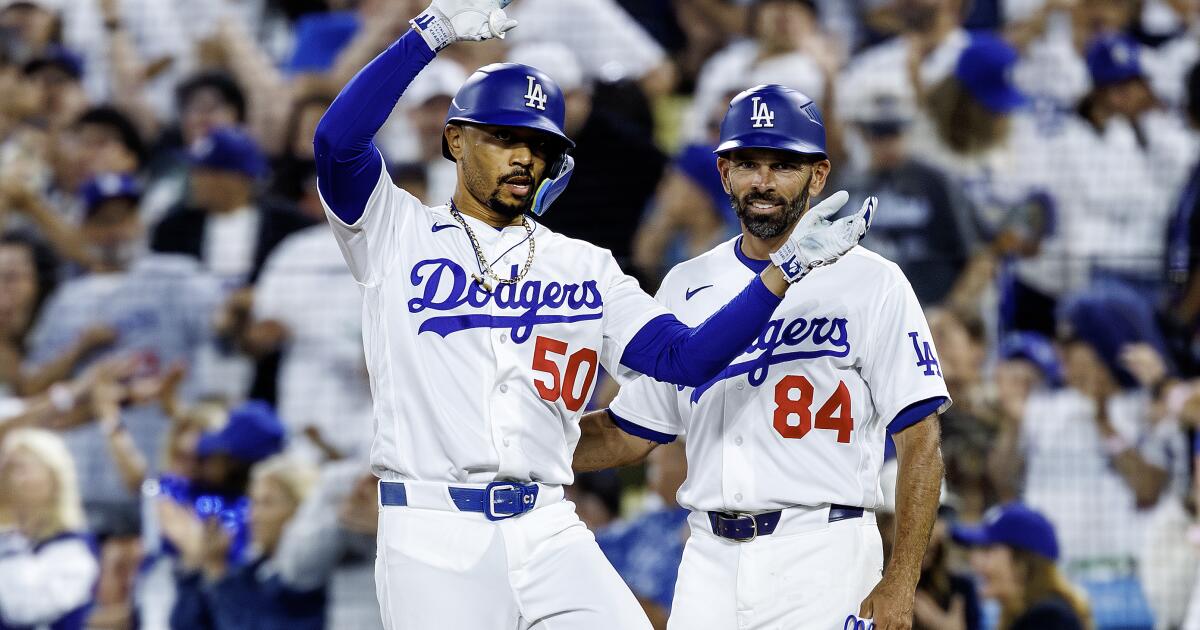
Mookie Betts’ eighth-inning single gives Dodgers the win over the Rockies
-
World41 minutes ago
From sewers to swimming sites: how Europe's cities reclaim their rivers
-

 News1 hour ago
Three more people charged with damaging Reflecting Pool after Trump’s multimillion-dollar restoration | CNN Politics


