News
Is Microsoft Excel the Next Big E-Sport?


Like soccer players taking the field in a giant stadium, the 12 finalists ran through a glowing “hype tunnel,” some wearing jerseys with sponsorship logos. As an announcer bellowed introductions and cameras captured their every move, they approached a neon-lit stage to raucous cheers.
Then the men sat down at desktop computers, opened their Microsoft Excel spreadsheets and began to type.
Excel, a program that does complex math on a human’s behalf, is often associated, rightly, with corporate drudgery. But last month, in a Las Vegas e-sports arena that typically hosts Fortnite and League of Legends tournaments, finance professionals fluent in spreadsheets were treated like minor celebrities as they gathered to solve devilishly complex Excel puzzles in front of an audience of about 400 people, and more watching an ESPN3 livestream.
Organizers call the event the Microsoft Excel World Championship. “Yes, it is a thing,” the official website says.
At stake was a $5,000 prize, a wrestling-style championship belt and the title of world’s best spreadsheeter. But the organizer, Andrew Grigolyunovich, is dreaming bigger. He hopes to turn competitive Excel into a popular e-sport where pros compete for million-dollar prizes and big-league glory.
“Excel was always thought of as a back-office product,” said Mr. Grigolyunovich, a Sudoku champion from Latvia. But in Vegas, “these people who are working, I don’t want to say boring jobs — but, you know, regular jobs — they could become stars.”
If that seems too ambitious, we’d like to introduce you to Erik Oehm, a software developer from San Francisco, who watched the action from the front row.
“This is the Super Bowl for Excel nerds,” Mr. Oehm said. “If Excel is the center of your universe, this is like hanging out with LeBron James and Kobe Bryant.”
The “LeBron James of Excel,” as he was introduced in Vegas, was Diarmuid Early, 39, an Irish financial consultant who lives in New York, who entered the arena in jeans, sandals and a jersey patterned to resemble abdominal muscles. The Kobe Bryant was Andrew Ngai, 37, a soft-spoken actuary from Australia known as the Annihilator, who began the world championship as its reigning three-time champion.
“We’re friends — for now,” Mr. Early joked as they posed for a photo. But his anxiety was palpable.
“I probably take it too seriously,” he said. “I’m very invested in it.”
The format for the finals was a mock-up of World of Warcraft, an online role-playing game. It required the 12 men (this particular nerdfest was mostly a guy thing) to design Excel formulas for tracking 20 avatars and their vital signs. If that sounds unfathomably complicated, it was: The players were handed a seven-page instruction booklet.
To prepare, Mr. Early adjusted the width of his Excel columns with the precision of a point guard lining up a 3-point shot. Mr. Ngai queued up a YouTube compilation of “focus music.”
After an announcer kicked off the 40-minute event — “Five, four, three, two, one, and Excel!” — the 12 players leaned over their keyboards and began plugging in formulas. One example: “=CountChar(Lower(D5),”W”)” allowed one competitor, Michael Jarman, to figure out how many times the letter “W” appeared in a spreadsheet.
The aim was to score as many points as possible while staying ahead of rolling eliminations. As cascading answers filled Excel columns, Mr. Ngai took a significant lead, to audible gasps. Then he got stuck on a problem, as did Mr. Early. Mr. Jarman pulled ahead as the two front-runners frantically tried to troubleshoot.
“Oh my gosh, oh my gosh,” Mr. Oehm chanted.
‘Well, this is ridiculous.’
The first electronic spreadsheet was VisiCalc, an “electronic blackboard” that automated pen-and-paper calculations. Microsoft introduced Excel in 1985. The company says its suite of office software, which includes Excel, has more than 400 million users. (Google has said that more than three billion people use its free suite of products, including Gmail and a spreadsheet program called Sheets.)
Part of the appeal, and the intimidation factor, of spreadsheets is their undefined scope. Excel can be a dating organizer or a tool for collating a country’s coronavirus caseload, for example.
Speaking in almost philosophical terms, Bob Frankston, a founder of VisiCalc, said that people who treat Excel merely as a finance tool ignore its vast potential. “They don’t realize it’s a mirror” of their minds, he said. “The financial planning tool they’re seeing is in their head.”
But for millions of people, it’s still just a tool for accomplishing the tasks their corporate overseers assign to them. It may say something about our times that the instruments of our servitude are also the basis of our games.
The first Excel competition, ModelOff, started in 2012. But ModelOff, which featured financial problems that took hours to solve, was not designed with thrills in mind.
When ModelOff was discontinued after seven years, Mr. Grigolyunovich, a former competitor, created the Financial Modeling World Cup, the organization that runs the Excel championship and other events. The championship — which has several corporate sponsors, including Microsoft — was held in person for the first time last year. He said its shortened rounds, eliminations, commentators and pregame “hype tunnel” were designed to raise tension and lure spectators.
“I remember thinking ‘Well, this is ridiculous, why do we have this?’” Mr. Jarman, 30, a British financial consultant who lives in Toronto, said of the tunnel. “But it’s all in good fun. And if the other e-sports do it, we should too.”
Mr. Grigolyunovich said his vision for future tournaments includes more spectators, bigger sponsors and a million-dollar prize for the winner. For now, many fans find out about the Excel championship through ESPN’s annual obscure sports showcase, where it is sandwiched between competitions like speed chess and the World Dog Surfing Championships.
Reluctant rivals
The competitors in Vegas said winning requires not just Excel-know how, but also problem-solving acumen, composure under pressure and intuition — or luck. Add the frisson of a live audience, they say, and the competition starts to resemble a sport in its unpredictability, if not physicality.
They seemed less interested in Mr. Grigolyunovich’s visions of fame and fortune, and more focused on adjusting to the transformation of their staid, niche hobby into a televised spectacle. Mostly they had come to geek out with fellow Excel buffs. Between rounds, they attended spreadsheeting workshops and added each other on LinkedIn.
More rivalries could help to build some excitement, several contestants said — but they were too polite, and on too friendly terms with one another, to initiate any.
“Basically everything that they do to make it more fun for viewers makes it more traumatic for competitors,” Mr. Early said.
There was a bit of celebrity stardust in the air, though, as Mr. Early and the Mr. Ngai, the LeBron and Kobe of Excel, fielded a stream of selfie requests.
“This guy is amazing,” one quarterfinalist, Joy Hezekiah Andriamalala, a finance student from Madagascar, said to a reporter after snapping a photo with Mr. Ngai. “Do you know him? Personally?”
Mr. Ngai, who appeared resigned to the possibility of losing his championship streak, admitted that being a minor celebrity for a few days was “pretty cool.” He said he had started to treat competitive Excel more like a sport than a hobby, setting aside more time to practice.
Onstage, the front-runners tried to prevent Mr. Jarman from running away with the championship belt. Mr. Early won a semifinal round by turning screens of mazes made of colored cells and emojis into numbers. In the finals, Mr. Ngai tried a Hail Mary: filling his remaining cells with random numbers.
As the clocked ticked down to zero, Mr. Jarman turned to stare at the leaderboard.
“Ten seconds, is anything going to happen?” a commentator, Oz du Soleil, shouted. Nothing did.
Mr. Jarman leaped out of his seat and threw his hands in the air, his face gleaming with sweat. The audience erupted. “Look at that! Look at that!” Mr. du Soleil yelled.
Mr. Jarman held the championship belt aloft as someone dumped glitter on his head. Mr. Oehm let out a breath he had been holding.
“You’d never see this with Google Sheets,” he said. “You’d never get this level of passion.”



A University of Alabama student who was found dead in Barcelona after going missing while vacationing evidently fell into the sea by accident in view of surveillance cameras – and an autopsy revealed injuries on his body that were consistent with having repeatedly struck a breakwater’s rocks.
Such details about James “Jimmy” Gracey surfaced in the Spanish media as a spokesperson for police in Barcelona told the Associated Press that “all signs point” to the 20-year-old’s death as having been inadvertent.
Gracey was last seen outside the Shoko nightclub at about 3am on Tuesday. The native of suburban Chicago raised alarm when he did not return to a short-term rental where he was staying with friends who accompanied him on their spring break to the Catalan region’s capital.
And, in a development that generated international news headlines, his corpse ultimately was recovered Thursday afternoon in 13ft deep waters off a beach near the Shoko club.
Spain’s El País newspaper, citing police sources, reported on Friday that local surveillance cameras captured video of Gracey walking by himself toward a dock and falling into the water “without third-party involvement”.
El Periódico, another outlet, added on Friday that a preliminary autopsy report filed in court in Barcelona “rules out foul play and supports the police hypothesis that [Gracey] accidentally fell into the sea and drowned”. Furthermore, the autopsy report documented “several injuries consistent with hitting the rocks of a breakwater”, according to Barcelona-based El Periódico, which also wrote that toxicology test results were pending.
The outlets’ reports contained details about the two-day search for Gracey. At one point, El País reported, Barcelona police found Gracey’s cellphone in the possession of a thief known to officers. But it was unclear whether Gracey lost the device or if it was stolen from him, and investigators ruled out its having anything to do with the subsequent fall into the sea, according to El País.
Meanwhile, El Periódico reported that police narrowed their search for Gracey after finding his wallet and some clothes. The outlet also reported that Gracey’s parents had traveled to Barcelona, and his body would be released to his family for repatriation and burial after the completion of the toxicology tests.
A statement from Gracey’s family members asked for prayers and privacy as they struggle “to come to terms with this unimaginable loss”.
“Our family is heartbroken,” the statement also said. “Jimmy was a deeply loved son, grandson, brother, nephew, cousin and friend.”
Barcelona draws millions of foreign tourists annually. It is considered generally safe, especially compared with major cities in the US, which has significantly higher rates of deadly gun violence than other high-income nations.
The Mediterranean beaches in Barcelona are within walking distance of its bustling city center and frequently draw young visitors. When he went missing, Gracey had gone out to a stretch of beach lined with restaurants and nightclubs that are popular with both locals and visitors.
Before police confirmed Gracey’s death, his aunt described him in an interview with the AP as “just a great kid, a good Catholic boy” from the US’s midwest.
A statement from the University of Alabama said its community was “heartbroken” upon learning of Gracey’s death.
“Jimmy’s loss is deeply felt across our campus,” the university’s statement said. “Our condolences are with the Gracey family during this devastating time.”
Associated Press contributed reporting


Case 1:25-cv-04218-PLF Document 35 Filed 03/20/26
Page 11 of 40
disrupt Pentagon operations.” SUMF at 11 (¶ 61). The Appendix also states that “actions other than convictions may be deemed to pose a security or safety risk, such as discussed in the [In- Brief].” Id. (¶ 62). In addition, Appendix A, Part B sets forth “[p]rocedures for [d]enial, [r]evocation, or [n]on-[r]enewal” of a PFAC. Id. (¶ 63). Those procedures allow for an appeal following the “immediate suspension” of a reporter’s PFAC and authorize the Department to “conduct [an] inquiry as deemed appropriate” after receiving a reporter’s “written or oral response to the proposed denial, revocation, or non-renewal.” Id. at 12 (¶¶ 64-65). Finally, the Policy includes the following “Acknowledgement”:
Id. (67).
I have received, read, and understand the “Pentagon Reservation In- brief for Media Members,” with Appendices A-E, including Appendix A, which addresses the standard and procedures for denying, revoking, or not renewing a PFAC. The in-brief describes [Department] policies and procedures. My signature represents my acknowledgement and understanding of such [Department] policies and procedures, even if I do not necessarily agree with such policies and procedures. Signing this acknowledgment does not waive any rights I may have under law.
After the Policy was issued, PFAC holders were informed that their PFACs would
be revoked if they did not sign the Acknowledgement by October 15, 2025. SUMF at 12 (¶ 68). Seven journalists with The Times, including Mr. Barnes, as well as most other journalists who held PFACs at the time, refused to sign the Acknowledgement. Id. (¶ 69). Mr. Barnes and his colleagues at The Times turned in their PFACs on or around October 15, 2025. Id. (¶ 70). Mr. Barnes has not been back to the Pentagon since that date. Id. at 13 (¶ 71).
6. The New “Pentagon Press Corps”
On October 22, 2025, in a post on his official X account, Mr. Parnell
“announce [d] the next generation of the Pentagon press corps.” SUMF at 13 (¶ 73). In that post,
11
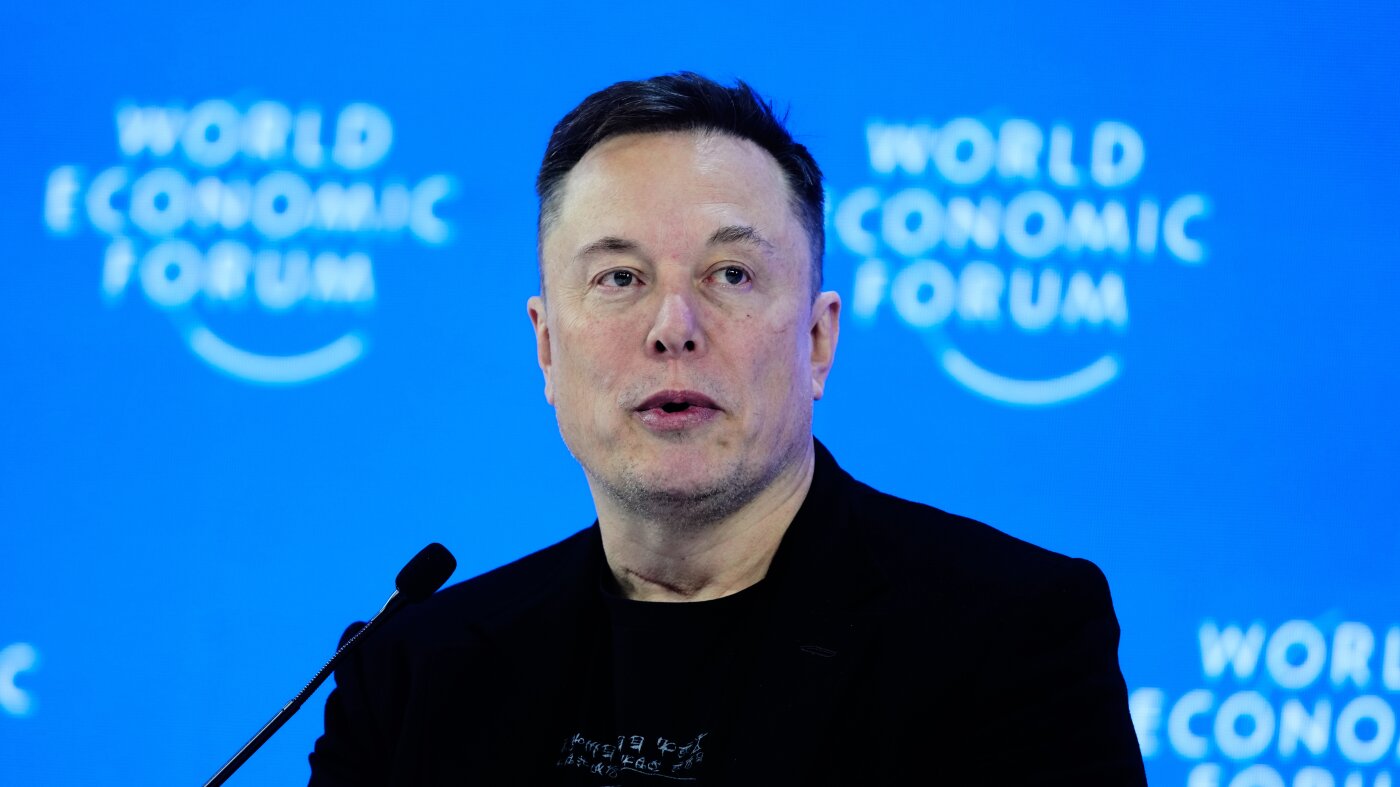
Elon Musk attends the annual meeting of the World Economic Forum in Davos, Switzerland, on Jan. 22.
Markus Schreiber/AP
hide caption
toggle caption
Markus Schreiber/AP
SAN FRANCISCO — A jury has found Elon Musk liable for misleading investors by deliberately driving down Twitter’s stock price in the tumultuous months leading up to his 2022 acquisition of the social media company for $44 billion. But it absolved him of some fraud allegations, finding that he did not “scheme” to mislead investors.

The civil trial in San Francisco centered on a class-action lawsuit filed just before Musk took control of Twitter, which he later renamed X. Jurors were asked to decide if two tweets and comments Musk made on a podcast in May 2022 amounted to him intentionally defrauding Twitter shareholders, who sold their shares based on Musk’s statements.
The nine-person jury returned the verdict after nearly four days of deliberation, nearly three weeks after the trial began on March 2. They said that while Musk was liable for misleading investors with two tweets — including one said the Twitter deal was “temporarily on hold,” he did not do so with a statement he made on a podcast and that he did not intentionally “scheme” to defraud investors.
The jury awarded shareholders between about $3 and $8 per stock per day as damages, which the plaintiffs’ lawyers said amounts to about $2.1 billion. Musk’s fortune is currently estimated at about $814 billion, much of it tied up in Tesla shares.
“It’s an important victory, not just for investors of Twitter, but for the public markets,” said Joseph Cotchett, an attorney for the plaintiffs. “I think the jury’s verdict sends a strong message that just because you’re a rich and powerful person, you still have to obey the law, and no man is above the law.”
Musk’s lawyers said they had no comment as they walked out of the courtroom.
Much of the trial focused on Musk’s claims about the number of bots on Twitter. Musk testified that Twitter had a much higher number of fake and spam accounts than the 5% it disclosed in regulatory filings. He used what he called Twitter’s misrepresentation of the number of fake accounts on its service as a reason to retreat from the purchase.
After Musk tried to back out, Twitter went to court in Delaware to force him to honor his original deal. Just before that case was scheduled to go to trial, Musk reversed course again and agreed to pay what he had originally promised.
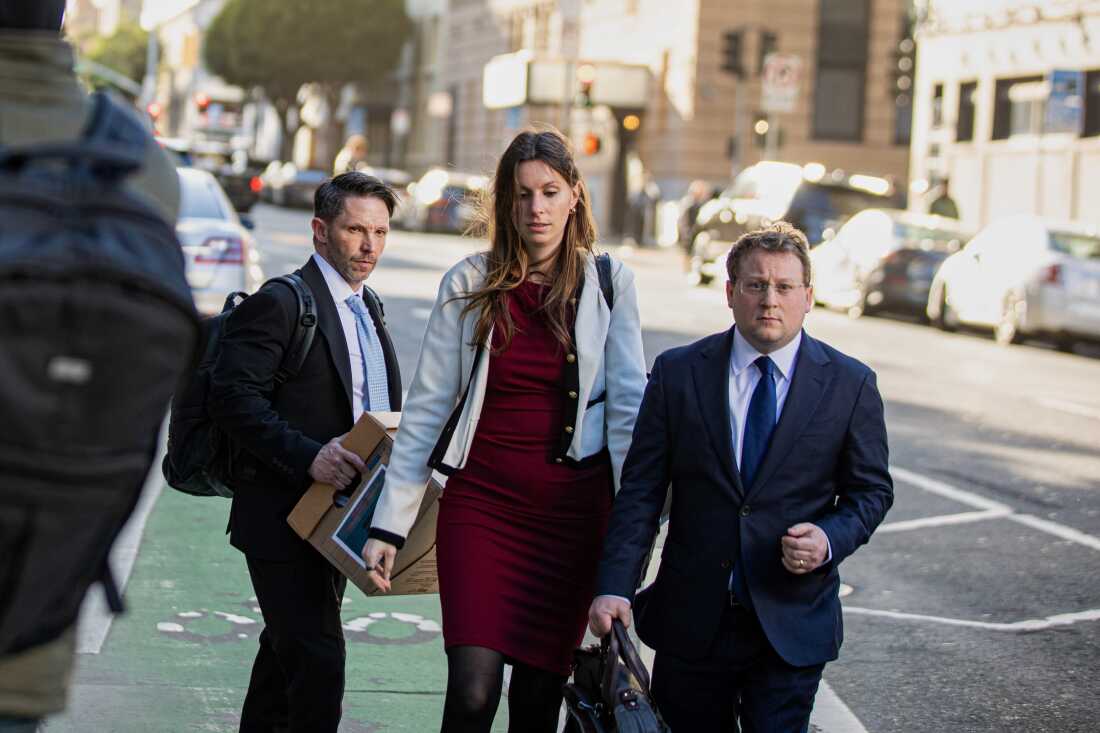
Members of Elon Musk’s legal team, including attorney Michael Lifrak (left), exit the Phillip Burton Federal Building in San Francisco on March 4.
Dan Hernandez/San Francisco Chronicle/AP
hide caption
toggle caption
Dan Hernandez/San Francisco Chronicle/AP
The central question of the case was whether Musk sent out tweets — including one on May 13, 2022, that said the Twitter deal was “temporarily on hold” while he sought information on the number of fake accounts on the service — as a deliberate scheme to tank Twitter’s shares. The jury found that while Musk did mislead investors with two tweets, he did not do so with a statement he made on a podcast because it was an opinion. The jurors also absolved him of scheming to drive down the stock.
The nearly three-week trial in San Francisco federal court for the Northern District of California saw testimony from former Twitter executives including CEO Parag Agrawal and CFO Ned Segal, as well as Musk, who was on the stand for more than a day.
In his testimony, Musk maintained that Twitter’s leadership lied about the amount of bots on the platform and withheld information from him about how the number of fake accounts was calculated. He repeatedly described the information that Twitter’s board provided with an abbreviation for a bull’s scatology. “I did make it clear that I thought it was BS,” Musk said of Twitter’s calculations asserting that only about 5% of its accounts were bots.
Musk also asserted that his decision to follow through on the deal at the original sales price provided a huge windfall for most Twitter shareholders.
But Twitter’s shares fell below $33, or about 40% below Musk’s original purchase price, while the deal was hanging in limbo. That downturn cost shareholders who sold their stock during the uncertainty caused by what the lawsuit alleges was Musk’s deceitful behavior.
“I can’t control whether people sell their stock, but everyone who held the stock fared extremely well,” Musk said.
The plaintiffs argued that, as Tesla’s stock price declined and buying Twitter became too expensive for Musk, he tweeted statements that drove down the stock price in the hopes he could renegotiate the deal for a lower price or get out of it altogether.
Musk’s tweets, the plaintiffs’ lawyer argued, were not some “innocent mistake” or a “stupid tweet” off the top of his head, but carefully calculated to drive down’s Twitter’s stock price.
In closing arguments, Mark Molumphy, a lawyer for the plaintiffs, asked jurors to hold Musk accountable and compensate thousands of investors who lost money because of tweets Musk sent, including one from May 13, 2022, that said the deal was “on hold.”
“He knew what he was doing,” Molumphy said.
Musk’s lawyers motioned for a mistrial several times during the contentious trial, contending that the billionaire Tesla CEO can’t get a fair trial in San Francisco because of animosity toward him from the public.
This isn’t the first time that Musk has been dragged into court to defend himself against allegations of duping investors with his social media posts. Three years ago, Musk spent about eight hours testifying in a San Francisco federal trial about his plans to buy Tesla — the electric automaker that he still runs as a publicly traded company — for $420 per share in a proposed 2018 deal that never materialized. A nine-member jury absolved Musk of wrongdoing in that case.

Georgia vs Virginia predictions, picks, odds for NCAA Tournament First Round

Washington Nationals release right-handed pitcher Drew Smith

Caroline Harvey gives Wisconsin hockey its seventh Patty Kazmaier winner

Score Predictions for No. 4 West Virginia vs. No. 13 Miami (OH)

Wild horse wipeout in Wyoming’s ‘checkerboard’ delayed until October due to funding, staffing, legal woes

Florida High School Football Rankings: Top 25 teams – Oct. 21

How old is Bo Nix? What to know about Oregon quarterback ahead of 2024 NFL Draft

Cleary's 21 help Le Moyne down Central Connecticut State 69-64 in OT

99th annual Pony Swim held in Virginia

Indiana Members Credit Union announced as new anchor tenant at Bottleworks District

Schumer gambit fails as DHS shutdown hits 36 days and airport lines grow

Trump threatens to deploy ICE to airports amid Homeland Security shutdown

Alabama student reportedly fell to his death in Barcelona waters by accident

Read the Ruling in The Times’s Lawsuit Against the Pentagon

NYC Mayor Mamdani’s wife glorified terrorists in online posts, criticized US military: report
-

 Detroit, MI3 days ago
Drummer Brian Pastoria, longtime Detroit music advocate, dies at 68
-

 Oklahoma7 days ago
Family rallies around Oklahoma father after head-on crash
-

 Nebraska1 week ago
Wildfire forces immediate evacuation order for Farnam residents
-

 Georgia5 days ago
How ICE plans for a detention warehouse pushed a Georgia town to fight back | CNN Politics
-

 Massachusetts1 week ago
Massachusetts community colleges to launch apprenticeship degree programs – The Boston Globe
-

 Alaska6 days ago
Police looking for man considered ‘armed and dangerous’
-
 Southwest1 week ago
Talarico reportedly knew Colbert interview wouldn’t air on TV before he left to film it
-

 Michigan1 week ago
Michigan-based Stryker hit with cyberattack