Arkansas
WBB Preview: Arkansas vs. Central Arkansas

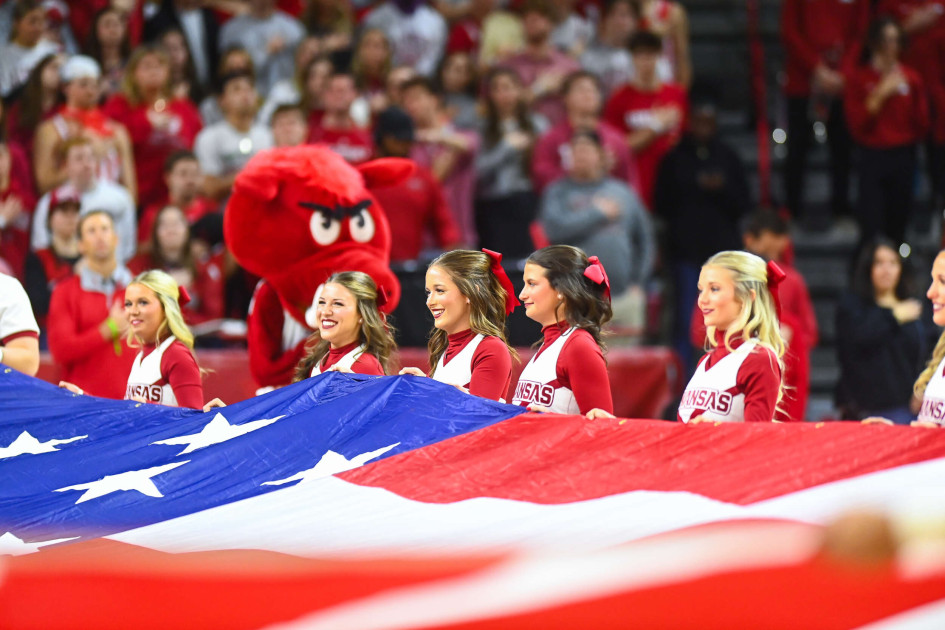
FAYETTEVILLE – Arkansas women’s basketball (2-0) will look to win its third straight game of the 2025-26 season on Monday night when it hosts Central Arkansas (1-1) at Bud Walton Arena.
Tipoff is set for 8:00 p.m. and the game will be televised live on SEC Network with Sam Gore (play-by-play) and Tamika Catchings (analyst) on the call.
Monday’s game will honor our veterans as the Salute to Service game, prior to Veterans Day on Tuesday.
INSIDE THE SERIES
Arkansas and UCA will meet for the seventh time overall and the fifth time in Fayetteville on Monday evening. The teams played each other for the first time in 1978 but didn’t meet again until 2020. This year’s meeting will mark the sixth straight, dating back to 2020. The Hogs have never lost to the Sugar Bears and last met in 2024, an 87-70 victory for Arkansas. Arkansas owns a 6-0 advantage in the all-time series.
LAST TIME OUT
Arkansas improved to 2-0 after a 101-49 win over Arkansas-Pine Bluff on Friday, Nov. 7. 13,032 fans and elementary students saw the win, the second-largest crowd in program history. The Hogs never trailed and led by as many as 52 points. Junior Jenna Lawrence led all scorers with a career-high 26 points and 5 three pointers. Freshman Bonnie Deas picked up her first collegiate double-double with 12 points and 11 rebounds. She also led the team with six assists. The Razorbacks’ 15 three pointers were the most in a game since the 2021-22 season, when they had 15 at Alabama on Jan. 20, 2022
QUICK HITS
Arkansas enters its third game of the Kelsi Musick era. Central Arkansas opened the season with a 78-71 defeat at Missouri and won its first game on Friday, against Lyon College, 115-43. The Sugar Bears were picked to finish second in the ASUN preseason poll. Freshman Bonnie Deas leads the Hogs with 18.5 points per game, which is tied for seventh nationally among freshmen through two games. Next up: The Razorbacks will host Southeastern Louisiana on Thursday before traveling to Texas Tech on Sunday for their first road game of the season.
ON THE SUGAR BEARS
The Sugar Bears (1-1) opened their home schedule on Friday, defeating Lyon College 115-43 at the Farris Center. The home team won the day with defensive pressure, forcing 36 turnovers and racking up 27 steals, the third-most in a single game in program history, as well as the first 20-steal game by the Sugar Bears since 2021-22. It was a total team effort on Friday, with 12 Sugar Bears scoring the ball, led by Cheyanne Kemp’s career-high 22 points. She was one of five players to score in double-figures, and the Sugar Bears made 15 three-pointers on 42 percent shooting. Central Arkansas enters its third season under head coach Tony Kemper. Kemper has led UCA to two straight 20+ win seasons and a pair of top 3 finishes in the Atlantic Sun Conference in his first two seasons in Conway.
VS. IN-STATE FOES
All-time, Arkansas is 30-12 against in-state opponents. Against DI in-state opponents, the Hogs are 27-4 and have only lost once since 2005, against UAPB in Fayetteville in 2023. This season, Arkansas will play all four DI in-state opponents: 11/7 vs. UAPB (W, 101-49), 11/10 vs. Central Arkansas, 11/20 vs. Little Rock and 12/28 vs. Arkansas State, the Hogs’ final non-conference matchup.
A FEW FIRSTS
Kelsi Musick is Arkansas women’s basketball’s first female head coach since Susie Garnder led the Razorbacks from 2003-2007. Hometown firsts: Danika Galea is the first Maltin player in Razorback history. Aisha Hassan is the first Egyptian player in Razorback history. Ashlynn Chlarson is the first Arizonan in Razorback history.
50 SEASONS
Arkansas women’s basketball will celebrate its 50th season in 2025-26. The program was founded in 1976 and has accumulated 884 wins since its first game against North Arkansas CC on Nov. 19, 1976. The Razorbacks’ first win came on Dec. 1, 1976 against John Brown, 92-87.
THE NEWCOMERS
The Razorbacks added eight newcomers to the 2025-26 roster: 5 transfers and 3 freshmen. Maria Anais Rodriguez joined Arkansas from Oklahoma State, where she saw action in 10 games during her first season, including three Big 12 games against Colorado, UCF and Arizona. On the FIBA side, she helped Spain to a 6-1 mark and the Silver Medal at the FIBA U18 Women’s Eurobasket competition in 2024 and averaged 8.3 points, 4.1 rebounds and 1.9 assists during the event.
Taleyah Jones followed Coach Musick to Arkansas after playing for her during her sophomore and junior seasons. Jones was the Summit League Newcomer of the Year in 2024 and a First Team All-Summit League selection in 2025. Last season, she led ORU’s offense that ranked in the top 10 nationally in scoring average (83.2) with 18.1 points per game.
Wyvette Mayberry signed with Arkansas on April 3, 2025, the first signee of the Musick era. Mayberry started her career at Tulsa before transferring to Kansas after two seasons. At Tulsa, she was named to the AAC All-Freshman team and led the Golden Hurricane in scoring her sophomore season with 14.1 points per game. At Kansas, she started in 31 games her junior season and recorded four 20+ point games. She started in all 32 games during her senior year and averaged 9.7 points and 2.4 rebounds per game. She injured her knee during her fifth year and came to Arkansas to finish her career.
Ashlynn Chlarson is the only JUCO product on this year’s team and joined Arkansas from Eastern Arizona CC in Thatcher, Arizona. In her two seasons with the Monsters, she averaged 8.4 points per game and 7.1 rebounds per game. Last season, she nearly averaged a double-double, with 10.9 points/game and 9.2 rebounds/game. She earned first team all-conference, second team all-region and NJCAA All-Tournament Team honors in 2025.
Emily Robinson also made the move from Oral Roberts after a successful start to her career. She was named the 2024 Summit League Freshman of the Year after averaging 10.3 points/game, 3.7 rebounds/game and 2.5 assists/game. She was the only freshman in the league to average double figures. She started in all 33 games her sophomore season and averaged 10.0 points/game and led ORU with 3.4 assists/game. She scored 17 points in the Summit League Tournament championship game against No. 24 South Dakota State.
Harmonie Ware, Aisha Hassan and Bonnie Deas were part of the 2025 signing class that Coach Musick managed to keep following her hiring in March.
THE FIBA FOUR
Four Razorbacks represent their countries at this summer’s FIBA events. Bonnie Deas (Australia) led her country to a silver medal in the FIBA U-19 Women’s World Cup. Deas averaged 12.3 points, 7.7 rebounds and 3 assists in 6 games at the World Cup and earned All-Star Five team honors alongside USA’s Saniyah Hall, the No. 1 prospect in the 2026 class, and UCLA’s Sienna Betts. Deas was Australia’s leading scorer in the championship game with 13 points in an 88-76 loss to the United States. Cristina Sanchez Cerqueira represented Spain in the U-20 FIBA Women’s EuroBasket and won gold. Maria Anais Rodriguez also represented Spain at the U-19 FIBA Women’s EuroBasket and earned a bronze medal. Danika Galea played for Malta in the FIBA 3×3 Europe Cup and won a silver medal in the qualifier in Prishtina, Kosovo.
NEW STAFF
Joining Musick for her first season in Fayetteville are new assistant coaches Brad Johnson and Alex Furr. Johnson made the short trip from nearby Farmington, Arkansas, where he was the head coach of the highly successful Farmington High School girls program, the home of Jenna Lawrence. Overall, Johnson finished his high school coaching career with 419 wins, four state titles, eight conference titles and seven state finals appearances. Furr joins the staff from SMU, where she served as an assistant coach and director of player development for two seasons. Furr played at Fresno State from 2010-2014 and ranks in the all-time top 10 in 3-pointers made and career free throw percentage. Other new staff include Director of On-Court Development Greg Gilman and Video Coordinator Carter Mumm. Assistants Lacey Goldwire and Nick Bradford and longtime Director of Operations Amber Shirey remain on staff.
For more information on Arkansas women’s basketball, follow @RazorbackWBB on social media.



Temperatures will climb to the upper 90s today and heat index values will get close to 105° this afternoon. There are heat advisories today for part of west and southwest Arkansas.
Today will bring a slight chance of showers or thunderstorms late in the day in Central Arkansas.
Friday will also bring a slight chance of showers and thunderstorms with very hot weather.
Rain chances increase and temperatures drop this weekend when a cold front moves through Arkansas.


Arkansas
ARKANSAS SIGHTSEEING: Randolph County can claim many firsts in Arkansas | Northwest Arkansas Democrat-Gazette

Copyright © 2026, Northwest Arkansas Newspapers LLC. (NWA Media)
All rights reserved.
This document may not be reprinted without the express written permission of Northwest Arkansas Newspapers LLC
Material from the Associated Press is Copyright © 2026, Associated Press and may not be published, broadcast, rewritten, or redistributed. Associated Press text, photo, graphic, audio and/or video material shall not be published, broadcast, rewritten for broadcast or publication or redistributed directly or indirectly in any medium. Neither these AP materials nor any portion thereof may be stored in a computer except for personal and noncommercial use. The AP will not be held liable for any delays, inaccuracies, errors or omissions therefrom or in the transmission or delivery of all or any part thereof or for any damages arising from any of the foregoing. All rights reserved.


Fort Smith Historic Site: Law, conflict and the West
Explore Fort Smith Historic Site, where westward expansion, federal justice and Native American history shaped life on the American frontier.
A former Arkansas Tech University graduate and commander of the U.S. Army Intelligence and Security Command is being remembered with two posthumous honors recognizing his lasting influence on the nation’s military intelligence operations.
The late Maj. Gen. Gary W. Johnston, a 1987 Arkansas Tech graduate and Russellville native, was honored during a dedication ceremony June 25 at Fort Huachuca, Arizona, where the Army officially named a newly consolidated military intelligence complex the Major General Gary W. Johnston Consolidated Mission Facility.
Johnston also was posthumously inducted into the Military Intelligence Hall of Fame for helping reshape Army intelligence through the integration of emerging technologies, including big data analytics, artificial intelligence and machine learning.
The new facility serves as a central hub for U.S. Army Intelligence and Security Command (INSCOM) operations at Fort Huachuca, known as the “Home of Army Intelligence.” It houses some of the Army’s most critical intelligence personnel and brings together units that had previously operated from aging buildings spread across the installation.
Army officials said the previous arrangement created operational challenges, including limited secure workspaces, outdated infrastructure and additional security requirements. Beginning in 2018, INSCOM launched an effort to consolidate those missions by renovating two existing buildings into a 16,300-square-foot intelligence operations center designed to improve collaboration and security.
The facility now houses INSCOM G3’s Detachment 52, elements of the U.S. Army Counterintelligence Command, representatives from the Ground Intelligence Support Activity, an emerging Foundry program element and other intelligence organizations.
Among those attending the dedication were Johnston’s wife, Brig. Gen. Amy Johnston, daughter Lauren Woodworth and granddaughter Arabella Woodworth.
Maj. Gen. Rhett R. Cox, commanding general of U.S. Army Intelligence and Security Command, said the building represents more than a new workplace.
“As we dedicate the U.S. Army INSCOM Major General Gary W. Johnston Consolidated Mission Facility, we do more than just open a new facility… we consecrate a tribute to his indelible legacy,” Cox said. “This facility will stand as a constant reminder of his service, his vision and his unwavering commitment to our nation and to the soldiers he led. It will inspire future generations of intelligence professionals to emulate his example of leadership and selfless service.”
Retired Chief Warrant Officer 5 Kevin Boughton, former INSCOM command chief warrant officer, said Johnston envisioned closer collaboration between the Army’s intelligence training and operational communities.
Boughton said Johnston believed the distance between the Intelligence Center of Excellence and INSCOM’s operational units “shouldn’t be measured in miles,” but instead by “a seamless flow of data, doctrine, and talent” where operational experience and institutional knowledge move freely between soldiers in the field and those training the next generation.
Johnston graduated from Russellville High School in 1983 before earning a Bachelor of Science in Business Administration from Arkansas Tech in 1987. Through the university’s Reserve Officers’ Training Corps program, he received his commission as a U.S. Army officer.
During a military career spanning more than 34 years, Johnston served in command and staff assignments ranging from platoon level to senior leadership within the Army and Department of Defense. He deployed in support of Operation Desert Shield, Operation Desert Storm, Operation Joint Endeavor, Operation Enduring Freedom and Operation Freedom’s Sentinel.
In 2015, Johnston became the seventh graduate of Arkansas Tech’s Army ROTC program to attain the rank of general officer. He was promoted to major general in 2017.
He concluded his military career as commanding general of U.S. Army Intelligence and Security Command, overseeing approximately 17,500 personnel operating in more than 40 countries.
Army leaders credited Johnston with helping modernize military intelligence by laying the groundwork for the establishment of the U.S. Army Counterintelligence Command, which was formally created in 2022 after his retirement. He also led development of what became the Army Intelligence Data Platform, designed to incorporate advanced data analytics, artificial intelligence and machine learning into intelligence operations while supporting future large-scale combat operations.
Johnston also promoted data science education within the military intelligence community by partnering with George Mason University to provide specialized training for Army warrant officers.
Colleagues remembered Johnston not only for his strategic vision but also for his leadership style. Despite working in one of the Army’s most demanding operational environments, they described him as a source of humor, kindness and encouragement whose focus remained on the soldiers, civilians and contractors carrying out the intelligence mission.
Johnston retired from active duty in 2021 and died in January 2022.
His latest recognitions add to previous honors from his alma mater. Johnston was a member of the inaugural Arkansas Tech Army ROTC Hall of Honor in 2017 and was inducted into the university’s Hall of Distinction in 2019.
-

 Hawaii2 minutes ago
First 5 Hawaii is a comprehensive online resource that helps families with young children find and connect to state and federal programs and services.
-
 Idaho7 minutes ago
Brush fire prompts GO NOW evacuations near Mesa in Adams County
-

 Illinois14 minutes ago
Illinois waives tax penalties for 11 counties hit by storms, including Stephenson and Winnebago
-

 Indiana16 minutes ago
Attempted murder suspect arrested in Indianapolis for Bloomington shooting
-

 Iowa21 minutes ago
Iowa WWII veteran approaching 100th birthday honored in Cedar Rapids
-

 Kentucky27 minutes ago
Exantus may be subject to involuntary hospitalization due to Kentucky law
-

 Louisiana37 minutes ago
Parasitic stomach illness that can cause explosive diarrhea rises in Louisiana
-

 Maine44 minutes ago
Is prison in play for Graham Platner?

