Arizona
Shutdown may be ending, but here’s why deal doesn’t suit Mark Kelly, Ruben Gallego


Senate strikes deal to end historic government shutdown
Lawmakers agree to end longest-ever government shutdown, reopen government through Jan 30
A faction of Senate Democrats joined with Republicans in preliminary steps to end the record-long federal government shutdown, although Arizona’s senators oppose the emerging deal.
On its 40th day, enough Democrats appeared ready to begin the multi-step legislative process needed to end the shutdown that began Oct. 1.
“It looks like we’re getting very close to the shutdown ending,” President Donald Trump told reporters in Washington.
Democratic Sens. Mark Kelly and Ruben Gallego each issued statements Nov. 9 against the short-term spending agreement.
“In the richest country in the world, families shouldn’t have to choose between putting food on the table and their health care,” Kelly said. “But that’s exactly what Donald Trump has done to Americans with this shutdown.”
Gallego signaled that he would not be moved by anything less than a deal to preserve the insurance subsidies that expire at the end of the year.
“I have been clear on this from the beginning: I will not turn my back on the 24 million Americans who will see their premiums more than double if we don’t extend these tax credits,” he said.
“At a time when prices are already too high, Americans are shopping for health insurance and experiencing such sticker shock that they are being forced to sign up for a crappy, overpriced plan or not signing up for insurance at all.”
The agreement, which could take several more days to finalize, appears to have enough Democratic support to allow it to move to a vote and would fund the government through January, along with several pieces of the annual budget bill that are supposed to be in place before the start of the federal fiscal year on Oct. 1.
It does not include any extension of the pandemic-era health insurance subsidies for those who buy coverage through the Affordable Care Act, which was the main Democratic demand. Sen. Angus King, I-Maine, who has been one of the three non-Republicans to consistently vote to end a shutdown, said Republicans had indicated they would allow a vote on the insurance issue.
“I think people were saying ‘We’re not going to get what we want,’ although we still have a chance,” he said, according to the New York Times.
The deal also includes a provision to bring back government workers fired by the Trump administration during the shutdown, said Sen. Tim Kaine, D-Virginia, who told reporters that was instrumental in moving him to support it.
Senate Minority Leader Chuck Schumer, D-New York, remained against the deal, reflecting the deep division within his party.
“On Friday, we offered Republicans a compromise: a proposal that would extend the ACA tax credits for a year and open up the government at the same time,” he said.
“They once again said no, and when they said no on our compromise they showed they are against any health care reform. Instead, they passed the biggest health care cuts in our nation’s history — just to give tax breaks to billionaires.”
When will Adelita Grijalva get sworn in?
The process of approving the plan will require several Senate votes and will necessitate calling the House of Representatives back into session.
That could bring with it the belated swearing-in of Rep.-elect Adelita Grijalva, D-Arizona, who has been kept officially out of office since she easily won the special election to fill the seat vacated by the March death of her father, Rep. Raúl Grijalva, D-Ariz.
Grijalva’s arrival in the House is expected to provide the last needed signatory to force the House to vote on publicly releasing the investigative files for Jeffrey Epstein.
The disgraced financier killed himself amid allegations of sex trafficking underage girls to VIPs. Trump is widely believed to be mentioned in the files involving his former friend.
Food benefit cuts and flight cancellations
For weeks, the shutdown had enough exceptions that many Americans could perhaps overlook the stalemate, but it has become more impactful for millions with impending limits on the government’s food benefits program and the growing cancellations of hundreds of domestic flights each day.
Kelly maintained there “should’ve never been a shutdown in the first place, and I worked to find a solution with Republicans and this administration.”
He accused Trump of not caring “about rising costs, skyrocketing health care premiums, or working families struggling to put food on the table. He has spent more time working on his ballroom than working to open the government. He sued to block food assistance for hungry families.”
Gallego said it was “disgusting that Republicans have put the country in the place, where they are pitting working people against each other.”
“There’s a phrase in Spanish, ‘Con salud, lo hay todo; sin salud, no hay nada.’ It means ‘With good health you have it all; without your health, you have nothing.’”



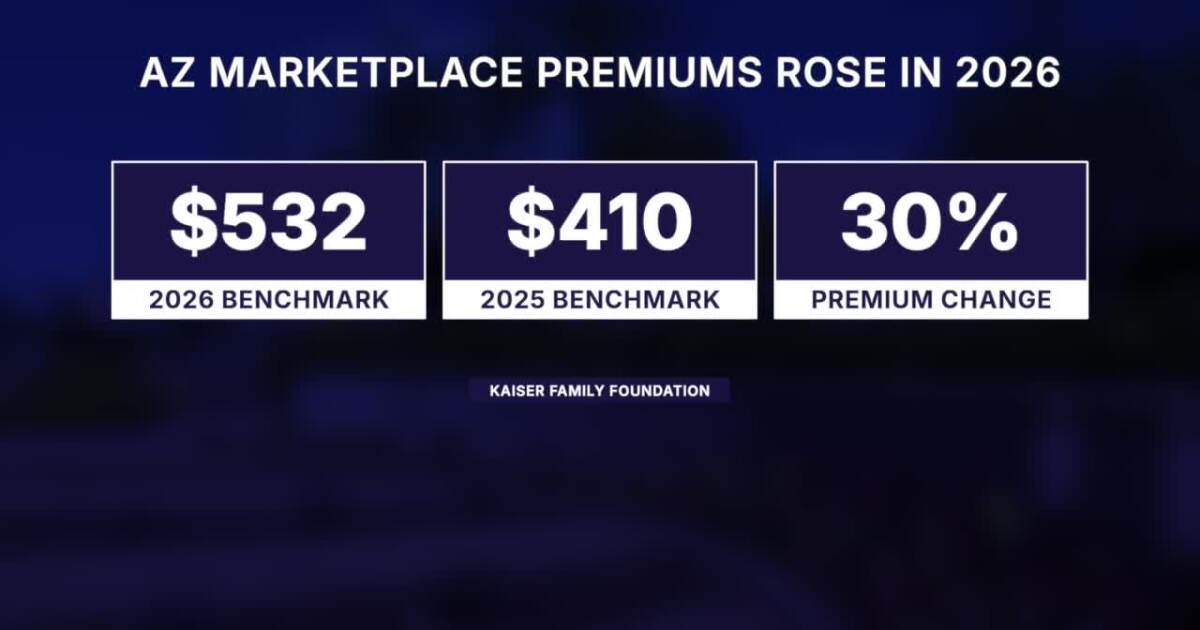
PHOENIX — Arizona’s ACA marketplace enrollment fell from 363,000 to just over 255,000 in a single year — a nearly 30% decline and the third-largest annual drop in the country.
Rising premiums and expired tax credits are driving the trend, with the average benchmark plan premium in Arizona now at $532 — up 30% from 2025.
In the player above, ABC15 Data Analyst Garrett Archer takes a look inside the numbers on how healthcare premiums are impacting health insurance enrollment.
This story was reported on-air by a journalist and has been converted to this platform with the assistance of AI. Our editorial team verifies all reporting on all platforms for fairness and accuracy.
Want more news in your community? Add ABC15 as a preferred source on Google below:

Arizona
Arizona man pleads guilty after illegally living in forest for years among ‘1,000lbs of trash’

A man in Arizona has pleaded guilty to violating federal fire restrictions and unlawfully residing in a national forest, after authorities said he spent years living at a makeshift campsite surrounded by what officials described as “approximately 1,000 pounds of trash”.
Mark Aaron Gatz was arrested on 25 June at his illegal campsite in Arizona’s Tonto national forest, according to court records. A United States Forest Service (USFS) officer wrote in documents submitted to court that Gatz had been operating an “illegal campsite” with a “hot wood burning campfire” despite fire restrictions and that he had told investigators that he had been living in the forest for about eight years.
The officer wrote that a records check found that Gatz had previously received multiple citations and was the subject of six outstanding federal arrest warrants for earlier violations, including for building fires during fire restrictions, constructing on national forest service lands, unsanitary conditions and occupying national forest as a residence.
Gatz “said that he knew about current fire restrictions but had to have fire to eat”, authorities said. The documents show that USFS officers made contact with Gatz multiple times over the last year or so, and issued him warnings as well as a violation notice for having campfires during fire restrictions.
Notes from officers’ previous encounters with Gatz earlier this year, submitted into the court docket, state that authorities observed “trash such as clothing, pans, tools, and plastic cups scattered throughout the campsite along with a structure that was four feet in height build using wood panels”.
During an encounter with Gatz in May, officers reported observing “approximately 1,000 pounds of trash” at the site, which they said included tires, plastic bags, trash bags, aluminum cans and other items. They also wrote that they found that the campfire site had been left unattended by Gatz the previous day while still hot.
In a separate report filed by law enforcement from an encounter in February, one officer wrote that “upon arrival at the camp, I was flabbergasted by the amount of debris in the area”.
Investigators said that during that encounter, the debris consisted of three ladders, six to eight totes “overfilled with debris”, five 55-gallon drums, eight tires, multiple bicycle frames, 5 gallons of motor oil, plywood and other “miscellaneous lumber”, and they wrote that trash was scattered over approximately half an acre of Forest Service land and creating what officers described as public safety concerns.
In a separate report from July 2025, officers said they observed what they described as a “large messy campsite” while patrolling the area due to complaints “from the district office abut one large messy camp”.
“There was roughly half an acre of resources ruined due to so much trash and goods on the ground for an extended period of time,” the officer wrote.
This week, after Gatz pleaded guilty, he was sentenced to time served and three years of probation, according to court records.
A representative for Gatz did not immediately respond to a request for comment.

Odds of winning the Powerball and Mega Millions are NOT in your favor
Odds of hitting the jackpot in Mega Millions or Powerball are around 1-in-292 million. Here are things that you’re more likely to land than big bucks.
The Arizona Lottery offers multiple draw games for those aiming to win big.
Here’s a look at Tuesday, July 7, 2026 results for each game:
Winning Mega Millions numbers
02-31-35-36-63, Mega Ball: 12
Check Mega Millions payouts and previous drawings here.
Winning Pick 3 Evening numbers
Evening: 4-7-2
Winning Fantasy 5 numbers
03-05-10-14-37
Check Fantasy 5 payouts and previous drawings here.
Winning Triple Twist numbers
03-06-18-23-27-32
Check Triple Twist payouts and previous drawings here.
Feeling lucky? Explore the latest lottery news and results
What time is the Powerball drawing?
Powerball drawings are at 7:59 p.m. Arizona time on Mondays, Wednesdays and Saturdays.
How much is a Powerball lottery ticket today?
In Arizona, Powerball tickets cost $2 per game, according to the Arizona Lottery.
How to play the Powerball
To play, select five numbers from 1 to 69 for the white balls, then select one number from 1 to 26 for the red Powerball.
You can choose your lucky numbers on a play slip or let the lottery terminal randomly pick your numbers.
To win, match one of the 9 Ways to Win:
- 5 white balls + 1 red Powerball = Grand prize.
- 5 white balls = $1 million.
- 4 white balls + 1 red Powerball = $50,000.
- 4 white balls = $100.
- 3 white balls + 1 red Powerball = $100.
- 3 white balls = $7.
- 2 white balls + 1 red Powerball = $7.
- 1 white ball + 1 red Powerball = $4.
- 1 red Powerball = $4.
There’s a chance to have your winnings increased two, three, four, five and 10 times through the Power Play for an additional $1 per play. Players can multiply non-jackpot wins up to 10 times when the jackpot is $150 million or less.
Are you a winner? Here’s how to claim your lottery prize
All Arizona Lottery retailers will redeem prizes up to $100 and may redeem winnings up to $599. For prizes over $599, winners can submit winning tickets through the mail or in person at Arizona Lottery offices. By mail, send a winner claim form, winning lottery ticket and a copy of a government-issued ID to P.O. Box 2913, Phoenix, AZ 85062.
To submit in person, sign the back of your ticket, fill out a winner claim form and deliver the form, along with the ticket and government-issued ID to any of these locations:
Phoenix Arizona Lottery Office: 4740 E. University Drive, Phoenix, AZ 85034, 480-921-4400. Hours: 7:30 a.m. to 5 p.m. Monday through Friday, closed holidays. This office can cash prizes of any amount.
Tucson Arizona Lottery Office: 2955 E. Grant Road, Tucson, AZ 85716, 520-628-5107. Hours: 7:30 a.m. to 5 p.m. Monday through Friday, closed holidays. This office can cash prizes of any amount.
Phoenix Sky Harbor Lottery Office: Terminal 4 Baggage Claim, 3400 E. Sky Harbor Blvd., Phoenix, AZ 85034, 480-921-4424. Hours: 8:30 a.m. to 5 p.m. Monday through Sunday, closed holidays. This office can cash prizes up to $49,999.
Kingman Arizona Lottery Office: Inside Walmart, 3396 Stockton Hill Road, Kingman, AZ 86409, 928-753-8808. Hours: 8 a.m. to 8 p.m. Monday through Friday, 8:30 a.m. to 5 p.m. Saturday and Sunday, closed holidays. This office can cash prizes up to $49,999.
Check previous winning numbers and payouts at https://www.arizonalottery.com/.
This results page was generated automatically using information from TinBu and a template written and reviewed by an Arizona Republic editor. You can send feedback using this form.
-

 Politics2 minutes ago
Who is Valli Geiger? Meet the Maine Dem that Platner urged to run for Senate
-

 Health7 minutes ago
Deadly Legionnaires’ disease outbreak sparks concern in major US city: Know the symptoms
-

 Sports14 minutes ago
Caitlin Clark’s return falls flat after Fever coach limits her in loss to shorthanded Sparks
-
Business22 minutes ago
Commentary: Trump wants to let companies make fewer disclosures, thus keeping investors in the dark
-
 Entertainment29 minutes ago
Justin Baldoni and wife break silence after ‘It Ends With Us’ legal battle with Blake Lively
-
 Lifestyle32 minutes ago
A meal with an animated Mona Lisa? Immersive dining goes high tech — but will L.A. eat it up?
-
 Politics37 minutes ago
Nexstar launches its first digital subscription service with The Hill Insider, aimed at political junkies
-
 Science44 minutes ago
Not everyone is leaving California. A new commercial battery maker just landed in Sacramento


