News
Judge says Education Dept. partisan out-of-office emails violated First Amendment

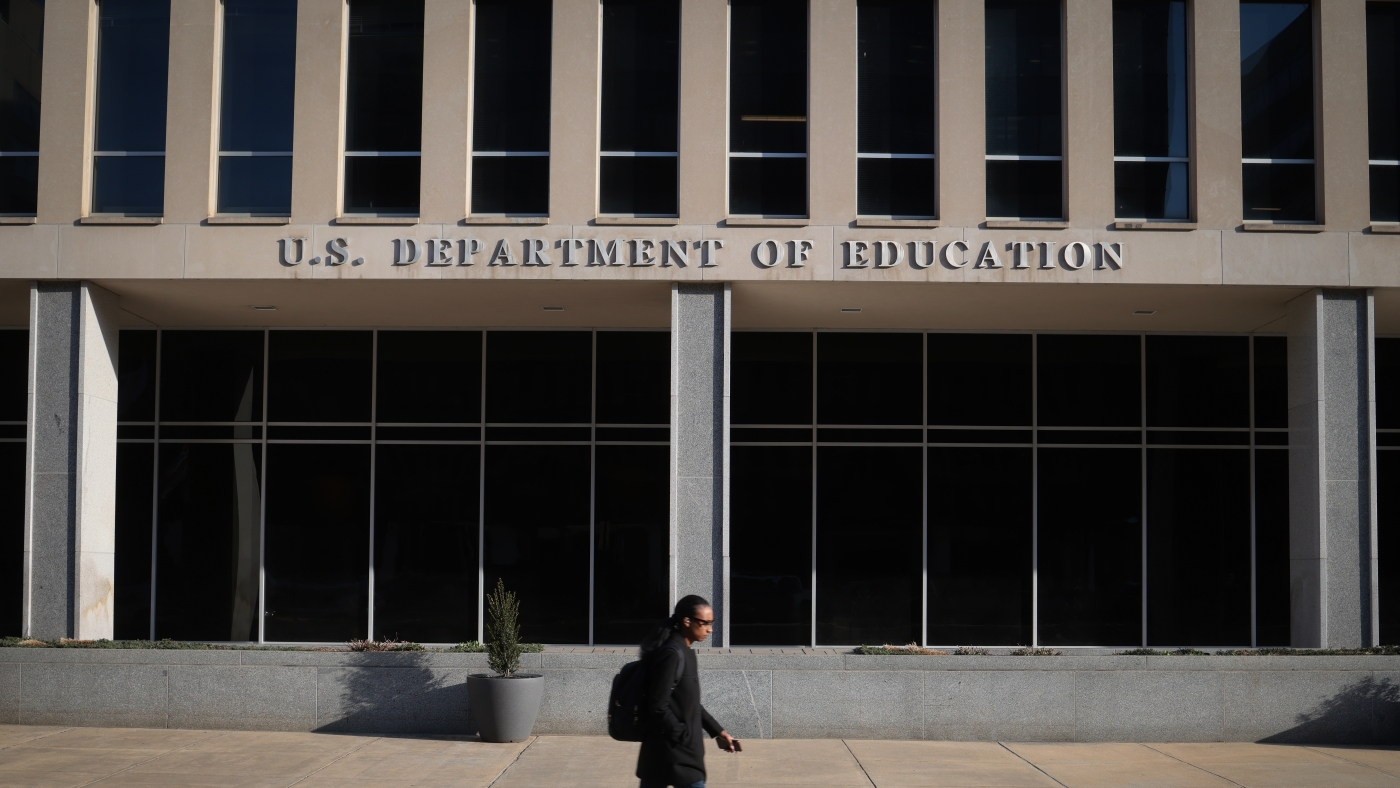
The Washington headquarters of the Department of Education on March 12. A federal judge ruled that the Trump administration violated the First Amendment rights of Education Department employees when it replaced their personalized out-of-office notifications with partisan language.
Win McNamee/Getty Images
hide caption
toggle caption
Win McNamee/Getty Images
A federal judge ruled that the Trump administration violated the First Amendment rights of Education Department employees when it replaced their personalized out-of-office e-mail notifications with partisan language blaming Democrats for the government shutdown.

“When government employees enter public service, they do not sign away their First Amendment rights,” U.S. District Judge Christopher Cooper wrote in his decision on Friday, “and they certainly do not sign up to be a billboard for any given administration’s partisan views.”
The lawsuit was brought by the American Federation of Government Employees (AFGE).
“This ridiculous ploy by the Trump administration was a clear violation of the First Amendment rights of the workers at the Education Department,” said Rachel Gittleman, the president of AFGE Local 252, which represents many Education Department workers, in a statement. She added it is “one of the many ways the Department’s leadership has threatened, harassed and demoralized these hardworking public servants in the last 10 months.”
Cooper ordered the department to restore union members’ personalized out-of-office email notices immediately. If that could not be done, he warned, then the department would be required to remove the partisan language from all employees’ accounts, union member or not.

According to court records, in the run-up to the government shutdown, Education Department employees were told to create an out-of-office message for their government email accounts to be used while workers were furloughed. The department even gave employees boilerplate language they could adapt that simply said:
“We are unable to respond to your request due to a lapse in appropriations for the Department of Education. We will respond to your request when appropriations are enacted. Thank you.”
But, on the shutdown’s first day, the department’s deputy chief of staff for operations overrode staffers’ personal messages and replaced them with this partisan autoreply:
“Thank you for contacting me. On September 19, 2025, the House of Representatives passed H.R. 5371, a clean continuing resolution. Unfortunately, Democrat Senators are blocking passage of H.R. 5371 in the Senate which has led to a lapse in appropriations. Due to the lapse in appropriations I am currently in furlough status. I will respond to emails once government functions resume.”
While the message was written in the first person, multiple employees told NPR they did not write it and were not told it would replace the out-of-office messages they had written.

At the time, Madi Biedermann, deputy assistant secretary for communications, said in a statement to NPR: “The email reminds those who reach out to Department of Education employees that we cannot respond because Senate Democrats are refusing to vote for a clean CR and fund the government. Where’s the lie?”
In his decision, Cooper lambasted the department for “turning its own workforce into political spokespeople through their official email accounts. The Department may have added insult to injury, but it also overplayed its hand.”
The department did not respond to an NPR request to comment on the ruling.
“Nonpartisanship is the foundation of the federal civil-service system,” Cooper wrote, a principle that Congress enshrined in the Hatch Act.
That law, passed in 1939, was intended to protect public employees from political pressure and, according to the U.S. Office of Special Counsel, “to ensure that federal programs are administered in a nonpartisan fashion.”


A massive 826,780-square-foot warehouse sits illuminated Feb. 12, 2026, in the El Paso suburb of Socorro, Texas, that was recently purchased by the U.S. Department of Homeland Security for $122.8 million.
Morgan Lee/AP
hide caption
toggle caption
Morgan Lee/AP
A federal appeals court on Tuesday allowed the Trump administration to resume carrying out speedy deportations of undocumented migrants throughout the United States, not just near the border.

A divided three-judge panel of the U.S. Court of Appeals for the District of Columbia Circuit threw out a lower court decision that temporarily blocked President Donald Trump’s expanded use of expedited removal. The ruling was a big victory for the Republican administration, which views the expansion of so-called expedited removal as a key tool for carrying out its mass deportation policy.
Expedited removal — quick deportation without a chance to appear before a judge — has previously been applied to migrants arriving by sea or caught at or near the border shortly after crossing.
In January, Trump expanded its use to undocumented migrants all over the United States. Immigration agents began whisking migrants away from courthouses where they had gone for immigration proceedings and then removing them from the country within days.
“The Trump administration’s push for fast-track deportations will subject people to an unfair and error-prone system,” Anand Balakrishnan, senior staff attorney with the ACLU’s Immigrants’ Rights Project, said in a statement.
Balakrishnan represented plaintiffs in arguments before the appellate panel and said its ruling “undermines the fundamental principle that people receive due process when the government seeks to deport them.”

DC Circuit Judge Justin R. Walker, one of the judges on the panel, said the plaintiffs had not shown the expanded use of expedited removal violated due process rights. Immigrants received notice of removal proceedings and were given a chance to respond, he wrote in his opinion.
Walker and the second judge in the majority, Neomi Rao, were appointed by Trump. The third judge on the panel was appointed by President Barack Obama, a Democrat.
Walker said there was no requirement that the administration inform immigrants that they can avoid expedited removal if they can show they have been in the United States for more than two years.
“The constitutional requirement is notice of the action the government is taking and the grounds for it, plus an opportunity to respond,” he wrote, adding that the plaintiffs’ “contrary reasoning would require immigration officers to provide what amounts to legal advice.”
Walker and Rao vacated an order by U.S. District Judge Jia Cobb that put the expanded use of expedited removal on hold. Cobb, who was appointed by President Joe Biden, a Democrat, ruled in August that the administration had not developed procedures to ensure migrants were not wrongly deported under the expedited process.

The plaintiffs had put forward “substantial evidence” that the expedited removal process, on the contrary, carried a high risk of error when applied more broadly, Cobb said. The ruling cited examples of people who had lived in the U.S. for far longer than two years but were still ordered to be removed in expedited proceedings.
In his opinion, Walker acknowledged evidence of such errors, but said they resulted from “individual officers’ failure to follow the law — not defects in the written directives under review or the procedures they incorporate.”
The Trump administration has argued that its expansion of expedited removal includes protections to prevent arbitrary removal. In a court filing in October, Justice Department attorneys said Cobb’s ruling was an “egregious error” that was depriving the administration of an “essential tool to combat the unprecedented surge of illegal immigration over the past few years” and efficiently deport potentially millions of people.

Just over 50 career and political intelligence staff at the Office of the Director of National Intelligence have been removed from their roles since Bill Pulte became the agency’s acting director, Friday.
Six career and political intelligence staff were terminated and 45 were sent back to their home agencies, according to three sources familiar with the personnel moves.
Pulte has been asking deputies and other directors for suggestions about cuts. Some of the ODNI deputies pushed for more cuts, but Pulte said that the 51 was enough for now, one of the sources said.
One source characterized the cuts as thoughtful and methodical. No staffers have been removed from the counterterrorism group.
No further firings are planned for now, two of the sources said.
The cuts follow hundreds of staff reductions last year by former Director of National Intelligence Tulsi Gabbard, who stepped down last week. Last year’s planned downsizing sought to bring the office’s headcount from 2,000 to around 1,300.
President Trump has pushed for further cuts, directing Pulte to “execute the immediate and needed downsizing of the office” in a Truth Social post earlier this month.
The office is charged with overseeing the country’s intelligence agencies and helping them coordinate with each other. It was created in response to the Sept. 11, 2001, terrorist attacks, which investigators widely believe was preceded by a failure of intelligence agencies to share information.
Since then, Gabbard and some lawmakers have argued the ODNI has become bloated and has added more bureaucracy to the intelligence community — worsening a problem it was created in part to resolve.
Republican Sen. Tom Cotton of Arkansas, who chairs the Senate Intelligence Committee, said earlier this month the office has “grown far beyond its original mandate.” Many of the office’s staff hail from other intelligence agencies but have been detailed to ODNI, and Cotton argued large numbers of them should be returned to their “home agencies.”
Sen. Mark Warner and Rep. Jim Himes, the top Democrats on the Senate and House intelligence panels, warned Pulte against making large-scale staff cuts, calling it an inappropriate course of action for an acting official without national security experience.
“While there is room to consider responsible reductions to ODNI’s workforce, any large cuts would follow on a substantial downsizing that has already occurred in 2025 and risk jeopardizing the mission of an organization explicitly created after 9/11 to prevent any future such terrorist attack,” the two Democrats wrote in a joint statement.
After Gabbard announced in May that she would resign from the post, Mr. Trump said he would install Pulte, a housing finance official, as acting director of national intelligence. He later nominated Jay Clayton, the top federal prosecutor in Manhattan, to serve as Senate-confirmed director.
Mr. Trump’s pick for acting director of national intelligence, who assumed the role on Friday, has sparked intense pushback in Congress. Democrats, and some Republicans, questioned the selection due to his lack of national security experience.
Democratic Rep. Jason Crow of Colorado said Sunday he’s worried that “Americans are at risk” with Pulte serving as DNI “because we have someone who’s incompetent at the head of this agency,” in an interview on “Face the Nation with Margaret Brennan.”
In addition to Pulte’s lack of national security experience, Democrats have railed against the pick for his role in investigations into Mr. Trump’s political foes. Crow, who serves on the House Intelligence Committee, said he’s “obviously concerned that this is somebody who’s a political attack dog, and his single biggest qualification is that he’s loyal to Donald Trump and is willing to go after Donald Trump’s enemies.” But he said more immediately, he’s concerned about Americans’ safety.
“This is a really important position. This sits atop our intelligence agencies, and by law, Congress mandated that this person have significant intelligence experience because they have to make sure that we’re keeping Americans safe, which is not what Bill Pulte is capable of doing,” Crow said.
Since Pulte’s selection, Democrats have declined to extend Section 702 of the Foreign Intelligence Surveillance Act, which grants intelligence agencies broad authority to spy on overseas targets, causing the legal provision to expire earlier this month.
And as Senate GOP leaders tried to bring an end to the impasse by moving to quickly confirm Clayton as permanent director of national intelligence, the president abruptly called for Clayton’s confirmation hearing to be canceled last week.
Talks on extending FISA Section 702 were already strained, with some members of both parties pushing for stricter guardrails and arguing the program can scoop up Americans’ communications without a warrant. Intelligence officials say the program is essential to national security.
Asked whether Democrats have miscalculated, Crow said “not at all.”
“I know how important it is, but I’m unwilling to trade Americans’ constitutional rights, privacy and essential civil liberties for temporary extension to this program,” Crow said.
Republican Sen. Lindsey Graham of South Carolina said on “Face the Nation” that “any Democrat that shuts down FISA at a time of great peril for the United States is making a huge mistake.”
“We’re playing with fire here, no matter what side does it,” Graham said. “America needs FISA up and running.”

Andrea (left), Pablo (center), and Martin Langesfeld (right) hold a photograph of their daughter and sister, Nicky Langesfeld and her husband Luis Sadovnic, at a park in Doral, Fla., where the city named a street Nicky Langesfeld Place to honor her memory, Martin says, “as a reminder that she’ll be here with us forever.” Nicole “Nicky” and Luis were two of the 98 people killed when the Champlain Towers South condominium building collapsed in Surfside on June 24, 2021.
Meredith Nierman/NPR
hide caption
toggle caption
Meredith Nierman/NPR
SURFSIDE, Fla. — Just around the corner from where a beachfront condominium collapsed five years ago, there’s a makeshift memorial: a plastic banner strung up on a wood frame, with the names of the 98 victims, ranging in age from a year-old infant to a 92-year-old grandmother.
“It’s an unfortunate reminder of how big this tragedy was,” says Martin Langesfeld, locating the name of his sister Nicky, 26, and her husband Luis Sadovnik, 28. “It’s more than just names. It’s stories. It’s families.”
Two-thirds of the 12-story Champlain Towers South building collapsed just after 1 a.m. on June 24, 2021. It started when the pool deck caved in. Seven minutes later, as many of the occupants were sleeping, the tower began to fall.
Five escaped, and three were rescued from the rubble with severe injuries by first responders. Search teams evacuated residents in the remaining part of the building, which was demolished 10 days later for safety reasons.

Search and rescue personnel work in the rubble of the 12-story, beachfront Champlain Towers South condominium that crumbled to the ground on June 24, 2021 in Surfside.
Joe Raedle/Getty Images
hide caption
toggle caption
Joe Raedle/Getty Images
Hundreds were left without a home and belongings, and the state was forced to grapple with how it regulates structural safety.
Langesfeld is among those who’ve been pushing to improve what they consider a lax system of building oversight. His sister and brother-in-law were newlyweds, who had moved into the condo together just a few months earlier.
“A dream place, home, where you feel you’re safest is where they were killed,” he says.
He’s also frustrated there is no permanent memorial honoring the victims, while a new luxury condo is going up on the land where Champlain Towers once stood.
“It’s been almost five years and there’s no development for the memorial,” he says. “And the development for the new building is very well underway.”

The North Tower of the Champlain Towers condominium complex stands on April 27, overlooking the vacant site where its sister building, Champlain Towers South, collapsed on June 24, 2021. The collapse resulted in 98 deaths and remains one of the largest structural failures in U.S. history. A new luxury condominium complex, the Delmore, is slated for construction on the empty lot.
Meredith Nierman/NPR
hide caption
toggle caption
Meredith Nierman/NPR
Technical findings released Monday by the National Institute of Standards and Technology concluded the problem started about three weeks before the collapse when two connections between garage columns and the pool deck failed, causing cracks to grow and loads to shift to connections that were not strong enough to support them.
Investigators found “severe and widespread deviations in the building’s original structural design from the codes and standards of the day,” and that the building’s construction in 1981 deviated from the design drawings. Investigators will issue a final report later that includes recommendations for changes to standards, codes and practices to improve building safety.
To date, no one has been held criminally responsible.
But in a complex civil lawsuit, more than 30 defendants contributed to a $1.2 billion class action settlement reached just a year after the collapse to address wrongful death, personal injury and property loss claims.
“I think what was apparent to all parties, legal parties, is that it was an enormous loss,” says Coral Gables attorney Rachel Wagner Furst, co-lead counsel representing the Surfside victims.

None of the settling parties admitted liability or wrongdoing, but Wagner Furst says the litigation pointed to many factors that contributed to the scope of the disaster beyond the condo board, which was singled out in the initial lawsuit for not heeding warning signs and deferring repairs on the 40-year-old building.
She notes, “Companies and individuals who had serviced the Champlain Towers South condominium building in the years before the collapse that had arguably or allegedly failed in some way to provide proper maintenance advice or counsel, including the security company that had staffed the front desk of the building and was on duty at the time that the alarm ought to have sounded.”

Attorney Rachel Wagner Furst served as co-lead counsel for the plaintiffs in a class-action lawsuit for the victims of the Champlain Towers South collapse in Surfside, which resulted in a $1.2 billion settlement.
Meredith Nierman/NPR
hide caption
toggle caption
Meredith Nierman/NPR
The Surfside collapse was a wake-up call for condo associations and regulators around the country.
In the immediate aftermath in South Florida, some two dozen properties were evacuated for safety concerns. Most eventually were able to return after repairs.
The state responded by passing more stringent regulations, including new mandates for structural inspections and requiring condo associations to maintain a minimum level of reserve funding for structural upkeep.
“The Florida legislature pushed the burden to create safe housing stock in Florida onto the people who are least able to bear it, which is the Florida consumer,” says Ft. Lauderdale attorney Donna DiMaggio Berger who specializes in condominium law, and founded a group that lobbies on behalf of the more than 50,000 community associations in Florida.
She says developers also should share in the burden.
“If we wind up with the safest housing stock in the country. Bravo, well done,” she says. But “safe buildings start with the people who build them and repair them.”

Construction cranes line the skyline along the beach in Surfside, Fla., on April 27.
Meredith Nierman/NPR
hide caption
toggle caption
Meredith Nierman/NPR
No matter how well-intentioned, the building reforms could have unintended consequences, says Miami-Dade County Mayor Daniella Levine Cava.
She says some buildings have been taken over by people who want to turn them into more expensive, luxurious developments.
“There’s tremendous pressure that people can’t afford these things and so they’re forced to sell,” she says. “We call it ‘condo vultures,’ and it is at our peril.”
Levine Cava says she understands that people want to live “the good life” in South Florida, but there must be balance.
“We know we live in paradise,” she says. “We also know that we need to have people of all means in our community.”

Miami-Dade Mayor Daniella Levine Cava says her community was severely changed by this tragedy, “the pain is still very real. Many people have moved on with their lives and others are still suffering greatly.”
Meredith Nierman/NPR
hide caption
toggle caption
Meredith Nierman/NPR
That’s long been the conundrum in Florida, a trend that accelerated during the COVID-19 pandemic when people flocked to the Sunshine State.
And it’s evident in Surfside, just north of Miami Beach, which is becoming an ultra-wealthy enclave with a wall of condos lining the Atlantic, and more under construction. The area is adjacent to swanky shopping malls and private islands where tech titans have waterfront estates.
The Champlain Towers South property itself is soon to be home to the community’s latest luxury development, The Delmore. Billed as “expansive mansions in the sky,” the sales price of the units starts at $15 million; penthouses go for more than $150 million.
“Each penthouse has its own private pool, and that’s a glass-fronted pool that gets the view to the ocean,” says developer Jeffery Rossely, pointing to the layout on a scale model in a posh sales gallery.

Jeffery Rossely, a developer at the Dubai-based firm Damac Properties, points to a model of a luxury property called The Delmore.
Marisa Peñaloza/NPR
hide caption
toggle caption
Marisa Peñaloza/NPR
Rossely is with Damac Properties, a Dubai-based firm. This is the company’s first residential project in the U.S. Damac was the only bidder with a $120 million cash offer for the property.
“It was obviously at the time a tragic opportunity, but the courts had already ordered sale of the property,” Rossely says. “The money was required to compensate the victims.”
But the project has not received a warm welcome in Surfside. At town meetings he says his company has been accused of having blood on its hands.

A sign welcoming visitors to Surfside, Fla., stands directly across the street from the former site of the Champlain Towers South condominium. Today, a new luxury residential development called The Delmore is under construction on the empty lot where the tower once stood.
Meredith Nierman/NPR
hide caption
toggle caption
Meredith Nierman/NPR
“I didn’t understand why there would be angst for someone coming in and paying that money upfront,” says Rossely.
But in retrospect, he concedes, the project needed a different approach.
“We should have spent a bit more time on due diligence, on community reaction, rather than on the physical property itself,” Rossely says. “We went through what I would call the traditional due diligence. Maybe we should have gone through emotional due diligence, as well.”
The question now is whether people will want to live in the new building. There are no buyers yet in the pre-sale phase.
Meanwhile, the town of Surfside will light a torch at 1:15 a.m. on Wednesday, just outside the development’s fence, to remember the Champlain Towers South victims five years after the collapse.
-
News3 minutes ago
Appeals court allows Trump administration expanded use of speedy deportations
-

 Los Angeles, Ca1 hour ago
‘What’s going on with our society?’ Elderly L.A. street vendor violently beaten
-

 Detroit, MI2 hours ago
Trailblaze Detroit: Blazing New Trails while Backpacking Metro Detroit | Visit Detroit | Visit Detroit
-

 San Francisco, CA2 hours ago
Giants open to moving big names before Trade Deadline
-

 Dallas, TX2 hours ago
Reports: Mavericks acquire Sergio De Larrea in four-team Draft night trade
-

 Miami, FL2 hours ago
Miami Gardens police make arrest in cold case murder from 2019
-

 Boston, MA2 hours ago
Woman killed in Mattapan carjacking crash honored at vigil
-

 Denver, CO2 hours ago
Nuggets trade 26th pick in NBA Draft to Spurs, moving out of first round

