News
Is getting food delivered worse for the climate? Sometimes it’s better


Micaeli and Gerhard du Plessis sometimes use a grocery delivery service, as well as prepackaged meal kits, and they get takeout delivered to their suburban Washington, D.C., home about once a week. With two full-time jobs and two children, it makes time-saving sense. But they’ve wondered how it affects their carbon footprint.
Ryan Kellman/NPR
hide caption
toggle caption
Ryan Kellman/NPR
Climate change is affecting our food, and our food is affecting the climate. NPR is dedicating a week to stories and conversations about the search for solutions.
There’s a whiteboard on the refrigerator in the du Plessises’ kitchen that the couple uses to plan dinners for the week — what to make and who will do the cooking. But with two young children, full-time jobs and the nearest supermarket 20 minutes away, figuring out what to eat sometimes feels like a chore.
To lighten the load, Micaeli and Gerhard du Plessis regularly use a grocery delivery service. They’ve also tried prepackaged meal kits and they get takeout delivered to their suburban Washington, D.C., home about once a week.
“Obviously, we’d rather be able to go out and buy fresh stuff every day, but that’s not realistic right now,” Micaeli says, as she holds her youngest, Eva, in a baby sling and unpacks boxes that have just arrived by Instacart. “With two little kids … at Costco, it’s just a really unpleasant experience. So I’d much prefer to pay someone a few extra dollars to just deliver it for us.”


America’s appetite for online grocery sales soared more than 50% during the COVID-19 pandemic, from $62 billion in 2019 to $96 billion in 2020, according to the U.S. Food and Drug Administration. One in five consumers now has groceries delivered to their door at least once a month. By 2029, Statista estimates, the market will be worth $455 billion.
Meanwhile, there’s been a steep increase in demand for restaurant takeout via such services as DoorDash and Uber Eats. Meal kits like HelloFresh and Home Chef, which come with premeasured ingredients, are also experiencing strong growth.

An Uber Eats delivery courier rides an electric bicycle through the Park Slope neighborhood of the Brooklyn borough of New York.
Amir Hamja/Bloomberg via Getty Images
hide caption
toggle caption
Amir Hamja/Bloomberg via Getty Images
At the same time, food production and transportation make up as much as one-third of a typical U.S. household’s annual contribution to climate change-inducing emissions. The U.S. Department of Agriculture estimates that 30% of food produced in the U.S. is wasted. And once in landfills, rotting food creates methane — a potent gas that heats the Earth. So, changing consumer behavior to minimize waste and reduce transportation could have a significant impact on the overall pollution that is fueling climate change.
“It’s crossed my mind,” Micaeli says about the environmental impact. “Unfortunately, it’s one of those things like Maslow’s Hierarchy of Needs. It’s like we have to meet our basic needs before we can be concerned about things like that.”
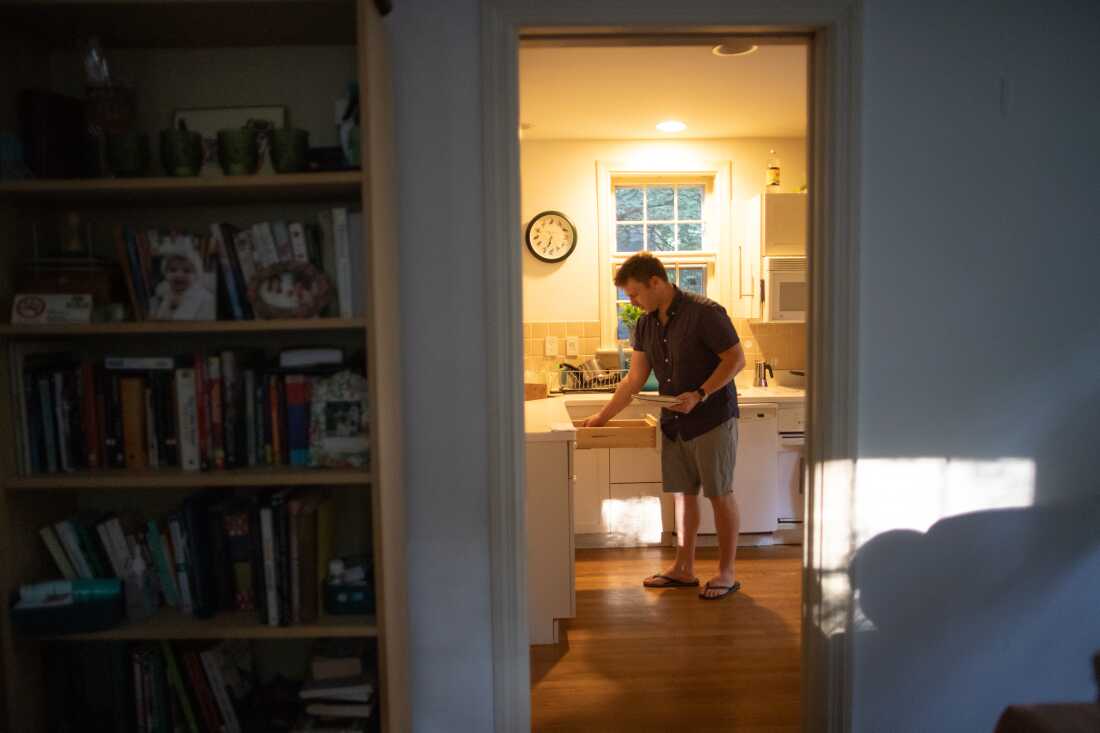
Gerhard du Plessis grabs a dinner plate while preparing to eat the Thai food he ordered for delivery.
Ryan Kellman/NPR
hide caption
toggle caption
Ryan Kellman/NPR
In 2022, researchers from the University of Michigan and Ford Motor Co. modeled a single 36-item grocery cart to compare greenhouse emissions from an e-commerce grocery delivery and a traditional trip to the store to get the same items. Gregory Keoleian and colleagues at the university’s Center for Sustainable Systems found that using an electric vehicle to pick up groceries could cut emissions by as much as half, compared to a gas-powered vehicle.
They also found that home delivery could be an even better option. That’s because with a delivery vehicle, orders are often clustered, with a driver dropping off not just your groceries, but also hitting neighbors during the same run. “Delivery is actually going to be more efficient in general than driving yourself in a gasoline SUV to the store to pick up your groceries,” Keoleian says.
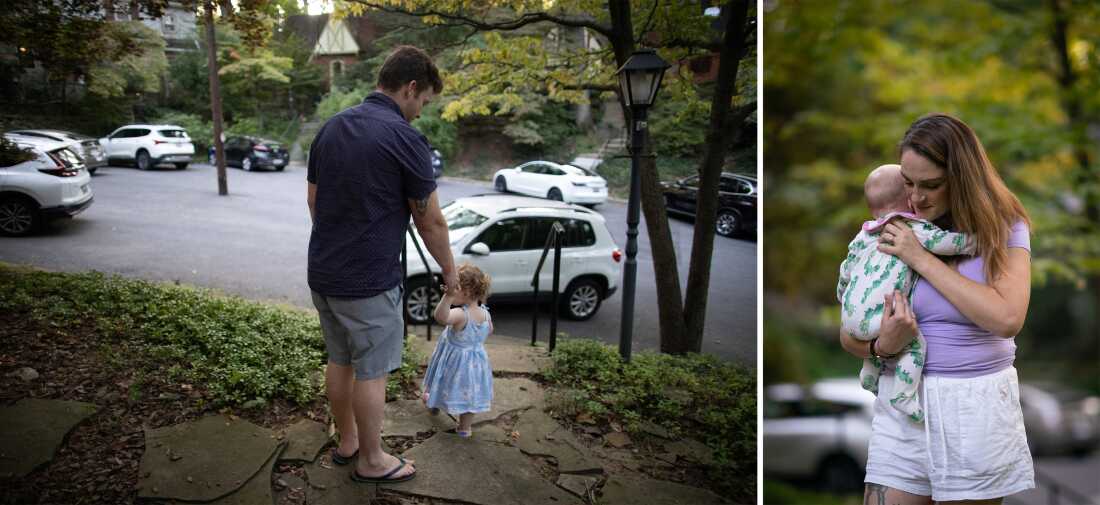
After waving goodbye to the delivery person, the du Plessises’ children wait outside with their parents.
Ryan Kellman/NPR
hide caption
toggle caption
Ryan Kellman/NPR
Meal kits versus cooking from scratch
In Sonora, Calif., Scott Jones, his wife and elderly father have made extensive use of HelloFresh. One of the company’s meal kits that is designed to feed two people works out “absolutely perfect [with] very little waste” for the three of them, he says. He’s also impressed with the packaging, much of which is compostable or recyclable.

Still, he’s a bit worried about the size of the carbon footprint such meal kits might produce, a concern echoed by the du Plessis family.
“I think the worst would probably be the meal kits,” Micaeli says. “Yeah, with all that packaging,” her husband, Gerhard, agrees.
In fact, a 2019 study found that, comparatively, meal kits could be one of the best options for lower greenhouse gas emissions. Shelie Miller and a group of researchers from the University of Michigan’s School for Environment and Sustainability compared the carbon footprint of meal kits with the same recipes sourced from a grocery store. She and her colleagues looked at emissions for each meal caused by food waste and packaging, and the supply chain structure.
The meal kits “did have more packaging overall and more impact associated with that packaging,” Miller says. “But what we really saw was that the meal kits had more efficient use of food.”
On average, the greenhouse gas emissions for a meal made with ingredients purchased at a grocery store are 33% higher than a comparable prepackaged kit, the study found.
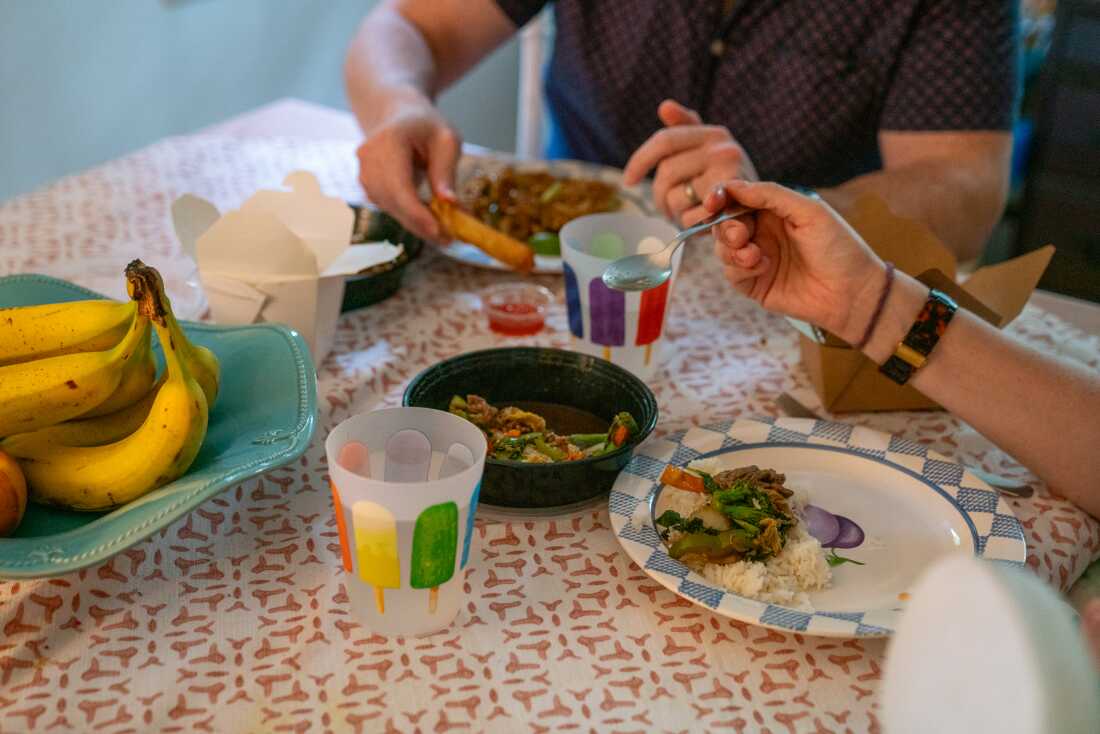
The du Plessises sit down to eat the Thai food they had delivered for dinner.
Ryan Kellman/NPR
hide caption
toggle caption
Ryan Kellman/NPR
The reason? When we cook from scratch, we tend to buy more ingredients than we need. Some of that goes to waste, Miller says. And leftovers get shoved to the back of the refrigerator and forgotten.
Case in point: At the du Plessis household, Gerhard says finishing up leftovers is a “50-50” proposition. “If you want to look in the fridge, there’s just Tupperware full of leftovers from last night and the night before” that might never get eaten, he says.

But shopping at a farmers market can help offset the carbon footprint of cooking from scratch, says Jury Gualandris, a professor at Western University’s Ivey Business School in Ontario, Canada, who studies food waste in supply chains. In one research paper, he and co-author Sourabh Jain consider the sustainability of individual consumer choices at a supermarket or farmers market compared to those made by a meal kit provider.
“When you cook your own meal, if you do it by sourcing materials that are grown locally, then you will cut the carbon footprint by a substantial amount …” Gualandris says.

Zelda leans in for help with a bite from her father.
Ryan Kellman/NPR
hide caption
toggle caption
Ryan Kellman/NPR
E-bikes, drones and robots deliver a smaller carbon footprint
When it comes to delivery services like DoorDash, Uber Eats and Grubhub, Gerhard du Plessis theorizes that “because this guy’s literally delivering two burgers and like two sodas,” such options would have a big footprint. “For the volume of food compared to the amount of carbon emitted, yeah, the equation doesn’t quite add up.”
Unlike grocery deliveries, it’s difficult to coordinate multiple drop-offs in a single vehicle, according to William Rose, an associate professor of supply chain management at Iowa State University.
A driver typically picks up an order quickly and, in the case of takeout food, ideally gets it to the customer while it’s still hot, Rose says. It becomes “impossible to cluster those deliveries,” he says — unless people who live near each other decide at the same time to order from the same restaurant or eateries within close proximity.
But there are ways to reduce the heavier carbon footprint even for this type of delivery.
E-bikes can save a lot on emissions and they are substantially cheaper to operate compared to automobiles. Keoleian says the study he worked on also looked at emerging technologies such as drones and sidewalk robots, finding that they could significantly reduce carbon emissions on small deliveries, such as restaurant takeout.
But he is quick to point out that the “last mile” of a delivery accounts for only about 10% of the greenhouse gases in the food supply chain. A much bigger factor is the type of food we eat, and “about a quarter to a third of the emissions are due to the food waste.”
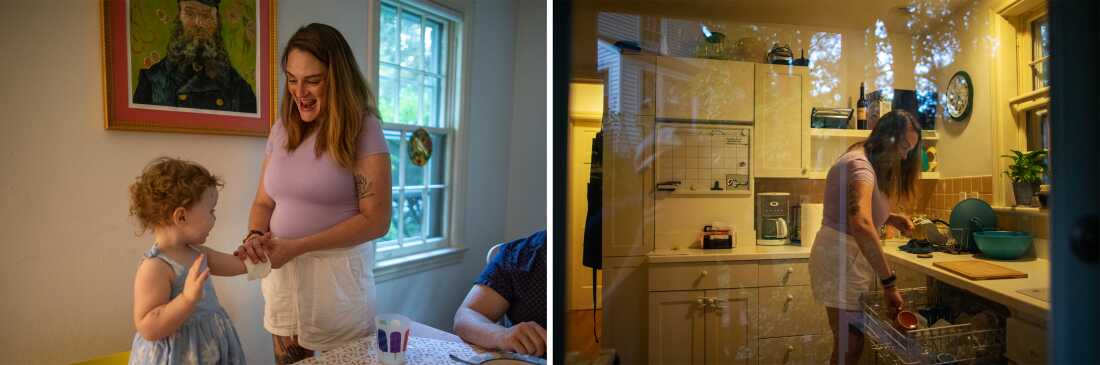
Zelda gets a temporary tattoo as a treat after dinner. Later, pictured at right, Micaeli loads dishes into the dishwasher.
Ryan Kellman/NPR
hide caption
toggle caption
Ryan Kellman/NPR
Key takeaways for ordinary consumers
For any type of delivery, sedans are better than SUVs, which are better than pickup trucks, Keoleian says. Bundling a grocery run with other errands or the work commute is another good strategy to reduce your footprint.
But these options aren’t for everyone. Meal kits and food delivery can be more expensive and aren’t affordable for everyone. And yet, they can also be indispensable.
It wasn’t the pandemic but a serious accident that changed Halima Jenkins’ shopping habits. About a decade ago, she fell down a flight of stairs and now, she says, “I have days where I can’t drive. I have days where I can’t move.”
Her daughters don’t drive yet, and her husband doesn’t always have time to shop. So grocery delivery has become the norm in their Hyattsville, Md., home. The family also gets restaurant food delivered by DoorDash or Uber Eats once or twice a week.
“There are days where I just feel like existing is profoundly difficult,” Jenkins says. “I’m happy to just have something delivered depending on how capable I am that day.”
So, what are the simple takeaways for ordinary consumers?
If meal kits fit your lifestyle, they may be the most climate-conscious choice. The packaging might put you off, but you’re less likely to waste food.
When it comes to groceries, delivery via a service like Instacart may be a better option for the environment compared to driving to the store, unless you can bundle grocery runs with your work commute or other errands.
Limiting restaurant takeout via DoorDash or Uber Eats also will help reduce your carbon footprint. But with these services, the mode of delivery makes a difference. In a busy city, where the driver uses an e-bike or electric car, the footprint of the service will be significantly less than a meal brought to you in a gasoline-powered vehicle.


At least about two dozen people have died amid the perilous climate crisis-driven heatwave that has scorched swaths of the US with record temperatures.
As a huge heat dome sits over the county’s eastern half, extreme heat gripped millions of people in the days leading up to the US’s semiquincentennial on Saturday – and beyond it. More than 20 states experienced have reported stifling temperatures more than 100F (38C), marring celebrations. And more than 140 million people remained under active heat alerts across the US on Sunday.
Officials in New Jersey believe the extreme heat was a factor in the deaths of 22 people across 10 counties there, mostly in central and northern parts of the state. Many of the individuals were found in homes with no air conditioning, outside their residences, on the street and in parked cars, according to officials.
The first of those deaths occurred on Thursday, and the ages of the deceased in question mostly range from their mid-30s to their 80s. Preliminary findings cause investigators to believe the deaths are heat-related, though the chief state medical examiner for New Jersey would later determine the exact cause of death for each.
“This is not a typical summer heatwave,” the New Jersey department of public health said in a statement. “This type of heat can quickly become life-threatening to humans and to animals of all ages.”
The National Weather Service (NWS) has said cool air from the north in the coming days is going to lower some of the most extreme temperatures in the region, including New Jersey. The Fifa World Cup final is scheduled to be held in the New Jersey city of East Rutherford on 19 July.
Elsewhere, a heat-related death was reported in Cook county, Illinois, Natalia Derevyanny, a government spokesperson, told NBC News. The cause of that death was recorded as organic cardiovascular disease – with heat stress as a contributing factor.
Hinds county in Mississippi reported the death of 74-year-old Mitchell Ray Cooley due to heat exposure on Thursday, state officials said. Cooley had been reported missing, and his body was found the next day behind a gas station, the county coroner said in a statement.
“Mr Cooley suffered from a medical condition that impaired his judgment,” the coroner’s office said. “Based on the investigative findings, scene examination, and subsequent evaluation, the cause of death has been determined to be weather-related heat exposure. At this time, there is no indication of foul play.”
Meanwhile, on 27 June, Martha Irene Van Egmond, 83, died in Bolton, Mississippi, after falling in her garden. When her husband, Rick, tried to help her up, he fell too. The couple were unable to get up and spent hours in the heat.
Rick Van Egmond said he and his wife called out for help, and eventually two men from a nearby apartment complex came – but it was too late for Martha. She died surrounded by flowers, doing what she loved, he said to local news outlet WAPT.
Jeramiah Howard, Hinds county’s chief death investigator, attributed her death to the heat combined with her age, WAPT reported.
after newsletter promotion
As Donald Trump spoke during rain-dampened celebrations in Washington DC on Saturday, emergency services there had treated 51 people with heat-related issues as of 8pm ET, with 12 taken to nearby hospitals, according to local emergency response officials.
Other events scheduled for Saturday – including the Independence Day parade in DC – were cancelled amid the blistering heat. Among other weather-related disruptions, Trump’s so-called Great American State Fair on the National Mall also temporarily closed down on Friday after reports that 44 visitors had been treated for heat-related illnesses.
The worst of the heat started moving out of the US’s north-east and midwest regions by Sunday, shifting farther south into the mid-Atlantic and south-eastern parts of the country.
But scientists warn that heatwaves with extreme temperatures are indications that the world must lower the greenhouse gas pollution driving the global climate crisis.
The NWS is urging the public to avoid heat sickness by drinking plenty of fluids as well as staying out of the sun and in air-conditioned environments. Officials have also asked people to check on relatives and neighbors.

Rep. Nancy Pelosi, D-Calif., and her husband Paul arrive at the funeral services for Clive Davis at Central Synagogue in New York, Monday, June 29, 2026.
Adam Gray/AP
hide caption
toggle caption
Adam Gray/AP
LOS ANGELES — The husband of former House Speaker Nancy Pelosi was involved in a hit-and-run in California that left a parked car with “major” damage authorities said Saturday, and he could face misdemeanor charges.
Paul Pelosi was driving his brown convertible Friday in Yountville, a town in the heart of wine country, when he struck a legally parked car on the side of the road, briefly stopped and then drove away, the Napa County Sheriff’s Office said in a statement. No injuries were reported.

A witness saw the collision and called 911. Shortly afterward sheriff’s deputies found Pelosi with damage to the front of his car on a road roughly a quarter of a mile away. He reportedly told officers he knew he hit something but was not sure when or what caused the damage.
Pelosi, 86, did not have any alcohol in his system, according to the statement. The sheriff’s office referred him to the Department of Motor Vehicles for a process to determine whether he may continue to drive — something that officials say is common for older drivers.
Pelosi was not arrested, and because no one was injured, the sheriff’s office recommended a misdemeanor charge for fleeing the scene of an accident.
A staffer for Nancy Pelosi did not immediately respond to an email seeking comment.
Paul Pelosi pleaded guilty in 2022 to misdemeanor charges of driving under the influence in Napa County and was sentenced to five days in jail and three years of probation. However, he served only two days in jail and received good conduct credit for two other days, leaving just one day to serve in a work program at the courthouse.
As part of his probation, Pelosi was required to attend a three-month drinking driver class and install an ignition interlock device, which forces drivers to provide a breath sample to prove sobriety before the engine will start. He also was ordered to pay about $5,000 in victim restitution for medical bills and lost wages, along with nearly $2,000 in fines.
That same year he was attacked and severely beaten with a hammer at the couple’s San Francisco home.

WASHINGTON (7News) — The thousands of people attending the Great American State Fair and other areas around the National Mall are being ordered to evacuate as stormy weather approaches.
The National Weather Service previously announced a Severe Thunderstorm Warning in the District. Officials are asking attendees to seek shelter.
SEE ALSO: Historic Fourth of July fireworks to light up National Mall: How to watch live
The DC Homeland Security & Emergency Management released a list of places where the crowds can go to get out of the weather:
Federal Buildings:
- Ronald Reagan Building – 100 Pennsylvania Ave NW
- Dept. of Commerce – 1401 Constitution Ave NW
- Dept. of Agriculture – 1400 Independence Dr SW
- Dept. of Education – 400 Maryland Ave SW
- Internal Revenue Service – 1111 Constitution Ave NW
- Voice of America – 330 Independence Ave SW
- Thomas Jefferson Memorial – 16 E Basin Dr SW
Museums:
- National Museum of American History – 1300 Constitution Ave NW
- National Museum of Natural History – 1000 Constitution Ave NW
- National Museum of African American History and Culture – 1400 Constitution Ave NW
Freedom 250 organizers released this statement:
“The safety of our guests, performers, and staff is our top priority. Due to approaching severe storms, Freedom 250, United States Secret Service, United States Park Police, National Park Service, the Federal Emergency Management Agency, and all public safety partners are asking all guests to evacuate event grounds and seek temporary shelter in a nearby building. Available shelter locations include the Department of Commerce, Department of Education, Department of Agriculture, Internal Revenue Service, VOA Building, Thomas Jefferson Memorial, National Museum of American History, National Museum of Natural History, the African American Museum, and the Ronald Reagan Building. Please remain calm, follow the directions of law enforcement and event staff, and stay tuned to Freedom 250’s official channels for updates. Freedom 250 will share updates on programming and doors reopening — please stay close to our official channels for updates.”
The Secret Service said they have suspended screening on the National Mall.
“Security screening on the National Mall has been suspended due to dangerous storms,” the Secret Service said. “If you are already on the grounds, follow directions from officers and event staff and move to shelter immediately. Do not shelter under trees.”
BE THE FIRST TO COMMENT
Metro riders are also asked to seek shelter. Commuters should expect heavy crowds at stations near the National Mall and are asked to consider using L’Enfant Plaza, Metro Center, Archives, Federal Triangle or Federal Center SW stations to avoid congestion.
-

 Pittsburg, PA1 minute ago
Sinkhole closes portion of road near UPMC Passavant hospital
-

 Augusta, GA8 minutes ago
Coroner investigating inmate death from Charles B. Webster Detention Center
-

 Washington, D.C11 minutes ago
Celebration to suffocation: Washington’s air turns world’s worst after July 4 fireworks extravaganza
-

 Cleveland, OH16 minutes ago
White Sox vs. Guardians game delayed due to rain Sunday 7/05/26
-

 Austin, TX23 minutes ago
Two found dead as deputies investigate double homicide at Travis County gentlemen’s club
-

 Alabama26 minutes ago
Alabama AME Bishop on Redistricting: “The Role of Black Church is to Be the Guardian of Democracy.”
-

 Alaska31 minutes ago
The Dan Sullivan saga in the Alaska Senate race is under investigation, sources say
-
 Arizona38 minutes ago
Fiery crash on Loop 202 in Tempe under investigation

