News
Hurricane Milton 2 AM Update


SARASOTA, Fla. (WWSB) – The National Hurricane Center’s latest cone shows Milton’s track has stayed on course.
Here is what is new from the update: The 2 a.m. advisory from the National Hurricane Center reports Milton continues to intensify. It has the center of Hurricane Milton moving to the east at 6 mph. Sustained wind speeds remain at 90 mph and the pressure has dropped by 2 mb to 975 mb.
The track remains nearly the same, but the satellite view shows the eye beginning to develop. Milton is expected to become a category 4 storm in the far Gulf waters before running into shear. That should weaken it to a category 3 hurricane by the time it makes landfall on the west coast of Florida on Wednesday, as a major hurricane capable of life-threatening impacts.
All preparations should be completed no later than Tuesday afternoon.
Areas of heavy rain will impact Florida in advance of the storm’s arrival. Hazards include storm surge, dangerous winds, heavy rains, possible tornadoes, and more.
Expect watches and warning to be issued for Florida later today. Mandatory evacuations will begin after 2 p.m. for level A and B in Manatee County, level A in Sarasota County, and all mobile homes and recreational vehicles in both counties.
Copyright 2024 WWSB. All rights reserved.



Federal judge Paul Friedman seemed skeptical of the new press policy implemented by the Pentagon last week, calling aspects of it “weird” and Kafkaesque.
Friedman struck down key aspects of the previously implemented Pentagon media policy on 20 March, but at the latest hearing on Monday stopped short of ruling on a motion filed by the New York Times to force compliance of his decision.
Friedman was particularly skeptical about the ways in which press space was being provided to the seven New York Times reporters, whom he previously ruled should have their press access badges returned.
The Times, along with dozens of other news organizations, chose not to sign the new restrictions implemented by the Pentagon last fall and returned their long-held passes. The Times sued the Trump administration over the policy.
Julian Barnes, one of the Times reporters at issue, had attested that he was told that library space was available for the journalists to use while the Pentagon built out a new space on the Pentagon grounds for all credentialed media workers to use. But, he wrote in a statement, “the Pentagon Press Office staff indicated that they were unsure how we could access the library.”
“How weird is that?” Friedman, a district court judge, said on Monday. “Is it catch-22? Is it Kafka? What’s going on? That hardly seems consistent with right of access and the first amendment.” (Lawyers for the government responded that a decision had been made to allow the Times reporters to use a Pentagon shuttle to reach the library.)
Theodore J Boutrous Jr, a lawyer representing the Times, charged that the administration was “brazenly, blatantly flouting the court’s order” by announcing the closure of the press space known as Correspondents’ Corridor and by creating a new policy that requires journalists to be escorted around the building by a Pentagon staff member.
“Nothing will stop them,” he said. “Not a court order. Not an injunction.”
With the new requirement requiring escorts, Boutrous said Pentagon press credentials were now “worthless”.
“They’ve made the press credentials that we fought so hard to get back a meaningless piece of plastic,” he added. “They’ve violated the first amendment.”
As he had during a previous hearing, the judge expressed alarm that journalists could be penalized for asking questions of military officials, which he said they had the right to do – and that a Pentagon employee could simply decline to answer.
The new policy includes language stating that, by offering anonymity to a Pentagon employee, a journalist would be demonstrating knowledge that the employee was not authorized to disclose the information, thereby putting their press pass at risk.
But the judge seemed skeptical that a source using anonymity suggested that they were leaking classified information. “Aren’t there lots of reasons why people in government ask for anonymity?” he asked. “People ask for anonymity because they’re afraid of retribution” or “because their bosses won’t like it”, he said, suggesting that it could create a “chilling effect”.
Timothy Parlatore, who played a central role in designing the revamped press restrictions announced last fall, told reporters after the hearing that the new restrictions didn’t bar questions – but prevented journalists from trying to force reluctant staffers to reveal information after they had indicated they would not do so.
“What we’re talking about here are when they go to department employees and they say: ‘Hey, can you tell me about this?’ And the employee’s like: ‘No, I don’t want to talk to you.’ And they say: ‘Well, what if I give you anonymity? Will you talk to me then?’ Then they’re trying to get somebody to talk who’s already said that they don’t want to talk,” he said.
He also said that the Pentagon did not plan to go through articles and try to determine who the anonymous sources were – but would act if an employee conveyed that a reporter had asked them to disclose classified information, something that would be barred under the language of the new policy. “Anytime a person with a security clearance has somebody that approaches them to try to solicit that information, they’re supposed to report that,” he said.
Parlatore, asked about the judge’s invocation of the Joseph Heller novel Catch-22, said it was based on “creative misinterpretations by the New York Times lawyers” and “a fictional interpretation of the policy”.
The goal of the press policy, Parlatore said, was to reduce leaks of classified information. “There was a significant amount of leaks of classified information and that was something that the department has an obligation, a statutory obligation, to try to stop,” he said.
Parlatore claimed that the policy had already paid dividends in a decrease of leaked classified information.
At the end of the hearing, the judge asked a lawyer for the government, Sarah Welch, to submit – by the end of the day – a brief explaining the case law basis for creating a new press policy in response to a court order striking down the crux of the previous policy.
Amid the US war on Iran, “time is of the essence”, Boutrous, the Times lawyer, said. “There is a war going on and the American people are being shut down from information.”

new video loaded: Iran to Allow More Oil Ships Through Strait of Hormuz, Trump Says
transcript
transcript
Iran to Allow More Oil Ships Through Strait of Hormuz, Trump Says
President Trump said that Iran had agreed to release 20 more cargo ships of oil through the Strait of Hormuz starting on Monday.
-
They gave us as a tribute, I don’t know, I can’t define it exactly, but they gave us, I think, out of a sign of respect, 20 boats of oil, big, big boats of oil, going through the Hormuz Strait. And that’s taking place starting tomorrow morning, over the next couple of days. A lot of boats.

By Jiawei Wang
March 30, 2026
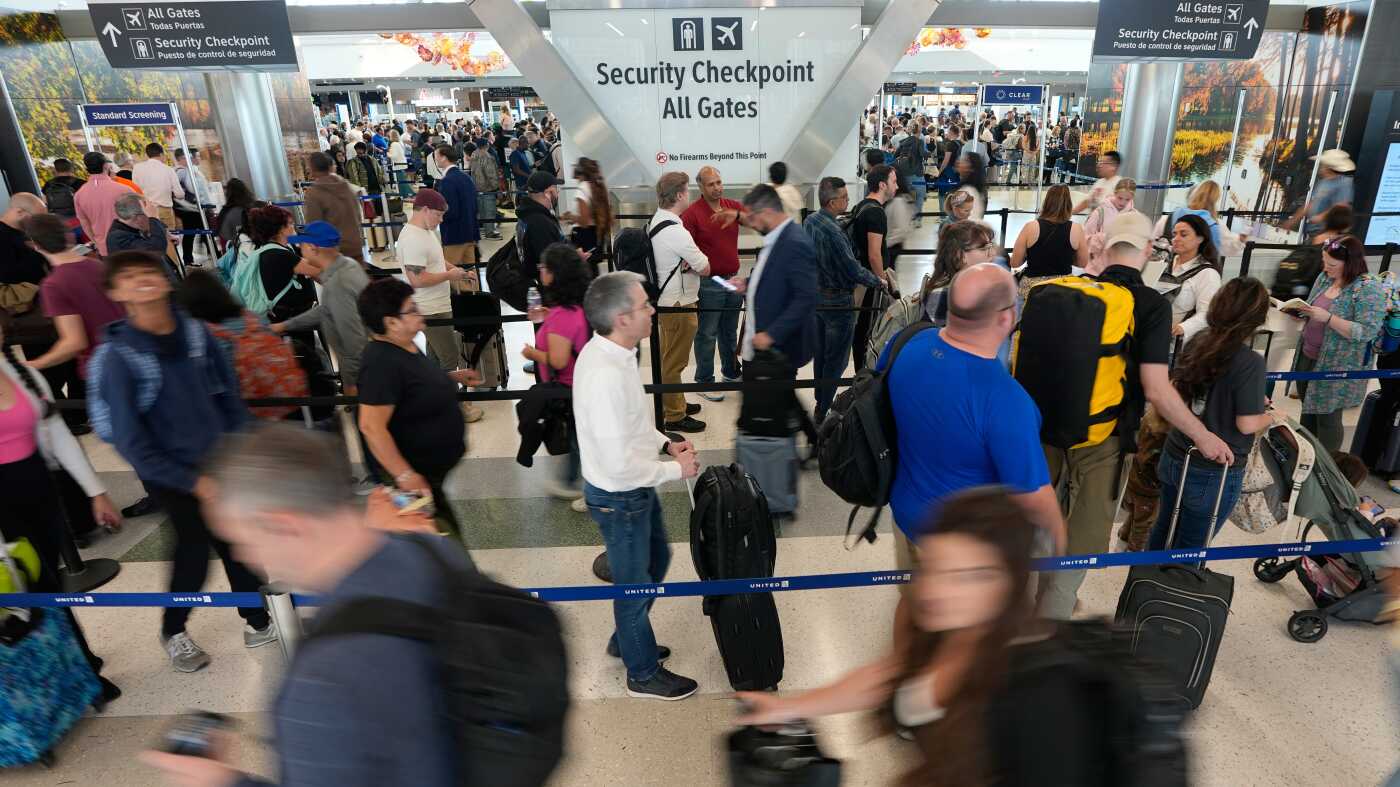
Travelers wait in long security checkpoint lines at George Bush Intercontinental Airport Friday, March 27, 2026, in Houston.
David J. Phillip/AP
hide caption
toggle caption
David J. Phillip/AP
Immigration and Customs Enforcement agents could remain at U.S. airports even after Transportation Security Administration workers receive their paychecks, according to White House border czar Tom Homan.
Asked if ICE agents will leave airports once TSA workers begin receiving pay again, Homan said on Sunday “we’ll see.”
“It depends on how many TSA agents come back to work [and] how many TSA agents have actually quit and have no plan [of] coming back to work,” Homan told CNN State of the Union host Jake Tapper.
Homan also said he spoke with Department of Homeland Security Secretary Markwayne Mullin, adding that there is a plan to get TSA workers paid “hopefully by tomorrow or Tuesday.”
“It’s good news… because these TSA officers are struggling. They can’t feed their families or pay their rent,” Homan told Tapper.
NPR reached out to DHS for additional comment on the timing of when workers would get paid but the department has not responded. A DHS social media post on Friday indicated TSA had begun the process of paying its workforce and that paychecks could arrive as early as Monday. That announcement came after President Trump signed a memo ordering that workers get paid from existing funds, even though Congress has not allocated the money amid an impasse over passing legislation to fund DHS. It remains unclear where the money would come from to fund the paychecks as NPR previously reported.
It’s been a week since the president ordered ICE to send agents to airports around the country to help TSA with security as the DHS shutdown entered a sixth week.
ICE officers have been assisting TSA agents by “checking identification” and “plugging other security holes,” allowing remaining TSA workers to focus on tasks that require more training, such as monitoring machines that examine luggage, according to Homan.
About 50,000 transportation security workers have been forced to continue working without pay, missing multiple paychecks since disagreements in Congress led to a DHS shutdown. More than 480 TSA workers have quit, according to TSA Acting Administrator Ha Nguyen McNeill. She told lawmakers at a hearing last Wednesday that worker absences were as high as 40% at some airports. That has led to long wait times for passengers at security checkpoints.
Homan says those lines have already become shorter.
“I was in Houston — wait lines decreased in about half. We got additional agents going to Baltimore yesterday, to bring those lines down,” Homan told CNN.
A notice on Baltimore/Washington International Thurgood Marshall Airport’s web page Sunday afternoon said wait times had improved since Saturday but remained longer than normal. At George Bush Intercontinental Airport in Houston, security wait times were under two hours Sunday. But the airport warned travelers that “TSA lines could exceed four hours.”
As for when permanent funding for DHS can be reached, that remains unclear. Negotiations in Congress remain stalled as lawmakers left Washington for a planned recess. The Senate returns April 13. The House is back on April 14.

Global streaming revenue surged to $160 billion in 2025. Here’s why

He swapped his lawn for native plants after asking, ‘What was meant to be here?’

Trump says ‘serious’ talks are occurring, threatens strikes on Iran energy, water sites

New York City Marathon winner Albert Korir banned 5 years for doping

Joey Browner, star defensive back for USC and Vikings, dies at 65

Florida High School Football Rankings: Top 25 teams – Oct. 21

How old is Bo Nix? What to know about Oregon quarterback ahead of 2024 NFL Draft

Cleary's 21 help Le Moyne down Central Connecticut State 69-64 in OT

99th annual Pony Swim held in Virginia

Indiana Members Credit Union announced as new anchor tenant at Bottleworks District

French police make two more arrests over foiled attack on Bank of America

‘What’s going on?’: US judge calls aspects of new Pentagon press policy ‘weird’

Video: Iran to Allow More Oil Ships Through Strait of Hormuz, Trump Says

Dem senator warns deportation could let Virginia woman’s illegal immigrant killer ‘escape accountability’

Newsletter: G7 ministers to hold talks on war’s economic fallout
-

 Sports1 week ago
IOC addresses execution of 19-year-old Iranian wrestler Saleh Mohammadi
-

 Miami, FL4 days ago
Jannik Sinner’s Girlfriend Laila Hasanovic Stuns in Ab-Revealing Post Amid Miami Open
-

 New Mexico1 week ago
Clovis shooting leaves one dead, four injured
-

 Politics1 week ago
Schumer gambit fails as DHS shutdown hits 36 days and airport lines grow
-

 Tennessee7 days ago
Tennessee Police Investigating Alleged Assault Involving ‘Reacher’ Star Alan Ritchson
-

 Minneapolis, MN4 days ago
Boy who shielded classmate during school shooting receives Medal of Honor
-

 South-Carolina1 day ago
South Carolina vs TCU predictions for Elite Eight game in March Madness
-

 Science1 week ago
Record Heat Meets a Major Snow Drought Across the West