Connect with us

News

German economy shrinks for second consecutive year

Published

on

German economy shrinks for second consecutive year

Stay informed with free updates

Germany’s economy shrank for a second straight year in 2024, underlining the severity of the downturn facing Europe’s manufacturing powerhouse.

The Federal Statistics Office said on Wednesday that Europe’s largest economy contracted by 0.2 per cent last year, after shrinking by 0.3 per cent in 2023. Economists had expected a decline of 0.2 per cent.

“Germany is experiencing the longest stagnation of its postwar history by far,” said Timo Wollmershäuser, economist at Ifo, a Munich-based economic think-tank, adding that the country was also underperforming significantly in an international comparison.

Advertisement

Confirmation that Germany is suffering one of the most protracted economic crises in decades comes six weeks ahead of a crucial snap election.

Campaigning has been dominated by the spectre of deindustrialisation, crumbling infrastructure and whether or not the country should abandon a debt brake that constrains public spending.

Friedrich Merz, head of the centre-right Christian Democratic Union who is likely to be Germany’s next chancellor, is campaigning on a reform agenda, promising to cut red tape and taxes and dial back welfare benefits for people who are not working.

Some content could not load. Check your internet connection or browser settings.

While private sector output contracted, government consumption rose sharply by 2.6 per cent compared with 2023.

Advertisement

Ruth Brand, president of the Federal Statistics Office, blamed “cyclical and structural pressures” for the poor performance, pointing to “increasing competition for the German export industry, high energy costs, an interest rate level that remains high and an uncertain economic outlook.”

In the three months to December, output fell by 0.1 per cent compared with the third quarter.

Robin Winkler, chief economist for Germany at Deutsche Bank, said the contraction in the fourth quarter came as a “surprise” and was “concerning”.

“If this is confirmed, the economy would have lost further momentum by the end of the year,” he said, suggesting this was probably driven by “political uncertainty in Berlin and Washington”.

The Bundesbank said last month that stagnation was set to continue this year, predicting growth of just 0.1 per cent and warning that a trade war with the US would trigger another year of economic contraction.

Advertisement

US president-elect Donald Trump has pledged to impose blanket tariffs of up to 20 per cent on all US imports.

Germany is struggling with a crisis in its automotive industry fuelled by Chinese competition and an expensive transition to electric cars, alongside high energy costs and tepid consumer demand.

Output in manufacturing contracted by 3 per cent, the statistics office said on Wednesday, while corporate investment fell by 2.8 per cent.

Germany has in effect seen no meaningful economic growth since the start of the pandemic, with industrial production hovering more than 10 per cent below its peak while unemployment has started to rise again after it fell to record lows.

Advertisement

News

Top U.S. archbishops denounce American foreign policy

Published

on

Top U.S. archbishops denounce American foreign policy

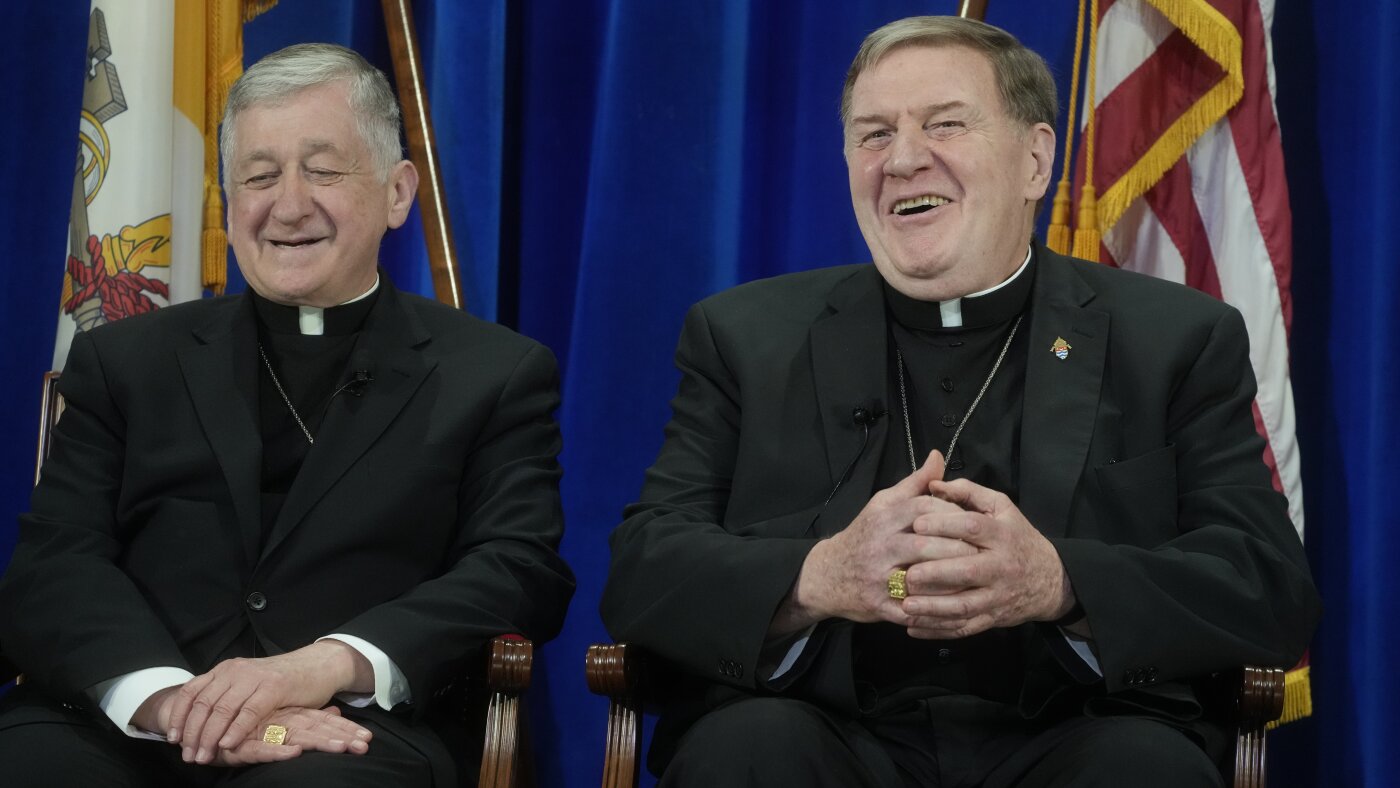
From right, U.S. Cardinals, Joseph Tobin of Newark, and Blase Cupich of Chicago, attend a press conference at the North American College in Rome on May 9, 2025. Along with Cardinal Robert McElroy, archbishop of Washington (not pictured), the men issued a strongly worded statement on Monday criticizing the Trump administration’s foreign policy.

Gregorio Borgia/AP


hide caption

toggle caption

Advertisement

Gregorio Borgia/AP

The three highest-ranking heads of Roman Catholic archdioceses in the United States issued a strongly worded statement on Monday criticizing the Trump administration’s foreign policy — without mentioning President Trump by name.

Cardinals Blase Cupich, archbishop of Chicago, Robert McElroy, archbishop of Washington, and Joseph Tobin, archbishop of Newark, say America’s actions raise moral questions.
“Our country’s moral role in confronting evil around the world, sustaining the right to life and human dignity, and supporting religious liberty are all under examination,” the statement reads. “And the building of just and sustainable peace, so crucial to humanity’s well-being now and in the future, is being reduced to partisan categories that encourage polarization and destructive policies.”

Advertisement

They continued, “We seek a foreign policy that respects and advances the right to human life, religious liberty, and the enhancement of human dignity throughout the world, especially through economic assistance.”

The senior leaders cited the recent events in Venezuela, Ukraine and Greenland, which they said “have raised basic questions about the use of military force and the meaning of peace.”

The White House did not immediately respond to NPR’s request for comment.

The statement by the American cardinals was inspired by a recent speech Pope Leo XIV gave to ambassadors to the Holy See. In it, he criticized the weakening of multilateralism.

“A diplomacy that promotes dialogue and seeks consensus among all parties is being replaced by a diplomacy based on force, by either individuals or groups of allies. War is back in vogue and a zeal for war is spreading,” Leo said in his Jan. 9 address. “Peace is sought through weapons as a condition for asserting one’s own dominion. This gravely threatens the rule of law, which is the foundation of all peaceful civil coexistence.”

Advertisement

Cupich said in a comment explaining the reasoning behind the archbishops’ statement, “As pastors entrusted with the teaching of our people, we cannot stand by while decisions are made that condemn millions to lives trapped permanently at the edge of existence,” he said. “Pope Leo has given us clear direction and we must apply his teachings to the conduct of our nation and its leaders.”

Continue Reading

News

Woman died after riding Revenge of the Mummy coaster at Universal Orlando, report says

Published

on

Woman died after riding Revenge of the Mummy coaster at Universal Orlando, report says

A 70-year-old woman died in November after riding the Revenge of the Mummy roller coaster at Universal Studios in Orlando, according to a report from the Florida Department of Agriculture and Consumer Services.

The woman became unresponsive while riding the attraction on Nov. 25, the state agency said in its latest quarterly report on injuries at theme parks, which covers the last three months of 2025. She later died at a hospital, it said. The report did not provide additional details about the circumstances surrounding her death.

CBS News has reached out to Universal Orlando.

Revenge of the Mummy is an elaborate-looking indoor ride that incorporates elements of a typical roller coaster, strapping riders into conjoined carts that whisk them along a dimly-lit track filled with jerks and jump scares, as promotional materials for the experience show. 

According to a description of the ride published in a Universal Studios safety guide, Revenge of the Mummy “is a high-speed roller coaster ride that includes sudden and dramatic acceleration, climbing, tilting, and dropping.” At times, the ride reaches speeds of up to 45 mph, CBS affiliage WKMG reported.

Advertisement

The ride has a minimum height requirement of 4 feet tall and isn’t suitable for passengers with a variety of medical conditions, including those who are susceptible to motion sickness or dizziness, or who have histories of heart conditions, abnormal blood pressure, back issues, neck issues, medical sensitivities to strobe effects, medical sensitivities to fog effects and any “other conditions which may be aggravated” by the ride, the safety description says.

This was the second death linked to a Universal Studios ride last year, Florida’s previous theme park injury report showed. On Sept. 17, a 32-year-old man died after riding the park’s Stardust Racers roller coaster. Citing a medical examiner’s report, WKMG reported that the man’s cause of death was determined to be “multiple blunt impact injuries.”

Earlier, in August, a 32-year-old woman was injured on the Revenge of the Mummy ride, according to the report, which said she suffered neck pain and motion sickness.

Florida law requires theme parks in the state to report ride-related injuries that require hospital stays of at least 24 hours.

Advertisement
Continue Reading

News

Parts of Florida receive rare snowfall as freezing temperatures linger

Published

on

Parts of Florida receive rare snowfall as freezing temperatures linger

A protective coating of ice clings to a strawberry plant in sub-freezing temperatures at a field on Friday in Plant City, Fla.

Chris O’Meara/AP


hide caption

toggle caption

Advertisement

Chris O’Meara/AP

A rare snowfall covered parts of the Sunshine State on Sunday for the second year in a row, while freezing temperatures will continue to grip parts of Florida into early this week.

A storm system brought up to 2 inches of snow to southern portions of Alabama and the Florida Panhandle, including Pensacola, on Sunday morning, according to the National Weather Service (NWS).

The snowfall occurred almost a year to the day after parts of Florida received record snow in mid-January 2025 — when Pensacola received between 6 to 8 inches of snow.

Advertisement

And while Sunday’s snowfall is over in Florida, a blast of arctic cold that has been felt across parts of the state since Friday is not.

Orlando and other areas will face a freeze warning Sunday night into Monday morning, with temperatures falling to at least 25 degrees and wind chills in the low 20s in some places, according to the NWS. Further south, Naples and surrounding areas will be under a cold weather advisory Sunday night into Monday morning, where 29-degree wind chills are expected.

Cold temperatures coupled with snow are abnormal for Florida but the cold weather will be “short-lived,” said Joe Wegman, a NWS meteorologist.

“We’re only expecting this level of cold for tonight. And then, even by tomorrow night, we’ll have lows in the upper 30s. So, just still cold, well below normal,” Wegman told NPR on Sunday. “By Tuesday night, lows are back up into the upper 40s.”

Advertisement
Continue Reading
Advertisement

Trending