News
Florida reefs are in trouble. Could the answer lie in coral from the Caribbean?

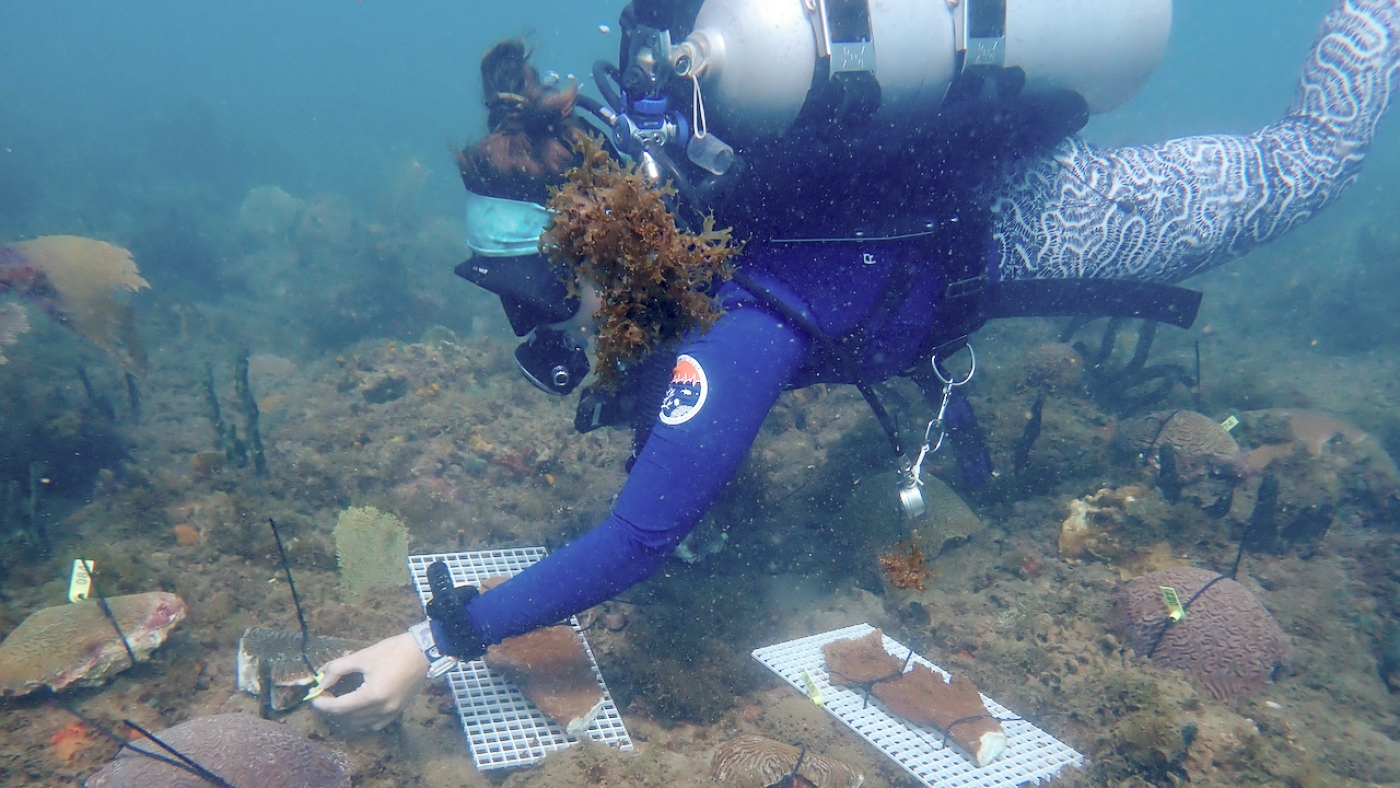
Cailyn Joseph, a PhD student in Andrew Baker’s lab, organizes brain and elkhorn coral in Honduras before the trip to Miami.
University of Miami Rosenstiel School
hide caption
toggle caption
University of Miami Rosenstiel School
MIAMI — Off the northern coast of Honduras, thick stands of endangered elkhorn coral have mysteriously defied warming oceans fueled by climate change to blanket the reef with healthy, cocoa-brown colonies branching toward the water’s surface like antlers.
Reefs near the small colonial town of Tela have more than three times the amount of live coral found elsewhere across the Caribbean.
Now scientists at the University of Miami Rosenstiel School hope to unlock that secret and crossbreed the sturdier coral with Florida elkhorn as they work to buy more time for a shrinking reef battered by rising ocean temperatures and disease.

Brain coral, left, and endangered elkhorn coral on a reef near Tela, Honduras, grow in water where temperatures hover around 88 degrees.
University of Miami Rosenstiel School
hide caption
toggle caption
University of Miami Rosenstiel School
“Usually we associate reefs with crystal clear water and lovely temperatures. These are rough, tough reefs,” said Andrew Baker, a Rosenstiel coral biologist leading the research. “There are enormous stands of elkhorn corals and great coverage of other corals. It’s kind of a mystery why the corals are doing so well.”
In Florida, and around the planet, oceans absorb more than 90%of additional heat trapped by greenhouse gas. The extra heat is decimating reefs. Record heat last year triggered a global bleaching event, marking the second in just a decade. In Florida last summer, coral turned a ghostly white when a blistering heat wave caused them to spit out their life-sustaining algae and bleach.

Rising ocean temperatures around the planet are endangering coral reefs, that bleach when water remains hot for too long. But near Tela, on the northern coast of Honduras, coral are thriving in hotter, more turbid water. Scientists hope to breed them with Florida coral to produce more resilient offspring.
Manuel Chinchilla/iStockphoto/Getty Images
hide caption
toggle caption
Manuel Chinchilla/iStockphoto/Getty Images
With waters around the state hitting record highs again this summer, Baker and a team of students flew to Honduras in May to scout out what he hopes could become the parents of new, more resilient Florida coral.
At 4 a.m. one June morning they rose to be on the reef at daylight to collect the coral. Once packed in wet paper towels and sealed in bubble wrap, Baker and his team loaded the coral into six couch-sized coolers to be whisked back to Miami aboard a donated Amerijet cargo flight.

Fabrizio Conejo, a PhD student in Andrew Baker’s lab, takes notes on elkhorn found on a Honduran reef.
University of Miami Rosenstiel School
hide caption
toggle caption
University of Miami Rosenstiel School
“It’s been a long day,” Baker said 14 hours later, standing on the tarmac at Miami International Airport waiting to clear customs as the evening sun turned the sky pink.
Baker’s biggest worry was temperature. Pilots set the cabin temperature to 77 degrees. But 14 hours is a long time, even for sturdy coral. Baker was confident the two species of brain coral would survive the trip, but he was less certain about the elkhorn.

Andrew Baker, left, removes coral from a reef near Tela, Honduras. Healthy elkhorn coral, right, are critically endangered around the world.
University of Miami Rosenstiel School
hide caption
toggle caption
University of Miami Rosenstiel School
“For those elkhorn corals, the ones we’re actually most interested in, they are notorious for not traveling well,” Baker said.
Amerijet workers have shipped whales, dolphins, and even giraffes in the spacious Boeing 767 freighter jets but never coral. They quickly ferried the coolers through a warehouse as big as six football fields to a waiting truck for the half-hour drive to tanks outside Baker’s lab alongside Biscayne Bay.
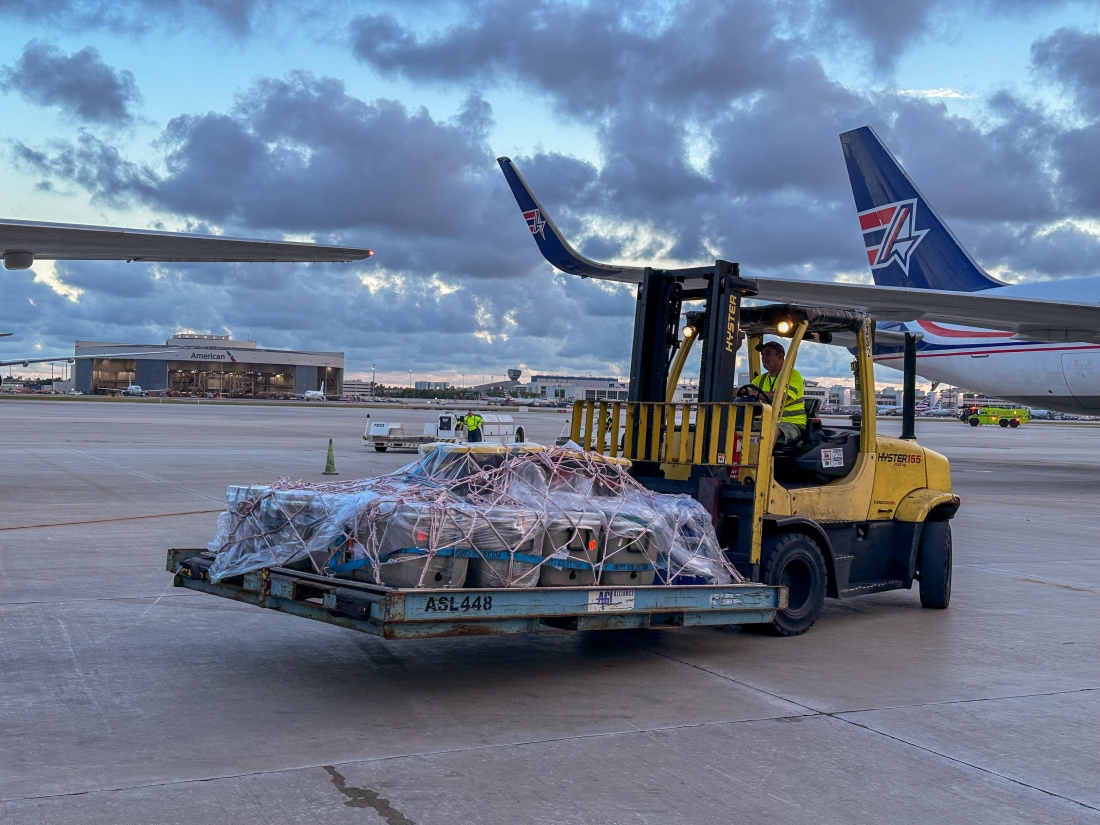
A forklift at Miami International Airport moves coolers containing elkhorn and brain coral shipped to Miami from Honduras in June.
Jenny Staletovich/WLRN
hide caption
toggle caption
Jenny Staletovich/WLRN
Clouds of mosquitoes mobilized as the students and Baker unloaded the coolers for the moment of truth.
“All right, here we go,” Baker said as he cracked open the first cooler. “There’s that smell.”
A sweet salty scent, like sea scallops, wafted out, signaling they’d survived being packed in a cooler for hours, bumped around on forklifts and jostled by airport workers.
Within a day, after most had acclimated to their new home, the coral were moved from the outdoor raceway tanks to an indoor spawning facility. Altogether 37 colonies of elkhorn and brain coral made the journey. To improve the chances for success, Baker gave seven elkhorn to the Florida Aquarium where scientists have been successfully breeding coral.

Coral Reef Futures Lab Manager Cameron McMath places places elkhorn coral into an outdoor runway tank to get acclimated after the trip from Honduras.
Diana Udel/University of Miami Rosenstiel School
hide caption
toggle caption
Diana Udel/University of Miami Rosenstiel School
This is the first time coral have been brought into the U.S. to attempt breeding more resilient babies, Baker said. The idea of using foreign coral to do this has raised concern over mixing genetics. Still the concerns don’t outweigh what’s at stake: Elkhorn that once blanketed Florida reefs have nearly disappeared in the state. What remains was hit hard by last summer’s heat wave.
It took a year just to obtain permits to bring the coral into the U.S. , Baker said. If he succeeds at breeding them, he’ll need to secure more state and federal permits to plant them on Florida’s reef. Baker hopes to have the coral spawn in July or August, when Florida coral typically spawn. He can then cross-breed them and have babies growing while he works through the permitting process.
Baker ultimately hopes he can fasttrack an evolutionary process now being outpaced by climate change.
“We can’t just wait for that solution to be ready and then think, ‘Okay, now what do we know now?’ What do we do to save these ecosystems?” he said. “We’ve got to work now, to have something left to save by the time we fix this bigger problem of climate change.”



The bombing of an Iranian elementary school that killed some 165 people, many of them schoolgirls, included more targets near the school than has been initially reported, a review of commercial satellite imagery by NPR has found.
The images suggest that the school was hit on Saturday as part of a precision airstrike on a neighboring Iranian military complex — and that it may have been struck as a result of outdated targeting information.
The new images come from the company Planet and are of the city of Minab, located in southeastern Iran. They show that a health clinic and other buildings near the school were also struck. Three independent experts confirmed NPR’s analysis of the additional strike points.
The strike points “look like pretty clean detonation centroids,” said Corey Scher, a postdoctoral researcher at the Conflict Ecology laboratory at Oregon State University.
“These certainly appear like detonation sites,” agreed Scher’s colleague, Oregon State associate professor Jamon Van Den Hoek.
Jeffrey Lewis, a professor at Middlebury College who specializes in satellite imagery, said the imagery was consistent with a precision airstrike.
The images show “very precise targeting,” Lewis told NPR. “Almost all the buildings [in the compound] are hit.”
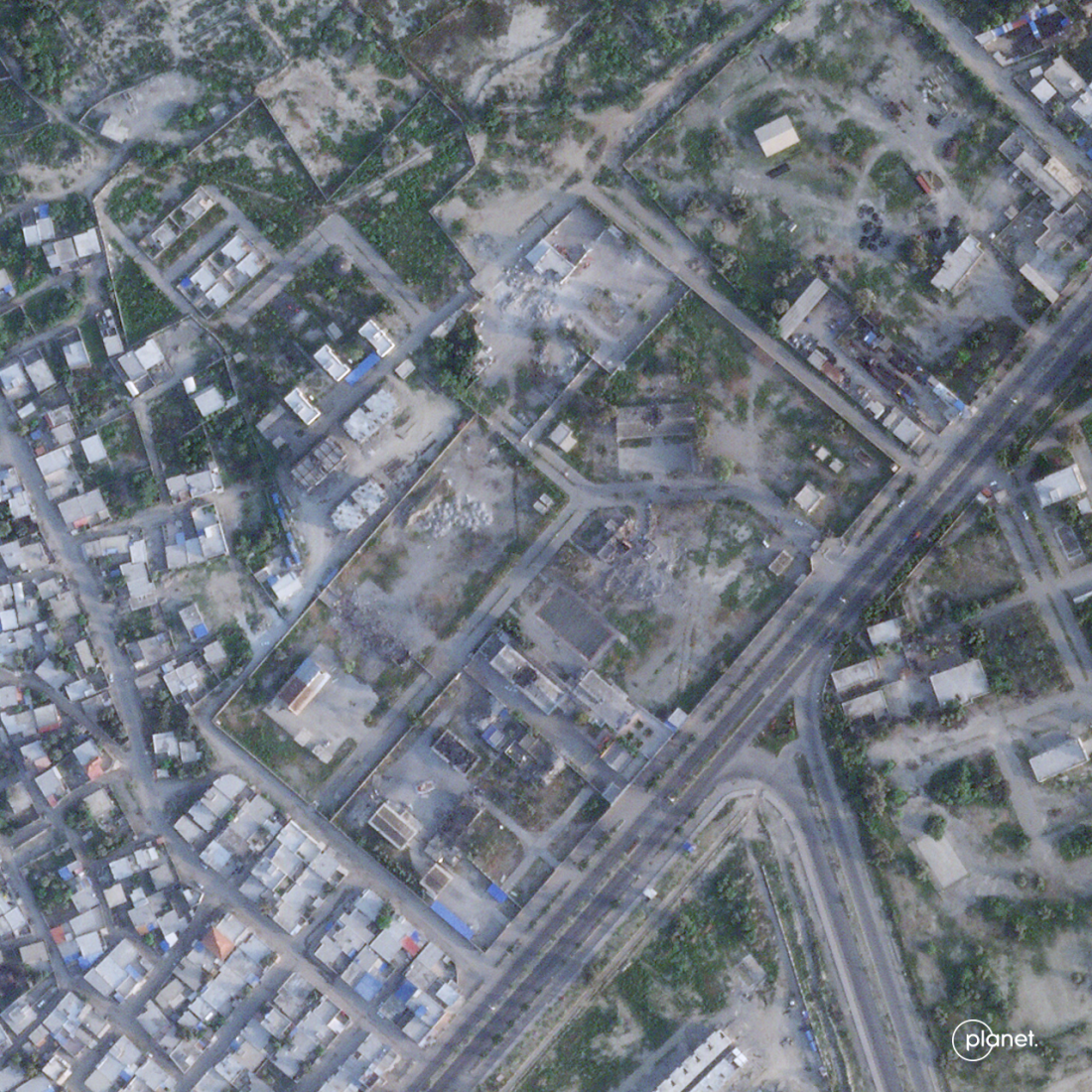
A satellite image of an Iranian Revolutionary Guard compound taken on March 4, several days after an airstrike destroyed a school on the edge of the compound. The image reveals that half a dozen other buildings in addition to the school were struck.
Planet Labs PBC
hide caption
toggle caption
Planet Labs PBC
Iranian state media said 165 people died in the bombing, which struck a girls’ school. The school was located within less than 100 yards of the perimeter of an Iranian Revolutionary Guard naval base, according to satellite images and publicly available information. The clinic was also located within the base perimeter, although both facilities had been walled off from the base.
Israel has denied involvement. “We are not aware at the moment of any IDF operation in that area,” Israel Defense Forces spokesperson Nadav Shoshani told NPR on Monday. “I don’t know who’s responsible for the bombing.”

At a press conference Wednesday morning, U.S. Defense Secretary Pete Hegseth said that the U.S. is looking into what happened at the school. “All I know, all I can say, is that we’re investigating that,” Hegseth said. “We, of course, never target civilian targets.”
Given Minab’s location in the southeastern part of Iran, Lewis believes it’s more likely the U.S. would have conducted the strike than Israel. As one gets farther south and east in Iran, “a strike is much more likely to be a U.S. strike than an Israeli strike because of the type of munitions and the geographic location,” he said.
Esmail Baghaei, the spokesman for Iran’s Foreign Ministry, called the strike “deliberate” and said that the U.S. and Israel bombed the school in part to tie up Iranian forces in the region with rescue efforts. “To call the attack on the girls school merely a ‘war crime’ does not capture the sheer evil and depravity of such a crime,” he said.
But Lewis said it’s more likely that the strike was the result of an error. Satellite images show that the school and clinic buildings were both once part of the base. The school was separated from the base by a wall between 2013 and 2016. The clinic was walled off between 2022 and 2024.
Lewis believes it’s possible American military planners had not updated their target sets.
“There are thousands of targets across Iran, and so there will be teams in the United States and Israel that are responsible for tracking those targets and updating them,” he said. “It’s possible that the target didn’t get updated.”
The Pentagon did not immediately respond to NPR’s request for additional information about the strike.
NPR’s Arezou Rezvani and NPR’s RAD team contributed to this report.

Mojtaba Khamenei, the second son of the assassinated Ali Khamenei, is being heavily tipped to succeed his father as supreme leader of Iran, which would pitch a hardliner into the task of steering the Islamic republic through the most turbulent period in its 48-year history and offer a powerful signal that, for now, it has no intention of changing course.
No official confirmation has been given and the announcement may be delayed until after the funeral of Ali Khamenei, which was on Wednesday postponed.
His son is believed to have been the choice of the Islamic Revolutionary Guard Corps (IRGC), and the Israeli defence minister, Gideon Saar, has warned he will be assassinated.
Ayatollah Seyed Khatani, a member of the Assembly of Experts, the body that chooses the new supreme leader, said the assembly was close to selecting a leader.
Rigid in his anti-western views, Mojtaba Khamenei is not the candidate Donald Trump would have wanted. Marco Rubio, the US secretary of state, said on Tuesday that Iran was run by “religious fanatic lunatics” – and Khamenei’s appointment is hardly likely to dispel that opinion.
The choice of supreme leader is made by the 88-strong Assembly of Experts, who in this case are picking from a field of six possible candidates. His election would be a powerful if unsurprising symbol that the government is not looking to find an accommodation with America.
Trump has said the worst-case scenario would be if Khamenei’s successor was “as bad as the previous person”.
There has been speculation for more than a decade that he would be his father’s successor, which grew when Ebrahim Raisi, the elected president and favourite of Khamenei, was killed in a helicopter crash.
Mojtaba Khamenei was born in 1969 and studied theology after graduating from high school. At the age of 17, he went to serve in the Iran-Iraq war, but it was not until the late 1990s that he came to be recognised as a public figure in his own right.
After the landslide defeat of Khamenei’s preferred candidate, Ali Akbar Nategh Nuri, in the 1997 presidential election, where he won only 25% of the final vote, various conservative Iranian groups realised the need to make changes to their structures and Mojtaba Khamenei was central to that project.
He was also seen as instrumental by reformists in suppressing the protests in 2009 that came after allegations the presidential election had been rigged, with his name chanted in the streets as one of those responsible. Mostafa Tajzadeh, a senior member of Iran’s reformist parties who was imprisoned after the vote, alleged that his and his wife, Fakhr al-Sadat Mohtashamipour’s, legal case was under the direct supervision of Mojtaba Khamenei.
In 2022 he was given the title of ayatollah – essential to his promotion. By then he was a regular figure by his father’s side at political meetings, as well as playing an influential role in the Islamic Republic’s Broadcasting Corporation, the government’s official media outlet often criticised for churning out dull political propaganda that many Iranians reject in favour of overseas satellite channels. He has also played a central role in the administration of his father’s substantial financial empire.
His closest political allies are Ahmad Vahidi, the newly appointed IRGC commander; Hossein Taeb, a former head of the IRGC’s intelligence organisation; and Mohammad Bagher Ghalibaf, the current speaker of the parliament.
His rumoured appointment and its hereditary nature has long been resisted by reformists. The former prime minister Mir Hossein Mousavi, referring to the long history of rumours about Mojtaba Khamenei succeeding his father as leader, wrote in 2022: “News of this conspiracy have been heard for 13 years. If they are not truly pursuing it, why don’t they deny such an intention once and for all?”
The Assembly of Experts, in response, denounced “meaninglessness of doubts” and said the assembly would select only “the most qualified and the most suitable”.
Israel on Tuesday struck the building in the Iranian city of Qom, one of Shia Islam’s main seats of power, where the assembly was scheduled, but the building was empty, according to IRGC-affiliated media.

new video loaded: Senators Question Kristi Noem on ICE Immigration Tactics
transcript
transcript
Senators Question Kristi Noem on ICE Immigration Tactics
Homeland Security Secretary Kristi Noem repeatedly refused to apologize for suggesting that Alex Pretti and Renee Good, two U.S. citizens shot and killed by agents, were domestic terrorists.
-
What we’ve seen is a disaster under your leadership, Ms. Noem. A disaster. What we’ve seen is innocent people getting detained that turn out are American citizens. I could talk about the culture that’s been created here. After the killings of Renee Good and Alex Pretti, when I spoke to Alex’s parents, they told me that you calling him a domestic terrorist — this was directly from them — the day after he was killed, a nurse in our V.A., Alex — one of the most hurtful things they could ever imagine was said by you about their son. Do you have anything you want to say to Alex Pretti’s parents? Ma’am, I did not call him a domestic terrorist. I said It appeared to be an incident of — I think the parents saw it for what it was. In a hearing — recent hearing before the HSGAC committee, C.B.P. and ICE officials testified under oath that their agencies did not inform you that Pretti was a domestic terrorist — during that hearing, stated during that hearing, I was getting reports from the ground, from agents at the scene, and I would say that it was a chaotic scene. How did you think that calling them domestic terrorists at that scene was somehow going to calm the situation? The fact that you can’t admit to a mistake, which looks like under investigation, it’s going to prove that Ms. Good and Mr. Pretti probably should not have been shot in the face and in the back. Law enforcement needs to learn from that. You don’t protect them by not looking after the facts.

By Christina Kelso and Jackeline Luna
March 3, 2026

Detroit Tigers 2026 roster prediction 2.0: Is Kevin McGonigle ready?

Latest California-based gig work app lets people book content creators, editors

Study says the real value of a $100K salary in Dallas is…less than that

Miami’s own Marcello Hernandez delivers special tribute to former teacher on SNL

When did Southie get richy-rich? – The Boston Globe

Florida High School Football Rankings: Top 25 teams – Oct. 21

Cleary's 21 help Le Moyne down Central Connecticut State 69-64 in OT

How old is Bo Nix? What to know about Oregon quarterback ahead of 2024 NFL Draft

99th annual Pony Swim held in Virginia

Indiana Members Credit Union announced as new anchor tenant at Bottleworks District

DHS defends McLaughlin against allegations husband’s company profited millions from ad contracts: ‘Baseless’

Sánchez defies Trump in political gamble as Madrid say no to war
Satellite images show Iran school strike hit more buildings than earlier reported

US submarine sinks Iranian warship by torpedo in a first since World War II

Which oil and gas facilities in the Gulf have been attacked?
-

 World1 week ago
Exclusive: DeepSeek withholds latest AI model from US chipmakers including Nvidia, sources say
-

 Massachusetts1 week ago
Mother and daughter injured in Taunton house explosion
-

 Wisconsin3 days ago
Setting sail on iceboats across a frozen lake in Wisconsin
-

 Maryland4 days ago
AM showers Sunday in Maryland
-

 Denver, CO1 week ago
10 acres charred, 5 injured in Thornton grass fire, evacuation orders lifted
-

 Florida4 days ago
Florida man rescued after being stuck in shoulder-deep mud for days
-

 Massachusetts2 days ago
Massachusetts man awaits word from family in Iran after attacks
-

 Oregon6 days ago
2026 OSAA Oregon Wrestling State Championship Results And Brackets – FloWrestling