News
Christine Blasey Ford aims to own her story with 'One Way Back'


Christine Blasey Ford speaks during a hearing of the Senate Judiciary Committee, Sept. 27, 2018, on Capitol Hill in Washington, D.C.
Michael Reynolds/AP
hide caption
toggle caption
Michael Reynolds/AP

Christine Blasey Ford speaks during a hearing of the Senate Judiciary Committee, Sept. 27, 2018, on Capitol Hill in Washington, D.C.
Michael Reynolds/AP
Christine Blasey Ford said civic duty compelled her to come forward when she learned Brett Kavanaugh was President Trump’s top choice for a Supreme Court opening in the summer of 2018. But her testimony did not change the ultimate result of Kavanaugh’s nomination.
Ford testified before the Senate Judiciary Committee that Kavanaugh had sexually assaulted her at a party back when they were teenagers in the Washington, D.C., area. When it was Kavanaugh’s turn to testify, he denied it happened.
In her new book, One Way Back, she writes “My story just can’t be about the three months in 2018 when my life exploded in front of the world’s eyes. My life weaves together surfing, statistics, motherhood, friendships, and politics.”
In an interview on Morning Edition, Ford said it was only a couple of years ago that she felt ready to revisit how her life was upended by Kavanaugh’s rise to the exalted position on the U.S. Supreme Court. Tired of an endless smear campaign, she decided it was time to write her own story.
While she moved far away from Washington, Ford says what she experienced there in her teenage years left an indelible mark. Reluctant to testify in a public setting, Ford forged ahead nonetheless. She writes that part of what gave her the strength to do so was her love of surfing; Ford equates the experience to facing the intensity of ocean waves. “You’ve got to take the wave and you might wipe out. You might get crushed and held under by three waves or you might get a great wave, you know? But you’re going to have to take it,” she told NPR’s Michel Martin.
Ford received tens of thousands of letters from supporters and detractors. She would have to hire a security team, take her family into hiding after threats to kill her, and she would see her character and sanity assailed for years.
But she also became a symbol of courage and hope to untold numbers of people. Following is an interview between NPR’s Michel Martin and Christine Blasey Ford. It has been lightly edited for length and clarity.
To hear the broadcast version of this conversation, use the audio player at the top of this page.
How did you come to share your story with the judiciary committee?
When I saw the short list, I was concerned and felt that I at least needed to share the information, not necessarily publicly, but let the government know that that had happened to me and that possibly they would want to look into some of the other candidates on that list.
Why did you think that was important to do?
I felt like as a citizen that it’s our responsibility to weigh in when we have relevant information for a job of that level of esteem and importance. I grew up in Washington, D.C., so I had high reverence for all of our governmental institutions and the Supreme Court as a child visiting there on field trips, that seemed to be where we send the best of the best. And I just felt a sense of patriotism and civic duty that I needed to let someone know and that they could then decide if it was of import.
This is years after Anita Hill was subpoenaed to testify, after it became known that she had had what she said was an experience of sexual harassment with Clarence Thomas when they both worked together. And that was a very bruising experience, you know, for all involved. Do you remember the whole experience with Anita Hill and Clarence Thomas? Did you think it would be like that or did you think it would be different than that?
I do remember that very well, and I remember most about that is her level of detail in recalling the incidents. I was hoping that it was not going to be similar. I was very scared of the idea of sitting in front of the Senate, and I was hoping that there was some other way that it could play out where I could share the information with the senators without having to sit in Washington, D.C., with them in that big room where she sat.
One of the things that surprised me, people may remember this from the coverage even at the time, is that the committee really did not want to hear from you. Did you find that surprising after all these years after Anita Hill was subpoenaed to testify against Clarence Thomas, and they were heavily criticized for this. At the time, the Judiciary Committee was all male. That was one of the issues sort of at play here .But did you think it would be different all these years later, that they really did want to hear from you?
I did overestimate how interested they would be in this information. I really thought that it was important for them to know and that they would want to know. And I viewed myself as helpful like I was trying to be helpful to them and apparently that was not how they necessarily viewed it and it became highly politicized.
When a decision was made and it was clear that you were then going to testify, can you even sort of describe what it was like to be in the middle of that?
I was still ambivalent about speaking publicly in front of the Senate. I wanted to meet with them privately. And I wrote a letter saying that I felt that was the best thing to do for his family and for my family and would reduce sort of the amount of attention and the circus around it and as well as the threats to both families. So that was my preference but it didn’t happen that way. They wanted to have an open hearing. I wasn’t watching it or thinking about how it connected to a MeToo movement or to another hearing. I was just trying to get through it.
What made you finally decide to cross that threshold? I was struck by your saying up to the last minute you were not sure you were going to go through with it. Why do you think you did?
Well, I certainly had a phone and email inbox full of messages of people telling me not to do it, either for caring reasons or for reasons where they were trying to scare me. And then I also had text messages and emails full of people from all over the world saying, we need you to do this as survivors. And so I had a lot of people, weighing in on what I should do. And it seemed like it was about 50-50 and finally I thought, this is so stressful, maybe this will just end the stress and that maybe if I testify, it’ll be over.
The level of smear media and a report from the Senate or from half of the committee with allegations that are salacious and criminal, that felt really gut wrenching for me because those were the people that I set out to help. So to me, that’s kind of the hardest part is setting out as a citizen and feeling you have a patriotic duty and a higher calling and that you’re willing to sustain some level of backlash. But to have the actual people that you’re trying to help be the people who are involved in that backlash is a little bit difficult to come to terms with. And part of why I wrote the book is I don’t want it to be the case that other people don’t come forward. So I wanted to show that no matter how scary this is, it is something you can live through and survive and come out the other side.
Nina Kravinsky produced the audio for this story. Meghan Sullivan edited the digital version.


BOSTON (AP) — A federal judge on Thursday halted President Donald Trump’s executive order that sought to create a federal voter list and limit who can receive a mail ballot.
U.S. District Court Judge Indira Talwani, who was nominated by Democratic President Barack Obama, sided with a coalition of nearly two dozen states that challenged the Republican president’s order in granting a summary judgment. Her ruling applies to this year’s midterm election cycle.
Plaintiffs argued in two lawsuits, both filed in federal court in Boston, that Trump’s order should be found unconstitutional because the states and Congress, not the president, have the power to set election rules. The judge agreed, noting in her ruling that the provisions of Trump’s order “unconstitutionally violate the separation of powers.”
It was the second ruling in as many days against executive orders Trump has signed seeking oversight of the nation’s elections. A separate ruling Wednesday prohibited an executive order he had signed last year that would have required people to show documents proving their citizenship when registering to vote.
The administration, in its motions to dismiss the lawsuits challenging the order seeking to establish a federal voter list, argued that the motions are premature and that plaintiffs lacked the legal basis to bring their claim based on the Administrative Procedure Act, which governs how federal agencies develop and issue regulations.
But in an interim order before Thursday’s ruling, Talwani said the motions pertaining to this year’s election cycle were relevant: “In light of the EO’s specific deadlines over the next three months, and the reality that elections will be occurring throughout this period with the November 3, 2026 midterm occurring in just five months, postponing judicial review is impracticable and may inflict significant hardship on Plaintiffs,” she wrote. That order denied the Trump administration’s motion to dismiss the challenges.
Trump’s executive order, the second one aimed at elections during his second term, comes as he continues to raise the specter of widespread voting by noncitizens as a reason to change election rules. But states already have detailed processes aimed at keeping their voter rolls accurate, and voting by noncitizens has been shown to be rare. It also is a felony that can be punishable by deportation.
Trump issued his second order in March after a bill he supported to overhaul voting stalled in Congress. The order would have had the federal government create a list of eligible voters and then directed the U.S. Postal Service to deliver mail ballots only to those on the list. Election officials argued that it was ripe for abuse and could cause chaos, and the postal union has objected to the idea of mail carriers policing ballots.
The Postal Service has published a proposed rule required by Trump’s executive order in the Federal Register. Among other things, the rule would not apply to primary elections or overseas ballots.
The lawsuit seeking summary judgment was filed by Democratic attorneys general representing 22 states and the District of Columbia. Also signing on were attorneys representing Democratic Gov. Josh Shapiro of Pennsylvania, which has a Republican attorney general.
The states also told the court that the move imposes a costly burden on election officials to comply and would spread fear about the possibility of prosecution. Stephen Pezzi, a lawyer for the Trump administration, had argued that no one would be prosecuted for violating the order.
In a separate lawsuit filed against the executive order, a federal judge in Washington, D.C., in May agreed with the Trump administration that it was too early to block the order because it had yet to be implemented. That lawsuit was brought by Democratic and civil rights groups, who have appealed.
Since his 2020 presidential election loss to Democrat Joe Biden, Trump has groundlessly claimed mail voting is rife with fraud and has launched a federal investigation into that year’s vote, even though repeated audits and investigations, including ones run by Republicans, found it was free of widespread fraud. Trump also has said he wants to “take over” election administration in Democratic areas.
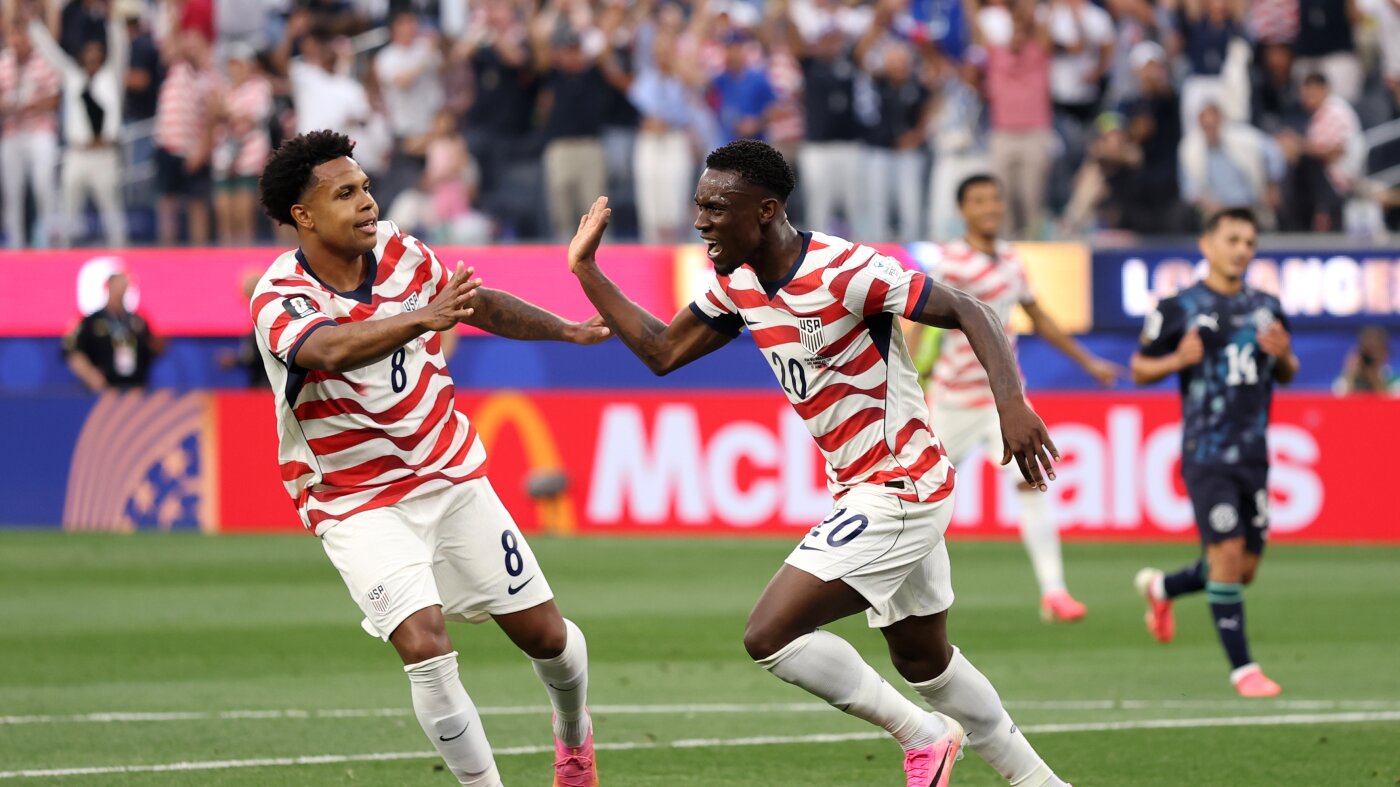
Folarin Balogun (r) of the U.S. celebrates scoring his team’s second goal with Weston McKennie during their World Cup match against Paraguay on June 12 in Inglewood, Calif. The U.S. defeated Paraguay and, later, Australia. The U.S. wraps up group play against Turkey on Thursday evening. Win, lose or draw, the U.S. has already won its group and will advance to the knockout round.
Richard Heathcote/Getty Images
hide caption
toggle caption
Richard Heathcote/Getty Images
INGLEWOOD, Calif. — For the U.S. men’s national soccer team, a loss in Thursday night’s FIFA World Cup game against Turkey wouldn’t change anything.
A win, though, would be history.

The squad’s earlier wins over Paraguay and Australia, plus two losses by Turkey to the same teams, mean the Americans have already won their group and clinched a favorable path in the knockout round, no matter the outcome of Thursday’s game.
But the American men have never won more than two games in a single World Cup. A third win would be new territory for this team, which has not been shy about its aspirations in this tournament and its confidence about living up to them.
“The group stage is not done yet. We want to end it the right way. We want to end it the way we came into it and continue to build off of the momentum that we’ve been creating,” said defender Mark McKenzie, speaking to reporters Wednesday.

Because the outcome of the game does not affect knockout-round placement, the U.S. can rest key starters who will enter the match with a yellow card. For those players — defenders Antonee Robinson and Chris Richards, midfielder Tyler Adams and forward Folarin Balogun — picking up a second yellow card against Turkey would result in a suspension in the Round of 32. (Any single yellow cards will be cleared after the group stage concludes.)
The team could also choose to ease in forward Christian Pulisic, who is expected to be available for the game after sitting out the U.S.-Australia game with a minor calf injury.
Turkey had come into the World Cup with high expectations. With talented young stars like the 21-year-old attackers Arda Güler of Real Madrid and Kenan Yildiz of Juventus, the team was thought by many — from analysts to the players themselves — to be a dark horse capable of a deep run.
Instead, they were eliminated last week when their loss to Paraguay followed the U.S. win over Australia, prompting apologies from Turkey’s despondent players to their fans after the game.
On Wednesday, Yildiz echoed that apology and promised to “give our best” in Thursday’s game against the U.S. “We had high expectations. I know because all of our country was supporting us and thought we will come very far,” Yildiz said. “Hopefully for the next game we can make a good result and go out with pride.”
The U.S. and Turkey last faced each other in an international friendly in June 2025, which Turkey won 2-1. The U.S. roster for that game was missing several key players, including Pulisic, Robinson, Balogun and midfielder Weston McKennie.
“We had a really young team, but we went out there and put in a good performance. I don’t think the result necessarily reflected how we played,” Richards said. “Whoever’s on the field, I know we’re going to go out there and give 110 percent.”

A federal judge on Wednesday permanently barred President Donald Trump’s administration from implementing most of his first executive order on elections, part of which sought to require people to show documentary proof of citizenship when they register to vote.
The ruling by U.S. District Court Judge Denise Casper in Boston effectively converts a preliminary injunction she issued a year ago, in which she temporarily blocked many of Trump’s efforts to overhaul elections, into a permanent ban.
Casper rejected the Republican administration’s argument that the lawsuit to block the changes brought by Democratic state attorneys general was premature because the rules had yet to be put in place. Instead, she agreed that the Constitution gives states and Congress the authority to regulate elections, and that Trump’s requirements violated the separation of powers.
The Constitution “does not grant the President any specific powers over elections,” wrote Casper.
Among other proposed changes, Trump’s order would have required people to provide documentary proof of citizenship when registering to vote, prevented mail ballots from being counted if they arrive after Election Day, even if they were postmarked by then, and punished states that failed to comply by withholding certain federal money.
In a statement, New York Attorney General Letitia James said she was grateful the court had blocked Trump’s “unconstitutional attempt to seize control of our elections” and would continue to defend voting rights in this year’s midterm elections.
“Generations of Americans fought tirelessly for the right to vote, and we honor their legacy by protecting that right against anyone who tries to undermine it,” said James, a Democrat.
A voter casts a ballot during New York’s primary election on Tuesday, June 23, 2026, in New York. (AP Photo/Ryan Murphy)
California Attorney General Rob Bonta, whose state was the lead plaintiff in the case, said the ruling reaffirmed the constitutional principle that it s up to the states and Congress to set election rules.
“While we are proud of this result, we are clear-eyed that President Trump’s attacks on voting rights and our elections show no signs of slowing down,” Bonta, a Democrat, said in a statement. “So let me be clear: we will keep fighting back every step of the way.”
Requests for comment sent to the White House and he U.S. Department of Justice were not immediately returned.
The ruling was the latest in a series against the elections executive order Trump signed just months after taking office for his second term. The Republican president has since signed another executive order on elections that seeks to create a national voter list and limit mail balloting. That directive also faces multiple legal challenges.
Last fall, a federal judge in Washington, D.C., overseeing a separate challenge to the first election executive order by civil rights and Democratic Party-aligned groups blocked the government from taking steps to include the proof-of-citizenship requirement on the federal voter registration form. That judge later barred Trump’s defense secretary from requiring documentary proof of citizenship when military personnel register to vote or request ballots.
In an apparent nod to the difficulty of implementing a proof-of-citizen requirement by executive order, Trump is pushing legislation in the Republican-controlled Congress to create such a mandate. The SAVE America Act has passed the House but has stalled in the Senate, leading Trump to advocate for eliminating the filibuster that is blocking the legislation.
On Wednesday, he abruptly canceled the expected signing of a bipartisan housing bill, saying he would not sign legislation until Congress passes his proof of citizenship requirement for voting.
The president and many of his Republican allies have been promoting the narrative that voting by noncitizens is a major problem, when in fact it’s quite rare. The federal voter registration form already requires people to attest that they are U.S. citizens. Violating that is punishable as a felony that can lead to prison or deportation.
In another major voting case, the U.S. Supreme Court is due to issue an opinion soon on whether mail ballots must arrive by Election Day. That could immediately change the rules in 14 states that allow grace periods ranging from days to weeks if the ballots are postmarked by Election Day.
Casper, who was nominated by Democratic President Barack Obama, is the chief judge for the U.S. District Court for the District of Massachusetts.
-

 Fitness15 seconds ago
How Kaye Adams’ varied exercise routine keeps her fit at 63 – and why she swapped HIIT for walking
-

 Movie Reviews8 minutes ago
8News Reel Talk: ‘Toy Story 5’ movie review
-

 World18 minutes ago
Strong Earthquake Rocks Venezuela Capital
-

 Health48 minutes ago
Does Berberine Aid Weight Loss? The Best Time To Take It To Boost Results
-
 Lifestyle1 hour ago
John Cena wanted to step away from the WWE ring before he became ‘too slow for the show’ : Wild Card with Rachel Martin
-

 Technology1 hour ago
Here’s a bunch of Prime Day deals on keyboards, mice, and other peripherals we like
-

 World1 hour ago
Israel slams UN report as ‘political blood libel’ for alleging deliberate targeting of Palestinian children
-

 Politics1 hour ago
Biden judge rejects Trump’s sanctuary cities lawsuit, says even a win wouldn’t solve DOJ’s problem

