Roula Khalaf, Editor of the FT, selects her favourite stories in this weekly newsletter.
Europe and China’s battle over the solar industry has been going on for two decades. Chinese solar-panel makers are winning with an unassailable lead: they now account for 80 per cent of global production capacity. But the cost of that victory is now looking too high.
China dominates the solar panel sector’s entire supply chain. Prices, which are nearly two-thirds lower than US counterparts, have helped it to win market share.
Every year, this price gap widens. There was another 40 per cent price cut in 2023. China’s dominance has come from years of investment. It ploughed over $130bn into the solar industry last year — into production capacity increases. Chinese makers are able to build over 860 gigawatts of solar modules annually.
Advertisement
The biggest advantage Chinese companies have is scale. Due to the sheer size of the domestic market — which added a record 217 gigawatts of solar last year — companies invested heavily in larger scale manufacturing and automation. That is paying off today.
Another 600 gigawatts of annual capacity is expected to start operations this year. That would be enough to cover the world’s total demand through 2032, according to energy research group Wood Mackenzie.
Clearly, the fact that there is now more than enough affordable supply of solar products is good news for the environment and global efforts to shift to cleaner forms of energy production. China was the main driving force behind the 50 per cent increase in global renewable electricity generation capacity last year.
But the problem is the pace of growth has been much too fast. Even its vast domestic market cannot soak up that excess capacity. The weak stock performance of Chinese solar cell manufacturers reflects that mismatch. Longi Green Energy Technology, JA Solar Technology and Trina Solar are down more than 50 per cent in the past year. Longi, China’s largest business in the sector which has grown to become the world’s second most valuable solar energy group, trades at 18 times forward earnings. That is less than half the valuation of smaller US peers. Operating margins have halved over the past four years.
The European Commission has started probes into bids by Chinese firms for projects in the region. The EU’s solar industry has blamed a flood of Chinese imports for losses and plant closures by several European panel makers. With that market looking increasingly unlikely to provide the growth Chinese makers need, the forecast looks decidedly cloudy.
• Read free articles
• Get our Editor’s Digest and other newsletters
• Follow topics and set up personalised events
• Access Alphaville: our popular markets and finance blog
The allegation sounded like the stuff of spy movies: A Pakistani businessman trying to hire hit men, even handing them $5,000 in cash, to kill a U.S. politician on behalf of Iran ‘s powerful paramilitary Revolutionary Guard.
It was true, and potential targets of the 2024 scheme included now-President Donald Trump, then-President Joe Biden and former presidential candidate and ex-U.N. Ambassador Nikki Haley, the man told jurors at his attempted terrorism trial in New York on Wednesday. But he insisted his actions were driven by fear for loved ones in Iran, and he figured he’d be apprehended before anything came of the scheme.
“My family was under threat, and I had to do this,” the defendant, Asif Merchant, testified through an Urdu interpreter. “I was not wanting to do this so willingly.”
Merchant said he had anticipated getting arrested before anyone was killed, intended to cooperate with the U.S. government and had hoped that would help him get a green card.
U.S. authorities were, indeed, on to him – the supposed hit men he paid were actually undercover FBI agents – and he was arrested on July 12, 2024, a day before an unrelated attempt on Trump’s life in Butler, Pennsylvania. During a search, investigators said they found a handwritten note that contained the codewords for the various aspects of the plot, CBS News previously reported.
Advertisement
Merchant did sit for voluntary FBI interviews, but he ultimately ended up with a trial, not a cooperation deal.
“You traveled to the United States for the purpose of hiring Mafia members to kill a politician, correct?” Assistant U.S. Attorney Nina Gupta asked during her turn questioning Merchant Wednesday in a Brooklyn federal court.
“That’s right,” Merchant replied, his demeanor as matter-of-fact as his testimony was unusual.
The trial is unfolding amid the less than week-old Iran war, which killed Iranian Supreme Leader Ayatollah Ali Khamenei in a strike that Trump summed up as “I got him before he got me.” Jurors are instructed to ignore news pertaining to the case.
The Iranian government has denied plotting to kill Trump or other U.S. officials.
Advertisement
Merchant, 47, had a roughly 20-year banking career in Pakistan before getting involved in an array of businesses: clothing, car sales, banana exports, insulation imports. He openly has two families, one in Pakistan and the other in Iran – where, he said, he was introduced around the end of 2022 to a Revolutionary Guard intelligence operative. They initially spoke about getting involved in a hawala, an informal money transfer system, Merchant said.
Merchant testified that his periodic visits to the U.S. for his garment business piqued the interest of his Revolutionary Guard contact, who trained him on countersurveillance techniques.
The U.S. deems the Revolutionary Guard a “foreign terrorist organization.” Formally called the Islamic Revolutionary Guard Corps, the force has been prominent in Iran under Khamenei.
Merchant said the handler told him to seek U.S. residents interested in working for Iran. Then came another assignment: Look for a criminal to arrange protests, steal things, do some money laundering, “and maybe have somebody murdered,” Merchant recalled.
“He did not tell me exactly who it is, but he told me – he named three people: Donald Trump, Joe Biden and Nikki Haley,” he added.
Advertisement
In 2024, multiple sources familiar with the investigation told CBS News Merchant planned to assassinate current and former government officials across the political spectrum.
Merchant allegedly sketched out the plot on a napkin inside his New York hotel room, prosecutors said, and told the individual “that there would be ‘security all around’ the person” they were planning to kill.
“No other option”
After U.S. immigration agents pulled Merchant aside at the Houston airport in April 2024, searched his possessions and asked about his travels to Iran, he concluded that he was under surveillance. But still he researched Trump rally locations, sketched out a plot for a shooting at a political rally, lined up the supposed hit men and scrambled together $5,000 from a cousin to pay them a “token of appreciation.”
This image provided by the Justice Department, contained in the complaint supporting the arrest warrant, shows Asif Merchant.
Advertisement
AP
He even reported back to his Revolutionary Guard contact, sending observations – fake, Merchant said – tucked into a book that he shipped to Iran through a series of intermediaries.
Merchant said he “had no other option” than to play along because the handler had indicated that he knew who Merchant’s Iranian relatives were and where they lived.
In a court filing this week, prosecutors noted that Merchant didn’t seek out law enforcement to help with his purported predicament before he was arrested. He testified that he couldn’t turn to authorities because his handler had people watching him.
Prosecutors also said that in his FBI interviews, Merchant “neglected to mention any facts that could have supported” an argument that he acted under duress.
Advertisement
Merchant told jurors Wednesday that he didn’t think agents would believe his story, because their questions suggested “they think that I’m some type of super-spy.”
“And are you a super-spy?” defense lawyer Avraham Moskowitz asked.
The bombing of an Iranian elementary school that killed some 165 people, many of them schoolgirls, included more targets near the school than has been initially reported, a review of commercial satellite imagery by NPR has found.
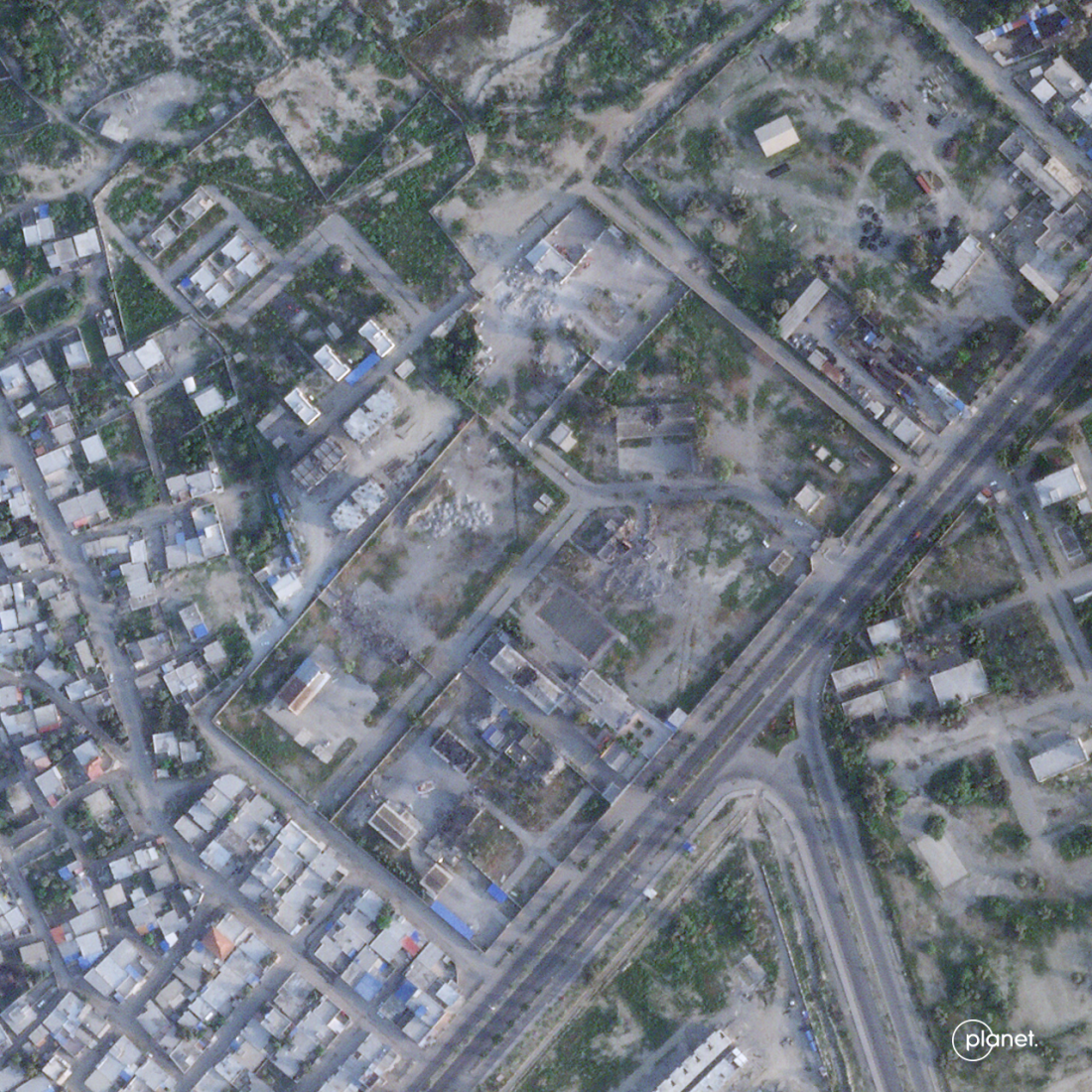
The images suggest that the school was hit on Saturday as part of a precision airstrike on a neighboring Iranian military complex — and that it may have been struck as a result of outdated targeting information.
The new images come from the company Planet and are of the city of Minab, located in southeastern Iran. They show that a health clinic and other buildings near the school were also struck. Three independent experts confirmed NPR’s analysis of the additional strike points.
Advertisement
The strike points “look like pretty clean detonation centroids,” said Corey Scher, a postdoctoral researcher at the Conflict Ecology laboratory at Oregon State University.
“These certainly appear like detonation sites,” agreed Scher’s colleague, Oregon State associate professor Jamon Van Den Hoek.
Jeffrey Lewis, a professor at Middlebury College who specializes in satellite imagery, said the imagery was consistent with a precision airstrike.
The images show “very precise targeting,” Lewis told NPR. “Almost all the buildings [in the compound] are hit.”
A satellite image of an Iranian Revolutionary Guard compound taken on March 4, several days after an airstrike destroyed a school on the edge of the compound. The image reveals that half a dozen other buildings in addition to the school were struck.
Planet Labs PBC
Advertisement
hide caption
toggle caption
Planet Labs PBC
Advertisement
Iranian state media said 165 people died in the bombing, which struck a girls’ school. The school was located within less than 100 yards of the perimeter of an Iranian Revolutionary Guard naval base, according to satellite images and publicly available information. The clinic was also located within the base perimeter, although both facilities had been walled off from the base.
Israel has denied involvement. “We are not aware at the moment of any IDF operation in that area,” Israel Defense Forces spokesperson Nadav Shoshani told NPR on Monday. “I don’t know who’s responsible for the bombing.”
At a press conference Wednesday morning, U.S. Defense Secretary Pete Hegseth said that the U.S. is looking into what happened at the school. “All I know, all I can say, is that we’re investigating that,” Hegseth said. “We, of course, never target civilian targets.”
Given Minab’s location in the southeastern part of Iran, Lewis believes it’s more likely the U.S. would have conducted the strike than Israel. As one gets farther south and east in Iran, “a strike is much more likely to be a U.S. strike than an Israeli strike because of the type of munitions and the geographic location,” he said.
Esmail Baghaei, the spokesman for Iran’s Foreign Ministry, called the strike “deliberate” and said that the U.S. and Israel bombed the school in part to tie up Iranian forces in the region with rescue efforts. “To call the attack on the girls school merely a ‘war crime’ does not capture the sheer evil and depravity of such a crime,” he said.
Advertisement
But Lewis said it’s more likely that the strike was the result of an error. Satellite images show that the school and clinic buildings were both once part of the base. The school was separated from the base by a wall between 2013 and 2016. The clinic was walled off between 2022 and 2024.
Lewis believes it’s possible American military planners had not updated their target sets.
“There are thousands of targets across Iran, and so there will be teams in the United States and Israel that are responsible for tracking those targets and updating them,” he said. “It’s possible that the target didn’t get updated.”
The Pentagon did not immediately respond to NPR’s request for additional information about the strike.
NPR’s Arezou Rezvani and NPR’s RAD team contributed to this report.