News
Chief Justice Roberts’s Two Landmark Opinions Turn Tide Toward Liberty


UNITED STATES – JANUARY 30: Supreme Court Chief Justice John Roberts listens to President Donald … [+]
Just in time for America’s 248th birthday, Chief Justice John Roberts has gifted our nation two landmark decisions that turn the tables on unlawful administrative power and turn the tide toward liberty. These cases do more to save Americans from being dominated by bureaucratic overlords than anything else the Court has done in at least half a century. The decisions in Securities and Exchange Commission v. Jarkesy and Loper Bright v. Raimondo (decided alongside NCLA’s case Relentless v. Department of Commerce) do not just right two wrongs; they deliver a one-two punch for independence. In different ways, each case changes the direction in which our ship of state was headed and steers it back on a course that is far more compatible with individual liberty and self-government than the tyrannical trajectory onto which the Court veered a century ago. Together they establish a legacy for The Chief Justice of the United States as a loyal defender of the structural Constitution and an ardent foe of unlawful administrative power.
A fuller examination of these two opinions will reveal just how rejuvenating they are. As Chief Justice Roberts notes in his Jarkesy opinion, the right to a jury trial was protected in the Constitution (in more than one place) in no small part because the colonists had personal experience with the monarch’s use of jury-less courts under the king’s control to adjudicate their alleged transgressions. So, when Congress started sidelining the federal judiciary and allowing federal agencies to go after alleged rulebreakers in their own tribunals, it had a familiar—if foreboding—feel. That individual rights suffered under this regime was as predictable as it was pernicious.
For the SEC, it was the Dodd-Frank Act of 2010 that dramatically increased the agency’s ability to herd regulated parties before biased in-house adjudicators. But whatever the legislative source of mischief, and sometimes there is not one (e.g., some of the adjudications at the Office of Federal Contract Compliance Programs are rooted in nothing more than an executive order), when agencies get to act as prosecutor, judge, and jury, they invariably abuse that combination of powers our Founders were so keen to separate and keep separate. For example, they bring cases that are marginal on the facts, on the law, or both. They pressure parties to settle rather than contest their innocence. They overcharge, they intimidate witnesses, they fail to turn over exculpatory evidence. Perhaps most outrageously—in part because SEC has been working feverishly to hide this grossly unethical conduct—they even have ‘control deficiencies’ whereby the prosecutorial staff downloads computer files from the adjudicative side of the agency. All those pathologies of administrative adjudication—and at least a couple dozen others—become much scarcer, and some nearly vanish, once the right to a jury trial in front of a real Article III court is restored.
Note that a mere ability to appeal to an Article III court of appeals, which has always been possible at least in theory, is not enough. By appeal time, the overwhelming majority of parties have already been forced into settlement—98% at the SEC. For those who do not settle, the administrative record is set. There is no jury at the court of appeals level to do fact-finding. So, only errors of law stand a chance of being corrected. But an ounce of jury-trial prevention on the front end stops a pound of factual problems that back-end appellate review cannot cure.
Critics of the Jarkesy decision complain that forcing agencies to bring enforcement actions in real courts will limit their ability to take wrongdoers to the woodshed. To be sure, it takes more resources to conduct a real trial than an ersatz in-house tribunal, so to the extent resources limit the enforcement actions agencies can bring, they will have to marshal their resources to go after the most deserving targets of enforcement now. But since when did respect for constitutional rights like jury trials or due process become an undesirable impediment to greater government control over Americans’ lives? And what happened to the presumption of innocence until proven guilty? Have administrative statists become so drunk with power or so smitten with statism that they presume every target of administrative enforcement is well chosen (and guilty) and that the efficiency gains from a rush to judgment outweigh the deliberative losses from jury trials?
Some jaundiced journalists have charged that big corporations are behind the campaign to restore jury-trial rights, as though honoring the Bill of Rights somehow provides cause to seek out suspect motives. In truth, George Jarkesy and his courageous counsel have been on a largely lonely campaign to fix multiple constitutional shortcomings with administrative adjudication. His fixation on jury-trial rights is explained by the simple fact that people with their proverbial backs up against the wall are motivated to try long-shot arguments and fight back hard enough to expose the cracks in what others mistook to be a rock-solid façade. Most voices in the appellate bar mocked Jarkesy’s counsel for trying this argument. Even when it succeeded at the U.S. Court of Appeals for the Fifth Circuit, most of the Supreme Court bar remained skeptical at Jarkesy’s chances of winning with this argument on appeal.
Not only did Mr. Jarkesy prevail, but he secured a victory whose implications ripple to the furthest reaches of the administrative shoreline. The Chief Justice’s opinion for the Court holds that the SEC must honor jury-trial rights in fraud cases, a kind of charge that had a familiar common-law counterpart. But the opinion also sweeps broadly enough to encompass at least every federal agency that tries to mete out punitive financial penalties, not just the SEC. The opinion forthrightly observes that the Seventh Amendment extends to all cases except for those that the Constitution excludes, namely cases in admiralty and equity. And it focuses lower courts’ attention on the remedy that the government is seeking in a case. Where financial penalties are dispensed for punitive or deterrence reasons, most often jury trials will be required.
Public-Rights Exception to Jury-Trial Rights Narrowed
Much to the chagrin of the dissenters, the Court’s opinion also questions and ultimately cashiers much of the so-called public rights exception to Article III jurisdiction, which the Court had long used to justify denying jury trial rights pretty much any time Congress chose to entrust enforcement of a new statute to an administrative agency. Back in 1977, the Supreme Court in Atlas Roofing Co., Inc. v. Occupational Safety and Health Review Commission held that the Seventh Amendment does not require a trial by jury in administrative proceedings to enforce civil violations of federal ‘public rights’ statutes. Worse yet, the scope of public rights was said to broadly include “cases in which the government sues in its sovereign capacity to enforce public rights created by statutes within the power of Congress to enact.” That had meant that pretty much every statutory prohibition could be enforced with civil penalties without a jury trial, if Congress so chose.
In tossing aside that flimsy doctrine, The Chief Justice gave notice that the government cannot turn jury-trial rights into options only exercisable at the government’s discretion. Congress does not have the power to take away jury-trial rights. That is, it is not just that agencies cannot do this on their own, they cannot even do it with Congress’s explicit blessing. Indeed, Americans’ right to trial by jury matters most in cases against the government, so the idea that jury-trial rights are limited to torts and contracts and other cases against private parties is wrong. This historically learned and deeply rooted decision seems destined to permanently secure Americans’ jury-trial rights against encroachment by the administrative state.
Practically-speaking that probably means pushing a bunch of cases back into Article III courts where they belong, i.e., not in front of administrative law judges. That might require appointing an additional handful of Article III judges, even though the agencies will not be bringing the same volume of cases as before. If so, that seems a small price for taxpayers to pay in exchange for the restoration of their jury-trial rights as a bulwark against aggressive agency enforcement tactics.
[NB: Chief Justice Roberts did not stop there. Stay tuned for the second half of the analysis, covering the Loper Bright and Relentless cases.]






US negotiators to head to Pakistan and Iranian cargo ship seized – a recappublished at 00:37 BST 20 April
Tankers in the Strait of Hormuz on Saturday
Here’s a recap of the latest developments.
US negotiators will head to Pakistan on Monday with the intention of holding further talks on ending the war, Trump says – but Iranian state media cites unnamed officials as saying Tehran has “no plans for now to participate”.
The prospect of further high-level negotiations – a White House official says Vice-President JD Vance will attend – comes amid reports of fresh attacks on commercial vessels.
Trump says the navy intercepted and took “custody” of an Iranian tanker attempting to pass through the US blockade, “blowing a hole” in the ship’s engine room in the process.
Earlier, in the same post announcing his representatives would travel for more talks, Trump renewed his threat to destroy Iranian energy sites and bridges if no deal is reached.
Reports in Iranian media over the weekend suggest Iran is continuing to work on plans to potentially apply a toll to ships passing through the strait – although it’s unclear if such a move will be implemented.
Iranian state TV cites unnamed officials as saying that “continuation of the so-called naval blockade, violation of the ceasefire and threatening US rhetoric” are slowing progress in reaching an agreement.
Trump also accused Iran of violating the ceasefire, saying more commercial ships have been attacked by Iran in the Strait of Hormuz.
A UK maritime agency reported two commercial ships came under fire in the strait on Saturday.
Iran’s foreign minister had said on Friday that the strait would be opened – which was shortly followed by Trump saying the US naval blockade of Iranian ports would remain in place until a deal is reached. Iran has since said the strait is closed again.

new video loaded: 8 Children Killed in Louisiana Shooting, Police Say
By Christina Kelso
April 19, 2026
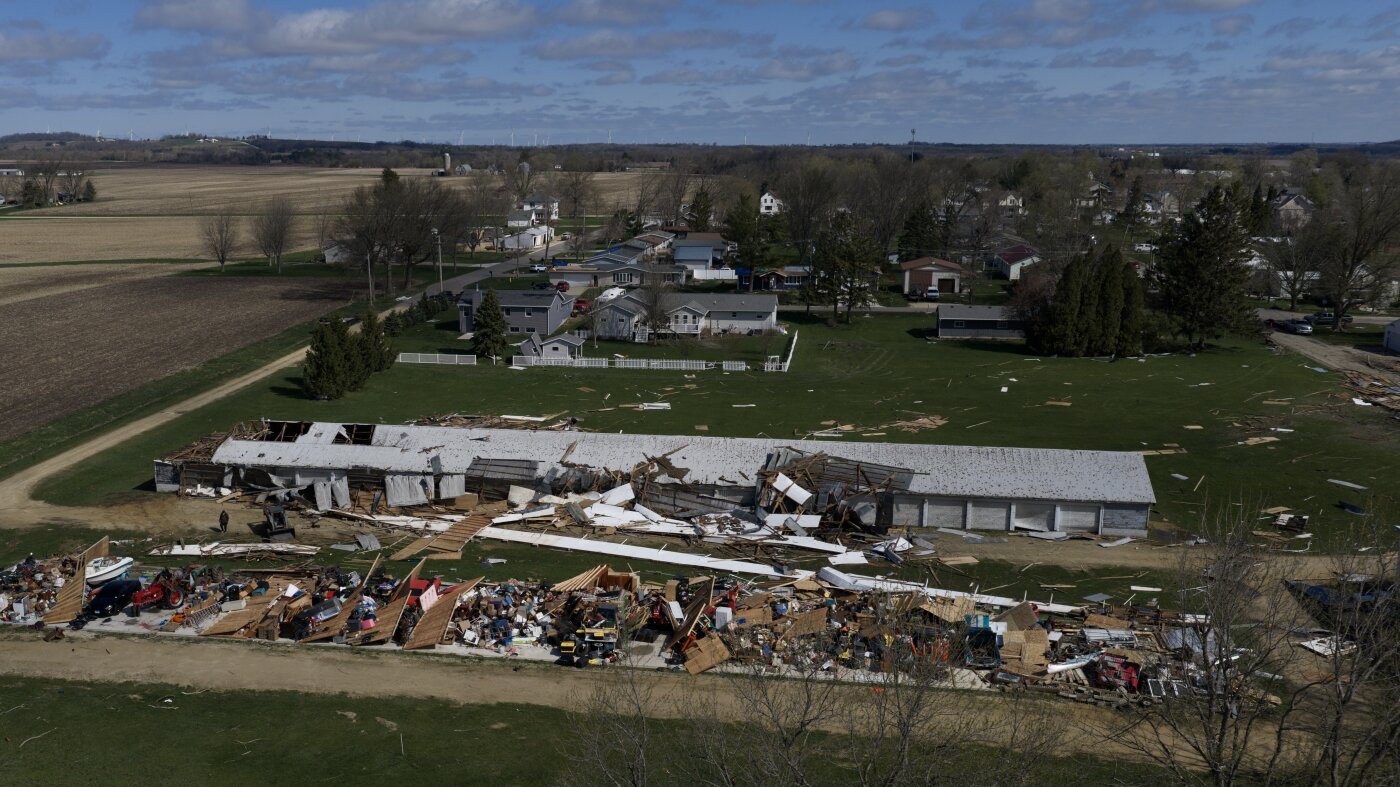
An aerial view shows damage from a tornado, on Saturday in Lena, Ill.
Scott Olson/Getty Images
hide caption
toggle caption
Scott Olson/Getty Images
Communities across the Upper Midwest are cleaning up after tornadoes and severe weather impacted the region over the weekend, damaging and destroying dozens of homes and knocking out power for tens of thousands.
“Numerous” severe storms were tracked across parts of Iowa, Illinois and Missouri on Friday, according to the National Weather Service. At least 66 tornado reports were submitted in multiple states including Oklahoma, Illinois, Missouri, Wisconsin and Iowa, the NWS Quad Cities IA/IL office said Sunday.
No deaths have been reported from the severe weather and tornado outbreak.

In Marion Township in Minnesota, about 30 homes were damaged and a dozen have significant damage because of a tornado, according to the Olmsted County Sheriff’s Office. The tornado also damaged at least 20 homes in Stewartville and there is a temporary shelter in Rochester for people displaced by the storms, according to MPR News.
“Tornado disaster recovery continues to occur at full speed,” the Olmsted County Sheriff’s Office said on Saturday.
In Illinois, McClean County officials declared a disaster emergency because of severe storms in Bloomington. “At this time, no injuries have been reported, and emergency response agencies remain actively engaged to ensure public safety and continuity of essential services,” officials said in a statement.
But further north in the village of Lena, an EF-2 tornado caused the “most significant damage” where “many homes and outbuildings were damaged, trees uprooted, and power lines downed,” the NWS said. Numerous roads have also been blocked by debris, the Stephenson County Sheriff’s Office also said.

People continue to clean up following a tornado, on Saturday in Lena, Ill.
Scott Olson/Getty Images
hide caption
toggle caption
Scott Olson/Getty Images
There have been no fatalities and no reports of serious injuries associated with the storm, Chief Deputy Andy Schroeder from the Stephenson County Sheriff’s Office told NPR on Sunday.
More than 43,000 customers lost power in Illinois but power was restored to almost all of them by Saturday night, according to electric utility ComEd.
Several tornadoes also occurred across Wisconsin, according to the NWS office in La Crosse. Twenty-six tornado warnings were issued by the office on Friday, the most in one day since the weather service office was built in 1995.

In one Marathon County town, 75 homes were destroyed by a tornado, according to Ringle Fire Chief Chris Kielman.
“It took out a whole residential area,” Kielman said, according to Wisconsin Public Radio.
The American Red Cross of Wisconsin said volunteers are helping those impacted by the storm with meals, shelter and support.
Parts of the state are still dealing with multiple rounds of severe weather and tornadoes from earlier in the week that brought flooding to some communities.
-
 Sports17 seconds ago
Quick final pit stop helps Alex Palou win Long Beach Grand Prix
-

 World12 minutes ago
Who is Rumen Radev, the former pilot who wants to give Bulgaria wings?
-

 News42 minutes ago
Tehran says ‘no plans’ for new talks after US seizes Iranian cargo ship
-

 New York2 hours ago
Inside the NYC Power Stations That Keep Trains Moving — or Bring Them to a Halt
-

 Detroit, MI3 hours ago
Detroit Pistons already facing must-win Game 2 vs Orlando Magic
-

 San Francisco, CA3 hours ago
Giants Head Home to San Francisco After Shutout Loss
-

 Dallas, TX3 hours ago
New video of Lake Dallas explosion draws focus on order decades ago to remove old plastic pipes
-
Miami, FL3 hours ago
Ty Simpson considered staying in college for $6.5 million offer from Miami
