News
A photographer captures life in America’s last remaining old-growth forests

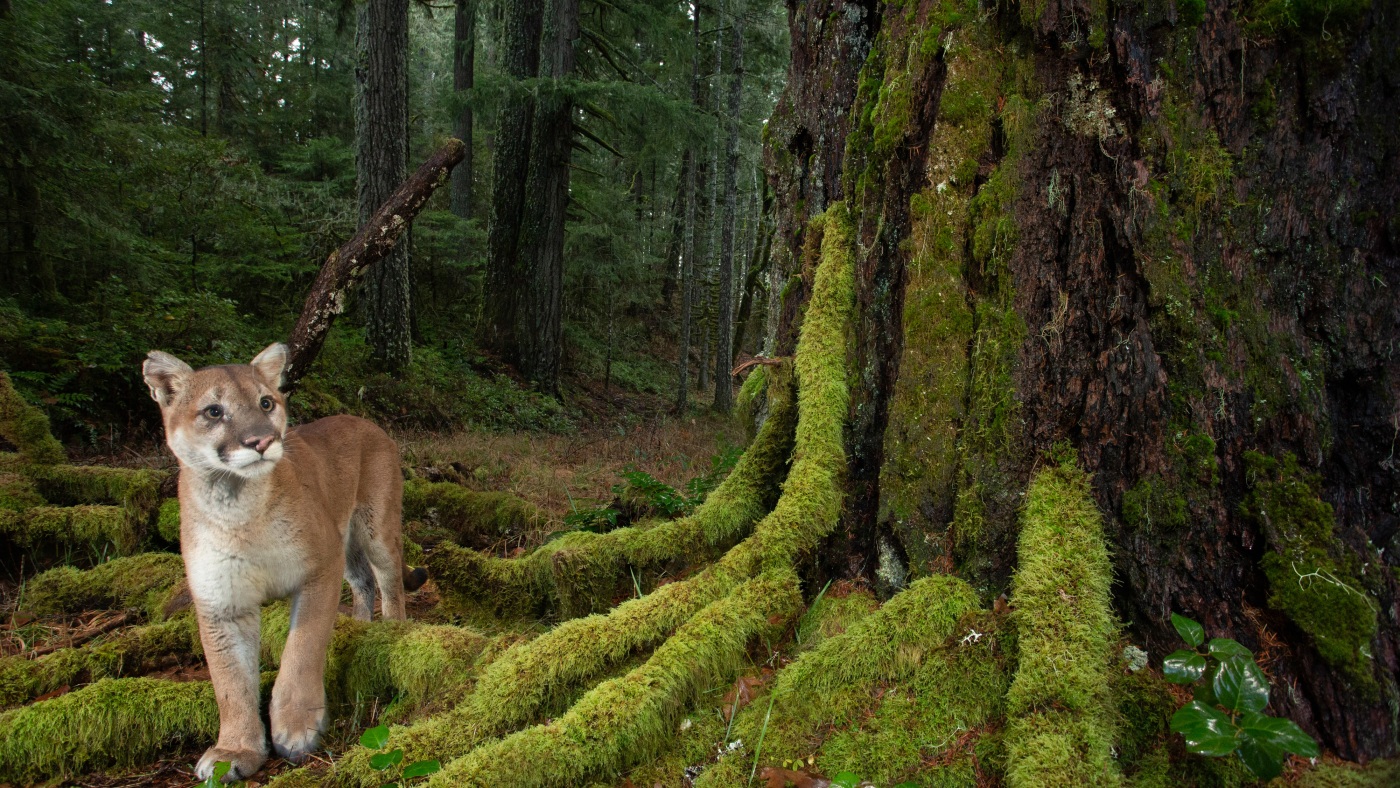
From mosses to mountain lions, the temperate old-growth rainforests of the Pacific Northwest provide the complexities and conditions necessary to support high levels of biodiversity. The Northwest Forest Plan has provided protection for these ancient ecosystems over the last 30 years and has helped advance forest management in Oregon, Washington and California. Developed in response to decades of unsustainable logging practices, the plan has helped restore forest ecosystems in 17 national forests.
David Herasimtschuk
hide caption
toggle caption
David Herasimtschuk
“As humans, our everyday lives are sustained by the behaviors and interactions of forest organisms,” photographer David Herasimtschuk writes of old growth forests. “Yet, because these processes and relationships occur in places and at scales rarely observed, our connection with forest biodiversity and the role it plays in nurturing our well-being often goes completely unnoticed.”
In the last 10 years, Herasimtschuk has photographed forests across the Pacific Northwest, documenting the inhabitants of these last remaining old-growth ecosystems. From salamanders and salmon to bears and mountain lions, his images illustrate not only the beauty of the forests and their creatures but the symbiotic relationships which are vital to the forests’ health and the planet’s welfare.
We interviewed Herasimtschuk about his efforts to educate people about the importance of preserving these ancient forests. The interview has been edited for clarity and length.

A group of pink salmon return home to the waters where they were born, bringing with them a pulse of nutrients that helps drive stream and forest ecosystems. From old-growth trees to aquatic insects, hundreds of species rely on the large amount of marine-derived nutrients that salmon provide. As salmon numbers have declined throughout the Pacific Northwest, this important ecological resource has been lost from many forest and river environments in the region. It’s now estimated that only 3-7% of the nutrients salmon deliver make it back into freshwater environments.
David Herasimtschuk
hide caption
toggle caption
David Herasimtschuk
What motivates you to photograph old-growth forests?
Protecting intact, mature and old-growth forests worldwide has been found to be one of the most immediate and cost-effective solutions to mitigating the impacts of climate change, yet adequate policy to manage these forests for ecosystem health and carbon storage has been limited.
The temperate rainforests of western North America have the highest carbon storage potential of any forest type in the world and are recognized as some of the most valuable ecosystems on the planet. Yet, conflicts over these forests have been ongoing since the 1980s, with the timber industry and conservation community battling over how they are managed.
Celebrating the beauty and importance of these environments, this photo essay is a present-day look at the complex connections we share with these forests. Currently, there are numerous proposed policy initiatives that are focused on creating a new framework for forest health and old-growth protection in the Pacific Northwest. This includes a movement to protect mature forests, which are made up of trees that are 80-150 years old and viewed as comprising the next generations of old-growth forests.

Climbing through an understory of fallen Douglas firs, a young black bear explores an old-growth forest in Oregon’s Coast Range. Researchers are finding that fallen trees, also known as “dead wood,” play an important role in forest ecosystems and influence everything from moisture and carbon storage to providing habitat for a number of species.
David Herasimtschuk
hide caption
toggle caption
David Herasimtschuk
These legislative actions also contain policy to update and rethink how private and state forests are managed in the state of Oregon, as well as work to modernize forest protection on federal lands nationwide. In an effort to advance our country’s climate initiatives, the Biden administration enacted an executive order in 2022 that committed the federal government to protecting the few remaining mature and old-growth forests we have left. In response to that order, the U.S. Forest Service plans to make major revisions to both the National Forest Plan and Northwest Forest Plan this year.
With many decisions currently being discussed about the fate of our forests in the Pacific Northwest, it’s important that the public and decision-makers understand how healthy forests function, and have the information they need to make science-based decisions in regard to forest management.

A clear-cut forest in Oregon’s Coast Range Forest. Recent research and analysis has shown that industrial logging practices impact both water quality and quantity. In Oregon’s Coast Range, stream flow was found to decrease by 50% on tree plantations that were cut on 40- to 50-year rotations.
David Herasimtschuk
hide caption
toggle caption
David Herasimtschuk
How long have you been working on this project?
I have been working, living and exploring in the Pacific Northwest since 2011, and started this old-growth focused project in 2022.
What kinds of images were you hoping to capture with your work?
From the top of the canopy to the waters below, my goal for this project is to create a series of photos that provide an entire ecosystem aesthetic. To do this, I work to create wide-angle images that put a species, or human, in context of the forest or habitat type.
Currently, a large amount of my work focuses on the connections between forests, rivers and fish. In the Pacific Northwest, the relationship between salmon and forests embodies a sense of connection that seems almost mystical. Delivering a pulse of nutrients, returning adult salmon nourish some of the largest trees in the world, and in return, these ancient forests provide a foundation for the complexity of conditions that salmon and other fish rely on. For millions of years, salmon, trout and numerous other aquatic species have adapted to the conditions created by these massive trees. From bank stabilization and water filtration to the creation of cover and spawning habitat, large trees provide a multitude of ecosystem services for aquatic environments.

In the Pacific Northwest, it’s becoming increasingly difficult to experience large salmon runs that are similar to what was seen historically. The forests of the Pacific Northwest have some of the highest carbon storage potential of any forest type in the world. With certain tree species’ ability to grow up to three times faster when supported by the nutrients salmon bring to a forest’s ecosystem, it’s believed that salmon restoration could be an important tool to help increase a forest’s ability to sequester carbon in the region.
David Herasimtschuk/Freshwaters Illustrated
hide caption
toggle caption
David Herasimtschuk/Freshwaters Illustrated
To illustrate these relationships, or to show how these connections have been lost, I work to find opportunities where I can put fish and forests in the same image. This type of image often helps share the story of how forest management plays a critical role in salmon conservation.

A male coho salmon migrates to its spawning waters in a small creek in Oregon’s Coast Range. Over a century of commercial logging has removed most of the old-growth trees from the region, resulting in riparian forests that are made up of much smaller trees. This lack of larger trees has had a major impact on forest and river ecosystems in the Northwest and remains as a major factor limiting in the conservation of federally protected fish, like coho salmon.
David Herasimtschuk/Freshwaters Illustrated
hide caption
toggle caption
David Herasimtschuk/Freshwaters Illustrated
What have you learned about the forest’s ecosystem since you’ve started this project?
One of the most important concepts I’ve come to understand while working on this project is that not all forests are equal. How we manage a forest can have huge repercussions that impact numerous species and processes, and can often lead to changes in ecosystem services that humans rely on.
Historically, the idea of old-growth forests as important natural systems was not the dominant perspective in our society. These ancient trees were once considered crops and perceived as “biological deserts.” Industrial logging in the 20th century removed most of the old growth, resulting in the younger forests we experience today. While some areas on federal land have been protected, allowing forests to regrow, there have also been large tracts of private land that are now managed for timber, and are cut every 50-80 years to meet the demand for timber.

A giant Douglas Fir disappears into the fog in Oregon’s Coast Range. The temperate rainforests of western Oregon have some of the highest potential to capture carbon of any forest type in the world, storing an average of 1,127 metric tons per hectare.
David Herasimtschuk
hide caption
toggle caption
David Herasimtschuk
Over the last 50 years, science has been working to understand how these impacts have changed forest ecosystems in the region. Beyond carbon sequestration, scientists are finding these environments play an important role in a multitude of ecosystem services, including water quantity and quality, and that management decisions can greatly impact these processes.
What have you learned that’s surprised you?
Looking beyond their physical beauty, scientists are discovering that old-growth forests are home to a network of almost unfathomable connections that showcase the importance and complexity of regions biodiversity. One of the greatest examples is the relationship between salmon and trees. Salmon are fundamental to the health of forest ecosystems in the Pacific Northwest. As they return home to spawn and die, they bring with them a large pulse of nutrients that helps drive stream and forest ecosystems. By absorbing the nutrients from decaying fish, researchers have found that salmon actually provide nitrogen to trees, which is a limited nutrient in forest ecosystems. It’s even been discovered that certain tree species can grow up to three times faster when influenced by salmon. As populations of these vital fish continue to decline throughout the Pacific Northwest, scientists worry that trees and forests no longer receive nutrients they need to reach their full ecological potential.

A western red-backed salamander navigates the understory leaf litter in a mature forest in Oregon’s Coast Range. Researchers in the Northwest have found that woodland salamanders actually play an important role in carbon storage by feeding on invertebrates that release carbon.
David Herasimtschuk/Freshwaters Illustrated
hide caption
toggle caption
David Herasimtschuk/Freshwaters Illustrated
Beyond the salmon and trees, some of the largest surprises in these forests come from some of the smallest species, like salamanders. Due to the cryptic nature of these amphibians, it’s hard to grasp their true importance within an ecosystem, but recent research has demonstrated that these amphibians play an important role in the global carbon cycle.
In Northern California, scientists have revealed that, by hunting and preying on insects that spend their lives ripping, shredding and feeding on leaves — a behavior that actually releases carbon dioxide into the atmosphere — salamanders effectively prevent this carbon from entering the atmosphere and allow it to stay locked in leaves and on the forest floor.

A group of rough-skinned newts interact with a breeding pair of newts in a small pond in Oregon’s Coast Range Mountains.
David Herasimtschuk/Freshwaters Illustrated
hide caption
toggle caption
David Herasimtschuk/Freshwaters Illustrated
What is your process for documenting the wildlife in the forest? Do you need special equipment?
Working and photographing in old-growth forests definitely comes with a unique set of challenges, and through trial and error, I’ve been able to develop methods that work relatively well in these environments. Documenting these forests from an ecosystem perspective often means I need a wide range of gear. This includes everything from underwater housings and drysuits to document fish, to camera traps to photograph large mammals like bears.
For me, personally, I also really enjoy the process and exploration that goes into the creation of each photograph. For each image, this often results in many miles hiked, and snorkeled, to learn the best locations and approaches to photograph different species. Most days aren’t a great success, photographically speaking, but I love being in the forest, and with each outing, I feel like I learn a little more.

Biologists from Oregon State University survey for trout and amphibians in the H.J. Andrews Experimental Forest. Tucked in the Cascade Mountain Range in western Oregon, this long-term ecological research site is one of the most studied old-growth ecosystems on the planet and has laid the foundation for how we understand forests worldwide.
David Herasimtschuk/Freshwaters Illustrated
hide caption
toggle caption
David Herasimtschuk/Freshwaters Illustrated
Do you work with scientists studying forest ecosystems? If so, how does that collaboration work?
Working at the confluence of science, conservation and storytelling, I’ve been fortunate to collaborate with many passionate scientists working at the forefront of forest ecology. Much of the imagery created for this project has been guided and inspired by the research and science from H.J. Andrews Experimental Forest, a forest co-managed by the U.S. Forest Service and Oregon State University. Tucked in the Cascade Mountain Range in western Oregon, this long-term ecological research site is one of the most studied old-growth ecosystems on the planet and has laid the foundation for forest science, understanding and policy worldwide.
As we move forward in our approach to address climate change, finding engaging and novel ways to communicate science becomes more important than ever. Working closely with the researchers who are uncovering the importance and mysteries of our natural world, this project focuses on creating imagery that sparks curiosity and helps celebrate the interactions and relationships in nature that are difficult to see.

A young black-tailed deer blends in among a pair of decomposing Douglas fir snags in Oregon’s Coast Range. Providing critical habitat for over one hundred species, snags help create locations for nesting, shelter and foraging, and are an incredibly important component to healthy old-growth ecosystems.
David Herasimtschuk
hide caption
toggle caption
David Herasimtschuk
What are some of your favorite images?
I think some of my favorite images so far for this project have been the ones created using camera traps. Communicating the size of old-growth trees is often difficult, so it’s helpful to have a subject in the image to convey scale. Few species symbolize wild environments better than mountain lions and bears, so to be able to create images of these elusive predators as they explore their old-growth habitats is truly special.

Navigating a maze of giant Douglas firs, a large black bear explores its home in one of the last old-growth stands left in Oregon’s Coast Range. These towering trees provide important habitat for bears, who use tree cavities as denning sites for their young and for hibernation.
David Herasimtschuk
hide caption
toggle caption
David Herasimtschuk
Creating a useful image with a camera trap can often take months of work and fine-tuning, and even then, it’s rare to get the shot you hoped for. The cameras sit in the forests for long periods of time, exposed to the elements and curious wildlife. It’s not uncommon to return to a trap to find it has been dismantled by a bear or knocked over from falling trees and branches.
Yet, with a little luck and a lot of persistence, every now and then you create a photo where all the elements come together. These unique photos provide an intimate perspective of these environments that few have ever seen, making them a valuable tool to help teach audiences about the importance of these forests.
What do you want people to come away with after looking at these images?
As the climate and planet continue to change, many people are trying to understand and grasp how the natural world is connected to their everyday lives. So often, the question is asked, what is the value of an individual species? Or what is the value of biodiversity? By creating storytelling imagery that helps audiences recognize the relevance of forest life, my hope is that this project will engage and inform audiences about the importance of old-growth ecosystems in the Pacific Northwest. Bringing to attention the individual species and relationships within ecosystems that play a role in maintaining our planet, my goal is to spark curiosity and wonder, encouraging people to want to learn more.
As our demand and impact on forests continues to grow worldwide, I believe images and stories of the environments and species affected will play a critical role in visually connecting forest ecosystems to their would-be stewards. Understanding the importance of biodiversity and how forests function is a critical part in creating that connection.

A hiker photographs a large western hemlock in an old-growth forest in Oregon’s Coast Range. Coastal forests in the region have some of the highest carbon-storing potential of any forest type in the world.
David Herasimtschuk
hide caption
toggle caption
David Herasimtschuk
David Herasimtschuk is a documentary photographer whose work focuses on forest and freshwater environments. You can find more of his photography on his website, DavidHerasimtschuk.com, and on Instagram, at @davidherasimtschuk.


A national physician staffing firm tried to take over the contract held by Eugene Emergency Physicians to work in local hospitals. The local physicians used a new state law to oppose the move.
sorbetto/Digital Vision Vectors/Getty Images
hide caption
toggle caption
sorbetto/Digital Vision Vectors/Getty Images
For the latest stories on the science of healthy living, subscribe to NPR’s Health newsletter.
In between shifts in the emergency room, Dr. Dan McGee was in an Oregon courtroom. He was fighting for his practice — Eugene Emergency Physicians (EEP). The group of more than 40 doctors and physician assistants work at multiple emergency departments; it was being replaced by a national company.
“This was big time, David and Goliath stuff,” McGee said. “You see 14 of their lawyers sitting there and you see three of ours.”
Those lawyers argued that ApolloMD, the national company, violated Oregon’s corporate practice of medicine law. The 2025 law bans corporations from taking control of a medical practice’s operations and finances.
The case garnered national interest because Oregon’s new law targets the loopholes large staffing firms have been employing to circumvent state corporate medicine laws.

Money for control
Most states have laws requiring that doctors own medical practices, not corporations. These rules aim to put patient interests ahead of profit motives. Over the last several years, companies have used a model where a doctor technically owns the local practice, but as Erin Fuse Brown, a professor at Brown University, explains, those physician owners are often not involved in care and cede hiring, firing and other operational functions to the corporation.
Fuse Brown said these arrangements are attractive to hospitals because these companies often promise more revenue and take over the responsibilities that come with running an ER.
“There’s worry that these investors or these corporate management companies should not be totally controlling the operations and the clinical decisions of those who are trained to deliver patient care,” Fuse Brown said.
The connection to patient care concerned Dr. Jonas Pologe, who works for Eugene Emergency Physicians, in the Eugene, Ore., area. ApolloMD offered local doctors jobs, but Pologe worried that if he pushed back on decisions ApolloMD made, he could lose work hours.
“There’s certainly a chance that if you make enough of a stink, you think that something needs to change, they can just stop giving you shifts,” said Pologe.

ApolloMD’s CEO, Dr. Yogin Patel, said the group doesn’t infringe on the way its doctors practice. He says the company is being unfairly lumped in with broader concerns over physicians’ feelings of disempowerment at the hands of corporate medical takeovers.
A closely watched experiment
Fuse Brown, policy experts and independent physicians theorized that updating state corporate medicine laws could be a fix to limit the control management companies can exert over medical doctors.
Oregon’s the first state to try this, and the case brought by the Eugene doctors group is the first test of that law. McGee, who leads the Eugene physicians group, says colleagues at other hospitals around the state were literally tuning in to their case.
“You could hear it almost like background music on an elevator,” McGee says he was told. “At key moments, all of a sudden the nurses would break out in a cheer.”
Before any ruling, the hospital system dropped its plan to work with ApolloMD and struck a deal to stick with McGee’s local group of doctors.
“This is a big victory for independent physician groups over corporate medicine,” McGee said. “This is a game changer.”
The American Academy of Emergency Medicine (AAEM) supported the Eugene doctors as part of the organization’s strategy to protect independent practices. The AAEM president, Dr. Vicki Norton, said Oregon has the strongest law in the country.
“This signals that that law works and we need it replicated in other states to really strengthen their corporate practice laws,” said Norton.
California and Vermont have passed similar legislation to Oregon, and lawmakers in other states, including Rhode Island and New Mexico, are considering related bills.
In Virginia, an independent group of ER doctors who were replaced by a large staffing firm is meeting with state legislators to try to change their laws.
Impact on Oregon physicians
Back in Oregon, the open question is about how the law may impact the physician practice market.
A few of the largest companies, Envision Healthcare, TeamHealth and USACS, declined to answer NPR’s questions about whether this case or the new law changed their outlook on investing in Oregon practices.
Opponents of the legislation warned lawmakers that many physician groups depend on outside investment to survive.

In an exclusive interview with CBS News on Thursday, Treasury Secretary Scott Bessent said he doesn’t believe the recent disclosure of President Trump’s billions in crypto earnings is problematic for the president.
“I don’t think there’s an appearance problem,” Bessent told CBS News anchor and MoneyWatch correspondent Kelly O’Grady regarding Mr. Trump’s earnings.
According to a financial disclosure released earlier this week, Mr. Trump has earned approximately $1.4 billion from his crypto ventures since beginning his second term. Those include his “meme coin” $TRUMP and earnings from World Liberty Financial, a cryptocurrency company backed by the president and his family.
Congressional Democrats have criticized Mr. Trump’s crypto windfall, arguing it presents a conflict of interest since his administration has sought to loosen regulations on cryptocurrency.
“This is an innovation presidency,” Bessent told CBS News. “So whether it’s digital access, whether it’s AI, whether it’s everything that is going on in the tech ecosystem that, you know, all Americans are benefiting from that.”
White House spokesperson Anna Kelly told CBS News on Tuesday that “there are no conflicts of interest” in the disclosure.
In his interview with CBS News, Bessent also touched on the latest developments with the tax-deferred Trump Accounts and his outlook for the U.S. economy as it grapples with the impacts of the Iran war.
Economic relief is coming for American families, Bessent believes
The Treasury secretary said his message to Americans who are experiencing strain at the grocery store and at the pump wrought by the Iran war is that “we’re going to get to the other side of this.”
Since the war began in late February, halts to shipping traffic in the critical Strait of Hormuz, which handles roughly 20% of the world’s global oil supply, have led to rising gas prices, which have in turn accelerated inflation and raised costs more broadly. In May, the annual inflation rate rose to 4.2%, according to the Labor Department, its highest level since April 2023.
The average price of a gallon of regular gasoline on Thursday was $3.83, according to AAA. At the height of the war, gas prices topped $4.50 a gallon, but have steadily declined in recent weeks as oil prices return to near prewar levels and the U.S. and Iran negotiate over a more permanent end to the war.
Bessent said he is hopeful that the average drops to $3 a gallon by Labor Day.
“Gasoline prices are a little stickier on the way down,” Bessent said. “We’re trying to give the gasoline retailers a little bit of a nudge. We’re telling them we’re watching them. We’ve had some good uptake from some of the bigger retailers from some of the bigger retailers in terms of what they want to do for consumers.”
Thursday’s jobs report from the Bureau of Labor Statistics showed that U.S. employers added 57,000 jobs in June, far below what economists had predicted, but the unemployment rate held steady, dipping slightly to 4.2% from 4.3% the month before. However, the report found that annual wage growth was 3.5%, below the rate of inflation.
Bessent described the discrepancy between wage gains and inflation as a “short-term spike,” and said he expects to see oil and energy prices continue to drop.
“I would expect, perhaps, as soon as this month, we’re going to see real wage gains,” Bessent said.
Asked whether the stock market’s strong performance in recent months, or the real-world pressure facing many Americans, is a more realistic view of the state of the U.S. economy, Bessent said he believes the market’s strong performance will be predictive of the direction the economy takes.
“The stock market lives in the future. So what the stock market is telling us is, presumably, what I am saying today, that we’ll get to the other side of this,” Bessent said. “Rates will come down and then we will be back up to real wage gain. So both can be true.”
Trump Accounts a tool to create “financial literacy,” Bessent says
The White House announced this week that beginning on July 4, Americans can begin contributing to Trump Accounts, a federal program launched earlier this year designed to help children under 18 invest money in the stock market and build savings before they reach adulthood, similar to how adults save for retirement.
“Thirty-eight percent of American households have no investment in our great equity markets, and we want everyone to share, you know, in the bounty that is the U.S.,” Bessent said. “In our innovation and our capital markets, and, you know, the economic engine, greatest in the history of the world. So, you know, over time, I would think that that 38% number would move toward zero. And then the other thing too is financial literacy.”
According to Bessent, more than 6 million Trump Accounts have been opened so far, and there are approximately 70 million children in the U.S. eligible for them.
On July 4, the federal government will begin contributing $1,000 to accounts for eligible children who are born between Jan. 1, 2025, and Dec. 31, 2028. The Trump Accounts were part of the White House’s “big, beautiful bill” legislation passed last year.
Bessent noted how wealthy philanthropists, organizations and states can also donate to the accounts, even by contributing public stock. Last year, Michael Dell, who founded Dell Technologies, and his wife Susan Dell announced they would donate $6.25 billion to the accounts, or $250 per person.
“I would expect that we are going to see, again from these philanthropic families and institutions and companies, I would expect that we would see the lower-income profile families, actually the accounts will be topped up more,” Bessent said.
Bessent said the accounts could also build throughout adulthood and be rolled into an individual retirement account.
“We want them to really understand the power of long-term compounding,” Bessent said of the families who take part in the program. “That you’ll own a share of a company, that many people have – bank deposits. They’re used to getting interest, they’re used to paying interest. So what we want them to understand is, what does a piece of the action feel like?”
News
Ukraine latest / Limits of military might / Can major powers regain dominance? : Sources & Methods

A view taken on June 24 shows a heavily damaged multi-story apartment building following a recent attack, which local Russian-installed officials called a Ukrainian drone strike, in the town of Gorlivka in the Donetsk region, Russian-controlled Ukraine, amid the ongoing Russian-Ukrainian conflict.
AFP via Getty Images
hide caption
toggle caption
AFP via Getty Images
Four years in and Ukraine is still giving Russia a run for its money. Four months in and Iran shows no sign of bowing to U.S. demands.
What do Russia’s fight with Ukraine and the U.S. war with Iran tell us about the limits of military might?
Host Mary Louise Kelly speaks with NPR’s Ukraine Correspondent Joanna Kakissis about the overnight attack in Kyiv, which comes on the heels of Ukraine’s drone assaults in Moscow. NPR National Security Correspondent Greg Myre joins them to talk about what the conflicts in Ukraine
and Iran say about military might and whether major powers can regain dominance.
Email the show at sourcesandmethods@npr.org
NPR+ supporters hear every episode without sponsor messages and unlock access to our complete archive. Sign up at plus.npr.org.
-

 Los Angeles, Ca28 seconds ago
Wildfire burning on hillside near Cal State San Bernardino
-

 Detroit, MI18 minutes ago
Pistons sign premier shot-blocker to two-way contract
-

 San Francisco, CA31 minutes ago
1 dead, 1 injured in Bay Point shooting; suspect sought
-

 Dallas, TX33 minutes ago
Viral video shows Egypt coach, team director in Dallas police confrontation
-

 Miami, FL33 minutes ago
Fourth of July celebrations planned across South Florida for America’s 250th birthday
-

 Boston, MA46 minutes ago
‘Forever grateful for all we accomplished together’: Jayson Tatum speaks out about Jaylen Brown trade – Boston News, Weather, Sports | WHDH 7News
-

 Denver, CO48 minutes ago
Nations Cup in Colorado another showcase for Denver’s bid to host the 2031 Rugby World Cup
-

 Seattle, WA53 minutes ago
USA Coach Mauricio Pochettino To Throw Out First Pitch At Seattle Mariners Game

