News
A bloody nose, a last hurrah for friends, and more prom memories you shared with us


Eddie Almance, left, and his sister Leila, pose for portraits taken by their cousin Ailem Villarreal on the rooftop of the Marriott Hotel in downtown Odessa, Texas
Danielle Villasana/Danielle Villasana
hide caption
toggle caption
Danielle Villasana/Danielle Villasana

Eddie Almance, left, and his sister Leila, pose for portraits taken by their cousin Ailem Villarreal on the rooftop of the Marriott Hotel in downtown Odessa, Texas
Danielle Villasana/Danielle Villasana
It’s prom season, and we asked you to share stories from that special night, whether you went last year or decades ago.
We received many heartwarming stories about going to prom with friends, future spouses and high school sweethearts.
Some people told us they didn’t go to prom at all — or didn’t go with a date. Some people learned big lessons at their prom, while others had unforgettable mishaps.
Here are some of the memories you shared with us. And remember that you can participate in future callouts by signing up for NPR’s Up First newsletter.
Day-of mishaps didn’t stop the celebrations
Marshall Metcalf from Taylorville, Ill. recalls how, after walking into his prom, his “nose exploded in a spontaneous fountain of blood.”
It was “Kind of like Footloose, without the fighting or dancing. Just an enormous nosebleed, all down the white rented shirt,” Metcalf wrote. “I dove into the bathroom to clean up, terribly embarrassed. But to my great surprise no one commented on it the rest of the night. Guess my classmates weren’t that bad after all.”
Anthony Rodas from Wisconsin almost crashed his car when his date mentioned she was dating someone else. “On the way there, she nonchalantly mentions, ‘Oh, by the way, that guy is my boyfriend.’ I drove through a stop sign — which has flashing red lights below the sign as well as little LEDs around the signs themselves, the least excusable stop sign to run — as I am processing what had just happened,” Rodas wrote. His date was a little startled and concerned, but no one was hurt and they made it safely to prom. “It was rather awkward, and we spent a good portion of the prom doing our own things, but we did dance to a few songs and still ended up having a good time,” Rodas wrote.
Jessica Reitano also ended up marrying her prom date. In 1990, her and her now husband crashed a prom when she came back home from college.
Jessica Reitano
hide caption
toggle caption
Jessica Reitano
Jessica Reitano also ended up marrying her prom date. In 1990, her and her now husband crashed a prom when she came back home from college.
Jessica Reitano
Josh Waters in Georgia wrote that his “prom date was so mad at me because I refused to wait in line for pictures right when we got there.”
After three hours of dancing to Boyz II Men, the pair looked “a sweaty mess. However, it must not have made her that mad,” Waters wrote. “We just celebrated 16 years of marriage.”
Prom night was clouded by difficult times, personal and political, for some
Robin Dias of Scottsdale, Ariz. went to prom in Darien, Conn. in 1968, as unrest around the Vietnam War reached its peak. The spring was fraught with protests, political unrest and the assassinations of two of America’s most high profile leaders, Martin Luther King and Robert F Kennedy. Dias wrote that “It almost seemed wrong to want to dress like a princess at a ball when there was so much turmoil,” Dias wrote.
She recalled her mother standing in her bedroom, ironing while the TV blared with the news of the MLK funeral march. Dias’ mother sighed, and said aloud, “It’s all so terrible. But I really hope the school won’t cancel the proms this spring. You kids still deserve to have your Prom Night.”
Casey Promise Thompson was one of the only openly gay students at her prom night in her small town in Tennessee.
“I walked in, nervous of people’s reactions to me wearing a tux. I had lived a life of being severely bullied and not being the best at making friends. But I had evolved over time and tried to learn to connect to others through art,” Thompson wrote to us.
She would give away her doodles and sketches all the time. She estimates she probably gave away hundreds of drawings. So, it came as no surprise that by senior year, she was voted “Most Talented” by her classmates.
Of course, this would mean that she would have to get on stage at prom and accept her award with all the other superlatives. “I was immediately nervous and sick to my stomach,” she wrote. “Instead of the expected cold shoulder and fear of being laughed at, they all smiled and welcomed me.”
Thompson learned an important lesson that day: “It suddenly dawned on me that my art had made an impact. Everyone did know who I was. I had actually been a popular kid my Senior year and I didn’t even know it. My brain had built up this idea that no one liked me all of these years, and right before I graduated high school…I finally learned that people actually did respect and appreciate me. My art has made me into someone.”
Romantic dates weren’t always the focus of prom
In 2010, Karley Ford went to her senior prom with her best friends instead of a date.
Karley Ford
hide caption
toggle caption
Karley Ford
In 2010, Karley Ford went to her senior prom with her best friends instead of a date.
Karley Ford
Karley Ford in Colorado told us that she “had the worst luck with getting dates to… literally any dance. I was just perpetually single. Prom was no exception. Junior prom, my date got swine flu. Senior prom, my date decided to go with someone else– one week – before prom. I had already gotten his boutonniere in 2010.
At senior prom, Ford said she expected to be depressed because she was going alone. One of her good friends asked Ford to join her as her “date” a couple days before.
“The best thing, though, was this picture. We had been friends since grade school, and it was one of the last hurrahs together before going off to college or wherever the wind took us,” Ford wrote. “Despite me not having a date, my childhood friends all rallied together, made sure that I had reasons to smile and reminded me that I am never alone (and I didn’t need a stinkin’ date).”
Going with a friend also made things 10 times more fun for Laura Popielski in Washington D.C. “My best friend and I decided to go to prom months before the date. He was gay and I was a bit of a wallflower when it came to dating/boys so it made good sense to go together,” Popielski wrote. “Nine years later, he passed away and now it’s been ten years since that… and I still remember how fun it was to collaborate with him, how we were the perfect pair.”
Some who didn’t attend prom are stamping their own traditions on the day
Ananya Paul grew up in India and never went to prom. Now in California, she “will be making memories when my rising Junior wears a saree to her prom. Our children take pride in celebrating and showcasing their culture.” Paul wrote that it is “heartening” to see more students wear traditional attire like sarees or lehengas to prom in recent years.
“What’s also intriguing is how my daughter has chosen to go to prom with her girlfriends rather than a date. It speaks volumes about the evolving dynamics of friendship and independence among today’s youth,” Paul wrote. “It’s these unique cultural shifts and personal choices that make each prom season special and memorable in its own way.”
Chad Campbell contributed production to the audio version of this story and Ally Schweitzer edited. The digital version was edited by Obed Manuel.






Mojtaba Khamenei, the second son of the assassinated Ali Khamenei, is being heavily tipped to succeed his father as supreme leader of Iran, which would pitch a hardliner into the task of steering the Islamic republic through the most turbulent period in its 48-year history and offer a powerful signal that, for now, it has no intention of changing course.
No official confirmation has been given and the announcement may be delayed until after the funeral of Ali Khamenei, which was on Wednesday postponed.
His son is believed to have been the choice of the Islamic Revolutionary Guard Corps (IRGC), and the Israeli defence minister, Gideon Saar, has warned he will be assassinated.
Ayatollah Seyed Khatani, a member of the Assembly of Experts, the body that chooses the new supreme leader, said the assembly was close to selecting a leader.
Rigid in his anti-western views, Mojtaba Khamenei is not the candidate Donald Trump would have wanted. Marco Rubio, the US secretary of state, said on Tuesday that Iran was run by “religious fanatic lunatics” – and Khamenei’s appointment is hardly likely to dispel that opinion.
The choice of supreme leader is made by the 88-strong Assembly of Experts, who in this case are picking from a field of six possible candidates. His election would be a powerful if unsurprising symbol that the government is not looking to find an accommodation with America.
Trump has said the worst-case scenario would be if Khamenei’s successor was “as bad as the previous person”.
There has been speculation for more than a decade that he would be his father’s successor, which grew when Ebrahim Raisi, the elected president and favourite of Khamenei, was killed in a helicopter crash.
Mojtaba Khamenei was born in 1969 and studied theology after graduating from high school. At the age of 17, he went to serve in the Iran-Iraq war, but it was not until the late 1990s that he came to be recognised as a public figure in his own right.
After the landslide defeat of Khamenei’s preferred candidate, Ali Akbar Nategh Nuri, in the 1997 presidential election, where he won only 25% of the final vote, various conservative Iranian groups realised the need to make changes to their structures and Mojtaba Khamenei was central to that project.
He was also seen as instrumental by reformists in suppressing the protests in 2009 that came after allegations the presidential election had been rigged, with his name chanted in the streets as one of those responsible. Mostafa Tajzadeh, a senior member of Iran’s reformist parties who was imprisoned after the vote, alleged that his and his wife, Fakhr al-Sadat Mohtashamipour’s, legal case was under the direct supervision of Mojtaba Khamenei.
In 2022 he was given the title of ayatollah – essential to his promotion. By then he was a regular figure by his father’s side at political meetings, as well as playing an influential role in the Islamic Republic’s Broadcasting Corporation, the government’s official media outlet often criticised for churning out dull political propaganda that many Iranians reject in favour of overseas satellite channels. He has also played a central role in the administration of his father’s substantial financial empire.
His closest political allies are Ahmad Vahidi, the newly appointed IRGC commander; Hossein Taeb, a former head of the IRGC’s intelligence organisation; and Mohammad Bagher Ghalibaf, the current speaker of the parliament.
His rumoured appointment and its hereditary nature has long been resisted by reformists. The former prime minister Mir Hossein Mousavi, referring to the long history of rumours about Mojtaba Khamenei succeeding his father as leader, wrote in 2022: “News of this conspiracy have been heard for 13 years. If they are not truly pursuing it, why don’t they deny such an intention once and for all?”
The Assembly of Experts, in response, denounced “meaninglessness of doubts” and said the assembly would select only “the most qualified and the most suitable”.
Israel on Tuesday struck the building in the Iranian city of Qom, one of Shia Islam’s main seats of power, where the assembly was scheduled, but the building was empty, according to IRGC-affiliated media.

new video loaded: Senators Question Kristi Noem on ICE Immigration Tactics
transcript
transcript
Senators Question Kristi Noem on ICE Immigration Tactics
Homeland Security Secretary Kristi Noem repeatedly refused to apologize for suggesting that Alex Pretti and Renee Good, two U.S. citizens shot and killed by agents, were domestic terrorists.
-
What we’ve seen is a disaster under your leadership, Ms. Noem. A disaster. What we’ve seen is innocent people getting detained that turn out are American citizens. I could talk about the culture that’s been created here. After the killings of Renee Good and Alex Pretti, when I spoke to Alex’s parents, they told me that you calling him a domestic terrorist — this was directly from them — the day after he was killed, a nurse in our V.A., Alex — one of the most hurtful things they could ever imagine was said by you about their son. Do you have anything you want to say to Alex Pretti’s parents? Ma’am, I did not call him a domestic terrorist. I said It appeared to be an incident of — I think the parents saw it for what it was. In a hearing — recent hearing before the HSGAC committee, C.B.P. and ICE officials testified under oath that their agencies did not inform you that Pretti was a domestic terrorist — during that hearing, stated during that hearing, I was getting reports from the ground, from agents at the scene, and I would say that it was a chaotic scene. How did you think that calling them domestic terrorists at that scene was somehow going to calm the situation? The fact that you can’t admit to a mistake, which looks like under investigation, it’s going to prove that Ms. Good and Mr. Pretti probably should not have been shot in the face and in the back. Law enforcement needs to learn from that. You don’t protect them by not looking after the facts.

By Christina Kelso and Jackeline Luna
March 3, 2026

The Trump administration is sending pregnant unaccompanied minors to a South Texas shelter (above) flagged as medically inadequate by officials from the Office of Refugee Resettlement. The facility is run by a for-profit contractor called Urban Strategies.
Patricia Lim/KUT News
hide caption
toggle caption
Patricia Lim/KUT News
The Trump administration is sending all pregnant unaccompanied minors apprehended by immigration enforcement to a single group shelter in South Texas. The decision was made over urgent objections from some of the administration’s own health and child welfare officials, who say both the facility and the region lack the specialized care the girls need.
That’s according to seven officials who work at the Office of Refugee Resettlement within the U.S. Department of Health and Human Services, which takes custody of children who cross the border without a parent or legal guardian, or are separated from family by immigration authorities. The children remain in ORR’s care until they can be released to an adult or deported, or turn 18.
All of the officials asked not to be named for fear of retaliation.
Since late July, more than a dozen pregnant minors have been placed at the Texas facility, which is in the small border city of San Benito. Some were as young as 13, and at least half of those taken in so far became pregnant as a result of rape, the officials said. Their pregnancies are considered high risk by definition, particularly for the youngest girls.
“This group of kids is clearly recognized as our most vulnerable,” one of the officials said. Rank-and-file staff, the official said, are “losing sleep over it, wondering if kids are going to be placed in programs where they’re not going to have access to the care they need.”
The move marks a sharp departure from longstanding federal practice, which placed pregnant, unaccompanied migrant children in ORR shelters or foster homes around the country that are equipped to handle high-risk pregnancies.
The ORR officials said they were never told why the girls are being concentrated in a single location, let alone in this particular shelter in Texas. But they — along with more than a dozen former government officials, health care professionals, migrant advocates and civil rights attorneys — worry the Trump administration is knowingly putting the children at risk to advance an ideological goal: denying them access to abortion by placing them in a state where it’s virtually banned.
“This is 100% and exclusively about abortion,” said Jonathan White, a longtime federal health official who ran ORR’s unaccompanied children program for part of President Trump’s first term. White, who recently retired from the government, said the administration tried and failed to restrict abortion access for unaccompanied minors in 2017. “Now they casually roll out what they brutally fought to accomplish last time and didn’t.”
Asked if the administration is sending pregnant children to San Benito to restrict their access to abortion, HHS said in a statement that the allegation was “completely inaccurate.”
In an earlier statement, the department said that “ORR’s placement decisions are guided by child welfare best practices and are designed to ensure each child is housed in the safest, most developmentally appropriate setting, including for children who are pregnant or parenting.”
But several of the ORR officials took issue with the department’s statement. “ORR is supposed to be a child welfare organization,” one of them said. “Putting pregnant kids in San Benito is not a decision you make when you care about children’s safety.”
ORR’s acting director, Angie Salazar, instructed agency staff to send “any pregnant children” to San Benito beginning July 22, 2025, according to an internal email obtained as part of a six-month investigation by The California Newsroom and The Texas Newsroom, public media collaboratives that worked together to produce this story.

A copy of the July 22, 2025, email notifying ORR supervisors of the directive to send pregnant unaccompanied minors to a single shelter in San Benito, Texas. The move comes over objections from the government’s own health and child welfare officials.
hide caption
toggle caption
Several of the officials said a handful of pregnant girls have mistakenly been placed in other shelters because immigration authorities didn’t know they were pregnant when they were transferred to ORR custody.
Since the July order, none of the pregnant girls at the San Benito facility have experienced major medical problems, according to the ORR officials and Aimee Korolev, deputy director of ProBAR, an organization that provides legal services to children there. They said several of the girls have given birth and are detained with their infants.
But ORR officials interviewed for this story said they worry the shelter is only one high-risk pregnancy away from catastrophe.
“I feel like we’re just waiting for something terrible to happen,” one of the officials said.
‘Blown away by the level of risk’
There are dozens of ORR shelters or foster homes across the country that are designated to care for pregnant unaccompanied children, according to several of the ORR officials, with 12 in Texas alone. None of them could recall a time when all of the pregnant minors in the agency’s custody were concentrated in one shelter.
Detaining them in San Benito, Texas, doctors and public health experts said, is a dangerous gambit.
“It’s not good to be a pregnant person in Texas, no matter who you are,” said Annie Leone, a nurse midwife who recently spent five years caring for pregnant and postpartum migrant women and girls at a large family shelter not far from San Benito. “So, to put pregnant migrant kids in Texas, and then in one of the worst health care regions of Texas, is not good at all.”
The specialized obstetric care that exists in Texas is mostly available in its larger cities, hours from San Benito. And several factors, including the high number of uninsured patients, have eroded the availability of health care across the state.
Furthermore, Texas’ near-ban on abortion has been especially devastating to obstetric care. The law allows an exception in cases where the pregnant person’s life is in danger or one of her bodily functions is at risk, but doctors have been confused as to what that means.
Many doctors have left to practice elsewhere, and those who’ve stayed are often scared to perform procedures they worry could come with criminal charges. While Texas passed a law clarifying the exceptions last year, experts have said it may not be enough to assuage doctors’ fears.
Several maternal health experts listed the potential dangers for the girls at the San Benito shelter: If one of them develops an ectopic pregnancy (where the fertilized egg implants outside the uterus), if she miscarries or if her water breaks too early and she gets an infection, the emergency care she needs could be delayed or denied by doctors wary of the abortion ban.
Getting the care that is available could take too long to save her life or the baby’s, they added.
Adolescents are also more likely to give birth early, which can be life-threatening for both mother and baby. The youngest face complications during labor and delivery because their pelvises aren’t fully developed, said Dr. Anne-Marie Amies Oelschlager, an obstetrician in Washington state who specializes in adolescent pregnancy.
“These are young adolescents who are still going through puberty,” she said. “Their bodies are still changing.”
Pregnant girls who recently endured the often harrowing journey to the U.S. face even more risk, obstetrics experts said. Experts who work with migrant children say many are raped along the way and contract sexually transmitted infections that can be dangerous during pregnancy. Add to that little to no access to prenatal care or proper nourishment, and then the trauma of being detained.
“You couldn’t set up a worse scenario,” said Dr. Blair Cushing, who runs a women’s health clinic in McAllen, about 45 minutes from San Benito. “I’m kind of blown away by the level of risk that they’re concentrating in this facility.”
A history of problems
The San Benito shelter is owned and operated by Urban Strategies, a for-profit company that has contracted with the federal government to care for unaccompanied children for more than a decade, according to USAspending.gov.

Meliza Fonseca lives across the street from the San Benito shelter. She said she occasionally sees kids in the yard on weekends, “but for the most part, you don’t see them.”
Patricia Lim/KUT
hide caption
toggle caption
Patricia Lim/KUT
The main building, an old tan brick Baptist Church, occupies a city block in downtown San Benito, a quiet town of about 25,000. The church was converted to a migrant shelter in 2015 and was managed by two other contractors before Urban Strategies took it over in 2021.
On a fall day last year, there were no signs of activity at the facility, though children’s lawn toys and playground equipment were visible behind a wooden fence. A guard was stationed at one of the entrances.
“It’s pretty quiet, just like it is today,” said Meliza Fonseca, who lives nearby. “That’s the way it is every day.”
She said she occasionally sees kids playing in the yard on weekends, “but for the most part, you don’t see them.”
Reached by email, the founder and president of Urban Strategies, Lisa Cummins, wrote that the company is “deeply committed to the care and well-being of the children we serve,” and directed any questions about ORR-contracted shelters to the federal government.
When asked about the San Benito facility, HHS wrote that “Urban Strategies has a long-standing record of delivering high-quality care to pregnant unaccompanied minors, with a consistently low staff turnover.”
But the ORR officials who spoke with the newsrooms said that as recently as 2024, staff members at the shelter failed to arrange timely medical appointments for pregnant girls or immediately share critical health information with the federal agency and discharged some of them without arrangements to continue their medical care.
ORR barred the shelter from receiving pregnant girls from September to December of 2024 while Urban Strategies implemented a remediation plan, but the plan did not add staff or enhance their qualifications, the officials said.
Some of the officials said ORR’s leadership was provided with a list of shelters that are better prepared to handle children with high-risk pregnancies. All of those shelters are outside Texas, in regions where the full range of necessary medical care is available. Yet the directive to place them at San Benito remains in place.
“It’s cruel, it’s just cruel,” one of the officials said. “They don’t care about any of these kids. They’re playing politics with children’s health.”
‘A dress rehearsal’
Jonathan White, who ran ORR’s unaccompanied children program from January of 2017 to March of 2018, said he wasn’t surprised to learn that the new administration is moving pregnant unaccompanied children to Texas.
“I’ve been expecting this since Trump returned to office,” White said in an interview.
He said he views the San Benito order as a continuation of an anti-abortion policy shift that began in 2017, which “ultimately proved to be a dress rehearsal for the current administration.”
Scott Lloyd, the agency’s director at the time, denied girls in ORR custody permission to end their pregnancies, court records show. Lloyd also required the girls to get counseling about the benefits of motherhood and the harms of abortion and personally pleaded with some of them to reconsider.
“I worked to treat all of the children in ORR care with dignity, including the unborn children,” Lloyd told the newsrooms in an email.
In the fall of 2017, the American Civil Liberties Union filed a class action lawsuit against Lloyd and the Trump administration on behalf of pregnant girls in ORR custody. The ACLU argued that denying the girls abortions violated their constitutional rights, established by the Supreme Court in its 1973 Roe v. Wade decision.
Not long after the lawsuit was filed, White said, he received a late-night phone call from Lloyd, who had a request. He wanted White to transfer an unaccompanied pregnant girl who was seeking an abortion to a migrant shelter in Texas, where, under state law, it would have been too late for her to terminate her pregnancy. White said that he believed following the order would have been unlawful because it might have denied the girl access to legal relief under the lawsuit, so he refused. The girl was not transferred.
Lloyd, who has since left the government, acknowledged making the request but said he didn’t think it was illegal.
The lawsuit was settled in 2020; the first Trump administration agreed not to impede abortion access for migrant youth in federal custody going forward. Four years later, the Biden administration cemented the deal in official regulations: If a child who wanted to terminate her pregnancy was detained in a state where it was not legal, ORR had to move them to a state where it was.
That rule remains in place, and the agency appears to be following it: ORR has transferred two pregnant girls out of Texas since July, though the agency officials said one of the girls chose not to terminate her pregnancy.
But now that Trump is back in office, his administration is working to end the policy.
‘Elegant and simple’
Even before Trump won reelection, policymakers in his circle were planning a renewed attempt to restrict abortion rights for unaccompanied minors.
Project 2025, the Heritage Foundation’s blueprint for a politically conservative overhaul of the federal government, called for ORR to stop facilitating abortions for children in its care. The plan advised the government not to detain unaccompanied children in states where abortion is available.
Such a change is now possible, Project 2025 argued, because Roe v. Wade is no longer an obstacle. Since the Supreme Court overturned the landmark decision in 2022, there is no longer a federal right to abortion.
Upon returning to office, Trump signed an executive order “to end the forced use of Federal taxpayer dollars to fund or promote elective abortion.”
Then, in early July, the Department of Justice reconsidered a longstanding federal law, known as the Hyde Amendment, that governs the use of taxpayer money for abortion. The DOJ concluded that the government cannot pay to transport detainees from one state to another to facilitate abortion access, except in cases of rape or incest or to save the life of the mother.
And now, ORR is working to rescind the Biden-era requirement that pregnant girls requesting an abortion be moved to states where it’s available. On Jan. 23, the agency submitted the proposed change for government approval, though it has not yet published the details.
Several of the ORR officials who spoke with the newsrooms said it’s unclear whether children in the agency’s custody who have been raped or need emergency medical care will still be allowed to get abortions.
“HHS does not comment on pending or pre-decisional rulemaking,” the department wrote when asked for details of the regulatory change. “ORR will continue to comply with all applicable federal laws, including requirements for providing necessary medical care to children in ORR custody.”
The day the change was submitted, an unnamed Health and Human Services spokesperson told The Daily Signal, a conservative news site, “Our goal is to save lives both for these young children that are coming across the border, that are pregnant, and to save the lives of their unborn babies.”
Experts who spoke with the newsrooms said it’s unclear why the government would concentrate pregnant children in one Texas shelter, rather than disperse them at shelters throughout the state. But they said they’re convinced that the San Benito directive and the anti-abortion rule change are meant to work hand in hand: Once pregnant children are placed at the San Benito shelter, the new regulations could mean they cannot be moved out of Texas to get abortions — even if keeping them there puts them at risk.
“It’s so elegant and simple,” said White, the former head of the unaccompanied children program. “All they have to do is send them to Texas.”
Mark Betancourt is a freelance journalist and regular contributor to The California Newsroom.
Mose Buchele with The Texas Newsroom contributed reporting.
This story was produced by The California Newsroom and The Texas Newsroom. The California Newsroom is a collaboration of public media outlets that includes NPR, CalMatters, KQED (San Francisco), LAist and KCRW (Los Angeles), KPBS (San Diego) and other stations across the state. The Texas Newsroom is a public radio journalism collaboration that includes NPR, KERA (North Texas), Houston Public Media, KUT (Austin), Texas Public Radio (San Antonio) and other stations across the state.

Mojtaba Khamenei, son of former supreme leader, tipped to become Iran’s next head of state

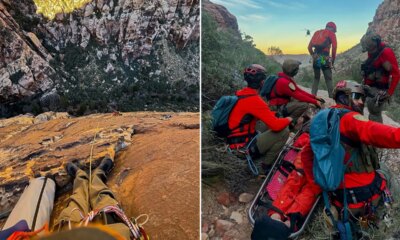
Las Vegas first responders conduct seven-hour rescue of injured climber stranded 600 feet up rock face

Breaking: Arkansas Announces Significant Partnership With Tyson Foods, Including New Uniform Patch Logos

Ted Cruz endorses Texas state Rep Steve Toth in GOP primary challenge to Dan Crenshaw

New York AG orders Manhattan hospital to resume gender-transition treatment for transgender youth

Florida High School Football Rankings: Top 25 teams – Oct. 21

Cleary's 21 help Le Moyne down Central Connecticut State 69-64 in OT

How old is Bo Nix? What to know about Oregon quarterback ahead of 2024 NFL Draft

99th annual Pony Swim held in Virginia

Indiana Members Credit Union announced as new anchor tenant at Bottleworks District
Mojtaba Khamenei, son of former supreme leader, tipped to become Iran’s next head of state

Video: Senators Question Kristi Noem on ICE Immigration Tactics

Combustible Republican Senate primary in Texas heading into overtime

Hungarian veto proves EU needs less unanimity, says new Dutch PM
Pregnant migrant girls are being sent to a Texas shelter flagged as medically risky
-

 World6 days ago
Exclusive: DeepSeek withholds latest AI model from US chipmakers including Nvidia, sources say
-

 Massachusetts7 days ago
Mother and daughter injured in Taunton house explosion
-

 Denver, CO7 days ago
10 acres charred, 5 injured in Thornton grass fire, evacuation orders lifted
-

 Louisiana1 week ago
Wildfire near Gum Swamp Road in Livingston Parish now under control; more than 200 acres burned
-

 Oregon5 days ago
2026 OSAA Oregon Wrestling State Championship Results And Brackets – FloWrestling
-

 Florida3 days ago
Florida man rescued after being stuck in shoulder-deep mud for days
-

 Maryland3 days ago
AM showers Sunday in Maryland
-

 Culture1 week ago
Try This Quiz on Thrilling Books That Became Popular Movies