Midwest
Swing state voter blames Biden for inflation, 'not buying' pandemic excuse in 2024: Prices 'still going up'

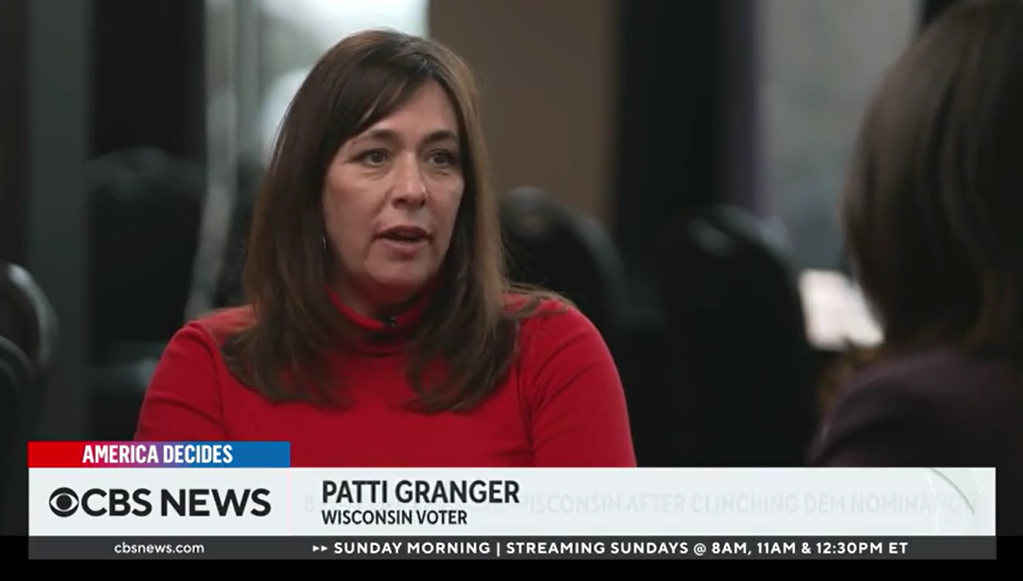
A voter in the swing state of Wisconsin told CBS News Friday she’s “not buying that” the pandemic is the cause of inflation instead of President Biden’s policies because prices are “still going up.”
CBS News chief White House correspondent Nancy Cordes asked voters in Milwaukee how they feel about the economy: “When it comes to inflation, how much of it do you attribute to the aftereffects of the pandemic, and how much do you attribute to President Biden’s policies?”
“It’s been years now since the pandemic. I’m not buying that anymore,” Wisconsin voter Patti Granger said. “At first I did, I’m not buying that anymore, because yogurt is still going up in price. I am not buying that anymore.”
Wisconsin voter Patti Granger said that while she may have given Biden the benefit of the doubt in the past, rising prices years after the pandemic are a bridge too far. (CBS News)
MAJOR CONSERVATIVE GROUP UNVEILS BIDENOMICS.COM TO TARGET PRESIDENT’S ECONOMIC POLICIES
Another voter who was interviewed on camera, Bobbi Tatum, appeared to say she still supports Biden, “because we’re still getting the aftermath. We’re still… it’s just a lot of things still happening since the pandemic.”
Cordes reported that she spoke to a trio of voters who, while agreeing that “the economy was a huge issue for each of them,” remained divided about who they are voting for and why they believe the economy is still struggling in the first place.
Wisconsin is a critical swing state, with Biden and former President Trump tied in a head-to-head matchup, according to the latest Fox News Poll. In 2016, Trump won Wisconsin by about 23,000 votes, but in 2020, Biden won by nearly 21,000.
By contrast, Wisconsin voter Bobbi Tatum argued, “We’re still getting the aftermath” and that “it’s just a lot of things still happening since the pandemic.” (Wisconsin voter Bobbi)
Nationally, grocery prices have surged more than 21% since the start of 2021, outstripping the overall 18% pace of inflation during that same time period. And while the pace of price increases for food has slowed in recent months, the overall cost of many grocery store staples is still high. Experts say that relief for consumers is unlikely to arrive anytime soon.
DO AMERICANS AGREE WITH BIDEN’S OUTLOOK ON THE ECONOMY?
Robert Frick, corporate economist at Navy Federal Credit Union, told FOX Business, “Prices very rarely go back … It’s going to take two or three years before people feel real relief from the surge in inflation, especially with things like food.”
According to a Fox News poll released March 3, 61% of voters say Biden has failed at handling the economy.
Fox News’ Megan Henney contributed to this report.
Read the full article from Here

The South Dakota Lottery offers multiple draw games for those aiming to win big.
Here’s a look at July 15, 2026, results for each game:
Winning Powerball numbers from July 15 drawing
02-07-18-29-38, Powerball: 16, Power Play: 2
Check Powerball payouts and previous drawings here.
Winning Lotto America numbers from July 15 drawing
26-29-41-46-47, Star Ball: 09, ASB: 02
Check Lotto America payouts and previous drawings here.
Winning Dakota Cash numbers from July 15 drawing
01-09-10-16-33
Check Dakota Cash payouts and previous drawings here.
Winning Millionaire for Life numbers from July 15 drawing
01-05-18-23-33, Bonus: 05
Check Millionaire for Life payouts and previous drawings here.
Feeling lucky? Explore the latest lottery news & results
Are you a winner? Here’s how to claim your prize
- Prizes of $100 or less: Can be claimed at any South Dakota Lottery retailer.
- Prizes of $101 or more: Must be claimed from the Lottery. By mail, send a claim form and a signed winning ticket to the Lottery at 711 E. Wells Avenue, Pierre, SD 57501.
- Any jackpot-winning ticket for Dakota Cash or Lotto America, top prize-winning ticket for Lucky for Life, or for the second prizes for Powerball and Mega Millions must be presented in person at a Lottery office. A jackpot-winning Powerball or Mega Millions ticket must be presented in person at the Lottery office in Pierre.
When are the South Dakota Lottery drawings held?
- Powerball: 9:59 p.m. CT on Monday, Wednesday, and Saturday.
- Mega Millions: 10 p.m. CT on Tuesday and Friday.
- Lucky for Life: 9:38 p.m. CT daily.
- Lotto America: 9:15 p.m. CT on Monday, Wednesday and Saturday.
- Dakota Cash: 9 p.m. CT on Wednesday and Saturday.
- Millionaire for Life: 10:15 p.m. CT daily.
This results page was generated automatically using information from TinBu and a template written and reviewed by a South Dakota editor. You can send feedback using this form.


Manuel Franco claims his $768 million Powerball jackpot
Manuel Franco, 24, of West Allis was revealed Tuesday as the winner of the $768.4 million Powerball jackpot.
Mark Hoffman, Milwaukee Journal Sentinel
The Wisconsin Lottery offers multiple draw games for those aiming to win big.
Here’s a look at July 15, 2026, results for each game:
Winning Powerball numbers from July 15 drawing
02-07-18-29-38, Powerball: 16, Power Play: 2
Check Powerball payouts and previous drawings here.
Winning Pick 3 numbers from July 15 drawing
Midday: 0-6-9
Evening: 8-6-6
Check Pick 3 payouts and previous drawings here.
Winning Pick 4 numbers from July 15 drawing
Midday: 9-3-8-0
Evening: 4-5-2-7
Check Pick 4 payouts and previous drawings here.
Winning All or Nothing numbers from July 15 drawing
Midday: 01-04-05-07-09-11-12-17-18-21-22
Evening: 05-06-10-11-12-13-14-16-17-19-21
Check All or Nothing payouts and previous drawings here.
Winning Badger 5 numbers from July 15 drawing
05-06-23-28-31
Check Badger 5 payouts and previous drawings here.
Winning SuperCash numbers from July 15 drawing
04-08-15-16-21-33, Doubler: N
Check SuperCash payouts and previous drawings here.
Winning Megabucks numbers from July 15 drawing
10-19-25-31-37-40
Check Megabucks payouts and previous drawings here.
Feeling lucky? Explore the latest lottery news & results
Are you a winner? Here’s how to claim your lottery prize
- Prizes up to $599: Can be claimed at any Wisconsin Lottery retailer.
- Prizes from $600 to $199,999: Can be claimed in person at a Lottery Office. By mail, send the signed ticket and a completed claim form available on the Wisconsin Lottery claim page to: Prizes, PO Box 777 Madison, WI 53774.
- Prizes of $200,000 or more: Must be claimed in person at the Madison Lottery office. Call the Lottery office prior to your visit: 608-261-4916.
Can Wisconsin lottery winners remain anonymous?
No, according to the Wisconsin Lottery. Due to the state’s open records laws, the lottery must, upon request, release the name and city of the winner. Other information about the winner is released only with the winner’s consent.
When are the Wisconsin Lottery drawings held?
- Powerball: 9:59 p.m. CT on Monday, Wednesday, and Saturday.
- Mega Millions: 10:00 p.m. CT on Tuesday and Friday.
- Super Cash: 9:00 p.m. CT daily.
- Pick 3 (Day): 1:30 p.m. CT daily.
- Pick 3 (Evening): 9:00 p.m. CT daily.
- Pick 4 (Day): 1:30 p.m. CT daily.
- Pick 4 (Evening): 9:00 p.m. CT daily.
- All or Nothing (Day): 1:30 p.m. CT daily.
- All or Nothing (Evening): 9 p.m. CT daily.
- Megabucks: 9:00 p.m. CT on Wednesday and Saturday.
- Badger 5: 9:00 p.m. CT daily.
That lucky feeling: Peek at the past week’s winning numbers.
Feeling lucky? WI man wins $768 million Powerball jackpot **
WI Lottery history: Top 10 Powerball and Mega Million jackpots
This results page was generated automatically using information from TinBu and a template written and reviewed by a Wisconsin editor. You can send feedback using this form.

4Warn Weather – The dangerous heat that gripped Metro Detroit Wednesday will ease, but having slightly lower temperatures does not mean that Southeast Michigan is in the clear.
The 4Warn Weather Alert remains in effect Thursday, as a thick plume of wildfire smoke from Canada settles into the region, bringing some of the poorest air quality this season.
While the Heat Advisory was allowed to expire Wednesday evening, the Air Quality Alert continues through Thursday, and for many communities, the smoke will pose the greatest health concern.
Unlike some air quality events driven by ozone or lighter smoke high in the atmosphere, this smoke is expected to settle close to the ground.
The result is unhealthy air pollution for the general population, with some neighborhoods potentially reaching very unhealthy and hazardous levels for a time, especially late Wednesday night through Thursday morning.
A few storms beating the odds Wednesday night
Although most of Southeast Michigan will stay dry Wednesday night, a few isolated thunderstorms developed Wednesday evening along the advancing cold front. Just enough instability developed for a handful of storms to briefly become severe.
The National Weather Service issued Severe Thunderstorm Warnings for portions of Oakland, Genesee and Shiawassee counties, with radar indicating the potential for wind gusts up to 60 mph and hail up to quarter-size.
Quarter-sized hail was reported in Holly at 7:19 p.m.
The Storm Prediction Center noted the overall severe weather threat remained isolated.
Overnight, attention turns back to the arrival of dense Canadian wildfire smoke, which is expected to become the dominant weather story through Thursday.
Smoke thickens late Wednesday night
The cold front opened the door for dense Canadian wildfire smoke to pour into Southeast Michigan on Wednesday.
The thickest smoke is expected overnight into Thursday morning, when cooler temperatures and a stable atmosphere trap the smoke close to the surface.
Visibility may be reduced at times; skies will appear hazy, and many people may notice the smell of smoke even indoors.
Those with asthma, COPD, heart disease, children, older adults, and pregnant women should avoid prolonged outdoor activity.
However, even healthy adults may experience irritated eyes and throats, coughing, headaches, or shortness of breath during periods of heavier smoke.
If possible:
-
Limit strenuous outdoor activity.
-
Keep windows closed.
-
Run your air conditioning on recirculate if available.
-
Change air filters.
-
Consider wearing a properly fitted N95 mask if you must spend extended time outdoors in smoky conditions.
Still hot Thursday
Even though the oppressive humidity backs off behind the front, Thursday will not feel cool.
Afternoon highs climb back into the lower 90s, with “feels like” temperatures generally remaining in the lower 90s as well.
That is noticeably more tolerable than Wednesday’s triple-digit heat indices, but it is still hot enough to require frequent hydration and breaks if you are spending time outside.
The combination of heat and smoky air may make outdoor conditions especially taxing, even if temperatures are not as high.
Rain chances return
Thursday stays dry before moisture begins returning on Friday.
Scattered showers and thunderstorms become possible Friday afternoon and continue at times into Saturday as the next weather system approaches the Great Lakes.
Not everyone will see rain, but several opportunities for showers and thunderstorms develop through the weekend.
By Sunday and early next week, temperatures settle closer to normal with highs generally in the lower to mid-80s, along with periodic chances for additional showers and thunderstorms into Tuesday.
While the cooler weather will be welcome, air quality should also gradually improve as the weather pattern becomes more active and winds help disperse lingering smoke.
The wildfire smoke will lead to more vibrant and redder sunsets and sunrises. Share your weather and nature photos with Local 4 at MIPics.
Copyright 2026 by WDIV ClickOnDetroit – All rights reserved.
-
South Dakota31 seconds ago
SD Lottery Powerball, Lotto America winning numbers for July 15, 2026
-

 Tennessee7 minutes ago
Heavy police presence reported near Highway 31W in White House
-

 Texas12 minutes ago
NTSB Confirms Texas Tesla Had 100% Floored Accelerator Pedal During Fatal Crash
-

 Utah19 minutes ago
Muslim man stabbed at Utah mall over his religion, authorities say
-

 Vermont24 minutes ago
Ben & Jerry’s Foundation says it will shut down amid legal dispute with parent company – VTDigger
-

 Virginia30 minutes ago
Drought emergency declared for parts of Virginia; governor warns of water restrictions
-

 Washington37 minutes ago
Trump fires WA US Attorney within an hour
-

 Wisconsin43 minutes ago
Wisconsin Lottery Powerball, Pick 3 results for July 15, 2026

