South Dakota
South Dakota committee OKs bill making school opt-out petitions easier


White House says shutdown ‘proved’ Education Department not needed
Sec. Linda McMahon announced the Education Department had partnered with other government agencies to outsource many of its functions.
Eight members of the House Education committee voted Wednesday, Feb. 25, to advance a bill that opponents called an “attack on public education.”
Senate Bill 223, brought by Sen. Sue Peterson, R-Sioux Falls, would give petitioners more time to gather fewer signatures to refer school district opt-outs to a vote. She said it’s a property tax relief bill with reasonable changes to refer opt-outs to the ballot.
Opt-outs allow school districts to raise additional operating funds beyond what they get in their existing tax levy, and in state aid, by “opting out” of those limitations to collect more taxes from property owners in the district.
Instead of having 20 days to get signatures from 5% of the total number of people registered to vote in the school district, the bill would give petitioners 40 days to collect signatures from either 5% of people who voted in the last school district election, or 50 voters, whichever is greater.
Sioux Falls School District Superintendent Jamie Nold said SB 223 “specifically attacks public schools,” and takes away school boards’ options to balance school district budgets because the state aid districts receive hasn’t met the rate of inflation for the last two years.
“Senate Bill 223 is an attempt to use the Legislature to negatively impact schools that serve all students,” Nold said. “Senate Bill 223 will continually make it harder for public schools to maintain a balanced budget, pay teachers and maintain local control.”
SB 223 previously passed on a 6-3 vote in the Senate State Affairs committee, and a 20-14 vote in the Senate. After the 8-7 vote in the House Education committee, SB 223 will move to the House in the coming days. If it passes there, it will land on Gov. Larry Rhoden’s desk.
‘Maybe, just maybe, there isn’t support to refer this to an election’
Much of the discussion on SB 223 centered on the most recent opt-out passed in the Sioux Falls School District −$2.1 million over 10 years, or $21 million total − and the failure of petition gatherers to get enough signatures to refer it to a vote. They needed 5,490 signatures, and only got 2,302 by the deadline. Peterson called it a “heroic effort.”
One of the proponents, Sioux Falls resident Amy Bruner, said the gathering of petition signatures included 50 volunteers. Peterson noted she was not involved in gathering signatures for the opt-out petition.
If the petition group’s goal was about 5,500 signatures, each of those 50 volunteers would’ve needed to gather 110 signatures over the 20-day period, or five to six signatures each day. The group as a whole needed to gather 275 signatures per day over 20 days.
Opponents argued that the failure of the petition group to gather more signatures from the public, or to find more people interested in gathering signatures, is evidence that people supported their local school board’s decision to opt-out.
“Maybe, just maybe, there isn’t support to refer this to an election,” said Heath Larson, lobbyist for Associated School Boards of South Dakota. “Maybe the people in the local community are supportive of what the local school board is doing, and they trust their local school boards.”
And while much of the discussion did center on the Sioux Falls School District, Nold said property tax issues and opt-outs aren’t a Sioux Falls issue alone. He said the district has the second-lowest levy of the 11 districts in the Sioux Falls metro area and is in the bottom 20% of South Dakota’s school districts in property valuation per student.
Opponents argue SB 223 makes it ‘too easy’ to refer opt-outs
The last school district election in May 2025 saw 2.33% of eligible registered voters − 2,958 of 126,334 − cast ballots in that election; which was one of the lowest turnouts in recent memory.
More people voted in the election than signed the petition to refer the opt-out to a vote.
If SB 223 had been in effect when the board passed the opt-out for fiscal year 2026 in June 2025, only 148 signatures would’ve been needed to refer the opt-out to an election.
Peterson said SB 223 wouldn’t make it “easy,” but “attainable” to refer opt-outs to an election.
But opponents, including South Dakota Education Association lobbyist Sandra Waltman and Sioux Falls School District lobbyist Sam Nelson, said SB 223 makes it “too easy” to refer opt-outs to elections.
Disagreement on public input, voter fatigue
While the proponents argued that SB 223 is about giving taxpayers a voice in local spending decisions, opponents said there are already opportunities to give input on those decisions.
That includes attending school board meetings, voicing concerns at those meetings during public comment time, contacting school board members and superintendents, voting in school board elections or running for school board.
When the Sioux Falls School District looks to pass an opt-out, it meets with community members and business leaders in its Finance Action Network to vet them in a five-month process before the opt-out is presented publicly to the school board, Nold said.
From there, the school board has three different public meetings to discuss the opt-out, with opportunities for the public to comment and give feedback, an “extensive process” before opt-outs are finalized and ratified, Nold explained.
Holding an opt-out election in an odd-numbered year would cost the district $63,000, Nold said. More elections would create voter fatigue, Waltman said.



RAPID CITY, S.D. (KOTA) – South Dakota is putting new money behind an effort Governor Larry Rhoden says will make national security the state’s “next big industry.”
Speaking at The Box during the Black Hills Military Coalition’s Defense & Industry Symposium, Rhoden announced the creation of the South Dakota Defense Institute (SDDI) — a new hub intended to connect business, education, and government and help South Dakota companies compete for federal defense contracts.
“We announced the creation of the South Dakota Defense Institute,” Rhoden said. “And this is a big step in hanging meat on the bones of the commitment I made in the State address… That national defense would be South Dakota’s next big industry.”
Rhoden said the state will invest $5 million from the Future Fund to establish and operate the institute for an initial five-year period.
According to the governor’s office, the institute is expected to serve as a central coordinating point for partners across the defense ecosystem and, once operational, engage directly with federal defense agencies and other related stakeholders to support businesses pursuing defense contracting opportunities.
Rhoden also announced an additional $1 million from the Future Fund to Elevate Rapid City to help purchase a building in Rapid City’s “Innovation District.” The facility will serve as the institute’s headquarters and is also expected to function as a collaboration space to bring together students, researchers, and defense companies to support innovation, workforce development, and industry growth.
South Dakota’s Commissioner to the Governor’s Office on Economic Development, Bill Even, gave us more info on the actual physical construction of the space. “The School of Mines and Western Dakota Tech have been pretty integral in figuring out how we really jump start the innovation district in downtown Rapid City with the natural focus on national defense,” He said. “And so we’ve identified some properties and we’ll be working closely with Elevate to secure those as well.”
The governor’s office said the South Dakota Defense Institute will be organized adjacent to the Governor’s Office of Economic Development and staffed by experienced leaders with military and defense industry backgrounds.
The institute will partner with private businesses and local economic development organizations, along with state agencies including the South Dakota National Guard, the Department of Labor and Regulation, the Board of Regents, and the Board of Technical Education.
State officials said additional details on staffing, timelines and programming will be released as the institute’s launch progresses.
See a spelling or grammatical error in our story? Please click here to report it.
Do you have a photo or video of a breaking news story? Send it to us here with a brief description.
Copyright 2026 KOTA. All rights reserved.


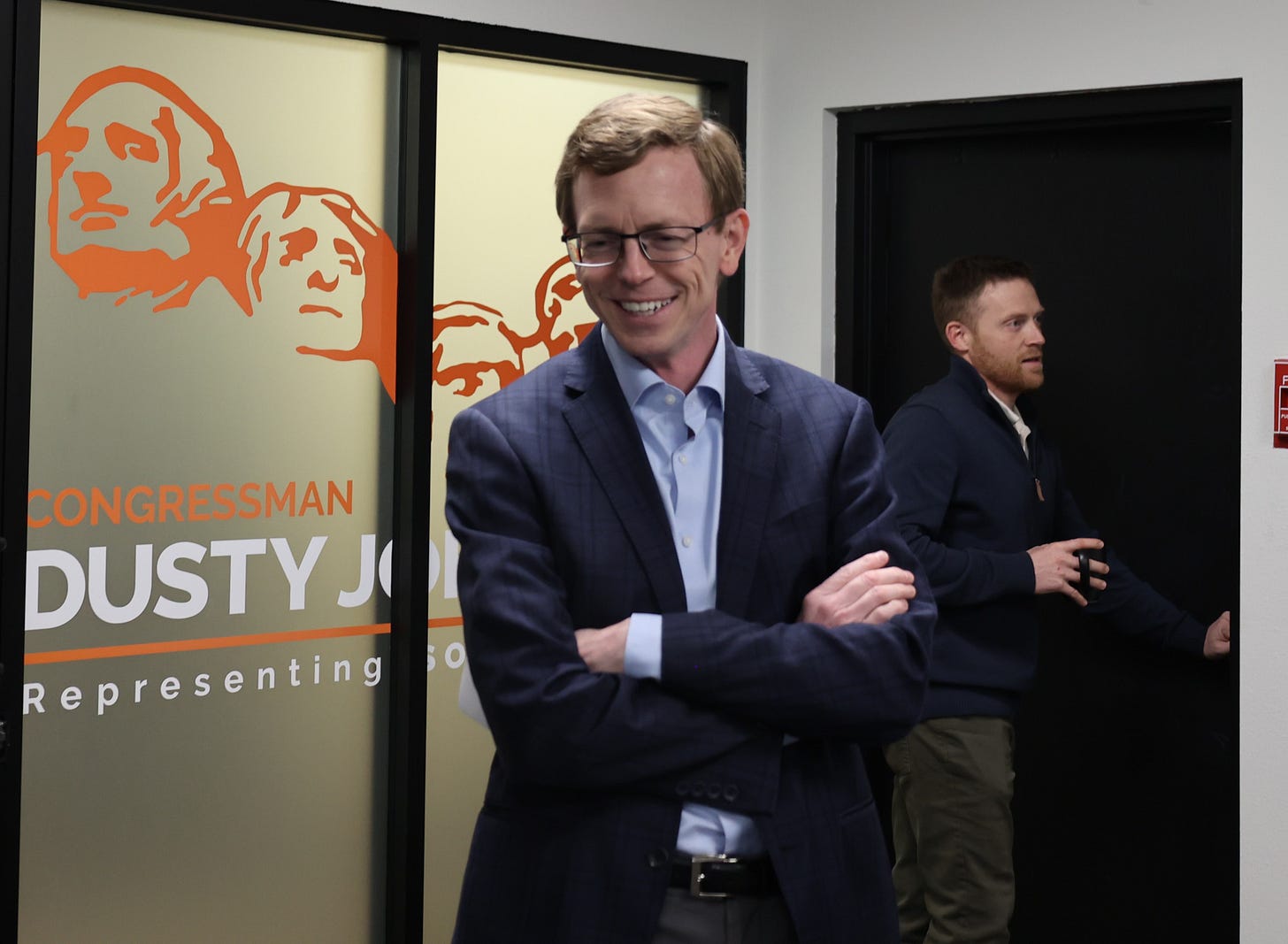
Rep. Dusty Johnson wants tougher penalties for drug dealers who distribute methamphetamine and fentanyl, while also vowing to create a task force to review how improvements can be made to stop repeat offenders from committing more crime.
Johnson, one of four Republicans vying for the GOP nomination for governor, unveiled his Safer South Dakota public safety plan on Tuesday. The plan includes a real-time monitoring system for drug overdose deaths, and he says schools should be required to notify parents when a student has a drug-related emergency.
The plan has the endorsement of top law enforcement officials.




SIOUX FALLS, S.D. (Dakota News Now) – One local artist is turning sneakers into support for Special Olympics athletes as they prepare to compete on a national stage.
What started as a simple idea quickly grew into something much larger for Team South Dakota. After discovering his work on social media, Special Olympics South Dakota reached out to artist Michael Middlen about designing a single custom shoe to auction off and raise funds.
“So I had stumbled upon him on Instagram and I just reached out and you know just kind of told our story of what USA games is and what it means to us and see if he wanted to partner with us to do a custom shoe and to raffle it off,” said Haley Zerr, head of sports and competition for Special Olympics South Dakota.
But after hearing more about the athletes and their journey, Middlen decided one pair wasn’t enough.
“So initially when we first started communicating, it was just going to be one pair of shoes, and then we met with him one day, and he brought it to our attention like, Hey, I would love to do a pair for everybody, so that was shocking to us but very rewarding,” Zerr said.
Instead, Middlen took on the task of hand-painting 67 custom pairs of shoes for every athlete and staff member representing South Dakota at the USA Games in Minneapolis.
“When I heard their story, it just really touched me and moved me, and I just felt that I needed to do something for them, and I just figured this would be the best way to do that,” Middlen said.
Each pair is uniquely designed, incorporating both the Special Olympics logo and the sport each athlete will compete in, adding a personal touch to every step they take.
“But I really wanted to do something to make it more personal, and I always try to do that with every custom to make it a little more personal to the individual that’s receiving them. So I thought it would be a really cool addition to add the sport logo of the sport that the athletes are competing in. So every athlete is going to get a pair in their own size, it will have the Special Olympics logo on one shoe, and then it will have the sport they are competing in on the other,” Middlen said.
Beyond design, the project carries a deeper meaning centered on unity and inclusion.
“I just wanted to really bring inclusion and help everyone, from staff to the athletes, to feel like they’re all one and just lift these athletes up and support them as they are going into the games,” Middlen said.
For many of the athletes, this is an experience they’ve never had before, making it all unforgettable.
“You know a lot of them have never received anything like this or gone to a USA Games, so it’s a big deal for all of our athletes attending,” Zerr said.
The custom shoes will also help Team South Dakota stand out as they represent their state during the opening ceremonies.
“And that was our whole thing behind this: we wanted to stand out when we go to the opening ceremonies. So just South Dakota and they all have matching shoes, custom shoes, so yeah, it’s a big deal for us,” Zerr said.
As excitement builds for the USA Games, leaders say the effort also highlights the broader need for community support.
“To be able to represent our state with the number of people we have going which is 67 to Minneapolis is a big important thing for us but the fundraising for that and raising money and awareness for getting our athletes there to compete is where we need help for the community as well,” said Nick Moen, president and CEO of Special Olympics South Dakota.
Middlen hopes the project encourages others to give back in their own way.
“I don’t think the public is completely aware of how much of a need there is to support them, and everything they rely on is donations, and you know, I think when people think of giving, they think that it’s gotta be money or whatever, but lots of times the best thing you can give is just your talent and your time,” Middlen said.
As Team South Dakota prepares to take the national stage, they’ll do so backed by more than just preparation, carrying with them a visible reminder of the support behind them.
More information on the Special Olympics of South Dakota and where to donate can be found here, and entering the custom shoe raffle drawing can be found here.
Copyright 2026 Dakota News Now. All rights reserved.

Video: NASA Prepares for Artemis II’s Return to Earth

Inside a One-Man Workshop for Ultrapotent Drugs

Hilariously caustic ‘Big Mistakes’ drags Dan Levy into organized crime

Google makes it easy to deepfake yourself

Iran threatens to end ceasefire over Hezbollah’s exclusion from truce deal

Florida High School Football Rankings: Top 25 teams – Oct. 21

How old is Bo Nix? What to know about Oregon quarterback ahead of 2024 NFL Draft

Cleary's 21 help Le Moyne down Central Connecticut State 69-64 in OT

99th annual Pony Swim held in Virginia

Indiana Members Credit Union announced as new anchor tenant at Bottleworks District

Spanberger ripped after taking credit for billions in investments secured under GOP predecessor: ‘Pathetic’

Newsletter: NATO holds amid fragile Iran ceasefire

Jim Whittaker, the first American to summit Mount Everest, dies at 97

Video: Military Families Bear the Burden of War, Again

Fox News Poll: Record number say taxes are too high; government spending seen as wasteful
-

 Atlanta, GA4 days ago
1 teenage girl killed, another injured in shooting at Piedmont Park, police say
-

 Culture1 week ago
Do You Know Where These Famous Authors Are Buried?
-

 Movie Reviews1 week ago
Vaazha 2 first half review: Hashir anchors a lively, chaos-filled teen tale
-

 Georgia2 days ago
Georgia House Special Runoff Election 2026 Live Results
-

 Education1 week ago
Video: We Put Dyson’s $600 Vacuum to the Test
-

 Pennsylvania2 days ago
Parents charged after toddler injured by wolf at Pennsylvania zoo
-
 Milwaukee, WI3 days ago
Potawatomi Casino Hotel evacuated after fire breaks out in rooftop HVAC system
-
 Entertainment1 week ago
Inside Ye’s first comeback show at SoFi Stadium