Midwest
Senator introduces legislation to rein in widely used, controversial abortion pill

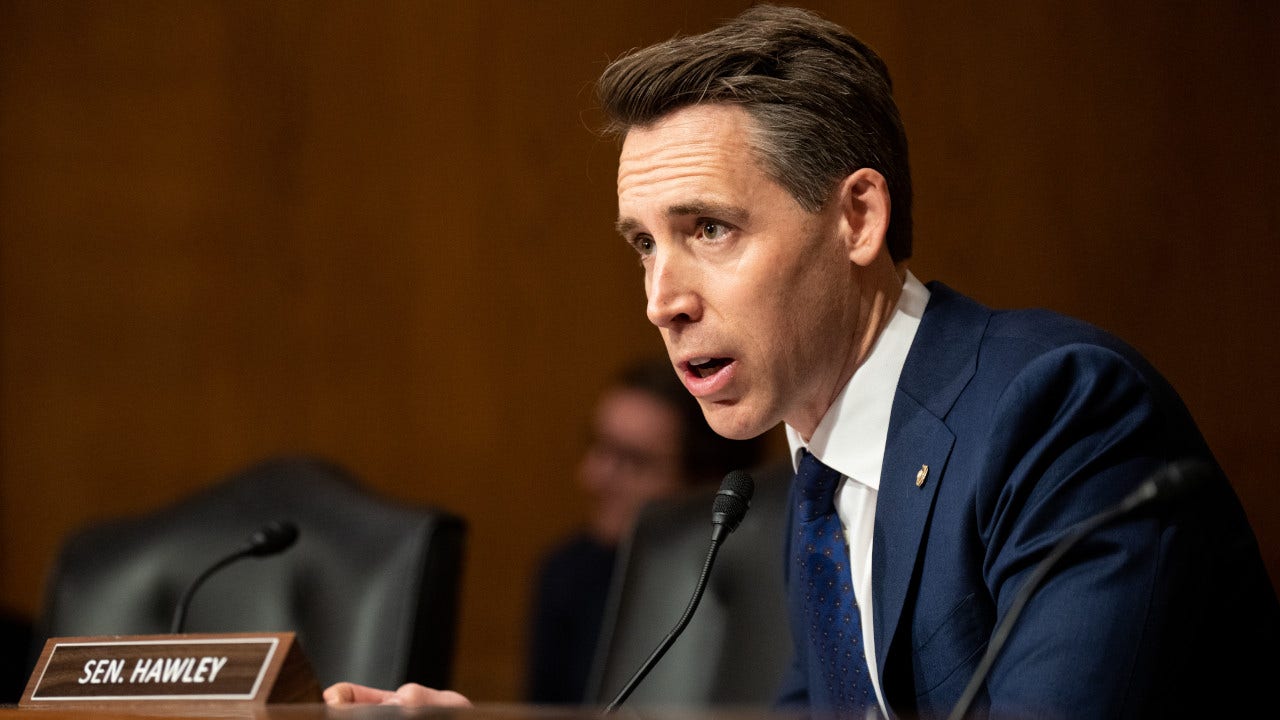
FIRST ON FOX: Sen. Josh Hawley, R-Mo., introduced legislation Tuesday to scale back the popular abortion drug mifepristone after a recent study revealed that 1 in 10 women who used the medication experienced “serious adverse effects.”
The Restoring Safeguards for Dangerous Abortion Drugs Act would direct the Food and Drug Administration (FDA) to create safeguards on the abortion drug mifepristone, allow women who have suffered complications from prescriptions the right to sue telehealth providers and pharmacies for damages, and ban foreign companies from mailing and importing mifepristone into the U.S.
Hawley introduced the legislation “after a bombshell study revealed the truth about mifepristone: it’s dangerous,” the Missouri senator told Fox News Digital. “The data shows 1 in 10 women who take mifepristone experience adverse health effects, like going to the ER or suffering from sepsis. The FDA needs to act to protect women now.”
Missouri Sen. Josh Hawley introduces legislation to implement safeguards for abortion pill mifepristone. (Reuters/Getty)
COVID VACCINE BOOSTERS CALLED INTO QUESTION BY FDA CHIEF: ‘VOID OF DATA’
Hawley cites last week’s study by the Ethics and Public Policy Center (EPPC), which revealed in its key findings that “10.93 percent of women experience sepsis, infection, hemorrhaging, or another serious or life-threatening adverse event within 45 days following a mifepristone abortion.”
The study assessed 865,727 insurance claims between 2017 and 2023 for women who used the medication to terminate early pregnancy. The pill can be taken up to “70 days since the first day of their last menstrual period,” according to the FDA.
The exact number of women who have undergone a mifepristone abortion since the FDA’s approval under the Clinton administration in 2000 can be difficult to calculate, as some pregnancies are terminated without official medical intervention.
Demonstrators gather in front of the Supreme Court as it hears oral arguments in U.S. Food and Drug Administration v. Alliance for Hippocratic Medicine on March 26, 2024, in Washington, D.C. The case challenges the 20-plus-year legal authorization by the FDA of mifepristone, a commonly used abortion medication. (Anna Rose Layden/Getty Images)
The Guttenmacher Institute, a non-governmental organization (NGO) which was once a part of Planned Parenthood, estimates that there were 1,038,100 clinician-provided abortions in 2024, though this number only reflects “states without a ban”. The estimation does not include the number of abortions that occurred illegally or in states where pregnancy termination laws vary.
SCOOP: REPUBLICANS DISCUSS DEFUNDING ‘BIG ABORTION’ LIKE PLANNED PARENTHOOD IN TRUMP AGENDA BILL
At the time of approval, there were stricter parameters for administering the drug. However, the Obama administration’s FDA rolled back some of these requirements in 2016 by reducing the need for in-person visits, removing mandatory physician prescription requirements, and eliminating non-fatal adverse event reporting.
Hawley sent a letter last week to Trump-appointed FDA Commissioner Dr. Marty Makary, whom Hawley questioned during the former Johns Hopkins School of Medicine professor’s confirmation before the U.S. Senate.
Sen. Josh Hawley has introduced the Restoring Safeguards for Dangerous Abortion Drugs Act. (Bill Clark/CQ-Roll Call, Inc via Getty Images)
“[D]uring your confirmation hearing, you pledged to me that you would ‘review the totality of the data and ongoing data’ to inform action on the drug,” Hawley’s letter to the FDA head explained. “I urge you to follow this new data and take all appropriate action to restore critical safeguards on the use of mifepristone. The health and safety of American women depend on it.”
TRUMP FOE LETITIA JAMES LEADING CHARGE ON NEW MULTISTATE LAWSUIT OVER HHS CUTS
The introduction of Hawley’s bill comes just one day after Trump’s Department of Justice (DOJ) asked a Texas federal judge to dismiss a case that could restrict access to the controversial pill. This move mirrored a similar stance taken by the Biden administration to keep a mifepristone lawsuit out of a Texas court.
Fox News Digital reached out to the FDA for comment.
Preston Mizell is a writer with Fox News Digital covering breaking news. Story tips can be sent to Preston.Mizell@fox.com and on X @MizellPreston
Read the full article from Here


A recent study published by three state agencies warns electricity shortages are coming to Illinois.
The shortages will start in PJM Interconnection’s regional transmission system by 2029, with the shortage hitting Illinois’ ComEd territory (which is within PJM) beginning in 2030, and then kicks in hard by 2032.
Capacity shortages in downstate Ameren’s territory are expected to begin in 2031 and escalate through 2035, when the stuff hits the fan. Ameren is in the Midcontinent Independent System Operator’s, or MISO’s, regional transmission network.
The report acknowledges that some fossil fuel power plants might have to remain open at least in the short-term, despite the state’s ambitious climate goals. A bill passed the legislature in October to facilitate that.
The Illinois Power Agency, the Illinois Environmental Protection Agency and the Illinois Commerce Commission conducted the study.
Massive increases in power needs by data centers are the “primary driver” of increased electricity demand, according to the report. Those gigantic increases were not foreseen when the state designed its landmark clean energy law in 2021 requiring net-zero carbon energy by 2045.
Coal and gas plants “are planned to retire across both [PJM and MISO] due to age, economics and emissions limits,” the new report points out, and that’s also contributing to the coming shortage.
Also problematic is the fact that new gas plant equipment takes 5-7 years to purchase and install, and the plants face additional siting and permitting barriers. Wind and solar face serious obstacles as well..
All that results in this warning from the three state agencies: “These conditions create a credible risk of regional capacity shortfalls that will impact Illinois’ future ability to import power during critical hours and may cause reliability issues in Illinois even if Illinois market zones have enough capacity to meet their [resource adequacy] requirements as determined by [PJM and MISO].”
Translation: Even if Illinois produces more power, we still might be in big trouble because other states are facing similar problems.
In the ComEd region alone, projected load growth “drives a 24% increase in resource adequacy requirements between 2025 and 2030, which contributes to growing dependence on external capacity even before the onset of an outright shortfall in 2032.”
However, the report claims, “The state can successfully navigate both near-term reliability risks and longer-term decarbonization goals through a diversified resource strategy.” That strategy includes “the continued use” of fossil fuel plants “even as their energy output declines with higher renewable penetration.”
Another study will be published in 2027. The report said that study will likely include increased renewables and battery storage but will also look at “delays and/or reductions” to emissions requirements allowed by the Clean and Reliable Grid Affordability Act, which passed in October.
That’s cutting it awful close. Some business groups, including the Illinois Manufacturers’ Association, want the state to act immediately to keep existing fossil fuel plants open.
Forty years ago, Illinois had some of the highest electric utility rates in the Midwest. Then, after the state deregulated the industry, our costs became far more competitive and the state used those low rates to lure new businesses.
But then abundant supply (encouraged by deregulation) pushed rates to a point where some nuclear power plant owners couldn’t afford to operate, so Illinois had to force consumers to subsidize the plants.
Then, with the gigantic data center and resulting artificial intelligence booms, along with aging plants going offline, electricity started becoming scarce again and rates have gone up.
Unilaterally cutting off data center expansion here won’t work because the state is part of those two large regional power distribution networks. They’ll just cross the state lines and continue consuming our juice.
Maybe the AI bubble will burst. But what is clear is that Illinois laws have to be flexible enough to deal with the unexpected, and that obviously hasn’t been the case
Yes, coal plants were closing anyway because they aren’t cost competitive. Same with some gas plants. But government operates so slowly that few have confidence it can turn the ship around in time to avert a coming shortage.
Everyone is pointing to the recently passed Clean and Reliable Grid Affordability Act as a possible solution because it gives the state more pollution control flexibility, but even that may not be adequate if there’s not enough will at the top to make extra sure we don’t enter a crisis stage.
The governor has expressed confidence that the state can handle this. But businesspeople are rightly freaking out.
Climate change is real. But if the lights don’t go on, or the local factories close, nobody will care about excuses. They’ll just want it fixed.
Rich Miller also publishes Capitol Fax, a daily political newsletter, and CapitolFax.com.

Alabama football completed Step 1. The Crimson Tide beat Oklahoma 34-24 on Friday, earning its first College Football Playoff victory.
With the first round completed, UA has a tougher test ahead. No. 1 Indiana awaits in the Rose Bowl quarterfinal, on Jan. 1 in Pasadena. As Alabama celebrates its victory and begins to prepare, here’s what to know about the 13-0 Hoosiers.
The coach
To say that Curt Cignetti has done a good job at Indiana is perhaps college football’s largest understatement. Cignetti, who took over last season, has turned the Big Ten’s ultimate doormat into the nation’s top team.
Cignetti joined up from James Madison before the 2024 season. He immediately took a program that had grown stale under Tom Allen to the CFP, then turned around and did even better this year.
“I just know that winning lifts all boats,” Cignetti said after the playoff field was announced. “In terms of fan support in the stadium, donations, all parts of the university, downtown when you pack the stadium, bring a lot of people to Bloomington, it helps their sales. A lot of pride in Hoosier Nation. The largest alumni base in America, over 800,000 people. I’d say right now the arrow is pointing up. We probably got a lot of momentum going in those kind of areas.”
Cignetti has a connection to Alabama as well. He worked as the Crimson Tide’s wide receivers coach and recruiting coordinator under Nick Saban from 2007 through 2011, helping set the groundwork for Saban’s dynasty in Tuscaloosa.
In addition to Indiana in James Madison, he was a head coach at Indiana University of Pennsylvania and Elon after leaving the Tide.
The quarterback
For the first time in program history, Indiana has a Heisman Trophy winner. Quarterback Fernando Mendoza beat out a group of finalists that included Vanderbilt’s Diego Pavia, Notre Dame’s Jeremiyah Love and Ohio State’s Julian Sayin.
Mendoza has thrown for 2,980 yards this season, with 33 touchdowns and six interceptions. He has completed 226 of his 316 passes so far.
“Our focus right now is winning the College Football Playoff,” Mendoza told reporters Monday in Bloomington. “That’s what would make this trophy so much sweeter. I believe this trophy is a little bit of a push of confidence on us, on the team, that we’re making history for the IU team in history to be 13-0 and also to bring home a Heisman Trophy to Bloomington.”
The junior, who hails from Florida, transferred into Indiana from Cal this year. He spent two seasons in Berkeley before joining the Hoosiers.
The season
Indiana was the losingest program in the Football Bowl Subdivision entering this season. Some predicted it would be a step back for the Hoosiers, who lost several key players from last season’s playoff team.
Instead, IU won its first Big Ten title since 1967. It enters the CFP undefeated.
“I think that if we hooked everybody up in this room on a lie detector test and told them, hey, do you think Fernando Mendoza is going to win the Heisman this year and we’re going to be 13-0, Big Ten champs, the team has a lot of self-belief and unwavering belief, but I think it’s tough to make those predictions,” Mendoza said Monday.
To cap off the season, Indiana, which had faced criticism for its strength of schedule throughout the year, pulled off a huge upset in Indianapolis. The Hoosiers beat then No. 1 Ohio State, earning the top seed in the CFP and a spot in the Rose Bowl.

IOWA CITY, Iowa (KCRG) – Grace Fincham led the West High girls to a second-half comeback in a 60-51 win over City High, giving the Trojans a win on their rival’s home floor.
The Trojans improve to 6-2 with the win. The Little Hawks drop to 6-2.
In the boys’ nightcap, the Little Hawks’ comeback attempt fell short, as the Trojans held on for a 53-51 win.
Copyright 2025 KCRG. All rights reserved.

Records in Texas AG Ken Paxton’s divorce case are unsealed

4 Takeaways From Alabama’s Comeback, Oklahoma’s Collapse in CFP First-Round Game

Winter Solstice celebration takes over Cuddy Park

Former Cardinals kicker Jay Feely switches congressional districts in Arizona race

23 state senators back University of Arkansas’ inquiry | Arkansas Democrat Gazette

Florida High School Football Rankings: Top 25 teams – Oct. 21

Cleary's 21 help Le Moyne down Central Connecticut State 69-64 in OT

How old is Bo Nix? What to know about Oregon quarterback ahead of 2024 NFL Draft

99th annual Pony Swim held in Virginia

Video: ‘It Didn’t Have to Happen This Way:’ U.Va. Faculty Call for Review of Police Response to Protests

Trump administration touts ‘most secure border in history’ as 2.5 million migrants exit US

How the reparations loan for Ukraine fell apart at the eleventh hour

Trump’s push to end transgender care for young people opposed by pediatricians

Takeaways from an eventful 2025 election cycle

Judge tosses Trump-linked lawsuit targeting Chief Justice Roberts, dealing setback to Trump allies
-

 Iowa5 days ago
Addy Brown motivated to step up in Audi Crooks’ absence vs. UNI
-

 Iowa7 days ago
How much snow did Iowa get? See Iowa’s latest snowfall totals
-

 Maine4 days ago
Elementary-aged student killed in school bus crash in southern Maine
-

 Maryland5 days ago
Frigid temperatures to start the week in Maryland
-

 Technology1 week ago
The Game Awards are losing their luster
-

 South Dakota6 days ago
Nature: Snow in South Dakota
-

 New Mexico3 days ago
Family clarifies why they believe missing New Mexico man is dead
-

 Nebraska1 week ago
Nebraska lands commitment from DL Jayden Travers adding to early Top 5 recruiting class