Midwest
On this day in history, March 15, 1869, Cincinnati Red Stockings become first professional baseball team

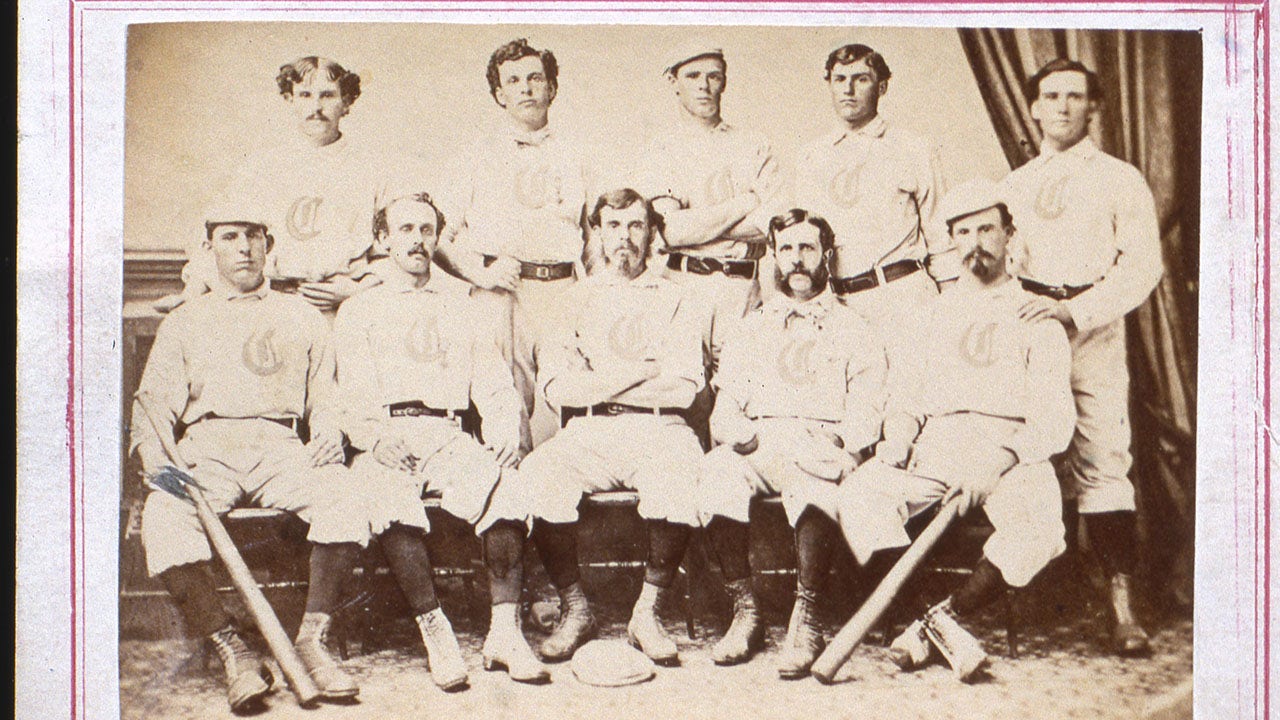
Professional baseball was born with the formation of the barnstorming Cincinnati Red Stockings on this day in history, March 15, 1869.
“The onset of professionalism was no small step for baseball: players received a small but growing degree of financial stability, and fans were treated to an ever higher standard of play,” writes the Baseball Almanac.
“The cradle for this groundbreaking practice was Cincinnati, where the first openly professional baseball team was founded.”
ON THIS DAY IN HISTORY, MARCH 14, 1879, ALBERT EINSTEIN BORN IN GERMANY, EXPLODED ONTO WORLD STAGE AT AGE 26
Baseball had evolved from earlier sports such as cricket and rounders over the previous three decades.
Its evolution is traced to its reported advent by Abner Doubleday in Cooperstown, New York, in 1839; to the proliferation of recreational “base ball” clubs in New York City in the 1840s; and to the formalization of the rules of the game we know today, including nine men per side and nine innings per game, in 1857.
The Red Stockings turned recreation into a whole new ball game.
The 1869 Cincinnati Red Stockings, the first professional baseball team, are featured on the front of a Sporting Goods trade card from Peck & Snyder of New York City. In the photo are captain Harry Wright, front row, center, George Wright, back row second from left, and in the back row, second from right, is catcher Cal McVey. (Mark Rucker/Transcendental Graphics, Getty Images)
They played their first official game on May 4, thumping the crosstown rival Great Western Base Ball Club, 45-9.
They never relented the rest of the year.
And never lost.
“The onset of professionalism was no small step for baseball.” — Baseball Almanac
The Red Stockings departed on May 31 for what the National Baseball Hall of Fame calls “the greatest road trip in baseball history.”
The team left by train from the former Little Miami Railroad Depot, located less than a mile east of today’s Great American Ball Park, home arena of the National League’s Cincinnati Reds.
TRUCKER RECORDS CREEPY GHOST-LIKE FIGURE ON ARIZONA HIGHWAY WHILE DRIVING ALONE: DASHCAM VIDEO
“The Red Stockings’ 32-day road trip was more like a rock ‘n’ roll tour than a baseball trip,” reports the Hall of Fame.
“Huge crowds turned out to see the handsome young men in their crimson hose and white-knicker uniforms in Cleveland, Buffalo, Rochester, Boston, New York City, Philadelphia, Baltimore and Washington, D.C., where the Red Stockings received an audience with President Ulysses S. Grant.”
The first professional baseball team, the Cincinnati Red Stockings, are celebrated in this sheet music issued in 1869 in New York City. (Photo reproduction, Transcendental Graphics/Getty Images)
The 1,821-mile trip included 20 games in the month of June alone.
The epic tour of America then brought the game to the Pacific Coast — a trip that would have been nearly impossible only year earlier.
ON THIS DAY IN HISTORY, MARCH 7, 1857, BASEBALL ADOPTS NINE PLAYERS, NINE INNINGS AS STANDARD OF COMPETITION
“They capped a 57-0 inaugural season with a 4,764-mile trip to San Francisco and back aboard the Transcontinental Railroad, which was completed only the previous May with the pounding of the Golden Spike at Promontory, Utah,” said the National Baseball Hall of Fame.
The players were quite young, most ages 18 to 23. They apparently enjoyed the good life on the road, as their tour began to generate widespread national interest.
“Huge crowds turned out to see the handsome young men in their crimson hose and white-knicker uniforms.” — National Baseball Hall of Fame
“A group of young women passed in front of the Red Stockings’ hotel,” the night before a big game in Philadelphia, reports the Hall of Fame.
“They lifted their long skirts to avoid the mud in the streets, many revealing a flash of red stockings.”
Wood engraving from Harper’s Weekly magazine depicts “Presentation of a Champion Bat to the Red Stocking Base-Ball Club … on Its Return Home,” Cincinnati, Ohio, 1869. The team finished the regular season with a perfect record of 57-0. (Stock Montage/Getty Images)
The Cincinnati Red Stockings lived only briefly. The organization folded in 1870.
But it changed the face of American sports forever.
MEET THE AMERICAN WHO CREATED THE NATION’S FIRST SPORTS BAR IN ST. LOUIS: WORLD WAR II VETERAN JIMMY PALERMO
The National Association of Professional Base Ball Players, the first professional sports league, was created in 1871 and survived until 1875.
The National League of professional baseball was founded with eight clubs in 1876. The American League followed in 1901. Both leagues still compete today in Major League Baseball.
“Triumphs over all the top Eastern clubs had made them the center of attention in the sporting press.” — Society for American Baseball Research
The champions of each league squared off in the first World Series in 1903.
The Red Stockings and their distinctive crimson hose are still seen on the fields of Major League Baseball today.
The National League’s Cincinnati Reds and the American League’s Boston Red Sox both trace lineage to the Cincinnati Red Stockings.
Both cities also embraced the sport early in the history of baseball, with rabid fan bases still today.
“Cincinnati is nuts with baseball!,” sportswriter Bugs Baer wrote 50 years later, in 1919. “They ought to call this town Cincinnutty!”
Baer, among other claims to fame, dubbed Babe Ruth the Sultan of Swat.
The red-colored socks of the Boston Red Sox of Major League Baseball trace their roots to the Cincinnati Red Stockings of 1869, the first professional baseball team. When the Red Stockings folded in 1870, manager Harry Wright was hired by a Boston businessman to bring baseball to the city. The Red Sox name and uniforms are a tribute to the legacy of the Red Stockings. (G Fiume/Getty Images)
The impact of the Cincinnati Red Stockings on American sports was profound — helping popularize from coast to coast a sport that would soon be known as America’s pastime.
Two Red Stockings are in the Baseball Hall of Fame.
Shortstop George Wright was inducted in 1937; his brother, center fielder/manager Harry Wright, was inducted in 1953.
Writes Greg Rhodes for the Society for American Baseball Research:
“Not only were they undefeated, but the novelty of their all-salaried status, their distinctive uniform style with the long red socks, and the triumphs over all the top Eastern clubs had made them the center of attention in the sporting press.”
For more Lifestyle articles, visit www.foxnews.com/lifestyle.
Read the full article from Here

Midwest
Walz slams Trump admin for temporarily halting Medicaid funding to Minnesota: ‘Campaign of retribution’
NEWYou can now listen to Fox News articles!
Minnesota Gov. Tim Walz accused the Trump administration of unleashing a “campaign of retribution” against his state after Vice President JD Vance announced a temporary pause in Medicaid funding there.
Vance’s announcement was made after President Donald Trump railed against fraud in Minnesota on Tuesday evening in his State of the Union address.
Vance said Wednesday that he is giving Walz 60 days to clean up how the state doles out funding, adding, “We are stopping the federal payments that will go to the state government until the state government takes its obligations seriously to stop the fraud that’s being perpetrated against the American taxpayer.”
“This is a campaign of retribution. Trump is weaponizing the entirety of the federal government to punish blue states like Minnesota,” Walz, a Democrat, wrote in response on X. “These cuts will be devastating for veterans, families with young kids, folks with disabilities, and working people across our state.”
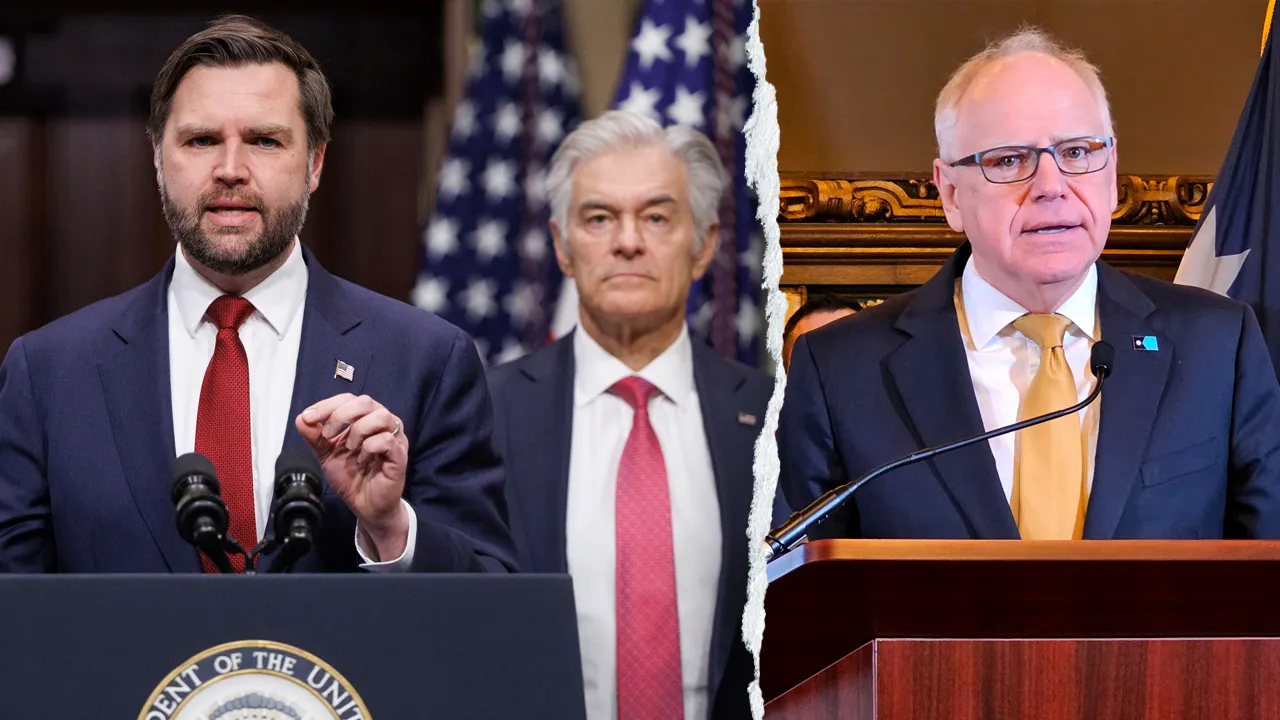
Vice President JD Vance, left, Administrator for the Centers for Medicare & Medicaid Services Dr. Mehmet Oz, center, and Minnesota Gov. Tim Walz. (Tom Brenner/AP; Steve Karnowski/AP)
“This has nothing to do with fraud. The agents Trump allegedly sent to investigate fraud are shooting protesters and arresting children,” Walz added. “His DOJ is gutting the U.S. Attorney’s Office and crippling their ability to prosecute fraud. And every week Trump pardons another fraudster.”
Fox News Digital has reached out to the White House for comment.
The administration and Congress have zeroed in on rampant abuse of federal taxpayers’ funds since December 2025, when details of Minnesota’s fraud relating to social and welfare programs stretching back to the COVID-19 pandemic first came into the national spotlight. Investigators have since estimated the Minnesota scheme could top $9 billion.
HEAVILY REDACTED AUDIT FINDS MINNESOTA MEDICAID HAD WIDESPREAD VULNERABILITIES
Gov. Tim Walz has 60 days to respond to a letter from Mehmet Oz, administrator for the Centers for Medicare & Medicaid Services. (Jim Vondruska/Getty Images)
Mehmet Oz, the administrator for the Centers for Medicare & Medicaid Services, said Wednesday that the pause marks “the largest action against fraud that we’ve ever taken” at the federal agency, before launching into how the administration is deferring funds to the state.
“It’s going to be $259 million of deferred payments for Medicaid to Minnesota, which we’re announcing, as I speak, to Gov. Walz and his team,” Oz said. “That’s based on an audit of the last three months of 2025. Restated, a quarter billion dollars is not going to be paid this month to Minnesota for its Medicaid claims.”
Dr. Mehmet Oz speaks beside Vice President JD Vance during a news conference on efforts to combat fraud, in the Old Eisenhower Executive Office Building on the White House campus on Wednesday, Feb. 25, 2026. (Tom Brenner/AP)
CLICK HERE TO DOWNLOAD THE FOX NEWS APP
“We have notified the state and said that we will give them the money, but we’re going to hold it and only release it after they propose and act on a comprehensive corrective action plan to solve the problem,” Oz also said. “If Minnesota fails to clean up the systems, the state will rack up $1 billion of deferred payments this year.”
Related Article

Read the full article from Here

I represent Mr. Terrion Arnold in connection with an incident that allegedly occurred on February 4, 2026, in Tampa, Florida, which resulted in the arrest of five individuals on serious felony charges.
To be clear, Mr. Arnold had no involvement whatsoever in the activities that led to those arrests. He did not participate in, nor was he present for, any conduct related to the alleged offenses. There is no evidence in police reports, text messages, or witness statements that implicates Mr. Arnold in any way.
In fact, after direct communication with the lead prosecutor, it has been confirmed that no charges have been filed against Mr. Arnold in connection with this matter.
Recent media coverage has referenced an Order issued by Circuit Judge J. Logan Murphy, which improperly suggests Mr. Arnold’s involvement in the incident. That same Order also incorrectly identifies Ms. Devalle as Mr. Arnold’s girlfriend. Both assertions are false, misleading, and entirely unsupported by the record.
Mr. Arnold categorically denies these unfounded claims and maintains his complete innocence. He was not involved in the crimes allegedly committed on February 4, 2026, in Tampa, Florida.
We strongly urge members of the media to refrain from perpetuating inaccurate or speculative narratives. The facts are clear, and they do not support any claim of wrongdoing by Mr. Arnold.

Drone view shows Milwaukee’s County Courthouse
Built in 1931, Milwaukee’s historic County Courthouse is in dire need of repair and upgrades. Here’s a recent drone view of the MacArthur Square building.
The Milwaukee County Sheriff’s Office will not move forward on a potential deal to use facial recognition technology, Sheriff Denita Ball announced Friday.
In a statement on Feb. 27, Ball said after “thoughtful evaluation” and “meaningful dialogue” with community stakeholders and leaders, she decided to stop pursuing a contract with Biometrica, a Las Vegas-based company whose technology allows authorities to compare photos to a large database of photos for matches.
“While we recognize the potential of this software as an investigative tool, we also recognize that trust between the MCSO and the people we serve is important,” she said.
“My discussions with local advocates highlighted valid concerns regarding how such data could be accessed or perceived in the current national climate. This decision is not a retreat from innovation but rather an understanding that timing matters, too,” Ball said.
The Milwaukee Journal Sentinel reported on Feb. 17 that the Sheriff’s Office was on the verge of signing off on the use of facial recognition technology after news broke at a community advisory board meeting held by the office.
The update on the office’s sign-off on an intent to enter into a contract with Biometrica blindsided local officials and advocates because it contradicted earlier claims that the office had not moved forward with a controversial contract.
At the time, supervisors on the county’s judiciary and legislation committee called for more information from the Sheriff’s Office about the nature of the then-potential contract.
Supervisor Justin Bielinski, who chairs the committee, said Ball’s decision to step away from the deal was good news, but said he was still feeling wary.
“I would like to see more I guess,” he said of the two paragraph statement from Ball. “At what point would she reconsider, right?”
County Executive David Crowley, who is running for governor as a Democrat, had also voiced concerns about a possible contract when news came to light earlier this month.
After learning of Ball’s decision to not move forward with Biometrica, Crowley thanked community members who voiced concerns about facial recognition technology, saying he will “continue doing everything in my authority to ensure our residents’ First Amendment rights, civil liberties, and personal data are protected.”
In recent months, Milwaukee politicians and residents rebuffed local law enforcement’s efforts to pursue the use of such technology at both the city and county levels, with many citing concerns over racial bias and unjust surveillance of residents.
The Milwaukee County Board of Supervisors voted last summer to recommend the development of a policy framework for the use of facial recognition technology as worries about its use by local law enforcement grew in the community.
The policy emphasized that the use of such technology doesn’t “suppress First Amendment-related activities, violate privacy, or otherwise adversely impact individuals’ civil rights and liberties,” and called for a pause on acquiring new facial recognition technology until regulatory policies were in place to monitor any existing and new surveillance technology.
In early February, the Milwaukee Police Department paused its pursuit of facial recognition technology after almost a year of pushback from activists and some public officials at public meetings. The department also noted that community feedback was a part of its final decision as well as a volatile political climate amid the federal government’s immigration crackdown.
(This story was updated to add new information.)

The Best Time To Drink Coffee for Weight Loss and a Faster Metabolism

Video: Prada Peels Back the Layers at Milan Fashion Week

Defense secretary Pete Hegseth designates Anthropic a supply chain risk

UN Human Rights Council chief cuts off speaker criticizing US-sanctioned official

ICE blasts Washington mayor over directive restricting immigration enforcement

Florida High School Football Rankings: Top 25 teams – Oct. 21

Cleary's 21 help Le Moyne down Central Connecticut State 69-64 in OT

How old is Bo Nix? What to know about Oregon quarterback ahead of 2024 NFL Draft

99th annual Pony Swim held in Virginia

Indiana Members Credit Union announced as new anchor tenant at Bottleworks District
ICE blasts Washington mayor over directive restricting immigration enforcement

Did the EU bypass Hungary’s veto on Ukraine’s €90 billion loan?

How the federal government is painting immigrants as criminals on social media

Where Iran’s ballistic missiles can reach — and how close they are to the US

Has India’s influence in Afghanistan grown under the Taliban?
-

 World2 days ago
Exclusive: DeepSeek withholds latest AI model from US chipmakers including Nvidia, sources say
-

 Massachusetts2 days ago
Mother and daughter injured in Taunton house explosion
-

 Montana1 week ago
2026 MHSA Montana Wrestling State Championship Brackets And Results – FloWrestling
-

 Louisiana5 days ago
Wildfire near Gum Swamp Road in Livingston Parish now under control; more than 200 acres burned
-

 Oklahoma1 week ago
Wildfires rage in Oklahoma as thousands urged to evacuate a small city
-

 Denver, CO2 days ago
10 acres charred, 5 injured in Thornton grass fire, evacuation orders lifted
-

 Technology7 days ago
YouTube TV billing scam emails are hitting inboxes
-

 Technology7 days ago
Stellantis is in a crisis of its own making