Midwest
On this day in history, March 15, 1869, Cincinnati Red Stockings become first professional baseball team

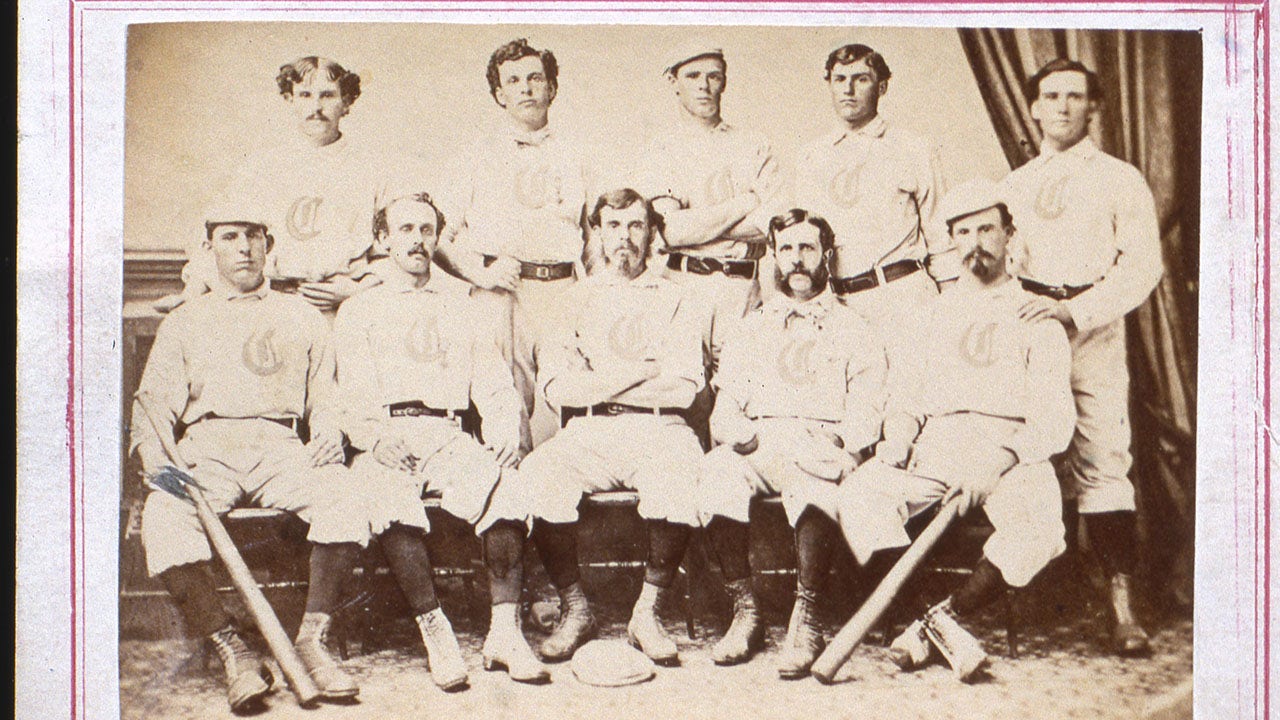
Professional baseball was born with the formation of the barnstorming Cincinnati Red Stockings on this day in history, March 15, 1869.
“The onset of professionalism was no small step for baseball: players received a small but growing degree of financial stability, and fans were treated to an ever higher standard of play,” writes the Baseball Almanac.
“The cradle for this groundbreaking practice was Cincinnati, where the first openly professional baseball team was founded.”
ON THIS DAY IN HISTORY, MARCH 14, 1879, ALBERT EINSTEIN BORN IN GERMANY, EXPLODED ONTO WORLD STAGE AT AGE 26
Baseball had evolved from earlier sports such as cricket and rounders over the previous three decades.
Its evolution is traced to its reported advent by Abner Doubleday in Cooperstown, New York, in 1839; to the proliferation of recreational “base ball” clubs in New York City in the 1840s; and to the formalization of the rules of the game we know today, including nine men per side and nine innings per game, in 1857.
The Red Stockings turned recreation into a whole new ball game.
The 1869 Cincinnati Red Stockings, the first professional baseball team, are featured on the front of a Sporting Goods trade card from Peck & Snyder of New York City. In the photo are captain Harry Wright, front row, center, George Wright, back row second from left, and in the back row, second from right, is catcher Cal McVey. (Mark Rucker/Transcendental Graphics, Getty Images)
They played their first official game on May 4, thumping the crosstown rival Great Western Base Ball Club, 45-9.
They never relented the rest of the year.
And never lost.
“The onset of professionalism was no small step for baseball.” — Baseball Almanac
The Red Stockings departed on May 31 for what the National Baseball Hall of Fame calls “the greatest road trip in baseball history.”
The team left by train from the former Little Miami Railroad Depot, located less than a mile east of today’s Great American Ball Park, home arena of the National League’s Cincinnati Reds.
TRUCKER RECORDS CREEPY GHOST-LIKE FIGURE ON ARIZONA HIGHWAY WHILE DRIVING ALONE: DASHCAM VIDEO
“The Red Stockings’ 32-day road trip was more like a rock ‘n’ roll tour than a baseball trip,” reports the Hall of Fame.
“Huge crowds turned out to see the handsome young men in their crimson hose and white-knicker uniforms in Cleveland, Buffalo, Rochester, Boston, New York City, Philadelphia, Baltimore and Washington, D.C., where the Red Stockings received an audience with President Ulysses S. Grant.”
The first professional baseball team, the Cincinnati Red Stockings, are celebrated in this sheet music issued in 1869 in New York City. (Photo reproduction, Transcendental Graphics/Getty Images)
The 1,821-mile trip included 20 games in the month of June alone.
The epic tour of America then brought the game to the Pacific Coast — a trip that would have been nearly impossible only year earlier.
ON THIS DAY IN HISTORY, MARCH 7, 1857, BASEBALL ADOPTS NINE PLAYERS, NINE INNINGS AS STANDARD OF COMPETITION
“They capped a 57-0 inaugural season with a 4,764-mile trip to San Francisco and back aboard the Transcontinental Railroad, which was completed only the previous May with the pounding of the Golden Spike at Promontory, Utah,” said the National Baseball Hall of Fame.
The players were quite young, most ages 18 to 23. They apparently enjoyed the good life on the road, as their tour began to generate widespread national interest.
“Huge crowds turned out to see the handsome young men in their crimson hose and white-knicker uniforms.” — National Baseball Hall of Fame
“A group of young women passed in front of the Red Stockings’ hotel,” the night before a big game in Philadelphia, reports the Hall of Fame.
“They lifted their long skirts to avoid the mud in the streets, many revealing a flash of red stockings.”
Wood engraving from Harper’s Weekly magazine depicts “Presentation of a Champion Bat to the Red Stocking Base-Ball Club … on Its Return Home,” Cincinnati, Ohio, 1869. The team finished the regular season with a perfect record of 57-0. (Stock Montage/Getty Images)
The Cincinnati Red Stockings lived only briefly. The organization folded in 1870.
But it changed the face of American sports forever.
MEET THE AMERICAN WHO CREATED THE NATION’S FIRST SPORTS BAR IN ST. LOUIS: WORLD WAR II VETERAN JIMMY PALERMO
The National Association of Professional Base Ball Players, the first professional sports league, was created in 1871 and survived until 1875.
The National League of professional baseball was founded with eight clubs in 1876. The American League followed in 1901. Both leagues still compete today in Major League Baseball.
“Triumphs over all the top Eastern clubs had made them the center of attention in the sporting press.” — Society for American Baseball Research
The champions of each league squared off in the first World Series in 1903.
The Red Stockings and their distinctive crimson hose are still seen on the fields of Major League Baseball today.
The National League’s Cincinnati Reds and the American League’s Boston Red Sox both trace lineage to the Cincinnati Red Stockings.
Both cities also embraced the sport early in the history of baseball, with rabid fan bases still today.
“Cincinnati is nuts with baseball!,” sportswriter Bugs Baer wrote 50 years later, in 1919. “They ought to call this town Cincinnutty!”
Baer, among other claims to fame, dubbed Babe Ruth the Sultan of Swat.
The red-colored socks of the Boston Red Sox of Major League Baseball trace their roots to the Cincinnati Red Stockings of 1869, the first professional baseball team. When the Red Stockings folded in 1870, manager Harry Wright was hired by a Boston businessman to bring baseball to the city. The Red Sox name and uniforms are a tribute to the legacy of the Red Stockings. (G Fiume/Getty Images)
The impact of the Cincinnati Red Stockings on American sports was profound — helping popularize from coast to coast a sport that would soon be known as America’s pastime.
Two Red Stockings are in the Baseball Hall of Fame.
Shortstop George Wright was inducted in 1937; his brother, center fielder/manager Harry Wright, was inducted in 1953.
Writes Greg Rhodes for the Society for American Baseball Research:
“Not only were they undefeated, but the novelty of their all-salaried status, their distinctive uniform style with the long red socks, and the triumphs over all the top Eastern clubs had made them the center of attention in the sporting press.”
For more Lifestyle articles, visit www.foxnews.com/lifestyle.
Read the full article from Here


BLOOMINGTON — Springfield’s Alex Eickhoff nearly had a magical Thursday as he tied for second place in the 95th annual Illinois State Amateur Championship at Crestwicke Country Club.
Eickhoff, a 2020 Hillsboro High School graduate and former standout on the Southern Illinois University Edwardsville’s men’s golf team, shot a 4-under-par 68 in Thursday’s third round and followed that with an even-par 71 to finish the three-day, four-round event 1-over 285. He tied for second with Bloomington’s Logan Stauffer.
Eickhoff briefly took the lead through nine holes of his fourth round when he sat at 1-under par. Chicago’s Charlie Kulwin finished both of Thursday’s rounds under par and finished 2-under 282. He was the lone golfer to finish under par for the tournament.
Eickhoff was The State Journal-Register’s Small School Boys Golfer of the year twice in his high school career: once as a freshman in 2016-17 and again as a senior in 2019-20. After high school, he golfed for the University of Minnesota for two years before transferring to SIUE.
He began the tournament with a 3-over 74 on Tuesday and shaved off a stroke Wednesday with a 2-over 73. He closed out the event with an even-par 71 in Thursday’s final round.
Other area golfers who made the cut were Springfield’s Charles Hoogland (7-over 291, tied for 20th) and Jacksonville’s Brady Kaufmann (8-over 292, 25th).
The last golfer from The State Journal-Register’s coverage area to win the Illinois State Amateur was Jay Davis. Davis, a Jacksonville Routt graduate, won the 1991 and ‘92 tournaments.
Contact Ryan Mahan: 788-1546, ryan.mahan@sj-r.com, Twitter.com/RyanMahanSJR.
Indiana
Where to watch Seattle Storm vs Indiana Fever on July 17: TV channel, start time and streaming
The WNBA has returned with a brand new collective bargaining agreement and a league full of loaded rosters as the 2026 season tips off.
A rookie class headlined by Dallas Wings top pick Azzi Fudd, Minnesota’s Olivia Miles and Washington’s Lauren Betts is ready to make a mark in the pros while the defending champion Las Vegas Aces look to keep their dynasty alive with a fourth title in five years.
As the the season gets going under a new media rights deal, it can be tough to figure out which channel each team is playing on every night. Here’s everything you need to know to tune in when the Indiana Fever host the Seattle Storm on Friday.
What time is Seattle Storm vs Indiana Fever?
Tip off between the Indiana Fever and Seattle Storm is scheduled for 7:30 p.m. (ET) on Friday, July 17.
How to watch Seattle Storm vs Indiana Fever on Friday
All times Eastern and accurate as of Friday, July 17, 2026, at 6:09 a.m.
- Matchup: SEA at IND
- Date: Friday, July 17
- Time: 7:30 p.m. (ET)
- Venue: Gainbridge Fieldhouse
- Location: Indianapolis, Indiana
- TV: ion
- Streaming: ion
Watch the WNBA all season on Fubo
WNBA scores and results
See scores, results for all of today’s games .
See WNBA scores, results from July 16
Odds for WNBA games today
The latest WNBA odds can be found below from the best sports betting apps . Some odds may include games scheduled on future dates.

DES MOINES, Iowa (Gray Media Iowa State Capitol Bureau) — U.S. Speaker of the House Mike Johnson told Gray Media Iowa that he got briefed late Thursday afternoon, a few hours before President Donald Trump gave a prime-time speech to make his latest claims about election fraud.
“Yeah, I just got off of a telephone call literally in the motorcade as we were driving here,” Johnson said after arriving at a campaign appearance with U.S. Rep. Mariannette Miller-Meeks (R – 1st District, Ottumwa) at a Pella bakery.
Miller-Meeks is running for re-election in what is again considered a competitive race with Democrat Christina Bohannan, a University of Iowa law professor from Iowa City.
This is the third straight election that the two will meet in a general election.
Johnson said the “off the record” intelligence briefing to leaders in the U.S. House and Senate previewed Trump’s new election fraud claims. He called it “blockbuster information.”
“It’s the result of an investigation that’s been ongoing for some time now about fraud and irregularity in in federal elections, American elections around the country,” Johnson said.
Gray Media Iowa asked Johnson whether he believes congressional colleagues were elected because of fraud.
He did not directly answer that question.
“…everybody’s going to be able to evaluate all that information on their own, and it will lead to other investigations, I’m certain,” Johnson said of the briefing.
He added, “we’ll have to see where all this goes.”
For years, Trump has alleged widespread fraud that cost him the 2020 election. Trump has lost dozens of court cases on the matter.
On January 7, 2021, Congress certified his defeat to Democrat Joe Biden, a day after Trump supporters rushed the U.S. Capitol Building. Some attacked law enforcement officers and damaged the outside and inside of the building.
After returning to office in 2025, President Trump pardoned supporters for their crimes.
Copyright 2026 Gray Media Iowa State Capitol Bureau. All rights reserved.
-

 Idaho20 seconds ago
China Landslide
-

 Illinois7 minutes ago
Hillsboro grad, Springfield golfer Alex Eickhoff 2nd at state amateur
-
Indiana13 minutes ago
Where to watch Seattle Storm vs Indiana Fever on July 17: TV channel, start time and streaming
-

 Iowa19 minutes ago
US House Speaker campaigning in Iowa responds to President’s election fraud claims
-

 Kentucky31 minutes ago
June unemployment rate shows slight increase in Kentucky Center for Statistics latest report
-

 Louisiana37 minutes ago
How Louisiana football’s Lunch Winfield has embraced his QB1 role
-

 Maryland49 minutes ago
Great nature trails for hiking, beachcombing on Maryland’s Lower Shore
-

 Michigan55 minutes ago
Michigan’s upcoming Aug. 4 primary: What’s on my ballot?

