Nebraska
Nebraska Prenatal Plus program bill to be heard on legislative floor


OMAHA, Neb. (WOWT) – In 2022 in Nebraska, March of Dimes reports that 11.3% of babies were born preterm.
That number is higher than the 10.4 national average, and the highest rate Nebraska has seen in recent memory.
When it comes to mothers of color, the preterm birth rate is even higher.
State Senator George Dungan of Lincoln wants to address and prevent those numbers from growing.
“No matter where you fall on the political spectrum, one of the things that everyone seemed to agree on is healthy moms and healthy babies,” Dungan tells 6 News when asked about LB857, his priority bill this legislative session. “What we’re seeking to do is increase the access to and the availability of prenatal services for at-risk mothers who are low income.”
While Dungan says Nebraska’s current program is robust, he adds that it’s time to do more when it comes to tackling adverse birth outcomes, namely low birth weights and preterm births.
“There are certain things we know are integral in helping those moms and raising birth weights that are not currently able to be built on.”
If passed, Nebraska would adopt the ‘Prenatal Plus Program,’ which Dungan says states like Colorado have seen great success with.
While Nebraska would adopt the program, Dungan says it wouldn’t be a direct copy but would have the same idea: not just focusing on the medical side of pregnancy, but the socio-economic side, too.
“It’s also about making sure you have access to mental health care, it’s about making sure you have access to substance use disorder treatment, smoking cessation, a big one is dietitian and nutrition counseling, and that you have somebody that can do case management for you that sees you throughout the entire pendency of your pregnancy to make sure you have consistent services and that you have access to additional service down the road,” he adds.
The main aspects the Prenatal Plus program would add are targeted case management, nutrition counseling, and making services available to moms who have been identified by their doctors or practitioners as having potential birth outcomes.
Dungan says in Colorado, the program not only saw healthier moms and babies, but it also demonstrated Medicaid cost savings.
“For every dollar, for example, that was paid into for this Prenatal Plus program, they actually saved $2.48,” he says. “So you’re seeing massive net savings on Medicaid which I think is what we should frankly be investing in overall, is upstream investments so that way we’re saving ourselves money down the road while also ensuring we have healthy moms and healthy babies.”
Dungan adds that services like these are also necessary, especially in a state where abortion care is limited.
“In a world where we have now limited our abortion to 10 weeks in Nebraska, think it’s imperative that we offer as many additional services as possible, and something I’ve been really encouraged by is conversations I’ve had with a number of colleagues, people that a prop choice, people that are pro-life, people that are somewhere in between, this is an issue they all agree on.”
Dungan’s bill originally sought to offer services to those on Medicaid and to those in the Children’s Health Insurance Program, as well as offer post-partum services for mothers.
An amendment to the bill in the Health and Human Services Committee limited the program to Medicaid users and prenatal care.
The bill was heard and supported by several healthcare professionals while in the HHS committee last Wednesday.
It passed the committee and will be heard on the legislative floor.
Copyright 2024 WOWT. All rights reserved.



Grand Island, Neb. (KSNB) – The Nebraska Siege are back at home for the first time in three weeks when they play the St. Joseph Goats Saturday night at the BigIron Events Center.
The last time the two teams played was in St. Joe, where the Siege beat the Goats 56 to 47.
The Saturday night matchup marks the final regular season, home game for the Siege. But with a win, the Siege can clinch home-field advantage throughout the playoffs.
Throwoff is scheduled for 7:05 p.m. Saturday night.
Click here to subscribe to our KSNB Local4 daily digest and breaking news alerts delivered straight to your email inbox.
Copyright 2026 KSNB. All rights reserved.
Nebraska
Nebraska DHHS evaluating USDA guidelines that could limit food access for undocumented immigrants

LINCOLN, Neb. — New requirements for the Emergency Food Assistance Program could mean some people lose access to food they previously received, and organizations like the Food Bank of Lincoln are warning the community about the looming change.
It has been five months since the U.S. Department of Agriculture (USDA) directed state agencies to review options to ensure undocumented immigrants do not receive taxpayer-funded benefits like food from the program. Nebraska DHHS manages the program in the state, and food banks distribute the food. DHHS confirms it is currently evaluating potential implementation of the request.
Says in a statement provided to 10/11,
The Food Bank of Lincoln says 10 percent of the food it distributes is provided by the USDA through the program, and the new rule would add another barrier to food access.
“We believe that all people should have access to food. Always. End of story for us. And so for us, it’s counter to our mission to think about turning away a child or a senior or a family because of their legal status and not providing them food,” said Tiffany Murray, chief operating officer of the Food Bank of Lincoln.
Currently, people receiving food provided by the USDA submit their income and household size, but their full name is not required on the form. The Food Bank said, under the new rules, a full name must be printed and signed, which may make some people hesitant to participate.
The Food Bank of Lincoln said during the last fiscal year they distributed
10/11 reached out to DHHS about when the changes would be implemented and had not received a response detailing the timeline as of Friday.
Click here to subscribe to our 10/11 NOW daily digest and breaking news alerts delivered straight to your email inbox.
Copyright 2026 KOLN. All rights reserved.

Stephen C. Mason, 76, professor emeritus of agronomy and horticulture at the University of Nebraska–Lincoln, died June 15 in Lincoln from complications of pneumonia and Parkinson’s disease.
Mason retired Sept. 5, 2017, after 33 years of teaching and research in crop production and management in the Department of Agronomy and Horticulture. Admired by his students and respected by colleagues, Mason was a passionate teacher, adviser, mentor and researcher who generously shared his time and expertise.
“Dr. Mason was widely recognized as one of the most dedicated and impactful teaching faculty members in our department,” said Martha Mamo, department head of agronomy and horticulture. “He had a deep commitment to agronomy education and made lasting contributions through his teaching, mentorship and service.”
The oldest of five children, Mason was born Aug. 24, 1949, in Chillicothe, Missouri, to Frank and Martha (Deaton) Mason. He earned a bachelor’s degree in agricultural education from the University of Missouri in 1971 and a master’s degree and doctorate in agronomy from Purdue University in 1976 and 1983, respectively.
He met his wife, Nora D’Croz, while they were both studying for their master’s at Purdue. They married in Colombia in 1979 and moved to Lincoln in 1984.
He began his career at Nebraska as an assistant professor in crop production and management with a 75% teaching and 25% research appointment. He moved to a 50/50 appointment in the early 1990s and was promoted to full professor in 1994.
Mason instructed all undergraduate grain-crop production courses at the university, co-taught several other courses and co-led College of Agricultural Sciences and Natural Resources education study tours to Argentina with his wife, Nora D’Croz, an adjunct assistant professor of agronomy and horticulture.
He greatly enjoyed teaching and working with graduate students. Working with the international sorghum and millet program gave him the opportunity to conduct research mutually beneficial to developing countries and Nebraska, mentor graduate students and work with them after they returned to their home countries — many of whom made meaningful contributions to academia, research and agricultural development.
He was the principal investigator for the INTSORMIL Collaborative Research Support Program from 1986 to 2007 and regional coordinator for INTSORMIL Central America Program for seven years. He led a McKnight Foundation-funded soil and water management research project in Burkina Faso from 2010 to 2015. He also served as the IANR point person for collaboration with the University of Zagreb in Croatia for numerous years.
Mason’s research at Nebraska focused on production practices and environmental effects on grain quality of maize and grain sorghum, dryland production practices for maize and grain sorghum including plant population and planting date, yield component analysis, grain sorghum/soybean rotation, production practices for pearl millet as an alternate grain crop as well as international research in Africa and Latin America.
Mason received numerous honors and awards. He was named a Fellow of the National American Colleges and Teachers of Agriculture in 1990, American Society of Agronomy in 1998 and Crop Science Society of America in 2006. He was honored with CASNR and university undergraduate teaching and advising awards, the Nelson Outstanding Graduate Student Advising Award and outstanding teaching awards from ASA and CSSA. He also authored or co-authored more than 90 peer-reviewed journal publications, four book chapters and one book.
“His work significantly advanced the mission of the department, the university and Nebraska agriculture,” Mamo said. “Many of us had the privilege of working alongside Dr. Mason and benefited from his collegiality, wisdom and unwavering commitment to student success and agricultural education.”
Having played basketball in high school, Mason continued pickup games with fellow university professors until his shoulders no longer allowed it. A devoted Husker volleyball fan, he attended nearly every home match beginning in the mid-1990s and greatly enjoyed traveling, especially with his family.
He was preceded in death by his parents and his sister, Linda Dale. He is survived by his wife, Nora; his son and daughter-in-law, Daniel Mason-D’Croz and Ximena Alvis Gonzales; his son and daughter-in-law, Michael Mason-D’Croz and Lisa Mason-D’Croz; his granddaughters, Gabriela and Camila Mason-D’Croz; his brothers, Mark and Larry Mason; and his sister, Ann Bach.
A celebration of life will be 2 to 4 p.m. Aug. 24 in the Nebraska East Union’s Arbor Suite.
-
 Entertainment5 minutes ago
Nara Smith says 2-year-old daughter Whimsy’s cancer is in remission
-
 Lifestyle11 minutes ago
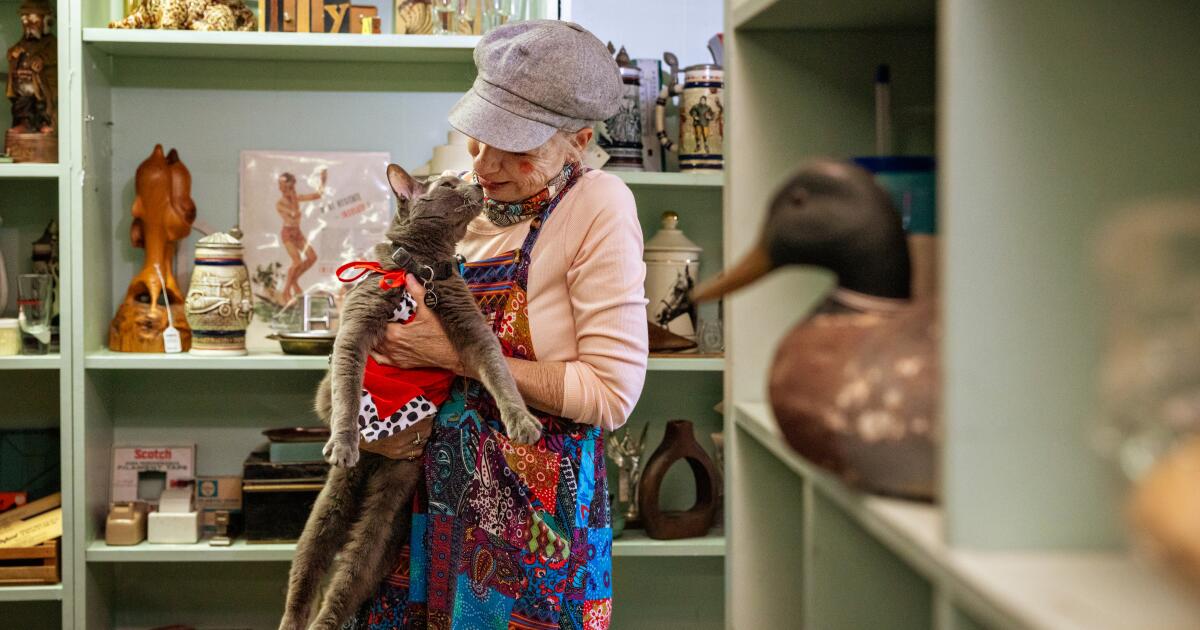
One-eyed rescue cat with Long Beach cult following celebrates 15th birthday in style
-
 Politics17 minutes ago
Commentary: Trump’s voter fraud speech was bait. Stop biting
-
 Science23 minutes ago
Commentary: The doctor who helped save her is in another state, and telemedicine follow-up is prohibited
-
 Sports29 minutes ago
Commentary: LAFC star Son Heung-Min proves life after the World Cup can offer hope and redemption
-

 World41 minutes ago
Death toll from the two earthquakes that hit Venezuela hits 5,069
-

 News1 hour ago
Where Wildfire Smoke Remains—And What To Do About It
-

 Los Angeles, Ca3 hours ago
Cybertruck driver arrested for DUI after Los Angeles pursuit crash

