Minnesota
Pair of suburban-centered Minnesota congressional districts attract differing levels of attention


They’re adjacent Minnesota congressional districts with suburban populations at their core. One features an Democratic incumbent with a well-stocked campaign account; the other is an open seat that not long ago was seen as Republican turf.
But only one has been on national watchlists for U.S. House races this year — and it’s the south-east metro 2nd Congressional District. There, Democratic Rep. Angie Craig is in pursuit of a fourth term.
Just across the Minnesota River in the western Twin Cities suburbs, Democratic state legislator Kelly Morrison is methodically marching toward joining the federal House delegation in the 3rd Congressional District, where she’s seen as favored over Republican Tad Jude. It has been a sleepy race by comparison.
In the 2nd, which runs from Eagan and South St. Paul down past Northfield, it’s a been another tug-of-war for Craig. She’s trying to hold off a stiff challenge from political newcomer Joe Teirab, a former federal prosecutor and ex-Marine.
MPR News helps you turn down the noise and build shared understanding. Turn up your support for this public resource and keep trusted journalism accessible to all.
Katie Kendrick, who lives in Burnsville, said she doesn’t know much about Teirab but plans to vote for him.
Katie Kendrick lives in Burnsville. Although she says she doesn’t know much about Teirab, she said on Friday she plans to vote for him.
Mark Zdechlik | MPR News
“Angie’s been there for a while,” Kendrick said as she took a break from arranging Halloween decorations. “I think it’s time for a change.”
Kim Nutting, who lives in Eagan, said she’ll happily cast her ballot for Craig.
“She’s smart,” Nutting said. “I think she’s for the people.”
Minnesota U.S. House District 2
Elisabeth Gawthrop | APM Research Lab

Craig has the benefit of name recognition after having run four times already in the district. (She lost narrowly in 2016 to Republican Jason Lewis.) And she’s way ahead in the money race, which comes in handy for the ads that have been on air since late August and for get-out-the-vote efforts.
Fundraising reports out last week showed Craig has spent almost three times more than Teirab — about $5.3 million to nearly $1.9 million — and with substantially more left at her disposal for the final weeks.
The race has already had more advertising exposure than the U.S. Senate race, which is a statewide contest.
On Saturday, House Minority Leader Hakeem Jeffries stopped by to campaign for Craig. Jeffries, of New York, is in line to become House speaker if Democrats can erase a narrow Republican edge in the chamber, which makes the Minnesota race that much more important to those prospects.
House Minority Leader Hakeem Jeffries says holding on to Minnesota’s 2nd Congressional District is key to his effort to win back control of the House from Republicans.
Mark Zdechlik | MPR News
“We’ve got to make sure, certainly, that every single one of our frontline members, our 31 frontline members goes back to Congress, and Angie is in one of the toughest seats,” Jeffries said as he kicked off a door-knocking push in West St. Paul.
In the 3rd District, Morrison also has a yawning financial edge over Jude. Morrison is a state senator and doctor; Jude is a former state legislator, past county commissioner and retired judge.
Morrison had spent about $900,000 through the end of September, compared with $240,000 for Jude. But Morrison had more than $1.1 million available for the final stretch to Jude’s $58,000. Morrison began airing TV ads last week.
Minnesota U.S. House District 3
Elisabeth Gawthrop | APM Research Lab
Some voters said that race has flown under the radar.
“I guess there really hasn’t been a lot of news about those folks. We haven’t heard too much about them,” said Bloomington resident Susan Bongaarts who voted early for Morrison.
Open seat races tend to attract more attention than this one has, particularly in an area that sent a line of Republicans to Washington. That was until 2018, when Democrat Dean Phillips defeated a Republican incumbent and went on to cruise to two more terms. He opted against a bid for another term amid a short-lived run for the Democratic presidential nomination that ended in March.
Roz Johnson, another Bloomington resident supporting Morrison, said she thinks Phillips helped change the district. New district boundaries set after the most-recent census also made it more favorable to Democrats.
“This area was 50-50 split when we moved here in the 80s, but it has been leaning more Democratic,” Johnson said as she took in a warm fall day in a riverside park.
Retired Carleton College political science professor Steven Schier said former President Donald Trump has a lot to do with the shift.
“The 3rd has always been a high-education, high-income district traditionally that was represented by moderate Republicans like Bill Frenzel and Erik Paulsen and Jim Ramstad,” Schier explained. “But high-education, high-income people in this state, and nationally, have been trending in the Democratic direction.”
In October 2024, Retired Carleton college political scientist Steven Schier says Minnesota’s 2nd Congressional District no longer seems to be the intense battleground it once was.
Mark Zdechlik | MPR News
Stan Danielson, an 86-year-old who lives in Bloomington, said he voted for many Republicans over the years but now is exclusively backing Democrats.
“I’m not going to vote for Republicans because they are much too far right and I’m just afraid of them,” Danielson said.
86-year-old Stan Danielson lives in Bloomington and says he’s voted for many Republicans but now is exclusively backing Democrats. “I’m not going to vote for Republicans because they are much too far right and I’m just afraid of them,” he said in October, 2024.
Mark Zdechlik | MPR News
Back across the river in the 2nd District, 30-year-old Nathan Schmidt voiced concern about the economy and border security. He plans to vote Republican up and down the ballot.
“The 2nd District does still have some more of those rural areas that lean heavily conservative,” Schmidt. “So, I think that kind of balances out some of the more left-leaning suburbs that are part of the 2nd District.”
Even so, Schmidt said he thinks Craig will win again.
Craig has had her closest races in presidential election years, losing narrowly in 2016 and winning by fewer than 3 percentage points in 2020. Two years ago, she won by about 5 percentage points.
The top of the ballot this year could also be instructive: Four years ago, Democrat Joe Biden won the district by the same margin he won statewide – about 7 percentage points.
Schier, who lives in the district, said despite the visible campaigning on both sides it no longer seems to be the intense battleground it once was.
“The 2nd District, I think, is a very good microcosm of the state as a whole because it has large rural areas that are deeply red,” he said, while noting the “inner-ring suburbs that are strongly blue and so it can, in many ways, be a bellwether for the state.”



SAINT PAUL, Minn. – Minnesota Wild President of Hockey Operations and General Manager Bill Guerin today announced the National Hockey League (NHL) club has acquired defenseman Jeff Petry from the Florida Panthers in exchange for a seventh-round pick in the 2026 NHL Draft. The draft pick becomes a fifth-round selection in the 2026 NHL Draft if Minnesota wins two playoff rounds and Petry plays in 50 percent or more of the Wild’s playoff games during those first two rounds.
Petry, 38 (12/9/1987), owns eight assists, 22 penalty minutes and 45 shots on goal in 58 games for Florida this season. The 6-foot-3, 207-pound native of Ann Arbor, Mich., has recorded 393 points (96-297=393), 103 power-play points (24-79=103), 1,745 shots on goal and 1,616 blocked shots in 1,039 games across 16 NHL seasons with the Edmonton Oilers (2010-15), Montreal Canadiens (2015-22), Pittsburgh Penguins (2022-23), Detroit Red Wings (2023-25) and Florida (2025-26). He has also amassed 13 points (5-8=13) and 90 shots on goal in 48 postseason games across four Stanley Cup Playoff appearances (2015, 2017, 2020, 2021), all with Montreal.
Petry skated in the 1,000th game of his NHL career with Florida on Nov. 17 vs. Vancouver after signing with the Panthers as a free agent on July 1, 2025. He served as an alternate captain for Montreal for three seasons (2019-22) and set career-high marks in goals (13), assists (33) and points (46) with the Canadiens during the 2018-19 season. Petry totaled 28 points (7-21=28) in 51 career American Hockey League (AHL) games in parts of three seasons (2009-12) with the Springfield Falcons (2009-10) and Oklahoma City Barons (2010-12), and represented the United States at the 2012, 2013, 2014 and 2024 IIHF World Championships, earning a bronze medal with Team USA in 2013. He was originally selected by Edmonton in the second round (No. 45 overall) of the 2006 NHL Draft. He will wear sweater No. 2 with Minnesota.
Minnesota travels to play the Vegas Golden Knights tomorrow, March 6, at 9 p.m. CT on FanDuel Sports Network and KFAN FM 100.3.
Minnesota Wild single-game tickets are on sale now at wild.com/tickets, ticketmaster.com and at the Grand Casino Arena Box Office. Flex, 11-Game, half and full season memberships are also available for purchase. Please visittickets.wild.com or contact a Wild Ticket Sales Representative by calling or texting (651) 222-WILD (9453) for more information. Group reservations of eight or more tickets can contact [email protected] for more information. Single game suite rentals are also available, contact [email protected] for more information or book instantly at wildsuites.com.
Follow @mnwildPR on X and visit www.wild.com/pressbox and for the latest news and information from the team including press releases, game notes, player interviews and daily statistics.

One of the oldest operating theaters in the Midwest is in danger of closing its doors for good.
If you’re heading south on Highway 15, Fairmont, Minnesota, is your last gasp before you hit Iowa. It officially became a city in the late 1800s — and not long after, the Opera House was born.
“We are the oldest, operating, continuously operating theater in the state of Minnesota,” said Jane Reiman, a lifelong resident of Fairmont.
When the doors opened in 1901, operas, musicals, plays, and concerts—drew people from across southern Minnesota, and even from Iowa and South Dakota.
“We have done a lot of entertainment over the years.”
The rock band America once performed at the opera house, as did folk legend Arlo Guthrie. In the 1990’s, the opera house even got a visit from Paul McCartney. His family bought seats.
“They came here and sat in the chairs, and now we have plaques on the chairs to memorialize them.”
In 3rd grade Blake Potthoff went to his first performance at the theater, and later, he acted on stage.
“You’ve grown up with this opera house?” asked WCCO’s John Lauritsen.
“Yeah. Absolutely, it’s a part of me even before I became executive director,” said Potthoff.
But like everything else, the theater has aged over time, to the point that it’s going to cost more than $4 million just to keep it running. If they can’t raise the money, the Opera House may have already seen its final curtain call.
“The building is on life support, and we are doing everything we can to make sure we get back to surviving and thriving,” said Potthoff.
Scaffolding is there, just to reinforce the roof; that’s the biggest expense. But the Fairmont community is starting to respond. Grants and donations have raised $1.5 million so far—still short, but a start.
When renovations are complete, they’d also like to maintain the old character of this theater. That includes this hand-cast plaster, which is also 125-years-old.
The chandeliers were installed a decade before the Titanic sank, and they’re hoping to keep those too. For Blake and others, the show has to go on. For the people in the seats, the actors on stage, and for the livelihood of a small town.
“There’s reason to save this building. That $4 million isn’t impossible. Only improbable. And I truly believe it too. I have a history of performing here. And I have two young kids. I want them to perform on stage like I had the opportunity,” said Potthoff.

WASHINGTON (TNND) — Rep. Clay Higgins (R-LA) called on Minnesota Attorney General Keith Ellison to resign during the House Oversight Committee’s hearing on the widespread fraud in Minnesota.
Higgins began his line of questioning by referring to Ellison’s open statement.
“Under Minnesota law, my Office has limited jurisdiction over criminal matters. The only kind of criminal case we can prosecute on our own is Medicaid fraud; any other criminal case must be specifically referred to us by county attorneys or the Governor,” Ellison said in his opening statement.
Higgins stated Ellison said that his office only had the authority to investigate Medicaid fraud, to which Ellison nodded his head in response.
But, Higgins pointed out that was incorrect.
“Under your own law, you have authority if the county district attorney asks you to get involved, or if the governor asks you to get involved, then your office can take the lead on any criminal investigation,” Ellison said.
Ellison remained speechless after Higgins asked him if that his statement was correct.
“So you have the authority to lead your state’s effort to respond to this massive fraud at the state level, from within the health care realm, where government money has been stolen at very, very high levels, unprecedented levels, in your state,” Higgins said.
“Are you leading that effort for the state of Minnesota?”
Ellison replied but his response was not picked up by the microphone.
“You’re addressing it,” Higgins asked. “Are you leading it?”
Ellison responded, “we are leading the effort to prosecute Medicaid fraud.”
“I’m not talking about Medicaid fraud,” Higgins yelled.
“Don’t hide behind that. You have the authority to prosecute anything criminally that the governor asked you to. And this thing is big.”
“I’m giving you an opportunity, sir. Are you leading the criminal investigative effort into this massive fraud across the board in the healthcare spectrum, in the state of Minnesota or not,” Higgins continued.
Ellison replied, saying his office was “following the law,” prompting Higgins to interject.
“You are not leading,” Higgins responded. “You’re not leading. I must say, Mr. Chairman, that the Attorney General of Minnesota should resign.”
SD Lottery Millionaire for Life winning numbers for March 5, 2026

Lady Vols fall to Alabama in SEC Tournament for seventh loss in row
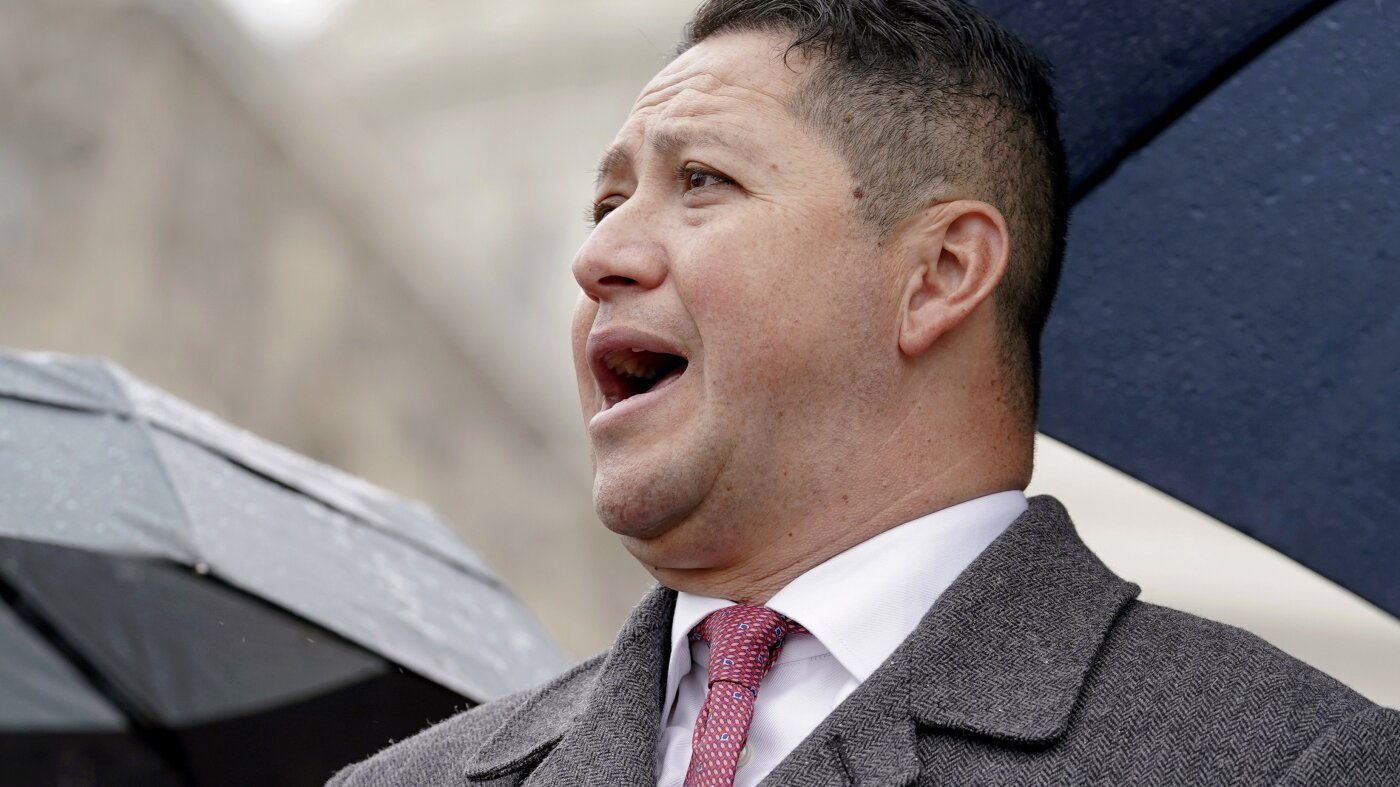
GOP Rep. Tony Gonzales of Texas ends reelection bid after admitting to affair with aide

Utah Blanks Philadelphia, 3-0 | Utah Mammoth

Friends, family rally behind Vermont veteran charged with domestic terrorism

Florida High School Football Rankings: Top 25 teams – Oct. 21

Cleary's 21 help Le Moyne down Central Connecticut State 69-64 in OT

How old is Bo Nix? What to know about Oregon quarterback ahead of 2024 NFL Draft

99th annual Pony Swim held in Virginia

Indiana Members Credit Union announced as new anchor tenant at Bottleworks District

DOJ continues Biden autopen probe despite former president unlikely to face charges
Fact check: Did French border guards mock influencers returning from Dubai amid Iran war?

Iran’s fight for survival / The widening war / Trump’s nebulous goals : Sources & Methods

Map: 4.9-Magnitude Earthquake Shakes Louisiana

Paxton vows he’s ‘staying in this race’ even if Trump backs Cornyn in Texas GOP clash
-

 World1 week ago
Exclusive: DeepSeek withholds latest AI model from US chipmakers including Nvidia, sources say
-

 Wisconsin4 days ago
Setting sail on iceboats across a frozen lake in Wisconsin
-

 Massachusetts1 week ago
Mother and daughter injured in Taunton house explosion
-

 Maryland5 days ago
AM showers Sunday in Maryland
-

 Massachusetts3 days ago
Massachusetts man awaits word from family in Iran after attacks
-

 Florida5 days ago
Florida man rescued after being stuck in shoulder-deep mud for days
-

 Denver, CO1 week ago
10 acres charred, 5 injured in Thornton grass fire, evacuation orders lifted
-

 Oregon7 days ago
2026 OSAA Oregon Wrestling State Championship Results And Brackets – FloWrestling