Texas
GOP Rep. Tony Gonzales of Texas ends reelection bid after admitting to affair with aide

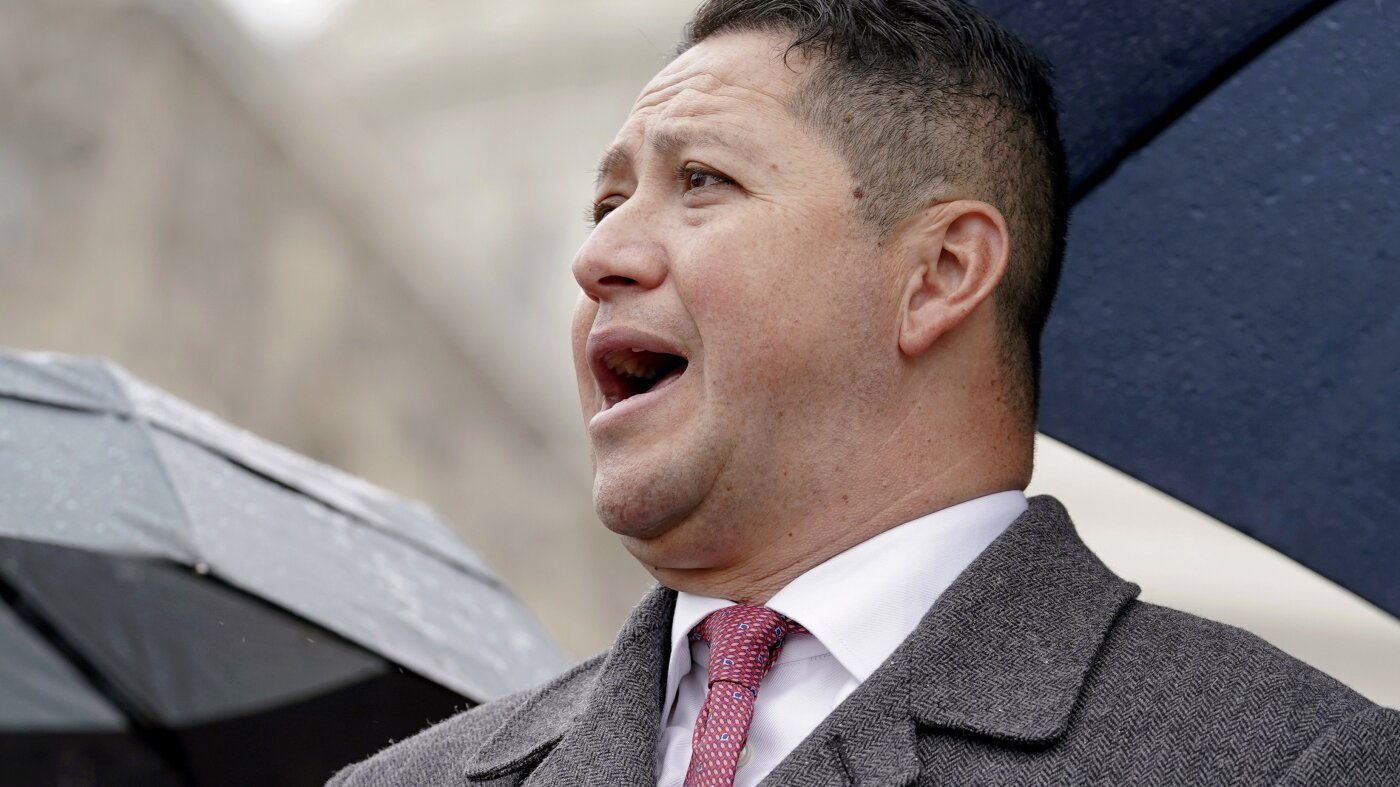
FILE – Rep. Tony Gonzales, R-Texas, speaks during a news conference Dec. 7, 2022, on Capitol Hill in Washington.
Mariam Zuhaib/AP
hide caption
toggle caption
Mariam Zuhaib/AP
WASHINGTON — Republican Rep. Tony Gonzales of Texas said late Thursday he was withdrawing from his reelection race, after having admitted an affair with a former staff member who later died by suicide, but he vowed to finish out his term in Congress.
He had faced calls from GOP leadership to end his reelection bid, and from others in Congress to resign.
“After deep reflection and with the support of my loving family, I have decided not to seek re-election,” Gonzales said in a statement posted late Thursday to X.
The move is the latest in a quickly changing situation that stunned Capitol Hill and resulted in a House Ethics Committee investigation into his conduct. Gonzales’ decision to bow out of the race appears to clear the field. On Tuesday, he had been forced into a May runoff against Brandon Herrera, a gun manufacturer and YouTube gun-rights influencer who narrowly lost to him in the 2024 primary.
House Speaker Mike Johnson and the GOP leadership earlier Thursday had called on Gonzales to withdraw from reelection after Gonzales, a day earlier, acknowledged a relationship that has upturned the political world in his home state and in Washington.
“We have encouraged him to address these very serious allegations directly with his constituents and his colleagues,” said Johnson, Majority Leader Steve Scalise, Whip Tom Emmer, and GOP Conference Chairwoman Lisa McClain in a statement.
“In the meantime, Leadership has asked Congressman Gonzales to withdraw from his race for reelection.”
Johnson, R-La., has been under enormous pressure from his own GOP lawmakers to take action, and several Republicans have already called for Gonzales to step aside. Rep. Anna Paulina Luna, R-Fla., has introduced two resolutions to punish Gonzales. The first seeks to remove him from his assignments on the House Appropriations and Homeland Security committees, while the second seeks to censure him.
House Democratic Leader Hakeem Jeffries of New York, meanwhile, said he would support expelling Gonzales from the House, a rare step that requires a two-thirds vote from the chamber.
GOP leaders notably did not call for Gonzales to resign from office as they struggle to maintain their slim majority in the House, which they hold by only a handful of seats.
Their move came after Gonzales, appearing on the “Joe Pags Show,” was asked whether he had a relationship with the aide, Regina Ann Santos-Aviles.
Santos-Aviles, 35, died after setting herself on fire in the backyard of her home in Uvalde, Texas. The Bexar County Medical Examiner’s Office later ruled her death a suicide.
“I made a mistake and I had a lapse in judgment, and there was a lack of faith, and I take full responsibility for those actions,” Gonzales said.
The congressman, now in his third term, had said he would not step down in response to the allegations, telling reporters recently that there will be opportunities for all the details and facts to come out.
Gonzales, a father of six, first won his seat in 2020 after retiring from a 20-year career in the Navy that included time in Iraq and Afghanistan.
In the interview broadcast Wednesday, Gonzales said he had not spoken to Santos-Aviles since June 2024. She died in September 2025.
“I had absolutely nothing to do with her tragic passing, and in fact, I was shocked just as much as everyone else,” Gonzales said.
Gonzales went on to say he had reconciled with his wife, Angel, and has asked God to forgive him. He also said he looked forward to the Ethics Committee investigation.
Johnson and GOP leadership urged that committee to “act expeditiously.”
Under House ethics rules, lawmakers may not engage in a sexual relationship with any employee of the House under their supervision.


AUSTIN – Texas Attorney General Ken Paxton said Wednesday he has secured a settlement of bankruptcy claims against genetic testing company 23andMe stemming from a 2023 data breach that exposed personal information, including some genetic ancestry data, of 6.9 million customers worldwide.
Paxton’s office said the settlement includes $150 million for a multistate coalition of 42 states. But because of limited funds in 23andMe’s bankruptcy estate and competing claims, the states’ recovery will be $18 million paid immediately, with Texas receiving $1,266,860.
23andMe disclosed in October 2023 that attackers had accessed accounts affecting 6.9 million consumers. Some of the information was later posted for sale on the dark web, according to Paxton’s office, which said the company learned of the breach months after the data became publicly available. The office said 23andMe initially denied a breach and later blamed consumers’ account settings and password practices.
Paxton joined a multistate investigation that concluded 23andMe used unreasonable security practices and failed to implement adequate safeguards against hacking, the office said.
23andMe filed for bankruptcy protection in March 2025. Paxton’s office said the settlement incorporates privacy and cybersecurity requirements, including enhanced security standards, comprehensive risk assessments and creation of an independent advisory board, along with enforcement of state privacy laws and continued consumer data deletion rights.
“Companies that collect and profit from Texans’ most personal information have a legal duty to protect it,” Paxton said in a statement.
The company also agreed to a $46.75 million class-action settlement in the bankruptcy case for affected U.S. consumers who submitted claims by Feb. 17, 2026, Paxton’s office said.
Copyright 2026 by KPRC Click2Houston – All rights reserved.


The Texas Longhorns entered the 2025 season with more expectations than any team has had to deal with in recent memory.
Many among the media were ready to crown the team and quarterback Arch Manning before they even played one game. Of course, those unrealistic expectations were never met, even though the team finished with a 10-3 record and a Citrus Bowl win over the Michigan Wolverines.
2026 is heading in the same direction for the Longhorns. Many believe head coach Steve Sarkisian has the most talented team in the country. But in order to fix the issues from this past season, the Longhorns needed to fix one issue that has cost them in the past.
Changing The Narrative
One of the biggest issues the Longhorns had last season was the play of the offensive line. It was apparent in the first game of the season against the Ohio State Buckeyes that Manning didn’t have the pocket time needed to make big plays.
This offseason, Coach Sarkisian went out and found two massive transfer portal additions that should completely change the narrative on this offensive line.
It starts with potential starting right tackle Melvin Siani. Siani has spent time with the Temple Owls and last season with the Wake Forest Demon Deacons.
The Longhorns are set at left tackle with Trevor Goosby, who could play himself into being a top 10 pick in the 2027 NFL Draft. If the team can get competent play from Siani, the offense will be able to open up the playbook, and the world may finally see Manning at his college peak.
The Longhorns also went out and found a potential fix at left guard for the 2026 season. Western Kentucky Hilltoppers transfer Laurence Seymore could be another strong patch for the holes in the offensive line.
After spending the first two seasons of his college career with the Miami Hurricanes, Seymore made stops with the Akron Zips and the Hilltoppers.
Of course, the one concern with Seymore is wondering if he can compete at the SEC level coming from the C-USA.
This season for the Longhorns starts and stops with the play of Manning. Coach Sarkisian and the rest of this coaching staff understood that protecting their quarterback was the most important goal when building the 2026 roster.
The Longhorns are going to be leaning on veteran talent to protect their quarterback, and it may very well be the best decision they made this offseason.
Sign up to our free newsletter and follow us on Facebook, X and Instagram for the latest news.
 Add us as a preferred source on Google
Follow
-
 News19 minutes ago
Argentina is back in the World Cup final after a thrilling semifinal win over England
-

 Los Angeles, Ca2 hours ago
Remains of murder victim identified as missing Southern California millionaire
-

 Detroit, MI2 hours ago
4Warn Weather Alert: Wildfire smoke leading to ‘unhealthy’ air quality in Metro Detroit
-

 San Francisco, CA3 hours ago
San Francisco fishermen recount harrowing rescue after boat capsizes near Alcatraz
-

 Dallas, TX3 hours ago
Timothée Chalamet ‘Starstruck’ by Dallas Cowboys Cheerleaders
-

 Miami, FL3 hours ago
Wives of detained men allege inhumane conditions at federal detention center in Miami
-

 Boston, MA3 hours ago
Driver charged in Norwood pedestrian crash that left man seriously injured
-

 Denver, CO3 hours ago
Boys, 12 and 14, arrested in deadly shooting in Denver’s Sunnyside neighborhood

