Minneapolis, MN
Camp Nenookaasi Brings Minneapolis' Policies Against its Unhoused Residents to the Forefront – UNICORN RIOT


Minneapolis, MN — The city of Minneapolis evicted Camp Nenookaasi, the city’s largest encampment of unhoused people, three times over the past month in an attempt to prevent encampments of this size and level of infrastructure from forming. After each eviction, Nenookaasi pops up again in a different spot. It gets smaller each time, but it has not disbanded.
Even after these evictions, residents and supporters of Camp Nenookaasi continue fighting to change the city’s prohibition of encampments. The camp has garnered support from legislators, housing service providers, and housed neighbors who are turning the camp into a launching pad for a campaign for a better approach to encampments.
In recent years, advocates have made numerous attempts to end the practice of evictions. They often point to the high price tag — each eviction costs anywhere from $40,000 to $265,000, per the city’s reporting — and the near-constant state of displacement that encampment sweeps force upon residents. Activists defending camps against eviction frequently get into scuffles with police. In October 2022, unsheltered people protesting eviction policies pitched their tents on the sidewalk in front of City Hall. Still, the evictions continued.
Camp Nenookaasi, a Beacon of Hope to the Unhoused, Faces Eviction
Minneapolis Continues Encampment Evictions, Displacing Hundreds in May
Nicole Mason, an organizer of Camp Nenookaasi, said, “I’m really dedicated this year to changing homelessness here in East Phillips and showing that if we listen to the people, we can make programs that work for them.”

During the five months of its existence, hundreds of unsheltered people have called Camp Nenookaasi home. Christin Crabtree, another camp organizer, said the recent wave of support for the camp has played a significant role in its staying power. Crabtree said, “We’ve been able to build more awareness. We’ve been able to help draw the connection between people who are experiencing homelessness and other things that help people see how this affects them too. That solidarity has really been a part of it, having people show up.”


Lex Horan stood outside Camp Nenookaasi in the predawn darkness on a January morning with a box of fliers to distribute and a pile of trash bags to fill. Horan, a resident of the Phillips neighborhood where all four iterations of Camp Nenookaasi have been, was part of a group that had self-organized to clean up the camp area and foster conversations with housed neighbors. The group provided information about the camp, invited neighbors to ask questions, and urged them to take action in pressing city officials to create long-term solutions.
“The city of Minneapolis and the Frey administration are fanning tensions between housed and unhoused neighbors by not providing the support that our unhoused neighbors at Nenookaasi need. We’re here to say that actually, a city that works for housed and unhoused neighbors is possible by providing the solutions that folks at Nenookaasi want,” Horan said.
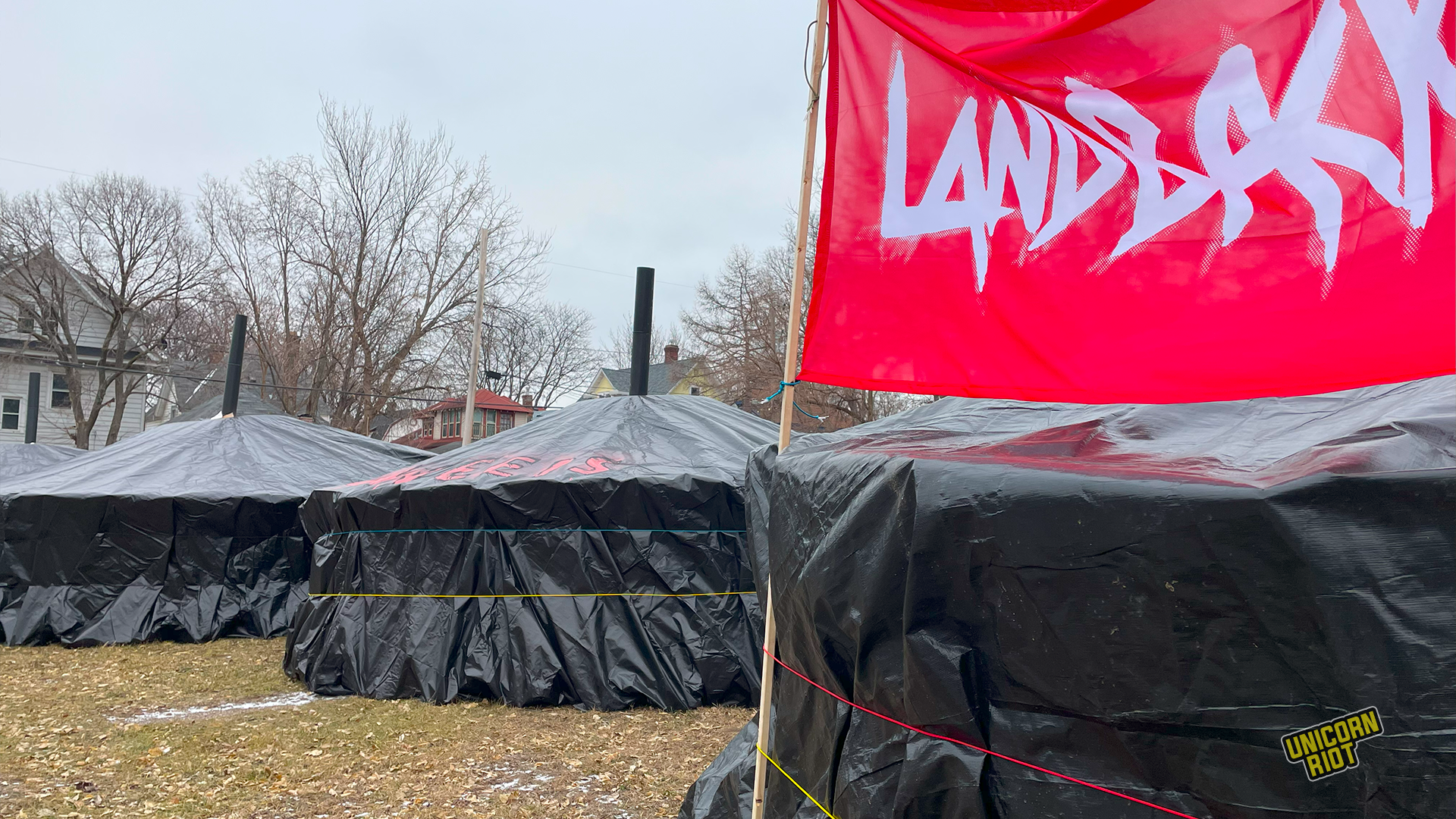
Community members are coordinating widespread efforts to make sure the camp has what it needs to operate. A group that calls itself the Autonomous Yurt Union has built dozens of yurts with wood-burning stoves for Nenookaasi and other encampments across the Twin Cities. Supply drives and meal deliveries keep the camp stocked and fed. They have received over $65,000 in donations. The city delivered portable toilets and trash cans, services that organizers fought for months to receive.
Over 100 former residents of the camp have found permanent housing and started recovery programs since late August. Many organizers and housing service providers attribute those numbers to the relative stability of the camp.


“When evictions happen, it’s hard for outreach to do their job. It’s hard for people who live in that camp to stay connected with their provider and do the work they need to do to get to that next step if that’s what they want. That often gets disrupted. It is a really strange way of trying to house people because it’s disruptive to the process,” Crabtree said.
John Tribbett, the director of the Ending Homelessness division of Avivo, a prominent housing organization in the Twin Cities, said, “If encampment displacements worked, then we would not have a situation where we have well over 100 people still here today in our community.”
Despite fierce campaigning to allow the camp to stay, police came to evict three times since the beginning of the year. According to a Minneapolis city ordinance, temporary structures used for shelter are prohibited on any public or private property. The city cited drug use, unsanitary conditions, a high volume of complaints from neighbors, and violence, among other concerns, in its reasoning for closing the camp.

The encampment response guidelines that the Frey administration established in 2022 require notice of eviction to be posted at encampments facing closure 72 hours in advance. However, the guidelines state that less than 72 hours notice is acceptable if the encampment meets any one of a list of broad criteria such as posing “imminent community safety risks,” or “inhibiting or interfering with the normal operation of a business, school, daycare, or sober living facility.”
The eviction tactics escalated as the city’s tolerance for the encampment thinned — for each of the three sweeps within one month, police arrived earlier in the morning and with less prior notice than the previous one. The taped-off area grew. Community Safety Commissioner Toddrick Barnette estimated that 70 Minneapolis Police Department officers were dispatched for the first eviction on January 4, and 90 were dispatched for the second on January 30. Fewer volunteers were allowed to enter the enclosure to assist residents. Squad cars guarded more intersections and alleyways. By the third eviction on February 1, police were stationed at vacant lots around the neighborhood to prevent unhoused people from settling there.
City Operations Officer Margaret Anderson Kelliher said at a City Council hearing on January 31, “We need to continue to do our work as a city per our ordinances to have continuous and coordinated efforts to deter encampments within the city.”
Several resolutions have been proposed in the City Council in recent years aimed at stopping evictions altogether or restricting their use. All have been voted down or vetoed by the mayor. On January 25, three city councilmembers tried a different approach, giving notice to introduce new legislation regarding encampments. If passed, the three proposed ordinances would provide “safe outdoor spaces” for unsheltered people, establish a “humane encampment response policy,” and require the city to prepare after each eviction a comprehensive public report.
Councilmember Jason Chavez, whose Ward 9 includes the new Camp Nenookaasi, coauthored the three ordinances. “It’s time that we as the City of Minneapolis restored the dignity of unhoused residents across the city,” Chavez said.
Camp organizers and residents met with Mayor Frey and representatives from several city departments in January to discuss possibilities for the future of the camp. In the following weeks, Kelliher announced that the city had identified two possible sites for construction of the Indigenous cultural healing center that camp advocates have pushed as one of their top priorities. She did not specify where the sites are.
With the fight continuing to play out in city government, the residents of Camp Nenookaasi are trying their best to stay together and survive the winter.
Jorge “Chico” Grijalva was unhoused in the Twin Cities on and off for eight years before he moved to Camp Nenookaasi. After the eviction of the first camp on January 4, he moved with his girlfriend and his tent to the next spot. Chico said he cycled in and out of the shelter system during that time, but he prefers camp life to the restrictions and dangers he experienced in shelters.
Shelters in Minneapolis opened 90 additional temporary beds — cots and mats in an overflow room — in early January. Crabtree said the arduous process of getting a spot in a single-night shelter deters many camp residents from even trying.
“It’s a really big risk to your life to go stay in a shelter bed because the next day, you may not get another one. If you go stay in this shelter, and you can’t have all your stuff in there, your stuff could get stolen or go missing. Also, you could lose connection with whoever you’ve been with outside, who you’re staying safe with. So it actually can be worse for people to choose a shelter bed for a night than it is for them to stay outside,” Crabtree said.
Chico said that the reliability of the camp compared to shelters or being alone on the streets made it worthwhile to stay there. “The fact that I don’t have to set up camp every day, and I’m not worried about me being evicted on a daily basis is the best part for me. Knowing that resources and food and water is constantly brought here is comforting — to know that there’s some kind of help other than us finding it all on our own.”
On January 30, the day of the second eviction, Chico had whatever belongings he could salvage piled high into a shopping cart and a wheelbarrow. He said he was going to spend the day in a library and figure out where to go next.


Camp organizers said they understand that the camp is not forever — nor do they want it to be — but they weren’t ready to pack up yet. They had four months, then three weeks, then two days between evictions. “Before we had to leave, we wanted to at least be stable where we were to hopefully get more permanent indoor solutions for the relatives and move in,” Mason said.
Now, in their fourth location, the roughly 70 people of Camp Nenookaasi are putting down roots again while they still can.
Looking ahead to the future she wants for the camp, Mason said, “Tearing our community apart here? I’m not going to let that happen. I’m going to keep everybody together until we have some real results.”
Unicorn Riot’s 2020-23 Unhoused Crisis in Minneapolis:
- Crisis of the Unhoused – Landing Page for Unicorn Riot Coverage
- Camp Nenookaasi, a Beacon of Hope to the Unhoused, Faces Eviction – Dec. 14, 2023
- ‘Wall of Forgotten Natives’ Encampment Revived After Five Years, Gets Evicted – Sept. 4, 2023
- Minneapolis Continues Encampment Evictions, Displacing Hundreds in May – May 26, 2023
- Samatar Encampment Eviction Leaves 100 Displaced Mid-Winter – January 24, 2023
- Dozens of Police Evict Quarry Encampment – January 2, 2023
- Quarry Encampment Faces Eviction in Minneapolis – December 28, 2022
- Three Encampments and Halfway House Evicted, Displacing Hundreds – October 12, 2022
- Personal Belongings Trashed as Minneapolis Encampment Evicted – July 22, 2022
- Minneapolis Community Resists Encampment Eviction – July 20, 2022
- Southside Minneapolis Encampment Faces Eviction Threat – June 28, 2022
- Eviction Defense Successful Despite Aggressive Contractors – June 9, 2022
- Uptown Streets Blocked During Protest Against Police Attack on Houseless – March 23, 2021
- Five Arrested as Minneapolis Police Attempt Raid on Near North Houseless Encampment – March 23, 2021
- Homeless Tenants Union: Unhoused Self-Advocacy in the Twin Cities – February 17, 2021
- Winter of Coronavirus: Seeking Shelter in Minneapolis During COVID–19 – December 14, 2020
- Unhoused Community Forms Tenants Union, Constituents Protest at Commissioner’s Home – November 11, 2020
- Minneapolis Prioritizing Park Sweeps Over Sheltering the Unhoused – October 29, 2020
- ‘No KKKops, No Pipelines’ Banner Dropped in Minneapolis – October 6, 2020
- Reclaimed Space Sprouts From Uprising’s Embers – September 28, 2020
- Peavey Park Sanctuary Homeless Camp Evicted in Minneapolis – September 24, 2020
- New Month Brings Added Urgency To Minneapolis’ Housing Needs – September 2, 2020
- Sanctuary Camp Residents Pressured To Move, No Housing Solution In Sight – August 22, 2020
- Minneapolis Police Sweep West Powderhorn Encampment, Pepper Spray Defenders – August 15, 2020
- Authorities Visit Loring Park Tent Encampment, Bring Eviction Scare – August 10, 2020
- Minneapolis’ Unhoused Speak Out Against Years of Evictions – August 3, 2020
- Minneapolis Park Police Displace Sanctuary Encampment – July 22, 2020
Follow us on X (aka Twitter), Facebook, YouTube, Vimeo, Instagram, Mastodon, Threads, BlueSky and Patreon.
Please consider a tax-deductible donation to help sustain our horizontally-organized, non-profit media organization:




MINNEAPOLIS (FOX 9) – A man has died days after he was assaulted by his neighbor in Minneapolis.
Minneapolis deadly assault
What we know:
According to Minneapolis police, on April 5, officers responded to an apartment building on the 300 block of Hennepin Avenue.
Officers found a man in his 70s unconscious. He was then taken to the hospital.
Police learned through surveillance video that the victim had been hit by another 61-year-old man after a verbal argument.
The 61-year-old man was found to also be a resident in the apartment building and was later arrested.
Police announced Tuesday that the victim died at the hospital from his injuries.
The suspect was initially charged with first-degree assault, but those are expected to be amended to include homicide, police said.
What we don’t know:
Police did not say what led up to the altercation between the two men.
The Source: A press release from the Minneapolis Police Department.

MINNESOTA — The cost of living varies widely across Minnesota, with new data from Niche highlighting a sharp divide between Twin Cities neighborhoods and smaller communities across the state.
The Niche rankings are based on a mix of housing costs, income levels, taxes, and everyday expenses like groceries and gas, using data from the U.S. Census, the Bureau of Labor Statistics, and Tax Foundation.
Many of the highest-cost areas are concentrated in Minneapolis, St. Paul, and nearby suburbs, while the most affordable places are largely found in rural and small-town Minnesota.
15 Most Expensive Places To Live In Minnesota
Niche places several Twin Cities neighborhoods and suburbs in its second-highest cost-of-living tier. No Minnesota locations ranked in the highest tier.
Among them:
- Macalester-Groveland (St. Paul)
- King Field (Minneapolis)
- St. Anthony Park (St. Paul)
- Downtown East (Minneapolis)
- East Harriet (Minneapolis)
- Summit Hill (St. Paul)
- Bryn Mawr (Minneapolis)
- North Loop (Minneapolis)
- King Field (Minneapolis)
- Edina
- Linden Hills (Minneapolis)
- Fulton (Minneapolis)
- Lowry Hill (Minneapolis)
- East Isles (Minneapolis)
- Lynnhurst (Minneapolis)
15 Most Affordable Places To Live In Minnesota
At the other end of the spectrum, Niche identified a number of towns with significantly lower costs of living.
These communities are spread across southern, western, and northern Minnesota and tend to have smaller populations and lower housing costs.
Among the most affordable places:
- Luverne
- International Falls
- Pipestone
- Caledonia
- Jackson
- Windom
- Redwood Falls
- Ely
- Breckenridge
- Blue Earth
- Lake Crystal
- Austin
- Sleepy Eye
- Mountain Iron
- Thief River Falls
The data underscores a familiar pattern in Minnesota: higher costs in the metro area and more affordable living in smaller towns, often with trade-offs in access to jobs, amenities, and services.

After a ruff start, the Sox are still a sad 6-9 but are only two games out of first place. Tonight, we ball behind Garrett Crochet to help close that gap in a wide-open AL East (and AL in general). Game’s at 7:40 p.m. and the Sox will face Bailey Ober, who’s had a tuff start to the season himself. Here are the lineups:
Given the venue, I’d like to add: Fuck ICE. Or maybe I’ll just let the Boss do it:

Milwaukee flooding traps drivers and leaves thousands without power

Atlanta daycare owner faces $400,000 loss as fire investigation stalls and insurance claim delayed

Minneapolis man dies after neighbor assaulted him

New board overseeing IPS and Indianapolis charter schools begins work on November referendum question

Penguins fall 7-5 to Blues in regular season finale

Florida High School Football Rankings: Top 25 teams – Oct. 21

How old is Bo Nix? What to know about Oregon quarterback ahead of 2024 NFL Draft

Cleary's 21 help Le Moyne down Central Connecticut State 69-64 in OT

99th annual Pony Swim held in Virginia

Indiana Members Credit Union announced as new anchor tenant at Bottleworks District

Dem fundraising giant in the hot seat as GOP lawmakers demand answers over dodged subpoena

Fifth woman accuses former US lawmaker Eric Swalwell of sexual misconduct

Commercial Ships Transit Strait of Hormuz as U.S. Blockades Iran’s Ports

Video: How Stephen Miller Is Adjusting Trump’s Immigration Agenda

Biden DOJ weaponized FACE Act against pro-life Americans, 882-report alleges
-

 Georgia1 week ago
Georgia House Special Runoff Election 2026 Live Results
-

 Ohio16 hours ago
‘Little Rascals’ star Bug Hall arrested in Ohio
-

 Arkansas5 days ago
Arkansas TV meteorologist Melinda Mayo retires after nearly four decades on air
-

 Pennsylvania1 week ago
Parents charged after toddler injured by wolf at Pennsylvania zoo
-
 Milwaukee, WI1 week ago
Potawatomi Casino Hotel evacuated after fire breaks out in rooftop HVAC system
-

 World1 week ago
Zelenskyy warns US-Iran war could divert critical aid from Ukraine
-

 Austin, TX1 week ago
ABC Kite Fest Returns to Austin for Annual Celebration – Austin Today
-

 Culture1 week ago
Can You Name These Novels Based on Their Characters?