Midwest
Expert reveals key factor that led to massive Minnesota fraud scheme

NEWYou can now listen to Fox News articles!
An ongoing decline in American assimilation and a deep fear of being accused of racism were key factors in the massive fraud scheme in Minnesota that is now coming to light, according to an expert.
Minnesota is facing one of the largest social-services fraud scandals in U.S. history after federal prosecutors uncovered what they describe as “schemes stacked upon schemes” by Somali-run non-profits that siphoned hundreds of millions of taxpayer dollars from child-nutrition and Medicaid housing programs.
Prosecutors have since charged more than 70 defendants, a large percentage of whom are members of Minnesota’s Somali community, securing dozens of convictions as new waves of indictments continue. The scandal has triggered state and federal investigations, congressional scrutiny, and calls for accountability over why warnings were missed and how the fraud was allowed to reach this scale.
Simon Hankinson, a senior research fellow at the Heritage Foundation’s Border Security and Immigration Center, said that the decline in immigrant assimilation in America was key during an interview with Fox News Digital.
INSIDE ‘LITTLE MOGADISHU’: MINNESOTA’S BELEAGUERED SOMALI COMMUNITY UNDER A CLOUD OF FRAUD AND TRUMP ATTACKS
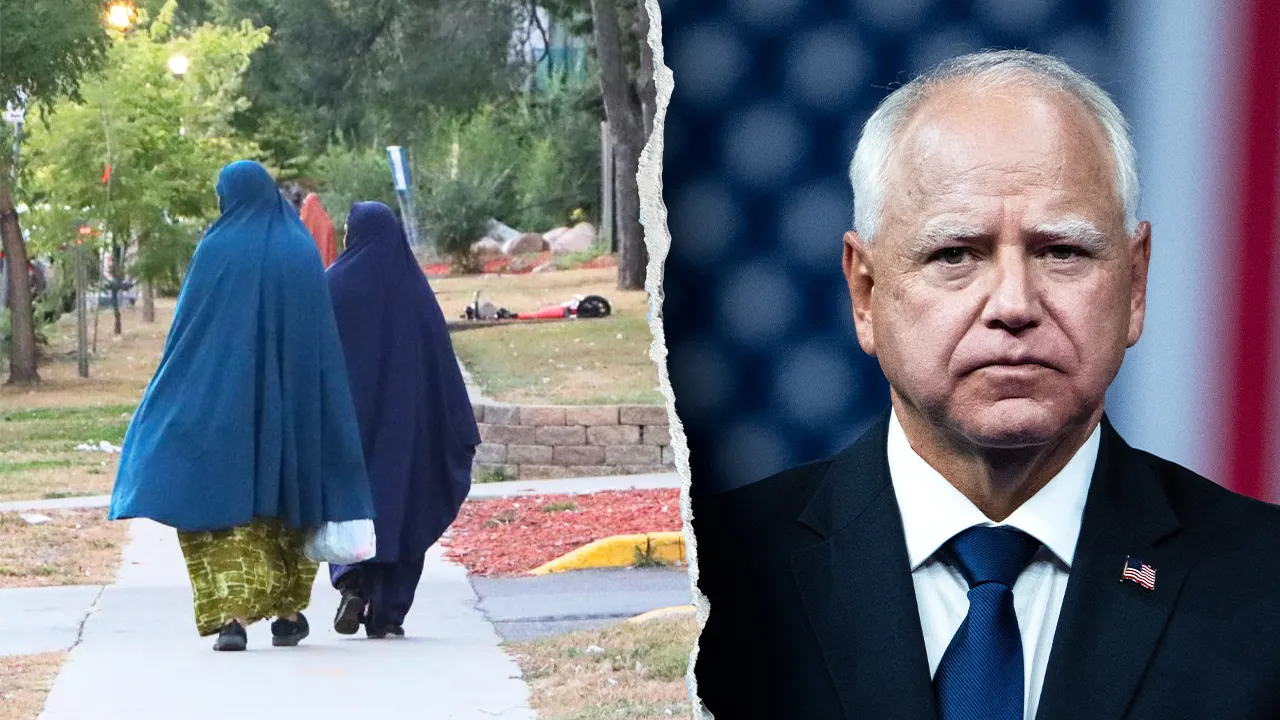
Two Somali women walk through a Minneapolis neighborhood as Minnesota Gov. Tim Walz appears in a split image. Lawmakers say the state’s oversight failures and political sensitivity around Somali-run nonprofits helped fuel the $1 billion welfare fraud scandal now under federal investigation. (Williams/CQ-Roll Call, Inc via Getty Images; Michael Dorgan/Fox News Digital)
“Assimilation is a two-sided coin. The pressure comes from inside, from you wanting to assimilate so you can make it in the new society, but it also comes from outside, where the society says, ‘Hey, we expect you to do this. We expect you, if you want a driver’s license, to be able to speak and read English at a basic level.’ We don’t do that anymore in America. We don’t we don’t really expect anything of our immigrants,” explained Hankinson.
“There are a lot of people who are American-born,” he went on, “who really don’t like this country and what it stands for. And so, they don’t think anyone else ought to accept it and adapt to it either.”
Hankinson noted that in no way can the fraud scheme be blamed writ large on the Minnesota-Somali community, which is estimated to have around 80,000 people. He said that those involved in the scam are a minority. However, the fact that the tight-knit community has by and large not assimilated into the broader American society and customs meant that many of the factors that could have exposed the scheme earlier were not there, according to Hankinson.
“When you come from a culture that provides you with nothing from the center, everything is family, everything is clan, everything is local, then it’s almost impossible for you to understand how a federal system would work. And if your neighbor came to you and said, ‘Hey, we got this cool thing going, if you just say your kid’s autistic, I’ll give you a thousand dollars a month.’ I mean, that’s a no-brainer for an awful lot of people,” he explained.
“Even if they thought that maybe it was wrong on some level, they might think, ‘Well, hang on, in my new country, maybe that’s frowned upon,’ they’re not going to rat out the clan member, the family member,” he added.
TIM WALZ CALLED OUT BY WASHINGTON POST FOR REFUSING TO TAKE RESPONSIBILITY FOR MINNESOTA FRAUD SCANDAL
Men take part in a weekly Friday Jum’ah prayer session at Abubakar As-Saddique Islamic Center amid a reported ongoing federal immigration operation targeting the Somali community in Minneapolis, Minnesota, U.S. Dec. 5, 2025. (Tim Evans/Reuters)
That, combined with the existence of generous taxpayer-funded welfare programs and Minnesota being what Hankinson called a “high trust state,” made the state “ill-equipped to handle fraud.”
“In Minnesota, these programs were low-hanging fruit. They were so easy to fleece, it’s almost farcical,” said Hankinson. “So, the carrot is there to commit fraud, and there’s no stick.”
He pointed to one aspect of the scheme in which prosecutors say Minnesota’s Medicaid autism program was exploited by companies recruiting families, securing fraudulent diagnoses, and billing for therapy that never happened, draining millions from the program.
“That is outrageous. Somebody should have noticed at some point that, ‘Hang on a minute, why have the autism rates in Somali kids gone from one in a hundred to like one in three or whatever it was?’” he said. “There should have been some oversight, and there again you get into the whole American racial guilt, which is a particular issue that we have, where if you’re an unscrupulous scammer, you can always play the race card, and that will often get you away with it because people are terrified.”
“Nobody likes to be called a racist. It’s about one of the worst things you could be called,” he went on. “But I do think liberal Americans, in particular white liberal Americans, are more afraid of that label than anything else. So, some of these scammers, they threatened to make a fuss about being targeted on account of race or immigrant status or religion. And that probably contributed to state authorities being a little slower.”
ILHAN OMAR SAYS SHE’S FRUSTRATED SINCE SOMALIS ARE ALSO VICTIMS IN ‘FEEDING OUR FUTURE’ SCAM
Somali illegal alien Abdul Dahir Ibrahim, who was convicted of fraud, has been photographed with Rep. Ilhan Omar, D-Minn., (left) and Democratic Minnesota Gov. Tim Walz (right). (ICE)
This dynamic has also played out on the national level. Following the Trump administration’s announcement of its crackdown on illegal immigrant Somalis in Minnesota, Democratic Gov. Tim Walz has accused it of “demonizing an entire group of people just by their race and their ethnicity.”
“I can’t take Tim Walz seriously, honestly, because he was the governor who was in charge while all this was happening. Where was he?” said Hankinson. “He was asleep at the switch.”
CLICK HERE TO DOWNLOAD THE FOX NEWS APP
“It’s not a question of scapegoating,” he said. “It’s a good thing to send a message, not to the Somali community per se, but to all of Minnesota and the rest of the 49 states that this is America, we have laws, we have rules. When you break those rules, you are going to get punished.”
Hankinson added that ultimately, he hopes to see many Somalis joining in the effort to crack down on the minority involved in fraud so that they can “give their community the reputation that it deserves.”
Read the full article from Here



KANSAS CITY, Kan. (KATV) — A few members of Little Rock Police’s Mounted Patrol Unit had a field trip this past month, traveling to Kansas City to assist with public safety during FIFA World Cup matches.
In a statement, police said these officers “provided high-visibility patrol, supported crowd management, and engaged with fans from around the world.”
They posted these pictures to their Facebook page:
Little Rock mounted police assist with public safety at Kansas City World Cup matches (Photo LRPD via Facebook)

Little Rock mounted police assist with public safety at Kansas City World Cup matches (Photo LRPD via Facebook)
Little Rock mounted police assist with public safety at Kansas City World Cup matches (Photo LRPD via Facebook)
“We are proud of our Mounted Patrol Unit for representing the Little Rock Police Department with professionalism, dedication, and excellence while helping provide a safe and welcoming environment for everyone attending this world-class event,” the Department said.
Michigan
60% of traffic restrictions to be lifted in Michigan during Fourth of July travel — what to expect

Governor Gretchen Whitmer has announced 60% of traffic restrictions will be removed for the Fourth of July weekend.
Traffic restriction removal will begin at 3 p.m. Thursday, July 2, and continue until 6 a.m. Monday, July 6.
Restrictions include road and bridge projects statewide.
106 out of 179 MDOT projects statewide will have lane restrictions removed.
For the Fourth of July weekend AAA estimates more than 2.6 million Michiganders will travel at least 50 miles or more from home.
Adjustments are aimed to keep traffic moving smoothly for the busy travel weekend.
While drivers will see suspended operations in most road work zone, equipment and certain temporary traffic shifts or shoulder closures may remain.
“As we celebrate America’s 250th birthday this Fourth of July, we want every Michigander to get where they’re going safely and with fewer delays,” said Governor Whitmer. “That’s why we’re temporarily lifting lane restrictions and removing orange barrels along key routes across the state. But once the holiday weekend ends, we’ll get right back to work fixing the damn roads.”
Here is a list of work zones and their status for the Fourth of July weekend.
Some routes may have detour routes posted at the project location.
All closures are subject to change.
Here is the most up-to-date information on MDOT projects.
Copyright 2026 by WDIV ClickOnDetroit – All rights reserved.
Minnesota
David Doty, Minnesota federal judge who oversaw NFL’s labor disputes for decades, dies at 96

A Minnesota federal judge noted for presiding over “several landmark disputes involving the National Football League” has died at 96, the U.S. District Court announced Monday.
David Doty died Saturday, just three days before his 97th birthday, the court said.
“Judge Doty devoted his entire professional life to serving others — as a Marine, as a lawyer who served not only clients but his community in many ways, and as a U.S. District Judge for nearly four decades,” Chief U.S. District Judge Patrick Schiltz said. “Despite his remarkable accomplishments, he was a genuinely humble man. He treated everyone — from the guy who shined his shoes to Justices of the U.S. Supreme Court — the same way: with kindness and compassion and a sincere interest in their lives.”
Former President Ronald Reagan appointed Doty to Minnesota’s district court in 1987, and the court said he “continued to maintain a significant caseload until just a few months before his death.”
Doty grew up in Minneapolis and earned his law degree from the University of Minnesota. Before becoming a judge, he practiced law for more than a quarter-century. He also served in the U.S. Marine Corps for six years.
Doty’s ruling in an antitrust case involving the NFL in the early ’90s led to the creation of the free agency system the league still uses. He oversaw decades of NFL labor matters, including a 2011 case that preceded a brief lockout. So influential was Doty in NFL labor matters that owners tried to get him removed from cases on multiple occasions, according to the Associated Press.
The NFL Network’s Tom Pelissero shared a statement from the league on Doty’s death: “Judge Doty devoted his life to public service and the law, presiding over NFL-related litigation for many years during his distinguished career. We express our sincere condolences to his family, friends and colleagues.”
-

 Kansas2 minutes ago
Little Rock mounted police assist with public safety at Kansas City World Cup matches
-

 Kentucky7 minutes ago
Northern Kentucky parents sentenced for shooting death of their toddler by his brother
-

 Louisiana14 minutes ago
Gas prices on the fall in Louisiana
-

 Maine17 minutes ago
ICE arrests operator of midcoast Maine market
-

 Maryland22 minutes ago
Southern Maryland Cooling Centers Open As Dangerous Heat Builds Ahead Of July 4 Weekend – The BayNet
-

 Michigan29 minutes ago
60% of traffic restrictions to be lifted in Michigan during Fourth of July travel — what to expect
-

 Massachusetts32 minutes ago
4 shot during World Cup watch party in Massachusetts
-

 Minnesota37 minutes ago
David Doty, Minnesota federal judge who oversaw NFL’s labor disputes for decades, dies at 96

