


The remainder of the bracket is going to be tough for the Michigan Wolverines, including Sunday’s tilt against the Tennessee Volunteers, but of the two options for the Elite Eight, this was the preferrable opponent. Analytics believe this squad is underseeded (No. 11 overall per Kenpom), but compared to the swarming defense of Iowa State, the Wolverines have to feel great about their chances of advancing to the Final Four.
Michigan
Harris effect in Michigan may mean most to down-ballot Dems – City Pulse


By TYLER SCHNEIDER
Judith Daubenmier’s first dose of political activism came when she volunteered for John Kerry’s presidential campaign in 2004.
In May, the Livingston County Democratic Party chair earned her first selection as a Democratic delegate for Michigan’s 7th Congressional District, which includes Ingham County. That means she’ll vote for the party’s presidential nominee during the virtual roll call before next month’s national convention in Chicago.
Until President Biden bowed out, Daubenmier was sure she would support him.
“I felt sad for him and had a lot of empathy for what he was going through and what it must have felt like to make that decision,” she said. “It took a while to work through that — but then I started thinking about the future.”
What might that political future look like for Michiganders?
Assuming Vice President Kamala Harris locks up the Democratic nomination, Michigan State University political science Professor Matt Grossman said the pivot still won’t necessarily put the state’s 15 electoral votes out of reach for either party.
“To the extent that Biden had a relative advantage over Harris, it would have been among older white voters, which Michigan has a lot more of than other states,” Grossman said. “So, the switch does not necessarily help in Michigan as much as it helped elsewhere. And there certainly still is the danger of losing for Democrats.”
The potential trade-off comes in Harris’ expected appeal among younger and minority voters. In February, 13% of the state’s Democratic primary voters selected the “uncommitted” option to protest Biden’s handling of the Israeli war. Many of those votes came from the 500,000 Arab Americans in Michigan — the most of any state — and college-age adults.
Thasin Sardar, an Islamic Society of Greater Lansing trustee, said Harris’ expected candidacy could chip away at that protest vote.
“I do see some attrition of some who were motivated to join the movement not only because of Gaza but also because Biden was not a winning candidate,” he said. “I’m pretty sure they all care for Gaza, but I think they may also see Harris as having a good chance.”
Before Biden dropped out, some thought he was also starting to lose ground with Black voters, long considered one of his strongest electoral demographics. Could that leak be stymied with Harris — who is half-Black and half-Indian — atop the ticket?
Daubenmier thinks so. But it’s still too early to tell for Michigan State University associate political science Professor Corwin Smidt.
“That’s one group that one would assume she can cement support with, but there’s a little concern about how much of a connection she’ll have with the Black voters in Michigan, which tend to also be older,” Smidt said.
She may earn new supporters elsewhere, however.
“There is an Asian-American community in suburban Detroit that does seem a little less unified politically,” he added. “The fact that she’s half-Indian American could resonate with some of those groups that you don’t traditionally see as active in Michigan politics,” Smidt said.
Despite these unknowns, Grossman predicted that Michigan’s electoral coalition would be “90% to 95% the same.”
Smidt agreed but added that the implications of Biden’s withdrawal may be more visible in who is and isn’t representing Michigan next year.
“When it comes to Michigan, it’s not like this is like a sea change, but it does sort of shuffle the chess pieces or the type of communication you might see,” Smidt said.
Gov. Gretchen Whitmer’s future is among the pieces that may be in play. While Whitmer has twice stated that she isn’t interested in becoming Harris’ running mate, her potential to help turn a key swing state blue means she’ll remain in the conversation.
“We have evidence that home state VP candidates do matter, but we’re talking about a very small 1% or so,” Grossman explained. “Were Whitmer in it, that would still make a specific difference in Michigan. Now, there are many other actors on that list, so, more than likely, it will go to someone else.”
If Whitmer stays put, Harris’ rise could still impact Michigan’s future, including in the race for Michigan’s 7th U.S. House District, which includes Ingham County. Democrat Curtis Hertel Jr. and Republican Tom Barrett want to succeed three-term Rep. Elissa Slotkin. The latter, a Democrat, is expected to face former Rep. Mike Rogers for the U.S. Senate, pending the outcome of the Aug. 6 primary.
Based on a poll by the nonpartisan firm Noble Predictive Insights conducted July 8 to 11, Barrett leads Hertel 48% to 41%, with 11% of the survey’s 532 respondents still undecided. The same polls suggested the Senate race would be much closer, with Rogers leading Slotkin by one point at 48%, with 4% undecided.
Grossman said Harris’ increased popularity with younger and minority voters could change the trajectory of these down-ballot races. For one, her candidacy may promote greater turnout, theoretically bolstering Democrats.
“In general, there’s an extremely strong relationship between the presidential vote and votes for all other partisan offices on the same day. It could be two or three points, but that could be important in determining the winner of those elections,” Grossman said.
With Biden out, Smidt added that Hertel’s odds of shoring up younger or moderate-leaning voters may also be boosted.
“There’s sort of a social media cache with Kamala Harris that could mobilize younger people more,” Smidt said. “Because this is a split district, Michigan State voters alone can be a decisive factor.”
Still, Smidt views Michigan’s Senate matchup as “more important than the presidential race.”
“You have Slotkin, who’s got some vulnerabilities in her base in terms of Israel and Gaza, and Rogers, who is seen as kowtowing to Trump in some ways. To me, that race has much more to say about the state party’s future and how both parties look coming into 2026 and 2028 than it does the presidential election,” Smidt said.
Grossman said the results of that race could ultimately echo that of the presidential contest.
“If it were literally 50-50 in the presidential race, you’d still expect Slotkin to win, but not much more than that. She pretty much needs Democrats to either win Michigan or come close,” he said.
State Sen. Sarah Anthony, D-Lansing, believes Democrats can win big if they focus on issues like inflation, the cost of living, the environment and reproductive rights.
“When Harris has come to the state, by and large, it’s been around reproductive health care, which was a defining issue two years ago when the Democratic trifecta was elected and continues to be at the top of mind for Michiganders, particularly women,” Anthony said.
Daubenmier agreed, noting that she hopes Michigan voters will get behind Harris.
“Some people will feel more interested in the campaign now because they wanted to see a new face. They wanted to see someone younger, and I think that will help us tremendously,” she said.
— TYLER SCHNEIDER


By

Paula Wethington is a digital producer at CBS Detroit. She previously held digital content roles at NEWSnet, Gannett/USA Today network and The Monroe News in Michigan. She is a graduate of the University of South Carolina.
Read Full Bio
Southeast Michigan will see an increasingly severe weather threat from Monday night into Tuesday, starting with warming temperatures in the 60s and 70s across the area.
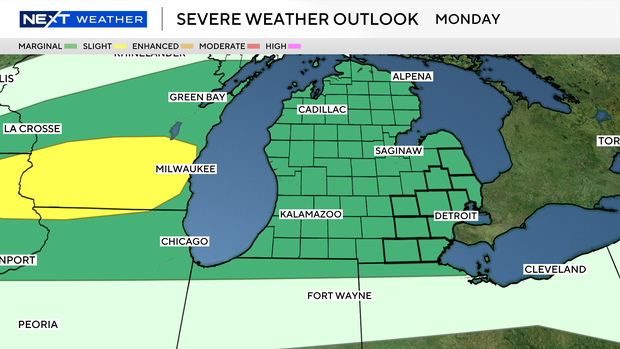
Monday’s weather
A marginal risk (level 1/5) is in place for Monday night, meaning only isolated severe storms are expected, mainly after 7 p.m. through midnight. The primary threats will be hail around 1 inch and a few localized damaging wind gusts, with storms moving quickly west to east, with storm coverage remaining limited.
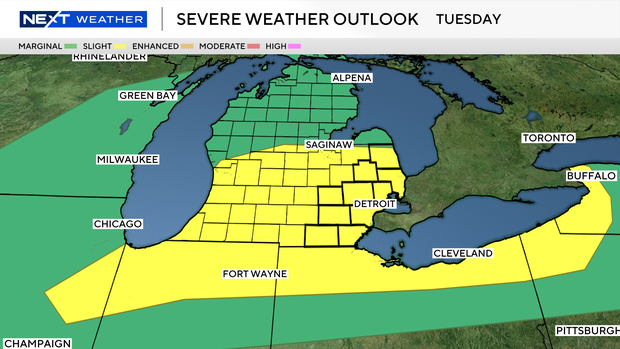
Tuesday’s weather
By contrast, Tuesday brings a Weather Alert Day with a slight risk (level 2/5), indicating a higher chance of more organized and scattered severe storms through the day as a cold front moves through.
On Tuesday, all severe weather hazards are possible, including damaging winds (potentially 60+ mph), large hail, heavy rainfall, and even a low risk of tornadoes, with damaging winds expected to be the main concern.
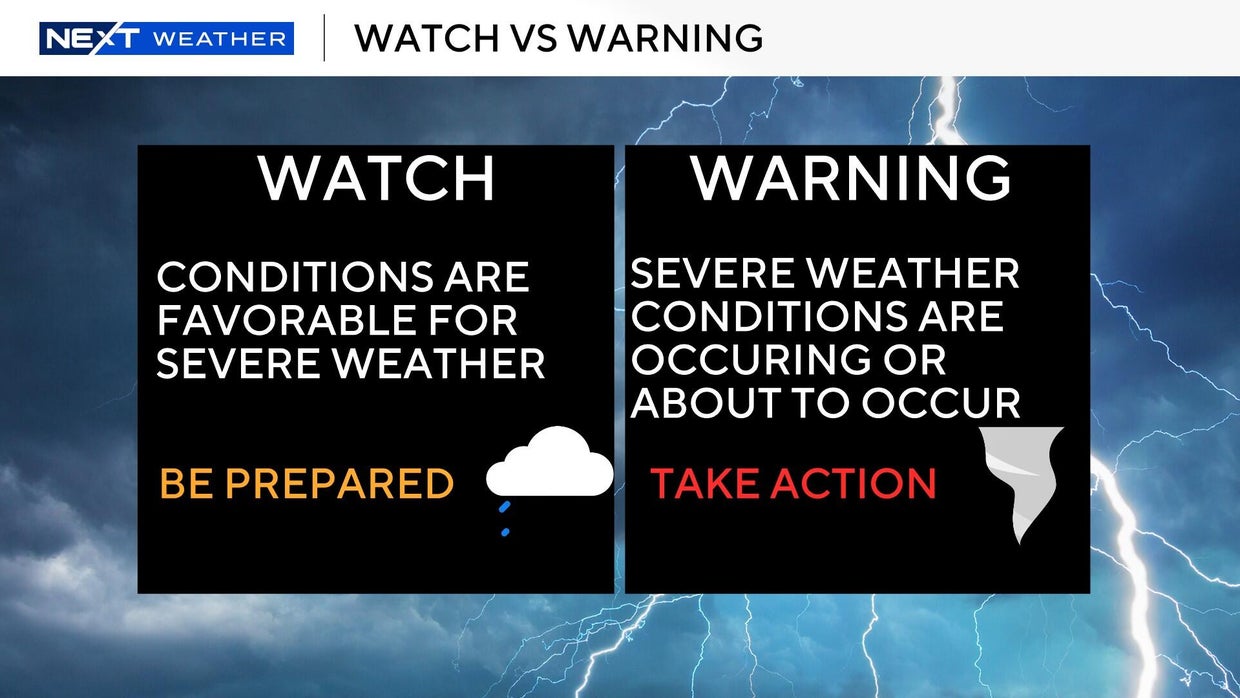
Watch vs. warning
The National Weather Service says a severe weather watch means “be prepared.” It is possible that the weather will reach severe levels during the time frame specified.
A severe weather warning means “take action,” that severe weather conditions have been reported by spotters or can be detected on radar. People are asked to take shelter indoors, away from windows.
It is possible for a tornado warning to be issued without a tornado watch already in effect. This is the scenario that happened in Southwest Michigan on March 6, 2026.

Jim Harding has landed his first commitment on the recruiting trail as offensive line coach in Ann Arbor, as 2027 four-star Sidney Rouleau announced on Sunday night that he will be playing college football for at Michigan.
Rouleau — a native of Canada but now playing high school football at The Brook Hill School in Bullard, Texas — is coming off an unofficial visit to Michigan this weekend. That was his third time in Ann Arbor, as he also visited for the Purdue game last fall and another time a couple summers ago.
Understandably so, Rouleau had great things to say after his most recent trip.
“My visit to Michigan was awesome,” Rouleau told Rivals’ Steve Wiltfong ($). “The energy around the program is contagious, and I really connected with the coaches and players. What excites me most about playing for coach (Kyle) Whittingham and the Wolverines is the chance to be part of building something special. Their vision for the future, combined with the tradition and passion of the fanbase, makes it an opportunity I couldn’t pass up. I’m excited to contribute to their success and also being able to play for coach Harding!”
Rouleau is listed at 6-foot-5 and 240 pounds, per Rivals, but 247Sports has him listed at 6-foot-7 and 269 pounds, so he may be a bit bigger than Rivals’ last update on him. Regardless, the expectation is that he will eventually play one of the tackle positions at Michigan.
Other than the Wolverines, Rouleau also earned offers from Ohio State, Clemson, Penn State, Oregon, Georgia, USC, Wisconsin, Texas, Alabama, Oklahoma Miami, Washington, Florida, Florida State and many others.
Michigan is now up to six total commitments in the 2027 recruiting class, and three of them are offensive linemen — Rouleau, and three-stars Louis Esposito and Tristan Dare. Rouleau also joins four-star edge rusher Recarder Kitchen, four-star safety Darrell Mattison and three-star safety Maxwell Miles in the class.
Rouleau is ranked No. 300 overall on the Rivals Industry Ranking. Check out some of his junior year highlights down below.

The Vols lost four of their last six games heading into the NCAA Tournament, though were impressive against Miami (OH), Virginia, and Iowa State. Their defense is solid (11th) while the offense is productive (31st), perhaps making their No. 6 seed a little misleading. Still, Michigan is the better overall team here, and unfortunately the odds of a third straight year of losing to a No. 1 seed in the Elite Eight are quite high for Rick Barnes and company.
Elite Eight: No. 1 Michigan (34-3) vs. No. 6 Tennessee (25-11)
Date & Time: Sunday, March 29, 2:15 p.m. ET
Location: United Center, Chicago, IL
TV/Streaming: CBS
Oddly, this is the fourth Tournament meeting between these schools since 2010-11, with the prior three favoring the maize and blue. That first contest was a 30-point First Round blowout, followed by a narrow Michigan win in the 2013-14 Sweet Sixteen. The most recent edition was also a close one, with Hunter Dickinson and Eli Brooks each topping 20 points as the No. 11 Wolverines upset No. 3 Tennessee in the Second Round in 2021-22.
Tennessee 2PT Defense: 49.0% (63rd)
The most obvious path to victory for Michigan over Alabama was using its huge size advantage in the paint, yet both Aday Mara and Morez Johnson had games to forget. The bigs will get their chance for redemption on Sunday against a Tennessee defense that is much better than its SEC rival’s, yet is beatable down low. Weak hands and poor finishing will not work against this frontcourt, but the Wolverines have proven they can win physical battles all year.
As fun as March Roddy (Gayle) is, or the rapid emergence of Trey McKenney, Michigan will not win a national championship if it does not get substantial production from the Mara-Johnson duo. Enough others contributed against the Tide to still claim the win, and perhaps that could be possible again in the Elite Eight, but it would give a lot more confidence heading into the final weekend if these two could bounce back in a big way. The Vols have had issues fouling too, so being aggressive at the rim is a must.
Tennessee Offensive Rebounding: 45.1% (1st)
Yes, that is correct — Tennessee grabs nearly half of its own misses. With an effective field goal rate around 140th, this is less extreme than the Texas A&M gameplan last year, but surely no one will be caught sleeping after witnessing the Vols collect 53.3% (!!) of their opportunities against the Cyclones on Friday. Without basically any outside shooting, second-chance points are the only way this offense scores enough to keep it close.
However, since the Duke and Illinois games, the Wolverines have been pretty solid on the defensive glass and should feel capable of at least reducing the impact of Tennessee’s rebounding. The Michigan frontcourt can match up body-to-body, and this is another way Mara and Johnson can make huge contributions. Like Saint Louis and Alabama hitting threes, there will be frustrating stretches of elongated possessions, but the key is just getting enough rebounds to stop any torrent.
Tennessee Defensive 3PT Rate: 44.7% (33oth)
Few teams see more opposing three-point attempts than the Vols do, yet this rarely seems to burn them, as opponents connect on just 30.3% of their shots, which is 11th-best nationally. This resilience is going to be really tested by a Michigan offense that is making 47.3% of its threes in the Tournament thus far after a cold Big Ten Tournament. The touch could certainly cool off on Sunday, but is that a bet Tennessee really wants to take?
If the Wolverines can stay disciplined and keep taking the high-percentage looks, this should be a huge factor on Sunday. While I still would like to see the offense attack the paint, there are too many good shooters on the roster to not take advantage when the defense is passive. Should Barnes choose to start closing out on shooters, there will be paths open to the hoop. Though the metrics consider this a strong defense, it feels like there is an easy way Michigan blows this game open.
Tennessee Adj. Offense: 31st
As a whole, the Tennessee offense appears fine, but the analytics are actually kind of sour on most of the parts. Bad free throw shooting (286th) on modest attempts (103rd), too many turnovers (233rd), limited three-point attempts (329th), and a slow tempo (290th) make me wonder how anything actually happens aside from getting good second-chance looks on offensive rebounds.
Clearly that strategy has worked this year — and over the past two weekends — but the 24-point loss to Florida (with a 17.1% OReb rate) might tell the story of what happens against defenses with size. The best actual shooter is Ja’Kobi Gillespie, who has improved since his combined 6-for-22 effort in two games against Michigan last season, but aside from him and Nate Ament, there is little outside threat.
I do think there will be enough offensive rebounds and tough makes to avoid an instant blowout (though not off the table for the final score), and maybe the Vols’ three-point defense is real, but the ways Michigan can win are so much more numerous than the ways it can lose. Trust the better team to take care of business and move on to Indianapolis next weekend.

New York1 hour ago
How a Database Manager Lives on $118,000 in Inwood

Detroit, MI2 hours ago
Detroit Lions ‘Ready’ for All-Pro Moving to Left Tackle

San Francisco, CA2 hours ago
This Week: Bike Ambassador, Lake Merritt Loop, Cayuga Street – Streetsblog San Francisco

Dallas, TX2 hours ago
How FC Dallas Can Unlock Santiago Moreno Alongside Musa, Valiente, and Farrington

Miami, FL2 hours ago
Could Miami Dolphins trade up in first round of 2026 NFL Draft?

Florida1 year ago
Florida High School Football Rankings: Top 25 teams – Oct. 21

Oregon2 years ago
How old is Bo Nix? What to know about Oregon quarterback ahead of 2024 NFL Draft

Connecticut2 years ago
Cleary's 21 help Le Moyne down Central Connecticut State 69-64 in OT

Virginia2 years ago
99th annual Pony Swim held in Virginia

Indiana2 years ago
Indiana Members Credit Union announced as new anchor tenant at Bottleworks District

News9 hours ago
Video: Iran to Allow More Oil Ships Through Strait of Hormuz, Trump Says

Politics10 hours ago
Dem senator warns deportation could let Virginia woman’s illegal immigrant killer ‘escape accountability’

World11 hours ago
Newsletter: G7 ministers to hold talks on war’s economic fallout
News12 hours ago
ICE officers could remain at airports after TSA workers are paid

Politics22 hours ago
Scathing report claims nation’s oldest labor union ‘betrayed’ MAGA members through ‘shocking’ spending
-

 Sports1 week ago
IOC addresses execution of 19-year-old Iranian wrestler Saleh Mohammadi
-

 Miami, FL4 days ago
Jannik Sinner’s Girlfriend Laila Hasanovic Stuns in Ab-Revealing Post Amid Miami Open
-

 New Mexico1 week ago
Clovis shooting leaves one dead, four injured
-

 Politics1 week ago
Schumer gambit fails as DHS shutdown hits 36 days and airport lines grow
-

 Tennessee7 days ago
Tennessee Police Investigating Alleged Assault Involving ‘Reacher’ Star Alan Ritchson
-

 Minneapolis, MN4 days ago
Boy who shielded classmate during school shooting receives Medal of Honor
-

 Science1 week ago
Record Heat Meets a Major Snow Drought Across the West
-

 South-Carolina1 day ago
South Carolina vs TCU predictions for Elite Eight game in March Madness