Midwest
Massive Theodore Roosevelt Presidential Library to open in North Dakota Badlands

Theodore Roosevelt is best known as the 26th President of the United States and the legendary “rough-rider” of the Spanish-American War. But much less is known about his deep connection and love for North Dakota, a state that was instrumental in shaping his larger-than-life persona, adventuring spirit and immense love for the outdoors.
Now, nearly 106 years after his death, the Theodore Roosevelt Presidential Library Foundation plans to celebrate and honor that connection between the man and the land that shaped him by opening a massive state-of-the-art presidential library built on over 90 acres in the North Dakota Badlands.
“IN THE ARENA” BOOK BY PETE HEGSETH USES THE TIMELESS TRUTHS OF TEDDY ROOSEVELT’S ICONIC ‘MAN IN THE ARENA’ SPEECH
The interior of the Theodore Roosevelt Presidential Library will use natural materials and lighting to draw visitors in and inspire them to seek the “strenuous life” enjoyed by Roosevelt. (Theodore Roosevelt Presidential Library Foundation)
The project is founded on the three Roosevelt values of citizenship, leadership and conservation. The library, built on the edge of Medora, North Dakota, will overlook Theodore Roosevelt National Park, which is the only national park named after a person.
In the spirit of Roosevelt, the foundation behind the project is not building just any ordinary library. The Theodore Roosevelt Presidential Library will harness the power of both technology and nature to give visitors a highly immersive experience that rather than shutting one in, inspires and pushes you to experience the joy of the outdoors as Roosevelt did.
The library will not just seek to educate people about Roosevelt. Instead, it will use immersive storytelling methods, the latest technology, including augmented reality, and the surrounding nature in Medora, North Dakota, to show people of all ages what they can learn from the life and experiences of the man and president.
ON THIS DAY IN HISTORY, OCTOBER 14, 1912, TEDDY ROOSEVELT SHOT IN CHEST, MAKES CAMPAIGN STOP MINUTES LATER
Teddy Roosevelt fell in love with the Badlands during a hunting trip in the 1880s, according to historians.
Citizenship
In a message announcing the project, Edward O’Keefe, CEO of the Theodore Roosevelt Presidential Library Foundation, said, “TR famously balked at the critic, and encouraged everyone to ‘get in the arena’ of life.”
O’Keefe, a North Dakota native, explained that the vision for the library is to serve as a hub for civic engagement, learning, and research. The library will include a large auditorium which the foundation envisions as a space that could host future presidential debates.
The Theodore Roosevelt Presidential Library is meant to serve as a hub for civic engagement, learning, and research. The library will include a large auditorium which the foundation envisions as a space that could host future presidential debates. (Theodore Roosevelt Presidential Library Foundation)
Above all, O’Keefe said that the library will seek to connect people with what Roosevelt used to describe as the “strenuous life” of the North Dakota wilderness.
“North Dakota is the fulcrum of the hero’s journey in TR’s almost unbelievable life story,” said O’Keefe.
North America, USA, North Dakota, Medora, Theodore Roosevelt National Park, Painted Canyon. (Photo by: Bernard Friel/UCG/Universal Images Group via Getty Images)
“[Roosevelt] wrote that if all his memories were to be taken from him, and he was forced only one memory from his incredible life he would choose to remember ‘my life on the ranch with its experiences close to nature and among the men who lived nearest her,’” he explained. “He did not choose the memory of the Roughriders or the charge up Kettle Hill; he would not recall McKinley’s assassination and his rise from the vice presidency to the Oval Office … TR chose to remember North Dakota, and so North Dakota chooses to remember TR.”
Leadership
Roosevelt, who served two transformative presidential terms from 1901 to 1909, moved to the North Dakota Badlands in 1884 in his early twenties. He was suffering from a broken heart after both his wife and mother died on the same fateful day. It was in North Dakota that the broken man found comfort in the solitude and beauty of the wilderness.
Above all, Edward O’Keefe, CEO of the Theodore Roosevelt Presidential Library, said that the library will seek to connect people with what Roosevelt used to describe as the “strenuous life” of the North Dakota wilderness.
He later wrote that he “would not have been president had it not been for my experience in North Dakota.”
With this in mind, O’Keefe said that the library “will not be a box in the Badlands with artifacts under glass,” but “like TR’s life, will be an experience.”
“We want every visitor to the TR presidential library and museum to walk out understanding the role of nature as a restorative force in TR’s life, and that each of us can be the change we want to see in the world,” said O’Keefe. “This museum can be a platform for embracing civic dialogue, thoughtful debate, and inspiration around the globe.”
In front of the library will be a large circular hiking trail surrounding the butte with several unique viewpoints along the way that encourage visitors to explore and reflect.
Conservation
After receiving the approval of Congress and then-President Donald Trump, the foundation completed its purchase of the land for the library from the U.S. Forest Service in 2022. The land is situated close to Theodore Roosevelt National Park and Roosevelt’s famous Elkhorn Ranch.
The building is designed to be able to live off the land, just as Roosevelt did.
The project website states that just as “through his action, passion, and foresight, Roosevelt ushered in a new era of conservation and stewardship of the American natural landscape,” the library’s design “will reflect and expand upon those values, setting an ambitious new standard for environmental conservation and sustainability leadership.”
The foundation is utilizing local contractors and constructing the library with materials that will allow the building to minimize waste and emissions as well as water and energy usage.
MEET THE AMERICAN WHO WAS THE ‘WORKING MAN’ FOUNDING FATHER, IRISH IRONSMITH GEORGE TAYLOR
The building has an earthen roof that curves with the nearby butte. The grounds and roof will be made up of native plants and grasses so as to help restore the biodiversity of the region which has been degraded over time.
Instead of disrupting the sloping, grassy North Dakota “burning hills,” the library’s design team from the U.S.-Norwegian architecture firm Snøhetta envisioned a building that blended in naturally with the landscape. The building has an earthen roof that curves with the nearby butte. The grounds and roof will be made up of native plants and grasses so as to help restore the biodiversity of the region which has been degraded over time.
Pictures shared exclusively with Fox News Digital by the foundation show that the library interior is already taking shape. Natural light flows down from glass ceiling panels, coloring a set of already completed massive, rammed-earth walls, composed of a mixture of gravel, sand, silt and clay.
A photo shared exclusively first with Fox News Digital shows a set of already completed massive, rammed-earth walls, composed of a mixture of gravel, sand, silt and clay. (Theodore Roosevelt Presidential Library Foundation)
Right in front of the library will be a large circular hiking trail surrounding the butte with several unique viewpoints along the way that encourage visitors to explore and reflect.
A new chapter
The library is expected to open on July 4, 2026, the 250th anniversary of America and the Declaration of Independence.
Theodore Roosevelt V, a great-great-grandson of the 26th president and ally of the project, has said through the library “North Dakotans have ensured a legacy not just for their state but also for our nation and the world.”
The Theodore Roosevelt Presidential Library will be situated in the North Dakota Badlands where the famed president transformed from a New York city man to the legendary “rough rider.” (Theodore Roosevelt Presidential Library Foundation)
But beyond North Dakota, Roosevelt said that all Americans can be inspired by the continuing legacy of his great-great-grandfather.
“My great great grandfather’s legacy of citizenship, leadership, and conservation are as relevant today as they were during the height of his presidency,” he said in a statement on the library website. “When you focus on people interested in solutions rather than divisive rhetoric, it becomes clear that there is much more that unites us than divides us – just as there was at the turn of the 20th century.”
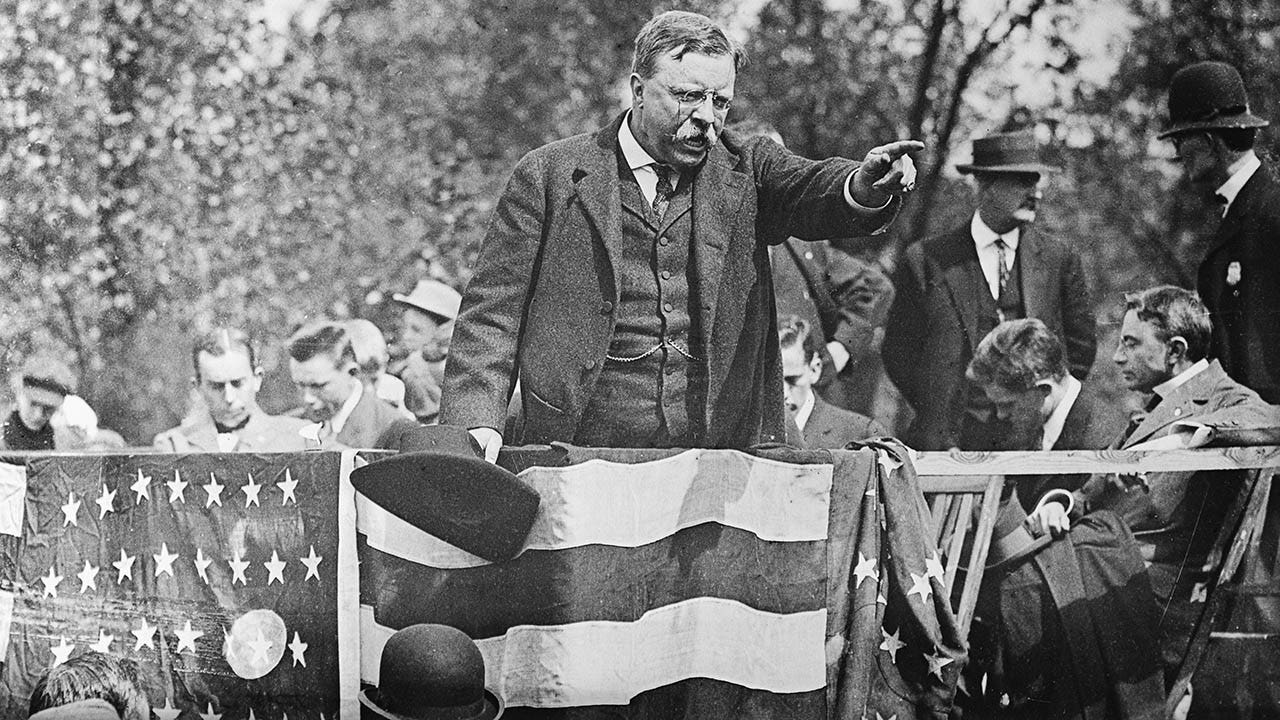
Theodore Roosevelt standing on a podium pointing into the crowd during a campaign rally speech. Ca. 1900s. (Getty Images)
“Like Theodore Roosevelt, a man of paradoxes – Republican and progressive, crusader against monopolies and capitalist, hunter and conservationist, partisan and rogue independent – our country is many different things. Finding the commonality among them may just be the key to America’s future.”
Read the full article from Here


Submitted Photo
U.S. Sen. Kevin Cramer, R-ND, spoke about the connection between North Dakota, the United States and Norway at the 12th annual Norwegian-American Defense Conference held April 17, where he delivered the congressional keynote address.
WASHINGTON – North Dakota’s deep Norwegian roots reflect the broad, long-standing relationship between the United States and Norway, one built on shared values, cultural ties and security cooperation.
U.S. Sen. Kevin Cramer, R-ND, spoke about the connection between the two countries at the 12th annual Norwegian-American Defense Conference held April 17, where he delivered the congressional keynote address.
He described the bond as historic and strategic, but also personal. His great-great-great grandfather, Erik Hjelden, fought in the Norwegian War of Independence prior to Norway adopting a constitution on May 17, 1814, Norway’s Independence Day known as Syttende Mai.
Starting in the 1870s, Scandinavian immigrants from Norway, Sweden, Denmark and Finland settled across what is now North Dakota. Today, one-third of the state’s population is of Norwegian descent, and North Dakota has the highest percentage of citizens with Norwegian ancestry of any state in the nation.
“I love the theme of this year’s conference, ‘From Seabed to Space,’ because I do think the size of the country is not nearly as important as the dynamic that happens when one plus one equals more than two,” Cramer said. “At a time when there’s talent on the factory floor, and talent in the executive suites, and talent in the engineering room, that we may have one or the other, maybe all. But together the dynamic of it is so much greater.”
Cramer emphasized how this foundation now supports a modern defense partnership. He said the United States and Norway are working together on Arctic security, aiming to strengthen interoperability and improve readiness across multi-domain operations. This alliance plays a key role in addressing today’s international security challenges.
Cramer also recognized the U.S.-Norway partnership through the North Atlantic Treaty Organization (NATO), as well as the history between the two countries.
“When you look at a globe, it illustrates why the Arctic is so important,” continued Cramer. “None of us can protect our silo without protecting our country, without protecting our continent, without protecting our hemisphere, without protecting ourselves. We protect one another by protecting ourselves, and we protect ourselves by protecting one another.”
Throughout his years in Congress, Cramer has been active in the House and Senate Friends of Norway caucuses. He hosted former Norwegian Ambassador to the U.S. Anniken Krutnes when she visited North Dakota in 2024, highlighting the state’s Norwegian heritage, economic strength and its role in advancing U.S.-Norway defense and national security cooperation. During the visit, Krutnes and Cramer emphasized the importance of strong alliances and the longstanding partnership between the two nations during various community stops, including events at the Sons of Norway Kringen Lodge and First Lutheran Church. The visit also focused on defense priorities, with a briefing at the North Dakota National Guard’s 119th Wing regarding the mission of the “Happy Hooligans,” before concluding with a public reception ahead of the Fargo premiere of the Norwegian film Songs of Earth.

COLUMBUS, Ohio (WCMH) — He’s won an Emmy, two James Beard Awards and has published best-selling cookbooks. Ted Allen’s rise to fame led him on an unforgettable path.
“I think there’s a lot of luck in life, but also a little bit of hustle certainly doesn’t hurt,” Allen says.
That mentality has driven Ted his entire life. His life began in 1965 in the Children’s Hospital in Columbus. Ted’s father moved the family to central Ohio for his work as a CPA.
“This all started out in a small apartment on Broad Street.” Ted days. “Later in Columbus, we lived on a street called Conestoga Drive. The view from our front yard,I could see them building up the soil, the berm to create the beltway that now exists around the city of Columbus.”
The Allen family moved to Indianapolis when Ted was 7. He went on to earn college degrees in psychology (from Purdue) and journalism (from NYU), but it was his passion for food and wine that drove his career path.
“Chefs are in the business of making happiness, as are winemakers, and they also tend to do it in really exciting or very beautiful places,” he says. “The whole food and wine world is in pursuit of happiness and joy. And who doesn’t want to be a part of that culture?”
Allen became a writer for Chicago Magazine and Esquire. While at Esquire in 2003, he got an audition for a new reality-style show on Bravo: Queer Eye for the Straight Guy.
“I was the only one who wasn’t from New York City. I’m from the Midwest, as you know. I was from Columbus, Ohio, and I didn’t talk like them. I was different.”
Allen earned the role of food and wine expert in the cast, and the show went on to win an Emmy Award. His profile soared.
“Grateful again, nothing but grateful. It was a trip getting famous.”
That led to Ted’s next big break as the host of one of television’s longest-running shows. He’s hosted nearly 1,000 episodes of “Chopped” and other Food Network shows under the “Chopped” brand. He’s also published best-selling cookbooks.
Ted and his husband, Barry, met while they were both working in Chicago, and oddly enough, Barry was also born in Columbus. He still has family members in central Ohio.
Allen’s traveled the world, but in his trips back to Columbus, he’s found world-class culture.
“I tasted the food and thought, I’m in Soho, New York,” he says. “This was a moment when it really gelled for me that the culinary revolution of the United States is certainly not confined to New Orleans, San Francisco, New York. It is everywhere. And Columbus was an excellent example of that. The food was just killer.”

LINCOLN, Neb. (WOWT) -Nebraska softball defeated South Dakota 4-1 in the opening game of its first NCAA Regional at Bowlin Stadium since 2013.
South Dakota took an early 1-0 lead in the fourth inning when Wahoo native Autumn Iverson hit a home run to left field that struck the scoreboard. The Coyotes started five players from Nebraska in their lineup.
Nebraska tied the game in the fifth inning when Hannah Coor hit a two-out triple up the middle that rolled to the wall, scoring Jordy Frahm.
Hannah Camenzind followed with a fly ball to right field that scored Coor with the go-ahead run. Camenzind was thrown out attempting to stretch the hit into a triple, ending the inning.
The Huskers added insurance runs in the sixth inning when Kacie Hoffmann, an Elkhorn South alum, hit an RBI double that scored Samantha Bland and Kennadi Williams to make it 4-1.
Frahm closed out the game in the seventh inning. Bella Bacon caught a line drive for the final out.
Nebraska will play Grand Canyon on Saturday at noon in the winner’s bracket.
Copyright 2026 WOWT. All rights reserved.
-

 North Carolina2 minutes ago
Eric Church delivers ‘greatest commencement speech ever’ in viral address to University of North Carolina graduates
-

 North Dakota8 minutes ago
Cramer: ND-Norway defense partnership strong
-

 Ohio14 minutes ago
Central Ohio native reflects on path to fame
-

 Oklahoma20 minutes ago
Oklahoma’s Saturday Bricktown Showdown with Tennessee Suspended Due to Weather
-

 Oregon26 minutes ago
#6 Oregon State Falls Friday to Air Force, 9-6
-

 Pennsylvania32 minutes ago
Breakfast for dinner is on the menu at these Western Pennsylvania eateries
-

 Rhode Island38 minutes ago
What’s the most expensive property sold in RI? May 16 real estate transactions
-

 South-Carolina44 minutes ago
South Carolina Lottery Mega Millions, Pick 3 results for May 15, 2026