A lot has happened since John Sherman, principal owner of the Kansas City Royals franchise, first floated the idea of a new stadium in November of 2021. The road since then has been winding and frustrating, and four years and one failed vote later and we don’t know where the stadium is going or what it will look like.
Kansas
The North Kansas City stadium site might just be the best one


But there is a light at the end of the tunnel. The Royals’ lease with the Truman Sports Complex ends after the 2030 season, which means they have to start on construction relatively soon to be ready by the 2031 season. Missouri and Kansas have both passed state-level funding. And the Royals had planned on announcing their final plan earlier this year, which implies they are close to an answer themselves.
Lately, there has been a lot of smoke surrounding the North Kansas City option. The office of NKC mayor Jesse Smith put out a press release on October 16 stating that:
The City of North Kansas City continues to have conversations with the Kansas City Royals regarding the possibility of a stadium and related development in North Kansas City. These discussions are substantial and will ultimately involve collaboration among the State of Missouri, Clay County, and the City in any final framework.
Additionally, the Missouri legislature had previously passed a bill that allows Clay County to create a sports complex authority that would govern the stadium. And we can’t forget that North Kansas City was one of two initial proposed sites by the Royals back in August 2023.
Like many folks, my reaction to the proposed Clay County site was one of skepticism. What was the point? To just leave a suburban area to go to another suburban area? Why not just stay in Kauffman Stadium?
I have since come around, and not because I am being paid off by the Royals. I have no idea what they’re doing and they have declined to comment on media requests about the stadium for a while now. No; I genuinely think that the North Kansas City site is the best one outside the East Village site, which seems dead. Let’s dig into why.
The Royals’ new stadium goals
So much has happened that it’s worth re-visiting the first real piece of official communication the Royals put into the world: an open letter from Sherman about what the Royals wanted to accomplish.
There are two things that stand out as clear benchmarks for what the Royals wanted the stadium to be from the very start of this project. First, though downtown was the primary goal, the Royals were cognizant that there were other sites that could work. They were pursuing sites “both in downtown Kansas City and close to it.”
Second, and most importantly, the Royals wanted to build a ballpark district, with “residential, commercial, and community components.” As Sherman wrote, their version was to construct “a new ballpark district and all that comes with it – one that is woven into the fabric of our city, can host events and concerts, and boosts our local economy.”
Why North Kansas City works
Kauffman Stadium is a beautiful park that exists within an ugly car dystopia that sucks the life out of the entire area. It’s surrounded by acres and acres of useless concrete. It’s cut off from goods, services, housing, and lodging. It is an unwalkable island wasteland.
Contrast that with walkable areas, where you don’t have to drive a car to get to where you want to go. More importantly, there are people already there. People live in walkable areas in multiunit apartments and condos, and walkable areas have narrower streets, more public transit, and a significantly higher density of resources and services than car-centric areas.
Downtowns are usually the only areas in American cities that have walkability and density. But suburbs can be walkable, too. Consider the area around Johnson Drive and Lamar in Mission, Kansas, versus the area around 119th Street and Strang Line Road in Olathe. Both Kansas City suburbs, but one is significantly prettier, more lively, and livable than the other.
North Kansas City is one of the only areas in the metro that has the ingredients for significant walkability. Indeed, the Armour Road area is already walkable and bikeable.
The above screenshot of Google Maps shows roughly where the Royals have proposed their site: bordered by Armour Road on the north and 16th Avenue on the south, and from Erie Street on the west to Howell Street on the east. North of Armour Road, there are rows and rows of houses, a public library, North Kansas City High School, and multiple new apartment complexes.
Add the streetcar into the equation, and the area quickly becomes an opportunity to transform into the type of urban neighborhood that is a destination. RideKC has already created an extensive and recent study of what an extension would look like up to North Kansas City, and their plan is to extend the line over the Heart of America Bridge and then up Swift Street.
And though walkability is key, car access is still easy. I-35 is immediately to the east, and there’s access to I-29, I-635, and Highway 169—along with access to downtown and I-70 via Highway 9.
So why wasn’t NKC the first choice?
No site is perfect, which I’m sure the Royals have grappled with significantly.
At the same time, there are some pretty big reasons why downtown is a better option than North Kansas City. One is population; the downtown KC population is about 32,000 people, compared to under 5,000 people in NKC as of the 2020 census. Furthermore, Jackson County has over two and a half times as many residents as Clay County, which is a significant difference when it comes to tax revenue and the inevitable “public” part of the “public-private partnership” that the Royals want.
And, of course, that streetcar thing? It’s already downtown.
But at this point in the juncture, North Kansas City is also the only place that fulfills all of the Royals’ initial desires for the project. The Washington Square Park site downtown is tiny and there is not space for a “ballpark village.” No site in Johnson County or Wyandotte County makes much sense for that, either, and a Legends site would end up as Kauffman Stadium West (derogatory).
If the Royals aren’t going to pull the trigger on the East Village site—which has always been the best choice—for whatever reason, North Kansas City provides a way to catalyze some public transit investment and transform the area into something the Royals can be proud of.
At least, if the public isn’t on the hook for too much money. But that, as they say, is a whole different ball game.

Continue Reading

WICHITA, Kan. (KSNW) — Colorado-based chicken restaurant Birdcall is expanding into Kansas.
The company announced Friday its plans to expand into Kansas and five other Midwestern states over the next five years. Birdcall plans to add six to eight fast-casual restaurants in Wichita and Topeka.
“The Midwest represents a tremendous opportunity for Birdcall,” CEO Mark Lohmann said. “From our award-winning chicken sandwiches and other handcrafted menu offerings to our commitment to innovation and community, we believe Birdcall offers an experience that resonates with today’s guests and is a natural fit for the region.”
Other locations announced are:
- Indiana – 10 to 15 restaurants across Indianapolis, Bloomington, Evansville and Fort Wayne
- Missouri – Up to 18 restaurants across St. Louis, Columbia, and Kansas City
- Nebraska – Seven to 10 restaurants across Omaha and Lincoln
- Ohio – Up to 20 restaurants across Cleveland, Cincinnati, Columbus and Toledo
- Wisconsin – 10 to 15 restaurants across Milwaukee, Madison and Appleton
Birdcall’s menu features a variety of chicken sandwiches, chicken fingers and nuggets, salads, tater tots, fries, and more. The restaurant also makes its own in-house sauces and serves up draft beer and house-made margaritas, with happy hour specials.
The company said each restaurant will use self-service kiosks and occupy about 2,300 square feet, with indoor and outdoor seating that can serve up to 150 people.
Birdcall currently operates 17 restaurants across Colorado, Arizona and Texas.
For more Kansas news, click here. Keep up with the latest breaking news by downloading our mobile app and signing up for our news email alerts. Sign up for our Storm Track 3 Weather app by clicking here. To watch our shows live on our website, click here.

KSHB 41 reporter Ryan Gamboa covers Miami County in Kansas and Cass County in Missouri. He also covers agricultural topics. Share your story idea with Ryan.
—
A video shared by a viewer, shows a resident speaking at the Osawatomie, Kansas City Council meeting being escorted out by police on Thursday evening.
The video shows a man holding a “Hell No Alcove” sign, while commenting about a blighted property, which according to public records is owned by Pacific Apartments, LLC, operating out of the same address as Alcove Development in Lawrence, Kansas.
KSHB 41
Alcove Development is behind the effort to build a $1 billion, 283-acre data center development in Osawatomie’s northland property.
The video, shared by a viewer, goes on the show two law enforcement officers approaching the individual, who is Lee Brewer, at the podium, after he begins to yell, while the crowd joins in behind him. Lee Brewer reached out to KSHB 41 late Thursday night, identifying himself as the person who was escorted out.
Osawatomie, Kansas Police Chief Dave Stutteville is seen in the video also approaching the man.
Fabian Rosales/KSHB

KSHB 41 Miami County Reporter Ryan Gamboa reached out to the Police Chief, City Manager, and Mayor Nick Hampson for comment late on Thursday night and is waiting on a response.
Residents in contact with Gamboa attending the meeting shared the meeting was still in session after 9:30 p.m.
Thursday night’s meeting was the city and Alcove Development’s attempt at sharing potential benefits of a data center for the community.
Gamboa has long covered the data center project in Osawatomie, Kansas — and neighbors to the project have voiced their opposition to the proposed development.
Brian Luton/KSHB
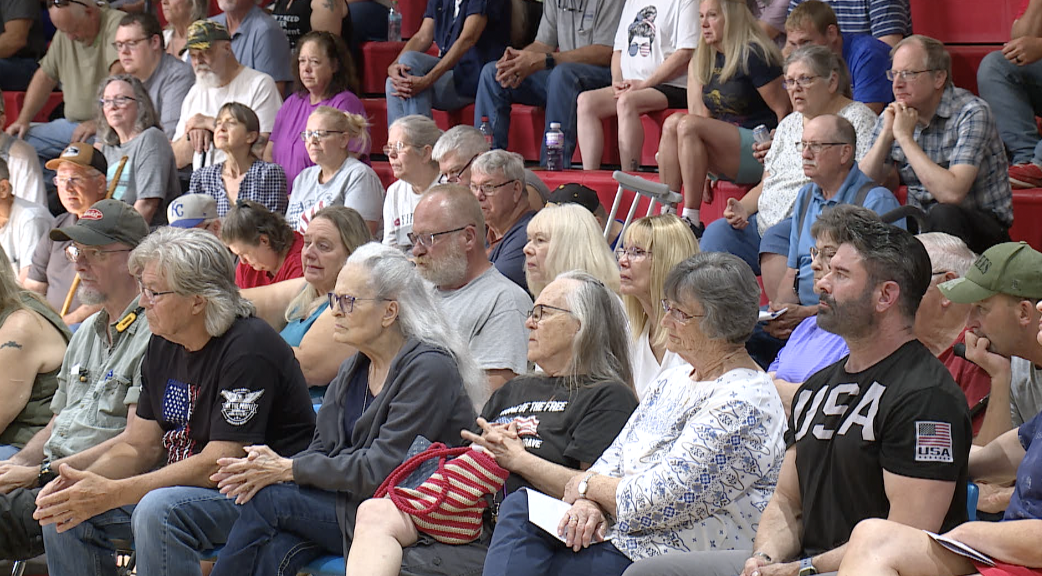
This is the first time Alcove Development has approached the public, but not the first time it has worked with the city of Osawatomie.
In late 2025, Alcove Development approached the city with the project and weeks later, a pre-development agreement was signed giving Alcove exclusive rights to the development for three years.
But city council meeting records from 2023 show, the city of Osawatomie entered into a pre-development agreement with Alcove Development to redevelop a property known as Old Swenson School.
Alcove Development had six months to asses the condition of the property and determine a course of action for redevelopment, and the overall agreement would last 18 months, according to public records.
Will Shaw/KSHB

The pre-development agreements states, Alcove would consider asking for tax breaks on the project, including utilizing the Low-Income Housing Tax Credit.
At the time, the property had sat in disrepair since 2016, according to the records, and was frequently found in violation of city code.
If the re-development were to fall through, the city would be on the hook to purchase the property from the developer for $25,000, with unclear total costs for infrastructure improvements.
KSHB 41

KSHB 41 will follow up on the status on this project at a later date.
Earlier this week, Miami County Reporter Ryan Gamboa, sat down with Donna Ingram who doesn’t live far from the data center site.
Ingram expressed her concerns about the amount of infrastructure that would be built to operate a data center, and how it might overtake the land around her home.
Ryan Gamboa/KSHB

She expressed concerns because the City of Osawtomie changed the public comment guidelines of a promise town hall with the developer.
“Watching this process play out is disheartening,” Ingram said in an interview on Monday. “A town hall was promised that didn’t come to fruition… I don’t believe it’s the definition. This is a city council meeting. We’re the ones that are gonna live next to it. We’re the ones that live in the path of the infrastructure.”
The city told KSHB 41 on Monday in a statement, they changed the format to prioritize the voices of city taxpayers, as county taxpayers have dominated the public comment periods over the past couple of months.
Brian Luton/KSHB

Mayor Nick Hampson also told Gamboa in an earlier interview he was hoping to have a productive “town hall” — instead, the first meeting with the public and the developer of the project was during a formal and regularly scheduled city council meeting.
The city also required residents to submit questions ahead of time, and the city would filter questions to the developer, while limiting public comment to three minutes.
“We have been and will continue to hear from the residents that are in the county and closest to this project,” Hampson told KSHB 41 in an email on Monday.

Miami County, Kansas
Residents shared a record to KSHB 41, submitted to the city for a formal investigation into 1009 Pacific Avenue in Osawatomie, which is owned by a company operating out of Alcove Development’s address.
The dilapidated property is the a former school house, that sits with broken windows, and other parts of the building breaking down.
The Miami County Republic reporting on Thursday, the city launched an investigation into the building.
Ryan Gamboa/KSHB
Residents cite the buildings deteriorating condition and potential danger to the public, and lack of property maintenance.
Lee Brewer issued a comment regarding the incident at Thursday night’s meeting, stating he was escorted out after the Mayor closed public comment, and he was not on the list.
Brewer told KSHB 41, he has a time -stamped email of pre-submitted questions ahead of the meeting. KSHB 41 asked Brewer to review the email, and is waiting for an answer.
I am severely disappointed in our Mayor and the city council. They told us we were required to send in an email with our questions and our address to prove we were citizens of the town by Wednesday the 24th at noon. I have my email which is timestamped at 10:26 a.m. Wednesday the 24th. They shut me down and first told me I didn’t put the email in and then once I was kicked out of there I was told by people coming out that they were told I turned in my email too late. I’m not a math teacher but last time I looked at my clock 10:26 a.m. falls just over an hour and a half before noon. I mean correct me if I’m wrong. I thought because the mayor and I were having decent conversations on Facebook Messenger, whereas I would ask him questions and he would answer to the best of his ability. And I would thank him I thought we were pretty cordial. So to basically call me a liar in front of the entire town on video recording, take away my freedom of speech My first amendment right, and have me removed from a public building was completely wrong I am very disappointed in our city council and mayor. When I approached the podium all I was trying to do was point out that resolution number 1169 in Osawatomie Kansas refers to Alcove development LLC being the owner of the old Swenson School at 1009 Pacific. As I pointed out in these earlier messages to you Alcove has left this building dilapidated in ruins and a danger to our community. Our great city council and mayor seem to have other plans for me being able to speak though.
Lee Brew, via Facebook to KSHB 41 News
KSHB 41 reached out to Alcove Development late on Thursday night, and is waiting on a response.
—


Editor’s note: This article has been updated to clarify information about cleanup information.
WICHITA, Kan. (KSNW) — A tanker transporting 8,000 gallons of ethanol crashed in El Dorado on Thursday.
It happened at the intersection of Kansas Avenue and South Main Street.
According to dispatch, the vehicle overturned, causing the fluid to leak out and spill into the storm sewer system.
City Manager David Dillner said traffic is being diverted in the area while crews work to clean up the ethanol.
Nearby residents have been evacuated to the El Dorado Civic Center due to the pungent smell of the fuel, Dillner said.
No injuries have been reported.
This is a developing story.
For more Kansas news, click here. Keep up with the latest breaking news by downloading our mobile app and signing up for our news email alerts. Sign up for our Storm Track 3 Weather app by clicking here. To watch our shows live on our website, click here.
-

 Technology12 minutes ago
Prime Day’s final hours bring rare discounts on Philips Hue smart lights
-

 World15 minutes ago
Video shows gaping hole after small plane crashes into towering skyscraper
-

 Politics20 minutes ago
Warren tells Trump to ‘sign the damn bill’ as bipartisan housing package remains stalled in Washington
-

 Health27 minutes ago
Common food preservatives may raise blood pressure and heart risks, study suggests
-

 Sports30 minutes ago
Who is Alyssa Thomas? WNBA star suspended for punching Caitlin Clark in the throat
-

 Technology35 minutes ago
Fox News AI Newsletter: Waymo’s robotaxi recall
-
Business42 minutes ago
Cisco to lay off more than 400 workers in California
-
 Entertainment45 minutes ago
Tom Sandoval’s girlfriend Victoria Robinson arrested after patio fire pit altercation


