


After a rough homestand that saw the Cats go 1-3, your Kansas State Wildcats are back on the road for a Big 12 series against Utah — K-State’s first trip out to Salt Lake City for a baseball game.
Kansas
Kansas City area cattle ranchers see beef marketing opportunity in trade war


BUTLER, Mo. — Kansas City area livestock producers are closely watching the economy as the United States navigates an international trade war.
“We’ve got to keep the economy strong to keep our beef prices going good,” explained Tim Clifton, a field representative and cattle rancher with MoKan Livestock Market.
Brian Luton/KSHB
The announcement of retaliatory tariffs on international trade partners rocked the stock market during the early stages of implementation. Missouri and Kansas livestock growers rely on a strong stock market to keep their prices high. When the market took a plunge a few weeks ago, so did cattle prices.
“When the stock market recovered, the cattle markets are back pretty much 100% to what they were three weeks ago,” said Clifton.
Brian Luton/KSHB
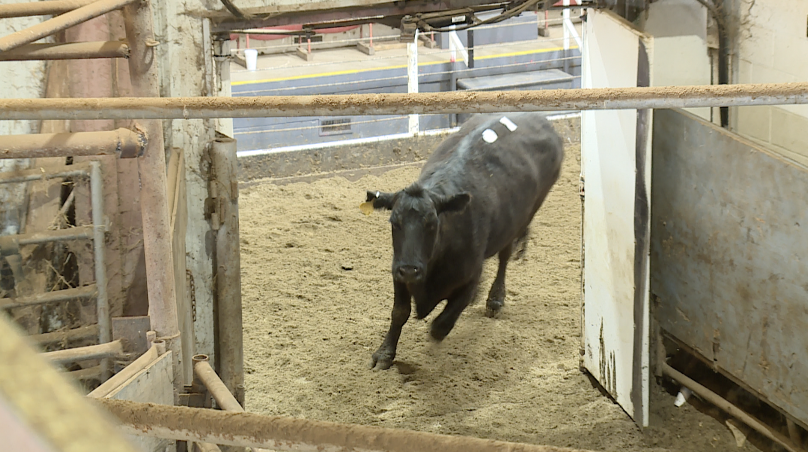
While a big focus is the economy, Clifton tells KSHB 41, there is an opportunity knocking at their door.
“We’re importing all kinds of Australian beef, and Australia doesn’t take any of our beef,” he explained. “We were taking their beef in, and they’re not taking any of ours. So that tariff is good for us.”
In the last five years, the U.S. cattle population declined due to drought.
American cattlemen were forced to cull herds to keep up with the cost of production.
Brian Luton/KSHB

The U.S. livestock head count has decreased by 1% in the last year since Jan. 1, 2025, to a total of 86.7 million.
The lowest head count since 1951, according to a report from AGDAILY.
American beef exports have only increased in billions of pounds since 2020.

USDA
Clifton tells KSHB 41 that implementing tariffs on trade competitors like Brazil could make his business more competitive.
“We get all this Brazilian beef coming in, and little goes back to Brazil of our beef,” he explained.
In the United States, four companies control 85% of America’s meat-packing industry: Tyson, JBS, Cargill, and National Beef.
Brian Luton/KSHB

JBS and National Beef are Brazilian-based companies.
“We import all this lean beef that we don’t know how it’s handled, what kind of regulations, what kind of antibiotics regulations they’re given. We import all this beef, the big four packers import it here,” Clifton expressed. “They cut it, they can mix it with our beef, do whatever they want, and the consumer doesn’t know. That’s where it could be beneficial for us, stopping some of that beef coming in that we don’t really need.”
Canada leads in exports of beef to the United States at 29% of U.S. product. Mexico and Brazil aren’t far behind.
Brian Luton/KSHB

Last year, Reuters reported on a positive case of Bovine spongiform encephalopathy (BSE), or more commonly referred to as “Mad Cow Disease”.
“We need to stop importing so much of this beef. We could process ourselves,” Clifton said.
Clifton says that engaging in stricter trade practices should create greater food independence in the United States.
Brian Luton/KSHB

“We’re relying on people that we don’t really need to be relying on,” he added. “We need to be relying on ourselves first.”
As long as the economy remains strong, Clifton sees positives for the American cattlemen and, more importantly, consumers.
“We’re really at an opportunity here to try to lower some of our input costs… If we can lower some of our input costs and keep our market strong, we’re set up for a good spot here,” Clifton said. “It would be a benefit to try and get more U.S. beef to a U.S. consumer. If this could all work out in our favor.”
—
KSHB 41 reporter Ryan Gamboa covers Miami County in Kansas and Cass County in Missouri. He also covers agricultural topics. Share your story idea with Ryan.

![[WatchLive]TV!!!] Portland Thorns FC vs Kansas City Current 𝐋𝐈𝐕𝐄 Streams ON Tv Channel](https://i0.wp.com/play-lh.googleusercontent.com/ER5zOyBOVRVaVVe-8eJqQNlm3U9Z9IPGuWi1JrRUNybb5zjXbAjEdq8_ckJLf0EjS2c=w526-h296-rw?ssl=1 "[WatchLive]TV!!!] Portland Thorns FC vs Kansas City Current 𝐋𝐈𝐕𝐄 Streams ON Tv Channel")
Portland Thorns FC-Kansas City Current
Portland Thorns FC vs Kansas City Current live: Portland Thorns FC vs Kansas City Current look to seize control of thrilling Portland Thorns FC vs Kansas City Current. Every team in the Portland Thorns FC vs Kansas City Current has two wins apiece as we go into the final two game weeks. Portland Thorns FC vs Kansas City Current will host Portland Thorns FC vs Kansas City Current at Durban’s Kings Park Stadium with the Portland Thorns FC vs Kansas City Current a single point ahead of Portland Thorns FC vs Kansas City Current in the standings and just one behind leaders Portland Thorns FC vs Kansas City Current.

With the offseason quickly ramping up, several Kansas basketball players will have a pivotal decision to make in the coming weeks. Those with remaining collegiate eligibility will have to determine whether they are returning to Lawrence or exploring other opportunities on the open market.
The Jayhawks are no strangers to losing talent to the transfer portal, as five players departed to other schools last year (six if you include Flory Bidunga’s brief stint in the portal).
Although KU has the ability to retool its roster with transfers across the country, there are some guys whom the program would certainly like to retain. But which players will end up leaving the university for more favorable options, and how many will there be?
Flory Bidunga: Declare for NBA Draft
Bidunga took the biggest leap of any player on the roster this offseason, seeing his scoring average nearly triple in addition to winning Big 12 Defensive Player of the Year. He is one of the most dominant rim protectors in the country and proved that by averaging 2.6 blocks per game.
After spending two years in Lawrence, Bidunga now has another critical decision to make after he nearly left last offseason. There have even been rumors of him transferring to another school, even with the NBA Draft on the radar.
Most mock drafts place him in the early-to-mid second round range, leaving some potential for his stock to rise if he returned to college. However, as an undersized center who likely won’t develop a perimeter game anytime soon, it’s difficult to see where he could improve his draft position.
Going to the NBA feels like the smartest and most logical decision for Bidunga. He would complete his lifelong dream of playing in the pros and could develop at his own pace with a team willing to invest in him.
Bryson Tiller: Stay at Kansas
A redshirt freshman who joined the team late last season, Tiller defied the odds and earned a spot in the starting rotation despite recovering from foot surgery. He was one of Bill Self’s most trusted options and formed a double-big pairing with Bidunga.
His final month or so of the season was quite abysmal, as he saw his averages plummet and his production take a massive hit. However, it is far too early to give up on the Overtime Elite product just yet.
Tiller has a smooth post game and a lot of good attributes to his skill set. Bringing him back should be one of the biggest priorities for the coaching staff this offseason, and if he’s promised a starting spot at power forward next year, it is reasonable to assume he returns.
Elmarko Jackson: Transfer from Kansas
Jackson has endured a rough ride in Lawrence since committing to the Jayhawks as a McDonald’s All-American three years ago. Following an underwhelming freshman season, he missed the entire 2024-25 campaign due to a torn patellar tendon before returning this season, where he didn’t fare much better than two years ago.
Coming out of high school, Jackson was viewed as a player with immense potential. But after three years at the school with virtually no improvement, it might be best for him to spend his final two years of eligibility elsewhere.
Unfortunately, allowing the game-winning basket to St. John’s that ultimately ended the season embodied what his tenure at KU has been like. That might be the last memory fans have of Jackson in the crimson and blue.
Kohl Rosario: Transfer from Kansas
Rosario had high expectations going into the year, starting as a member of the starting five before eventually being phased out of the rotation. The Miami native was touted as a strong 3-point shooter coming into college, but massively struggled from beyond the arc for most of the year, leading to a difficult path to playing time.
Even when Rosario wasn’t hitting his shots, though, he contributed with his athleticism and on the glass as a hustle player. Rosario is absolutely someone the coaching staff should prioritize this offseason. However, it may be best for him to leave the program to look for other opportunities.
He showed flashes throughout the year yet was never trusted heavily by Coach Self. He proved he belonged in the rotation in the Big 12 and NCAA tournaments, where he made an immediate impact when he entered and outplayed other bench options.
Ultimately, Rosario will already be competing with freshman wings Trent Perry and Luke Barnett for playing time next year. If the coaches are not going to give him minutes, there is little reason to believe he will stay another year at KU as such a high-potential player.
Paul Mbiya: Stay at Kansas
After riding the pine for the majority of the regular season, Mbiya showed real promise in the NCAA Tournament, scoring a season-high eight points in the Round of 64 and playing strong minutes in place of Bidunga against St. John’s in the first half as he battled foul trouble.
With his otherworldly wingspan and frame, Mbiya feels like someone who could blossom into a star long-term. Even with his raw offensive game, he has traits that should allow him to improve once he refines his skill set.
Mbiya could technically transfer this offseason without it being a massive surprise, but that stretch at the end of the year may have been enough to earn Coach Self’s trust. At the very least, he could be playing double-digit minutes per game next year as the backup five.
Jamari McDowell: Stay at Kansas
McDowell committed to Kansas as a member of the Class of 2023, making him and Jackson the longest-tenured players on the roster. He has been a steady bench piece who plays sparingly but offers defensive intensity and outside shooting when he enters the game.
Unlike Jackson, McDowell didn’t have the same level of hype coming out of high school and was never viewed as much more than a role player. He is best suited to play short spurts off the bench to provide an offensive spark when needed.
Given his clear love for Kansas, his situation is far different from Jackson’s. McDowell feels like someone who is content with limited minutes and simply wearing a Jayhawk uniform with pride.

The Cats sit at 17-8 on the season and 3-3 in Big 12 play, and after starting the season strong have really struggled since the Sunday game against Houston two weekends ago. Either the bats go wild and they win in a rule-ruled game, or they lose. Not exactly a recipe for confidence moving into the heart of the season.
And a lot of that struggle is on the bullpen and the K-State defense, with the former struggling to throw strikes and avoid giving up easy homeruns, and the latter struggling with staying focused and committing unforced errors at the worst times. But if ever there was a good weekend in conference play to get back on track, it would be this one for K-State. Utah enters today 13-9 and 3-3 in Big 12 play, but currently rank dead last in hitting in conference play despite putting up runs and picking up wins. If K-State can avoid errors and letting bad plays snowball, they will have a good opportunity to sweep this series.
But the Cats have to be more consistent than they’ve shown the past couple weeks.
All games here in Salt Lake City are at the America First Ballpark, a park that opened last spring and is also the home of Triple-A Salt Lake Bees, and will be available on online via KMAN and at KStateSports.com/watch with Matt Walters calling the action there. All three games will be streamed on ESPN+, with a Bill Riley on the broadcast.
James Guyette takes the mound Friday night at 7:000pm CT for his seventh start of the season. The junior righty went into the sixth inning last Friday against Arizona State before getting lifted after recording just one out. He gave up three runs on five hits, one of those over the fence, and five free bases while tossing five strikeouts. Through six games he’s got an ERA of 5.51, the highest of K-State’s weekend starters.
The Cat batters will face junior right-hander Colter McAnelly to open the game. McAnelly finished 2025 as an All-Big 12 First Team selection, and the Wyoming native earned Big 12 Pitcher of the Week honors three times as a sophomore. He’s not been quite as productive so far in 2026, sitting at just 2-3 in six starts this season with an ERA of 3.94. But that number is way up after last week, when he gave up six runs on six hits in five innings in what ended up as a 4-13 loss to Cincinnati.
Saturday’s game is set for a 3:00pm CT first-pitch. Lincoln Sheffield moves up a day as Pete Hughes looks to shake things up in his maligned bullpen, also making his seventh start of the season. Last Sunday, the senior lefty pitched a run-ruled complete game, giving up just one run on five hits and two free bases, but tossing six strikeouts enroute to a 12-1 K-State victory, and Sheff’s fifth of the season. He leads K-State starters with a 3.97 ERA that dropped back under 4.00 after his 1.29 effort last Sunday.
Utah will send to the mound Payton Riske to face the Cat batters. The right-handed junior is also making his seventh start of the season, all as the Saturday starter — a role the Las Vegas-native earned last season and has yet to relinquish. Last week he went just three innings against Cincinnati, giving up five runs on six hits — but no walks — in what became a 10-20 loss to the Bearcats.
Sunday’s start time is set for 2:00pm CT, and Tanner Duke will take the bump for the Cats in the swap with Sheffield. Duke was solid in his first two Saturday starts, before struggling against Arizona State last Saturday. The junior righty lasted just three innings, giving up seven runs (five earned) on six hits, including two over the fence, before leaving the game with the Sun Devils up 5-7. But ultimately it didn’t matter as the bullpen was just as giving, with the Cats eventually falling 12-18. After falling to 3.43, Duke’s ERA ballooned back up to 4.88 for the season.
Utah has not named a starter for Sunday’s game, but sophomore Cameron Nielson made the start last Sunday for the Utes in their 13-11 finale win over the Bearcats. Last week, the right-hander was solid through the first two innings before getting lifted after snagging just one out in the third. His final line was two runs (one earned) on four hits and two walks (one of those was intentional), tossing just one strikeout. He’s got a season ERA of 3.86, but has only pitched more than three innings one time in his seven appearances so far this season.

Austin, TX3 minutes ago
Goodwill Central Texas launches “Swap Your Shop” Challenge

Alabama9 minutes ago
Auburn vs Alabama live score updates, highlights from Saturday’s game

Alaska15 minutes ago
6 Alaska high school track and field athletes to watch, plus top Big C Relays performances

Arizona21 minutes ago
Jenae Berry’s strongest outing as a Wildcat secures Arizona softball’s series win over Baylor

Arkansas27 minutes ago
Renegade wins 2026 Arkansas Derby

Florida1 year ago
Florida High School Football Rankings: Top 25 teams – Oct. 21

Oregon2 years ago
How old is Bo Nix? What to know about Oregon quarterback ahead of 2024 NFL Draft

Connecticut2 years ago
Cleary's 21 help Le Moyne down Central Connecticut State 69-64 in OT

Virginia2 years ago
99th annual Pony Swim held in Virginia

Indiana2 years ago
Indiana Members Credit Union announced as new anchor tenant at Bottleworks District

Politics7 hours ago
Jeffries declines to break with indicted Democrat after ethics panel’s guilty verdict

World8 hours ago
Hundreds of thousands march through London in stand against the far right

News8 hours ago
2 students killed, 7 other people injured in Tennessee bus crash during school field trip

Politics19 hours ago
Dem senators dodge crucial question on illegal alien accused of killing Chicago college student

World20 hours ago
EU Parliament unblocks key political hurdle in digital euro talks
-

 Movie Reviews1 week ago
‘Youth’ Twitter review: Ken Karunaas impresses audiences; Suraj Venjaramoodu adds charm; music wins praise | – The Times of India
-

 Sports1 week ago
IOC addresses execution of 19-year-old Iranian wrestler Saleh Mohammadi
-

 New Mexico6 days ago
Clovis shooting leaves one dead, four injured
-
 Business1 week ago
Disney’s new CEO says his focus is on storytelling and creativity
-

 Tennessee5 days ago
Tennessee Police Investigating Alleged Assault Involving ‘Reacher’ Star Alan Ritchson
-

 Technology6 days ago
YouTube job scam text: How to spot it fast
-

 Texas1 week ago
How to buy Houston vs. Texas A&M 2026 March Madness tickets
-

 Minneapolis, MN2 days ago
Boy who shielded classmate during school shooting receives Medal of Honor