Indiana
Heading out on the water this summer? You can help Indiana DNR track wildlife


INDIANAPOLIS — During the months of June and July, you can help the Indiana DNR collect data about wildlife along waterways.
The Paddlecraft Wildlife Index started in 2020. This project utilizes volunteers who are already out paddleboarding, canoeing or kayaking. After paddling, volunteers fill out a short survey via postcard about the number and type of animals spotted.
One volunteer in the Paddlecraft Wildlife Index project is Erica Weddle. She operates Simply Fitness in Brown County. You can often find her leading group paddleboard trips on Yellowwood Lake.
“This time of year, probably three or four times a week,” Weddle explained about how frequently she is on the water.
WRTV
Weddle says when she paddleboards, she encourages lake visitors to use all of their senses to really plug into their surroundings.
“Whether they’re feeling something, seeing something, hearing something, maybe it’s just something new and different for them,” she started. “Encouraging people to stop and think about all that and pause.”
She uses this mindset herself when paddleboarding. She says she loves animal watching, and seeing beavers is her favorite.
Attentiveness like this is useful when monitoring for animals to report back to the DNR.

WRTV
“Indiana DNR has a history of working with the public on data collection,” explained Andy Byers.
Byers is the Furbearer and Turkey Research Biologist for the Division of Fish and Wildlife and Nature Preserves. He explained how the program got started.
“There was this group of people that’s really passionate about the outdoors and were using Indiana’s waterways to get out and look for wildlife. We wanted to use that to our advantage,” Byers recalled.
Volunteers have been reporting their findings to the DNR with this project since 2020. Last year, paddlers put in more than 2,000 hours of volunteer work.
WRTV
“If I was going to go out and do that by myself, I would have to work 40 hours a week all year, just to collect that much data,” Byers said. “That’s a huge amount of work!”
Volunteers who are already out on the water are acting as the eyes and ears of the DNR to help keep an eye on animal populations.
With this survey, the DNR is specifically interested in 12 animals. They are watching for four mammals: beaver, river otter, muskrat, and mink. There are five birds: bald eagle, great blue heron, osprey, great egret, and kingfisher. There are also three types of turtle: painted turtle, red-eared slider, and Blanding’s turtle.
WRTV
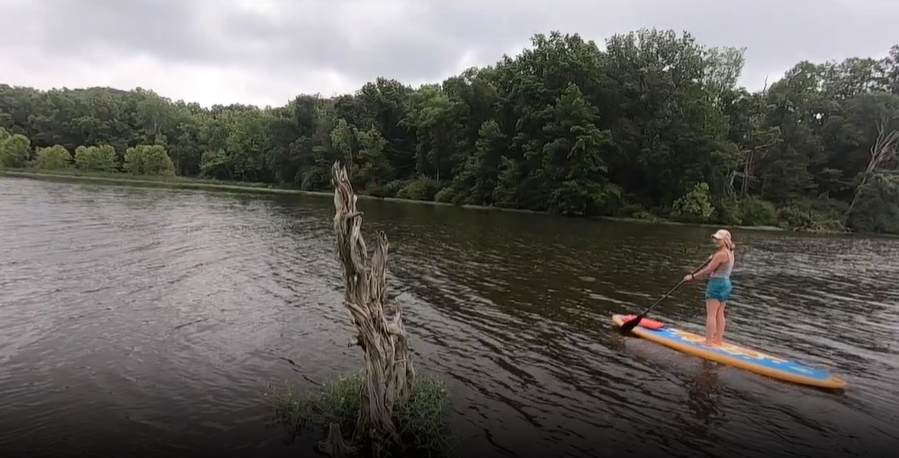
Weddle took WRTV out onto the lake. Along the way, she was quick to point out the birds flying above, the locations where she typically sees beavers, and all the other animals she spotted.
“Today we saw some blue herons and a couple of turtles,” Weddle explained. “Getting people out on the water and in nature is key to my mission, but also to the DNR.”
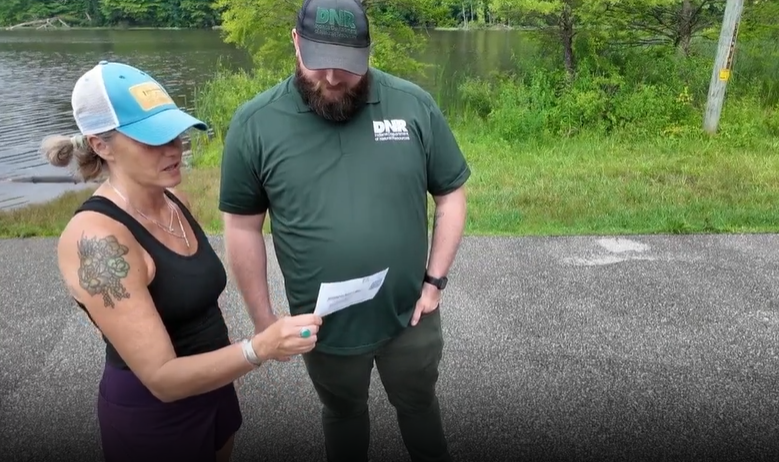
The data on the postcard (the time spent on the water, the type of animals, and the number of animals) is used by many different departments in the DNR, not just for Byers and his team.
“We want to share this data with the other biologists that work for DNR who can use that for management decisions,” Byers explained. “We’re also sharing that data with property managers around the state so they can kind of see what’s going on with the land they manage.”
Byers shared that there are over 2,700 volunteers with the program all across the state. He said there are hotspots of volunteers in places like Brown, Steuben, and LaGrange Counties.
WRTV
You can participate in this program by sending a postcard from a single trip, or send multiple postcards if you’ll be out paddling multiple times throughout June and July.
You can find a link to volunteer in the Paddlecraft Wildlife Index here.
Once you sign up, the DNR will send you materials to get started, including the postcards that you’ll complete and send back to Byers after your paddle.
Byers is constantly combing through the data provided by volunteers. He hopes that now, in the program’s sixth year, he will be able to start seeing some trends developing.

WRTV
“The goal of this survey is to establish kind of a long-term data set that we can use to look at trends of these species,” Byers explained. “It gives us a really good idea of where in the state people are seeing these different wildlife species.”
Byers is thankful for volunteers like Weddle, and is hopeful that others who love the water will sign up.
“The more people that we have participating, the more data we get, and the more people get to get out and enjoy Indiana’s waterways,” Byers concluded.

Indiana
Indiana sheriff busted for theft after GPS locator ties him to stolen election campaign signs

VERNON, Ind. (WANE) A grand jury last week indicted the Jennings County Sheriff on multiple charges following a six month investigation by Indiana State Police involving the alleged theft of campaign signs.
In November 2025, Troopers from the Indiana State Police-Versailles Post were contacted by a candidate for Jennings County Sheriff, who reported having campaign signs stolen that had been placed around area roadways. The candidate then placed a GPS locator device on one of his signs. When that sign was stolen, he tracked it to a dumpster located on the property of Jennings County Sheriff William “Kenny” Freeman, Jr.
Troopers went to Freeman’s property and retrieved the sign and the GPS locator from Freeman’s dumpster. They also found other campaign signs in the dumpster including a sign for a Jennings County Judge candidate, who also reported having campaign signs stolen.
Soon after troopers located the stolen signs in Freeman’s possession, Freeman issued tickets to both political candidates related to the placement of their signs.
Because the investigation involved an acting sheriff, a request was made for both a Special Prosecutor and Judge. The Dearborn and Ohio Counties Prosecuting Attorney Lynn Deddens was appointed along with Ripley County Superior Judge Jeffery Sharp. The case was presented to a Jennings County Grand Jury this past Thursday.
The Grand Jury reviewed the case and indicted Freeman on the following charges:
*Theft (2 counts)-Class A Misdemeanor
*Official Misconduct-Level 6 Felony
*Obstruction of Justice-Level 6 Felony
*Perjury-Level 6 Felony
Indiana
Where to watch Indiana Fever vs Washington Mystics on June 8: TV channel, start time and streaming
The WNBA has returned with a brand new collective bargaining agreement and a league full of loaded rosters as the 2026 season tips off.
A rookie class headlined by Dallas Wings top pick Azzi Fudd, Minnesota’s Olivia Miles and Washington’s Lauren Betts is ready to make a mark in the pros while the defending champion Las Vegas Aces look to keep their dynasty alive with a fourth title in five years.
As the the season gets going under a new media rights deal, it can be tough to figure out which channel each team is playing on every night. Here’s everything you need to know to tune in when the Washington Mystics host the Indiana Fever on Monday.
What time is Indiana Fever vs Washington Mystics?
Tip off between the Washington Mystics and Indiana Fever is scheduled for 7 p.m. (ET) on Monday, June 8.
How to watch Indiana Fever vs Washington Mystics on Monday
All times Eastern and accurate as of Monday, June 8, 2026, at 6:11 a.m.
Watch the WNBA all season on Fubo
WNBA scores and results
See scores, results for all of today’s games .
See WNBA scores, results from June 7
Odds for WNBA games today
The latest WNBA odds can be found below from the best sports betting apps . Some odds may include games scheduled on future dates.

-

 Atlanta, GA1 minute ago
Two Atlanta dates, one red-hot welcome: Spain draws fence-line fans in Chattanooga
-

 Minneapolis, MN6 minutes ago
Minneapolis Woman Paralyzed Before Wedding Rebuilds Life After 2nd Heart Transplant
-

 Indianapolis, IN13 minutes ago
Indianapolis Colts 2026 Positional Spending: Defense & Special Teams
-

 Pittsburg, PA16 minutes ago
Recently retired Steelers WR praises Aaron Rodgers
-

 Augusta, GA21 minutes ago
City of Augusta launches ‘2027 Budget Priorities Survey’
-

 Washington, D.C28 minutes ago
Holly area veteran to travel to Washington D.C. on honor flight mission
-

 Cleveland, OH31 minutes ago
Historic steam locomotive Big Boy No. 4014 rolling through Northeast Ohio
-

 Austin, TX36 minutes ago
Hinojosa launches program to fight Texas school closures, citing public school crisis

