Illinois
Illinois’ soil conservation funding stagnates amid recent high-profile dust storms


State Rep. Charlie Meier shows clover growing in a field on his Washington County farm in 2022. In 2009, Meier was cited with the award for the State of Illinois Conservation Farm Family of the Year.
Capitol News Illinois
Three main factors contribute to the formation of Midwest dust storms: strong winds, dry soil in farm fields and large amounts of loose soil.
That’s according to Andy Taylor, the Science and Operations officer at the National Weather Service’s office in Lincoln. He said these are key ingredients that meteorologists, farmers and experts in the agricultural community have found cause dust storms when they converge.
On May 16, Chicago saw its first major dust storm since the Dust Bowl, which stretched from Texas to New York in the early 1930s and deposited 300 million tons of soil across the nation — 12 million tons of which settled in the Chicago region, according to the Bill of Rights Institute. The storm in May dropped visibility in the city to near zero as wind gusts blew over 60 mph at times, according to the National Weather Service.
Taylor said the atmospheric environment that day was more characteristic of the dry environments in the High Plains or Southwest U.S., not the Midwest. As rain began to fall near Bloomington, it quickly evaporated and cooled the atmosphere, creating strong pockets of wind that began to move North. And as winds sped up, the storm began to pick up and move dry and loose soil from fields it passed over, which created the dust storm.
“The type of dust storm event that we had that affected the Chicago area, I wouldn’t necessarily take that occurrence as saying we’re going to see an increase in those type of events from this point on,” he said. “Although, anytime you see all those ingredients come together, we certainly could see that again.”
While there were no deaths due to the storm in Chicago, a major dust storm that occurred in central Illinois on a portion of I-55 resulted in a multi-car pileup that took the lives of eight people and injured dozens more in May 2023.
That dust storm also dropped visibility to zero on the stretch of the interstate between Farmersville and Divernon, and was again caused by dry, loose soil being picked up and moved by winds.
Although Taylor said dust storms are not new to Illinois — as his office has documented events back to the 80s — most of the storms don’t move across vast expanses of the state. Instead, he said they often occur in more localized areas, like the storm near Divernon in 2023.
“When we’re seeing the right weather-related factors coming together and the ground is fairly dry, which matches up with loose soil so we know we’re going to be more prone to blowing dust, we coordinate with partners in the agricultural community to determine when we might anticipate those blowing dusts events,” Taylor said.
The Association of Illinois Soil and Water Conservation Districts has been lobbying for increased funding for additional district employees. This year’s state budget allows for each district to staff one full-time employee, which AISWCD Executive Director Eliot Clay called “wildly inadequate” as he said each district needs at least two.
“I really, honestly think conservation funding has been deprioritized,” he said.
Soil and water conservation districts began to crop up across the U.S. in the late 1930s as a response to the Dust Bowl and Congress’ subsequent declaration of soil and water conservation as a national priority. According to the Association of Illinois Soil and Water Conservation Districts, that declaration prompted then-President Franklin D. Roosevelt to recommend legislation to state lawmakers that would enact districts in every state.
Illinois has 97 districts, or nearly one district for every county in the state. Employees of the districts are responsible for a variety of tasks — including assessing farmland, educating farmers about conservation practices and connecting farmers with grants from the state and federal government. These all play a key role in the association’s mission of protecting Illinois’ natural resources.
“Unlike a group like the Department of Natural Resources or the EPA or even the Department of Agriculture, SWCDs are not a regulatory body,” Clay said. “We are not going out there and enforcing rules and laws on people, we’re just trying to help farmers do better. And that’s the reason a lot of farmers rely on SWCDs, is because they do not see us as like, the ‘government’ coming in and telling them, ‘this is how you’re going to do your operation.’”
The fiscal year 2026 budget signed by Gov. JB Pritzker last week allots $7.5 million to the state’s SWCDs — that’s a $1 million overall cut from the previous year, although funding for operations remained level. Funding had already been cut by $4 million total in fiscal year 2025.
Of that $7.5 million, $3 million will go to cost-share grants, which act as reimbursements to farmers for the costs of implementing both state and federal conservation policies, such as cover crops. The remaining $4.5 million will go to administrative costs.
Clay said the breakdown of that $4.5 million provides $40,000 to each Soil and Water Conservation district — meaning that every district will have enough funds to pay one full-time employee. He called the salary “wildly inadequate” for the district employees, most of whom have college degrees.
“$40,000 — and that’s supposed to include benefits, so their take-home is less than that — is barely enough, I mean I would say it’s not enough even for one person” Clay said. “And it’s hard to keep people and incentivize people to come to work when there’s not the kind of money there that there should be.”
In addition, Clay said each district needs two full-time employees to be fully-staffed — one to make on-site visits to farms and one to coordinate schedules, receive phone calls and emails, and staff the office.
He said in recent years, the association was told by both the Department of Agriculture and the governor’s office that if they wanted more funding, they would have to advocate for the money to individual lawmakers outside of budget negotiations.
“I don’t know of any other agency or subsect of an agency that has to, on their own, go to the Capitol and get money,” he said. “That’s very peculiar to me and is something I’ve been trying to wrap my head around, and I have not gotten a good explanation from anybody.”
The governor’s office did not respond to a request for comment.
Over the past two years, Clay said the association unsuccessfully lobbied for $10.5 million in annual funding.
“The bigger question I’m left with after being the executive director over the past six months and witnessing it from this angle is, what does the legislature and the administration value?” Clay said. “It really gets to bigger questions about how the state has dealt with conservation funding in general for the last 20-plus years.”
Kevin Brooks, a commercial agriculture educator at the University of Illinois Urbana-Champaign, said the agriculture community has identified practices farmers can use to reduce the amount of dry, loose topsoil in their fields.
“Measuring the humidity level as a cause is not the issue,” Brooks said in an interview with Capitol News Illinois. “I won’t say it’s not 100% not about the weather, but this is primarily about tillage.”
One suggestion he made was for farmers to till their fields less frequently and instead resort to strip-tilling or using no-till strategies whenever possible to reduce the amount of loose topsoil in fields.
Strip-till is a tilling practice where only narrow rows of a field where seeds will be planted are tilled, leaving the rest of the field untouched. While there are many short- and long-term benefits to strip-tilling, no-till practices often don’t seem to benefit farmers right away but do often have long-term advantages, Brooks said.
Rep. Charles Meier, an Okawville Republican, farms 1,500 acres in southern Illinois with his family, including corn, wheat, beans, hay, and beef cattle. He said most crops are already minimally tilled by farmers.
“I’m 66 years old and we never no-tilled when I was a kid,” he told Capitol News Illinois. “All of our conventional soybeans are no-tilled now, all of our wheat is done by minimal-till, and our corn is all by minimal-till now.”
He said he’s in frequent contact with his SWCD, including a call on Monday with his district’s employee, and criticized Democratic leadership’s funding priorities, such as subsidies for renewable energy.
“They’re not funding the nuts and bolts of Illinois conservation,” Meier said. “I’m not against wind and solar but they don’t pay for themselves and they’re making us taxpayers pay for them.”
Another main practice Brooks recommended farmers employ was planting cover crops, which are crops planted after harvest not for their produce, but for their benefits to the soil. Cover crops can be planted after a fall harvest for a variety of benefits, including to preserve topsoil through the winter, increase organic matter in the soil and dry the field earlier in the spring.
Brooks also attributed recent dust storms to the invention of high-speed discs — a tillage attachment with many more disks than normal tillage attachments, which tills at faster rates. He said these disks have taken tillage speeds from around 4 mph to over 10, and that farmers in Illinois quickly amassed these machines during and after the COVID-19 pandemic, due to the pandemic relief funds they received.
“In theory, they’re supposed to be a kind of conservation because they don’t go into the ground very deep,” Brooks said. “But they literally turn the top several inches of a farm field into powder.”



Name: Eric Godoy
Title: Associate Professor
Unit: Department of Philosophy
Years at Illinois State: 8 1/2 years
Tell us about your teaching and research in the College of Arts and Sciences.
“Renewable energy alone won’t make our energy systems more just. The production, distribution, and consumption of energy are connected to many ethical issues. For example, even renewable energy projects can pollute environments or displace people. My recent research examines these ethical challenges and asks what a just transition might look like. I’ve also published work on climate ethics, trophy hunting lions, urban park design, interdisciplinary research, and dinosaur films. My most popular course is PHI 236: Values and the Environment, but I also teach many topics in moral, social-political, and environmental philosophy. I’m also a proud affiliate of the Women’s, Gender, and Sexuality Studies Program (WGSS).”
What are your proudest accomplishments during your time at Illinois State?
“I was awarded an American Council of Learned Societies’ fellowship for my work on energy democracy this year. I was nominated by our university for a Carnegie Fellowship in 2024. I was also very honored to receive a College of Arts and Sciences (CAS) Excellence Award for Outstanding Teaching in 2021. But I’m always the proudest when I hear about the success of my former students. I love getting emails about their new careers or their graduate studies in all kinds of fields: law, environmental work, and, of course, philosophy.”
What’s your favorite thing about Illinois State or the College of Arts and Sciences?
“I do my best research in conversation with students and colleagues in different fields. Our students and faculty are so talented. They’re often working on amazing projects. I learn so much from them. They encourage me to explore new research questions I wouldn’t have thought of on my own. Environmental problems are inherently interdisciplinary. I’m very grateful that CAS supports interdisciplinary work and programs, such as WGSS, Environmental Systems Science and Sustainability, and Civic Engagement. Philosophy lends itself so well to interdisciplinary relationships since there are philosophical questions at the heart of every field.”
Department of Philosophy Chair Christopher Horvath on Godoy:
“Dr. Eric Godoy is an innovative, student‑centered educator whose inclusive and interdisciplinary pedagogy consistently elevates the department’s instructional standards. He is deeply committed to creating learning environments that empower students from diverse backgrounds to engage meaningfully with complex philosophical issues. His leadership in curriculum development has made him one of the department’s most forward‑thinking educators. Complementing his teaching excellence, his research provides practical, ethically grounded solutions to energy‑policy conflicts and will shape national conversations about democratic participation in a just transition away from fossil fuels.”
Read more stories from the College of Arts and Sciences at News.IllinoisState.edu/Unit/College-Arts-Sciences and follow the college on Facebook and Instagram.

Murals and memorials of César Chavez are continuing to come down across Chicago after allegations emerged last week that the Latino civil rights activist groomed and sexually assaulted girls and women.
The allegations were revealed in a New York Times investigation published March 18.
Some artworks are being repainted with murals of Dolores Huerta, the longtime ally of Chavez in the labor rights movement. Huerta, 95, told the New York Times that Chavez had sexually assaulted her.
The Illinois Senate adopted a resolution Wednesday honoring Huerta and declaring April 10 as “Dolores Huerta Day” in Illinois.
“In recent months, Dolores Huerta has shown profound resilience and courage in sharing her own experience of harm, doing so in order to uplift the stories of countless women whose voices were overlooked or silenced,” the resolution states.
One of the resolution’s sponsors, State Sen. Celina Villanueva, D-Chicago, said she is also working on a plan to rescind César Chavez Day, which is next week on March 31st.
At Cafe Tola in Lake View, a Chavez mural outside the restaurant’s building was replaced this week with a painting of Huerta, who coined the phrase, “Sí, se puede,” which loosely translates to, “Yes, we can.”
“We are deeply saddened by this news, yet we stand in unwavering support and admiration for Dolores Huerta and every woman who has found the courage to come forward,” Cafe Tola said in a social media post. “This moment is powerful — proof that truth cannot be silenced and that it is never too late to reclaim your voice. We honor that strength.”
A plaque dedicated to the 30th anniversary of the death of César Chavez, honoring him and Sister Dolores Huerta, before it was taped over at the Haymarket Memorial in the West Loop.
In the West Loop, a plaque honoring Chavez’s labor rights movement has been covered with black tape at the Haymarket Memorial. According to the Chicago Federation of Labor, the organization is planning to fully remove it.
“We will be discussing with all our partners on how to best honor both the survivors of Cesar Chavez’s horrific abuse and the workers that were betrayed by Chavez,” a spokesperson for the Chicago Federation of Labor said in a statement.
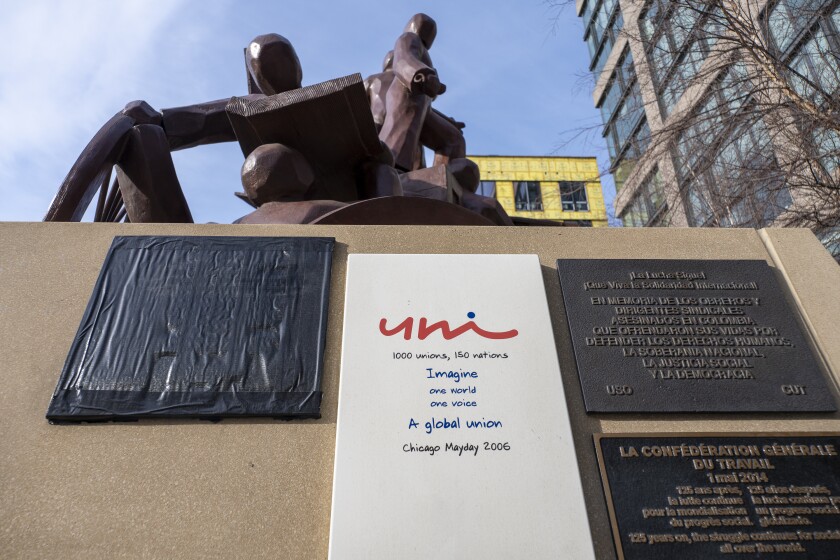
Black tape covers up a plaque (left) that commemorates the 30th anniversary of César Chavez’s death on the base of the Haymarket Memorial in the West Loop, Wednesday, March 25, 2026.
Tyler Pasciak LaRiviere/Sun-Times
Last week, Bob Reiter, president of the Chicago Federation of Labor, said the allegations that Chavez sexually assaulted children, women, workers and labor organizers “is a betrayal to our movement.”
Chavez, who died in 1993, has long been revered in Chicago’s Latino community. In addition to numerous murals of him across the city, a public elementary school in Back of the Yards and a post office in Pilsen are both named after him.
The school, César E. Chavez Multicultural Academic Center, has initiated the process that could lead to a new name. It is receiving community feedback about a possible new name, according to Chicago Public Schools officials. Any recommendation would need approval from the Local School Council and the school board.
Another school in Pilsen, Peter Cooper Dual Language Academy, has a mosaic of Chavez and Huerta side by side. It’s unclear if the school plans to remove the mosaic of Chavez.
The Sun-Times was the first to report that Chavez’s face had been painted over last week on the “Libertad” mural across a long wall at Barrett Park in Pilsen.
A splotch of green paint initially covered the portion where Chavez was depicted, but Park District officials have since painted over that with a continuation of the mural’s background design, a Park District spokesperson said.
Other historical figures on the mural, including Mexican artist Frida Kahlo, Malcolm X, Rosa Parks, and the Rev. Martin Luther King Jr. remain visible on the wall.

Paint covers Cesar Chavez’s face on a mural depicting civil rights figures that can be seen an exterior wall of Barrett Park in the Pilsen neighborhood, Friday, March 20, 2026.
Tyler Pasciak LaRiviere/Sun-Time
“The Chicago Park District takes recent allegations of misconduct by Cesar Chavez seriously … and are conducting a district-wide review of any other park features that may honor him,” a Park District spokesperson said previously. “Where appropriate, we will take further action consistent with our values and standards.”
The Park District has not identified any other murals or memorials of Chavez on any of its properties, the spokesperson said Wednesday.
Contributing: Isabela Nieto

Did you get a strange text claiming to be from the Illinois DMV, demanding money? It’s a trick, the Illinois Secretary of State’s Office says, with Alexi Giannoulias issuing an “urgent warning” about a new wave of threatening scam texts going out.
The unsolicited texts, which falsely claim to be from the Illinois Secretary of State or DMV, prompted the office to issue several messages about it this week, saying “scammers have recently escalated their tactics” with texts that look even more official with fake fines and regulations, deadlines or penalty dates.
“Many of the texts cite an upcoming enforcement date and list severe consequences to pressure recipients into acting quickly,” a press release from Giannoulias’ office said Tuesday. “These schemes are designed to create panic and trick individuals into surrendering money or personal information.”
Suburban police departments and even Chicago officials have also warned of the scam.
In a March 20 message posted to Facebook, the Oswego Police Department shared a photo of what one scam text may look like, saying “it includes a photo of what appears to be an official notice for a traffic violation hearing.”
“The document may look legit at first glance, even listing Illinois statutes, but there are some clear red flags,” the department said.
Below is a photo the department shared of what some of the texts may look like or contain:
The Illinois Secretary of State’s office says it will never send a text message demanding payment or threatening to suspend a license. The only time the office will send a text, Giannoulias said, is to remind someone of a scheduled DMV appointment.
“If you receive a message like this, remember it’s a scam – plain and simple. Do not click the link and please report the message to scamalert@ilsos.gov,” the release said.
Wednesday at 2 p.m., Giannoulias will hold a news conference about the scam, saying “don’t click it’s a trick.” Giannoulias is expected to break down how it works, and what to watch out for.
If you do receive a text, here’s what the Secretary of State’s office recommends:
-NEVER to click a link
-Do not reply
-Do not provide personal information
-Forward the message to the SOS’ scam alert email

Butler PD seeks help identifying suspects in Hinkle Fieldhouse break-in

$1.5 million-winning Pennsylvania Lottery ticket sold at Pittsburgh hospital

CSRA Habitat for Humanity gets $1.85M to build affordable housing in Augusta

Cherry Blossoms Hit Peak Bloom in Washington DC

Cleveland Guardians Legend Announces Retirement From MLB Before Opening Day

Florida High School Football Rankings: Top 25 teams – Oct. 21

How old is Bo Nix? What to know about Oregon quarterback ahead of 2024 NFL Draft

Cleary's 21 help Le Moyne down Central Connecticut State 69-64 in OT

99th annual Pony Swim held in Virginia

Indiana Members Credit Union announced as new anchor tenant at Bottleworks District

Video: Jury Rules Against Meta and YouTube for Addictive Features

New Jersey Gov Sherrill signs law barring ICE agents from wearing face coverings to shield identities

Escalation in the Middle East – Not Europe’s war? MEPs in the Ring

War with Iran disrupts fertilizer exports as U.S. farmers prepare for planting season

White House unleashes on Raskin for clinging to ‘deranged’ Jack Smith ‘lies’ in latest Trump docs flare-up
-

 Detroit, MI1 week ago
Drummer Brian Pastoria, longtime Detroit music advocate, dies at 68
-
 Science1 week ago
Industrial chemicals have reached the middle of the oceans, new study shows
-

 Science1 week ago
How a Melting Glacier in Antarctica Could Affect Tens of Millions Around the Globe
-

 Movie Reviews1 week ago
‘Youth’ Twitter review: Ken Karunaas impresses audiences; Suraj Venjaramoodu adds charm; music wins praise | – The Times of India
-

 Culture1 week ago
Test Your Memory of Great Lines From Classic Irish Poems
-

 Sports5 days ago
IOC addresses execution of 19-year-old Iranian wrestler Saleh Mohammadi
-
 Science1 week ago
I had to man up and get a mammogram
-

 New Mexico4 days ago
Clovis shooting leaves one dead, four injured