Midwest
Kansas law invalidates transgender driver’s licenses and birth certificates

NEWYou can now listen to Fox News articles!
Kansas has officially invalidated driver’s licenses and birth certificates for transgender residents who changed their sex designation on government documents under a law that took effect Thursday.
Roughly 1,700 individuals in Kansas will be required to obtain a new standard driver’s license at a cost of $26, according to the House Substitute for Senate Bill 244.
The state’s vehicle division informed residents that no grace period will be offered for those who need to update their IDs, according to The Kansas City Star.
“Please note that the Legislature did not include a grace period for updating credentials. That means that once the law is officially enacted, your current credentials will be invalid immediately, and you may be subject to additional penalties if you are operating a vehicle without a valid credential,” the Kansas Department of Revenue’s vehicle division said.
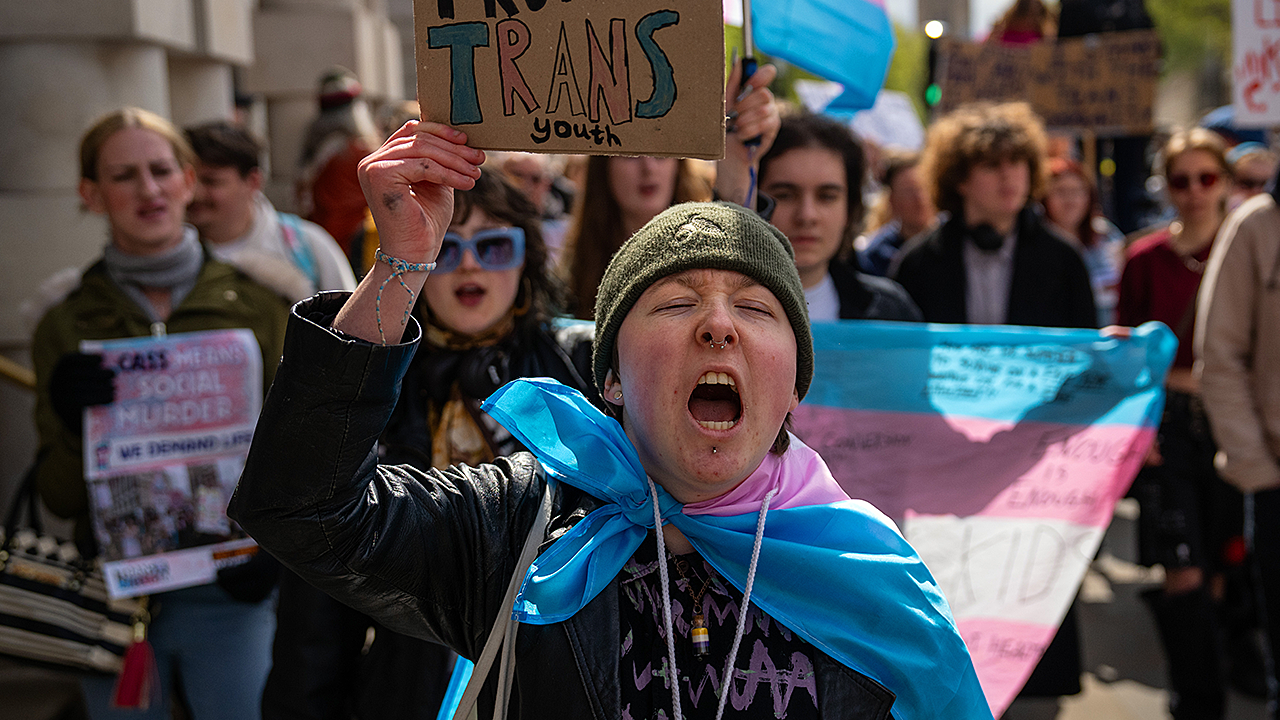
Trans rights activists take part in a protest April 20, 2024. (Carl Court/Getty Images)
The law also establishes clear rules for shared private spaces in government buildings, restricting their use to a single sex. This applies to facilities such as restrooms, locker rooms, changing rooms and shower rooms where individuals may be partially or fully undressed.
The bill further reinforced a strict definition of sex and gender as an “individual’s biological sex, either male or female, at birth.”
Consequently, individuals or entities who violate the space restrictions may face significant civil penalties or potential criminal charges.
KANSAS JUDGE SAYS TRANSGENDER RIGHTS NOT VIOLATED BY STATE’S REFUSAL TO CHANGE SEX ON DRIVER’S LICENSES
A drone aerial view of downtown Wichita (Joe Sohm/Visions of America/Universal Images Group via Getty Images)
Individuals are also given the right to take legal action if someone of the opposite biological sex violates their privacy in these spaces.
Democratic Gov. Laura Kelly, whose veto of the bill was ultimately overridden by the Republican-led Kansas Legislature Feb. 18, had previously called it a “poorly drafted bill with significant, far-reaching consequences.”
“It is nothing short of ridiculous that the Legislature is forcing the entire state, every city and town, every school district, every public university to spend taxpayer money on a manufactured problem,” she said. “Kansans elected them to focus on education, job creation, housing and grocery costs.”
SUPREME COURT CONSERVATIVES SIGNAL SUPPORT FOR STATE TRANSGENDER SPORTS BANS DURING ORAL ARGUMENTS
Kansas Gov. Laura Kelly previously tried to veto a bill that ultimately went into effect Feb. 26, 2026, restricting identification preferences for transgender state residents. (Rich Sugg/Kansas City Star/Tribune News Service via Getty Images)
Under the bill, entering a multiple-occupancy space designated for the opposite sex constitutes a violation. After a first warning, a second offense could result in a $1,000 civil penalty and a third or subsequent violation is treated as a class B misdemeanor.
Anyone who believes their privacy has been violated in such a setting may bring a civil lawsuit against the violator and seek $1,000 in liquidated damages, according to the bill.
CLICK HERE TO DOWNLOAD THE FOX NEWS APP
Government entities, such as state agencies or local districts, that fail to align with the new regulations are subject to steep fines. Entities face a $25,000 civil penalty for a first violation and $125,000 for each subsequent violation.
The law provides specific exceptions for entering spaces designated for the opposite sex, including custodial or maintenance work, medical or emergency aid, law enforcement duties, assisting someone who needs help or children under 9 accompanied by a caregiver.
Related Article

Read the full article from Here



Milwaukee, WI
Squire Robinson leads a new generation of Milwaukee artists with his distinctly bold style

In a cavernous attic studio stands Squire Robinson.
Next to him on the ground is an unfinished painting of his. Hung above him are numerous paintings that he’s finished in the past year.
The walls are filled with works of art, crafted by the various artists who also call 100% MKE, a nonprofit arts studio and workspace at 217 N. Broadway, home.
Robinson’s art doesn’t just stand among them – it stands out.
Maybe it’s the saturated reds that prevail in each of his pieces.
Maybe it’s the bold strokes that create the even bolder figures that call his paintings home.
Either way, Robinson’s art has a tangible effect for those with the eyes to see.
“Sometimes the most important piece of art is that you feel. His art makes you feel,” Richard Badger Jr. said. Badger, who goes by the artist name Coyote Rich, is also an artist in residence at 100% MKE.

Robinson first fell in love with art through his grandfather, who painted signs for corner stores. Early memories of drawing contests with his grandfather enchanted Squire into the art world.
Later, Robinson drew comics and superhero characters, foreshadowing the powerful figures he paints today.
“My style has always been there, it’s just evolution, it grows and changes,” Robinson said.
Robinson, a 2024 graduate of the Milwaukee Institute of Art and Design, has always had a certain fascination with Renaissance-era paintings.
Yet despite his appreciation of the style, something was missing.
“I appreciated the technique and skill, but I just couldn’t really relate to it,” Robinson said.
For him, the lack of diversity made the style feel distant.
Black culture in art
Now, Robinson’s style flows through the powerful Black people he paints.
“I took some of that flavor and remixed it to something that is more me,” Robinson said. “My inspiration comes from Black culture, music and my dreams.”

Robinson’s own personality is vehemently present in each of his pieces.
“His art has a very strong personality behind it,” said Nelle Speerschneider, a co-founding board member of 100% MKE.
By the end of a lengthy creative process, Robinson’s pieces are saturated with color and shapes that make viewers stop and stare. For Robinson, that’s the goal.
“To me, good art is when you can just stare at it and sit with it and think,” Robinson said. “If you see my work and walk right past it, then I didn’t do something right.”
Music and the flow state
Robinson said when he is met with a blank canvas, he doesn’t begin with a person or a setting; he starts with the mood. Then, with the help of music, he lets his art flow.
“I don’t try to contain the style, it’s just all me,” Robinson said.
Music is a big deal for Robinson. So much so that he can’t paint without it. Robinson’s taste in music, from classical and jazz to his love for Kendrick Lamar, seeps into his art.
“Squire’s art makes me feel like music,” Badger said.
Robinson said music helps him loosen up and get out of a funk.
“It helps me escape and enter that flow state,” Robinson said.
He said music supports his ethereal creative process.
“Sometimes when I paint, I feel like I’m being guided by something higher than me,” Robinson said.
Milwaukee made
As a young figure in the Milwaukee art scene, Robinson wears the city on his sleeve.
“Growing up in Milwaukee made me hard in the sense of staying true to myself,” Robinson said.
At 100% MKE, Robinson offers a unique voice. “It’s nice to have his youthful and urban take in the studio,” Speerschneider said.
Badger said young artists like Robinson are vital for pushing the scene forward.
“They’re the driving force of what Milwaukee looks and feels like,” he said.
Future goals
Going forward, Robinson wants to become an art therapist, someone who uses the medium of art to process emotional challenges.
“Art has always been a way to self-express and get my own feelings out,” Robinson said. “That’s why the tone of my paintings matters the most, because those feelings are what I’m trying to evoke.”
As for his art career, Robinson says his finest work is yet to come.
“I haven’t created my best one yet.”

Jonathan Aguilar is a visual journalist at Milwaukee Neighborhood News Service who is supported through a partnership between CatchLight Local and Report for America.
This <a target=”_blank” href=”https://milwaukeenns.org/2026/07/13/squire-robinson-leads-a-new-generation-of-milwaukee-artists-with-his-distinctly-bold-style/”>article</a> first appeared on <a target=”_blank” href=”https://milwaukeenns.org”>Milwaukee Neighborhood News Service</a> and is republished here under a <a target=”_blank” href=”https://creativecommons.org/licenses/by-nd/4.0/”>Creative Commons Attribution-NoDerivatives 4.0 International License</a>.<img src=”https://i0.wp.com/milwaukeenns.org/wp-content/uploads/2025/07/cropped-NNS-Favicon.png?resize=150%2C150&ssl=1″ style=”width:1em;height:1em;margin-left:10px;”>
<img id=”republication-tracker-tool-source” src=”https://milwaukeenns.org/?republication-pixel=true&post=168492&ga4=G-HGM4XK3QCM” style=”width:1px;height:1px;”><script> PARSELY = { autotrack: false, onload: function() { PARSELY.beacon.trackPageView({ url: “https://milwaukeenns.org/2026/07/13/squire-robinson-leads-a-new-generation-of-milwaukee-artists-with-his-distinctly-bold-style/”, urlref: window.location.href }); } } </script> <script id=”parsely-cfg” src=”//cdn.parsely.com/keys/milwaukeenns.org/p.js”></script>

INDIANAPOLIS — The Indiana Department of Transportation (INDOT) is planning to close a few ramps connecting Interstate 65 and Raymond Street on the south side of Indianapolis later this month.
According to a release, the ramp from northbound I-65 to Raymond Street is due to close. The ramp ties I-65 northbound to both eastbound and westbound Raymond Street.
A ramp from westbound Raymond Street to I-65 northbound will also be shut down.
INDOT reported that the closures will allow crews to reconstruct the ramps with new asphalt. The closures will go into effect on July 24 around 6 a.m. The ramps are slated to reopen in October.
Traffic shift in downtown Indianapolis
In addition to the I-65 ramp closures, INDOT has also announced traffic shifts on Interstates 70 and 65 near downtown Indianapolis. The shifts are part of pavement improvements that are being made to portions of I-65 and I-70 between Fletcher Avenue and Washington Street.
Once the traffic shift is in place, northbound I-65 will be separated by a work zone and a barrier wall. The new pattern will force drivers who want to continue north on I-65 to keep left. Drivers aiming to exit for Washington Street will need to keep right before Fletcher Avenue.
Lane and ramp restrictions will be implemented when crews implement the shift. INDOT is expected to provide additional information on the timelines associated with the shifts next week.
While construction is ongoing, the speed limit on I-65 will be reduced to 45 mph.
The ramp closures and traffic shifts are both part of INDOT’s I-65 Safety and Efficiency project. The goal of the initiative is to replace pavement and add additional lanes along the interstate. Officials believe the project will help increase interstate capacity and improve pedestrian and traffic safety in the area.
-

 Los Angeles, Ca1 hour ago
Ritzy Pasadena hotel settles lawsuit for allegedly price gouging wildfire victims
-

 Detroit, MI2 hours ago
Brother Nature at Night: Jack’s backyard & kayaking the Huron River
-

 San Francisco, CA2 hours ago
Hardin Fire in Napa County burns 55 acres near Pope Valley
-

 Dallas, TX2 hours ago
Former Dallas ISD Superintendent Michael Hinojosa runs for Dallas Mayor
-

 Miami, FL2 hours ago
South Florida mother arrested for leaving daughter chained to fence, police say
-

 Boston, MA2 hours ago
Boston man charged after allegedly assaulting Burger King employee, punching customer
-
 Denver, CO2 hours ago
Denver Country Club caddie earns full-ride Evans Scholarship, becomes first in family to attend college
-

 Seattle, WA2 hours ago
Seattle very much in running for another World Cup

