Midwest
Critics warn red state ballot measure is progressive 'power grab' that will 'decimate' voice of voters

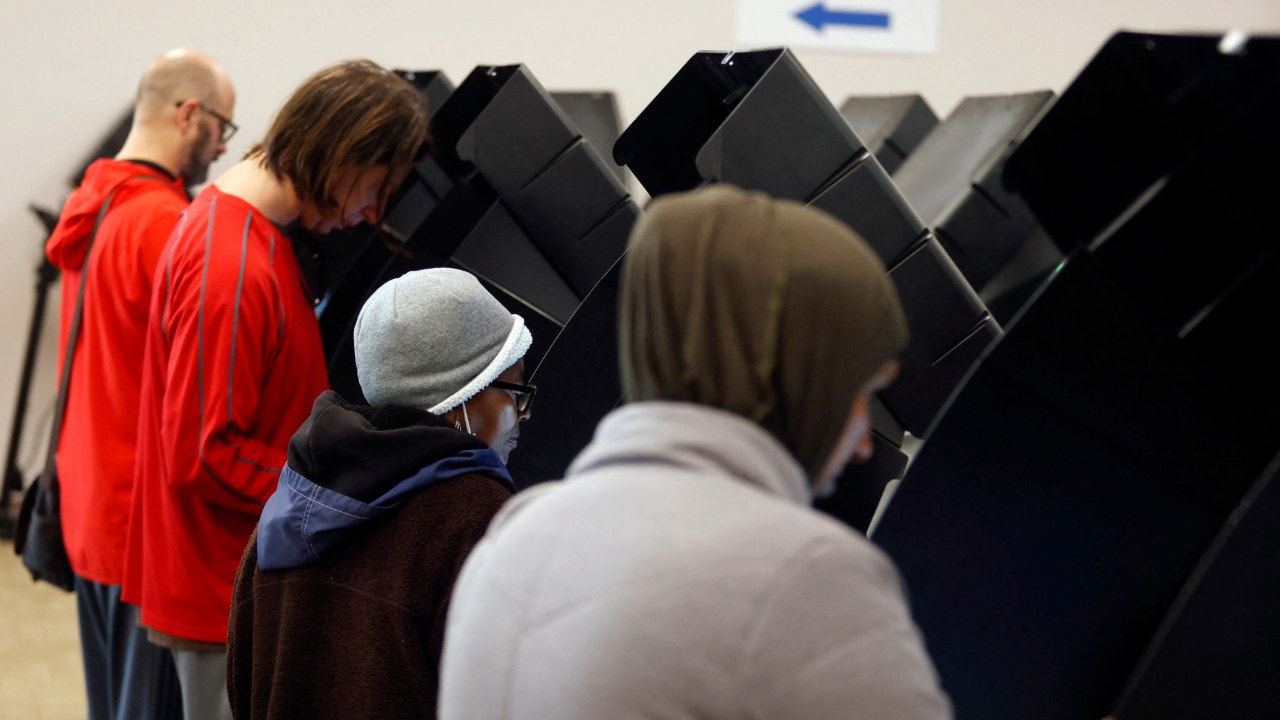
DAYTON, Ohio – A competitive Senate race in Ohio has resulted in voters being flooded with ads about national issues, but a lesser known state ballot measure to amend the state constitution could, according to its critics, fundamentally change the makeup of elections for the worse for years to come.
On Tuesday, Ohio voters will vote “yes” or “no” on a measure “to create an appointed redistricting commission not elected by or subject to removal by the voters of the state.”
The ballot question states that it would, among other things, “repeal constitutional protections against gerrymandering approved by nearly three quarters of Ohio electors participating in the statewide elections of 2015 and 2018, and eliminate the longstanding ability of Ohio citizens to hold their representatives accountable for establishing fair state legislative and congressional districts.”
Ohioans voted overwhelmingly in 2015 to create the commission and have it draw State House districts. During that bipartisan campaign, which was called Fair Districts for Ohio, they were promised the new system would “protect against gerrymandering.” In 2018, voters gave the commission an additional role in a new system set up to draw congressional districts.
NONPARTISAN WATCHDOG RELEASES REPORT OUTLINING TOP ELECTION SECURITY THREATS FOR 2024: ‘A LOT CAN GO SIDEWAYS’
Voters cast their ballots for early voting at the Franklin County Board of Elections on the eve of the U.S. midterm elections in Columbus, Ohio. (Getty Images)
Citizens Not Politicians (CNP) argues the existing system has failed. The group is calling for replacing the current regime with an independent body made up of average citizens. Current and former politicians, party officials and lobbyists would be ineligible. The 15-member Ohio Citizens Redistricting Commission would include Republicans, Democrats and independents and represent a mix of the state’s geographic and demographic traits.
CNP sued the Ohio Ballot Board and Republican Secretary of State Frank LaRose over the wording of the ballot measure, and small tweaks were made. However, the court ruled the phrase “required to gerrymander” was accurate and upheld the majority of the wording.
While CNP argues that this measure puts citizens in control of district mapping, opponents warn that the measure is a partisan power grab funded by progressive groups, including dark money.
“Issue 1 doesn’t empower citizens, it does the exact opposite,” Honest Elections Project Executive Director Jason Snead told Fox News Digital. “It creates a new class of politicians who are wholly unaccountable to the people of Ohio. It’s nothing more than a liberal power grab designed to send more progressive politicians to Washington and Columbus.”
KEY BIDEN AGENCY SLAPPED WITH ANOTHER SUBPOENA RELATED TO VOTER REGISTRATION PUSH IN CRUCIAL SWING STATE
Ohio Secretary of State Frank LaRose speaks during a House Administration Committee hearing in the Longworth House Office Building at the U.S. Capitol on Sept. 11, 2024 in Washington, D.C. (Getty Images)
Americans for Public Trust Executive Director Caitlin Sutherland has raised concerns about who is funding the “yes” side of the argument.
“Liberal operatives have openly discussed their strategy to weaponize ballot issues in competitive states not only to bypass the legislatures, but also boost their preferred progressive candidates,” Sutherland said. “That’s the exact playbook they’re using in Ohio with Issue 1. The Arabella-managed Sixteen Thirty Fund is the number one donor to the campaign to pass Issue 1, which would force gerrymandering in the state and decimate the voice of Ohioans.”
Issue 1 Ohio Works has argued that a “yes” vote “creates an unaccountable commission whose members are chosen out of a hat by four retired judges, an unknown private hiring firm and commission members themselves.”
“Issue 1 will require Ohio’s legislative districts be gerrymandered to ensure that Republicans and Democrats can each win a set number of seats in the General Assembly and Congress,” Ohio Works argued. “Ohio voters could be stuck with a representative from the opposite party on the opposite end of the state who doesn’t share their point of view. Issue 1 will allow for maps to divide any county, city or township into as many districts as necessary to achieve the set number of seats. It will also create legislative districts with strange shapes like the famous ‘snake on the lake’ district that has defined Ohio gerrymandering for years.”
UNEARTHED DOCUMENTS CONTRADICT VULNERABLE HOUSE DEMOCRAT’S RHETORIC ABOUT CHAMPIONING EVICTION BAN
The Ohio State House. (Getty Images)
Fox News Digital spoke to LaRose about the ballot measure on Saturday and asked what his message would be to voters who are still undecided or perhaps confused by the barrage of ads from both sides.
“Here’s the easiest way to describe it,” LaRose said. “Issue 1 would replace the current redistricting process where people that you can fire, that are accountable to you, right? Elected officials are in charge of drawing district lines and are required to draw those in a balanced, bipartisan way. That’s what the Ohio Constitution was amended to do ten years ago when over 70% of Ohioans voted for that.”
“Now, if Issue 1 passes, all of those rules that protect against gerrymandering go away. A 15 member panel will be created. It’s supposed to be five Democrats, five Republicans and five Independents. But they’re appointed through this really complex process. I call it a Rube Goldberg device, like one of those drawings with the overly complicated thing. So, somehow they get these 15 people, those people then can never be fired from the redistricting commission. You’re literally never allowed to talk to them, which I think is a First Amendment violation. It says right in the amendment. You only can talk to them at a public meeting. So if your kid plays soccer with one of their kids, you can’t tell them how you think that the line drawing should work, which is crazy.”
SWING STATE GOP CANDIDATE COULD HIT MAJOR MILESTONE IN MAYORAL RACE AMID ‘REPUBLICAN WAVE’ OPTIMISM
LaRose explained that “they’re required to sit down and draw state legislative and congressional districts to create a certain number of Democratic seats and a certain number of Republican seats,” which he calls the “definition of gerrymandering.”
LaRose also warned that a “yes” on Issue 1 could end up negatively affecting minority communities in inner cities.
“They will try to create an arbitrary number of Democrat seats that really don’t fit, square peg, round hole kind of stuff and what they will do is crack urban populations, reduce minority representation,” LaRose said. “This is what happened in Detroit when Michigan passed something just like this. They’ll reduce minority representation, cracking urban populations and then drawing them, gerrymandering them all the way out into the suburbs.”
“Yes on Issue 1” has massively outspent opponents of the measure and the majority of the money from the “yes” side has come from outside the state, Ohio Capital Journal reported.
Ohio GOP Lieutenant Gov. Jon Husted told Fox News Digital that Issue 1 is the “biggest power grab” the state has seen in “many years” funded by “Democrats outside of Ohio.”
“A 17-page amendment that gives them unlimited spending ability, an unlimited legal defense fund, that will allow them to literally gerrymander more Democrats into Congress,” Husted said.
Ohio Lt. Gov. Jon Husted said Issue 1 is the “biggest power grab” the state has seen in “many years” funded by “Democrats outside of Ohio.” (Lt. Governor Jon Husted’s office)
Ohio businessman Bernie Moreno, running for Senate in Ohio, told Fox News Digital the debate on the ballot measure is “simple” and Ohioans should vote “no.”
“Look, we live in a constitutional Republic,” Moreno said. “If you don’t like your elected leaders, you get to vote them out. We don’t want to have legislation through constitutional amendment, especially one funded by an out-of state billionaire. The right vote is no.”
CNP and other groups supporting Issue 1 have made the case that a “yes” vote “creates accountability where it currently does not exist.”
“What could be more unaccountable than the current system in which politicians ignore seven Ohio Supreme Court rulings to make Ohio one of the 10 most gerrymandered states in the country?” the CNP website states.
“The politicians on the current Redistricting Commission are not accountable to the voters: One of the Republican members got his seat on the Senate after running with no opposition in a gerrymandered district, and one of the Democratic members is running unopposed for reelection this November after she redrew her district to make it even more gerrymandered. That’s not accountability.”
CNP says that the new system will ensure that “neither party, nor the independents alone, can force a map through without bipartisan consensus.”
Bernie Moreno speaks to Fox News Digital in Bellbrook, Ohio. (Fox News)
CNP has also made the case that the “ballot language is false and misleading and has no impact on what the constitutional amendment itself actually says and does,” which LaRose denied to Fox News Digital.
“The yes people don’t like it, but the ballot language is truthful,” LaRose told Fox News Digital. “When you get to your voting booth, and you read that and if you think that that’s a good idea, then you’re a rare bird.“
The Associated Press contributed to this report.
Read the full article from Here


Getty
DETROIT, MICHIGAN – MARCH 12: Cade Cunningham #2 of the Detroit Pistons while playing the Philadelphia 76ers at Little Caesars Arena on March 12, 2026 in Detroit, Michigan. NOTE TO USER: User expressly acknowledges and agrees that, by downloading and or using this photograph, User is consenting to the terms and conditions of the Getty Images License Agreement. (Photo by Gregory Shamus/Getty Images)
The 2026 NBA offseason looks to be an interesting one for the Detroit Pistons, who are fresh off a 60-win regular season. The Pistons have had one of the most impressive turnarounds in recent history, going from the hands-down worst team in basketball to the top seed in the Eastern Conference.
Detroit’s future is centered around none other than rising superstar point guard Cade Cunningham, who is coming off an MVP-caliber season and one of the best individual campaigns in franchise history. For Cunningham to continue turning the tide in Detroit and ascending individually, the Pistons will need to land their 24-year-old point guard some help.
Could Pistons Feature Another All-Star Around Cade Cunningham?
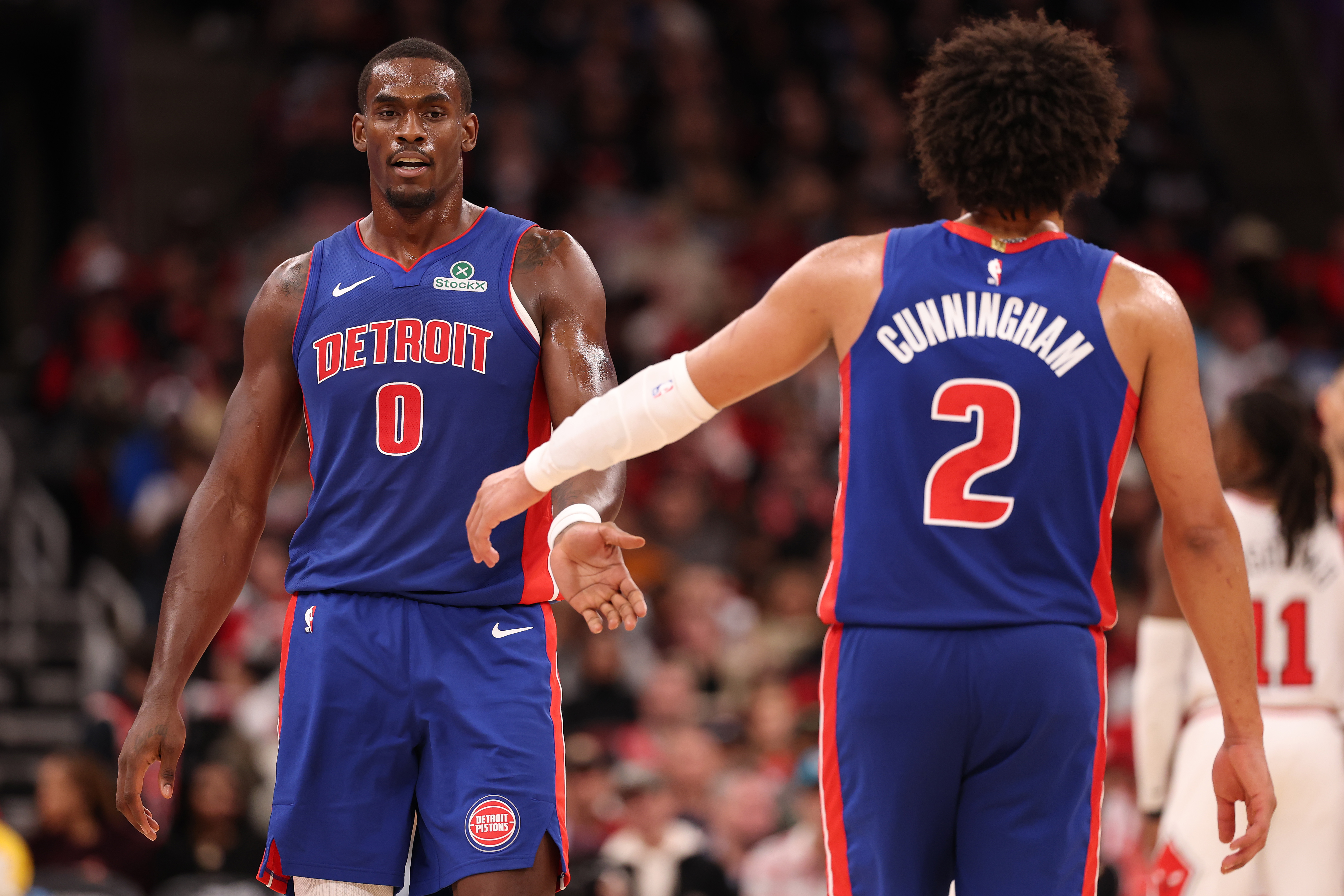
GettyCHICAGO, ILLINOIS – OCTOBER 22: Jalen Duren #0 and Cade Cunningham #2 of the Detroit Pistons high five against the Chicago Bulls during the second half at the United Center on October 22, 2025 in Chicago, Illinois.
While Cunningham is largely responsible for transcending the Pistons’ fortunes, Jalen Duren, the rising 22-year-old big man, is also to thank for the success. But for Detroit to rise into legitimate title contender status, it may need to feature another star.
According to ClutchPoints NBA insider Brett Siegel, the Pistons have their eyes on Kawhi Leonard of the Los Angeles Clippers. Leonard, a seven-time All-Star could be an addition that would take Detroit over the hump.
“Now, if a team approached them with a massive trade offer for the seven-time All-Star, they would have to at least consider the idea of taking a step back and moving on from Leonard, especially since he turns 35 years old on Monday,” Siegel reported. “Multiple teams, including the Warriors, Timberwolves, and Pistons, have contacted the Clippers both at the trade deadline and this offseason to inquire about Leonard’s availability. At no point did Los Angeles show any interest in trading him, sources said.”
While the Clippers have not formally made Leonard available, Siegel reports there is a chance the franchise would look to move the two-time Finals MVP if they receive a worthy package.
Does Detroit have enough in its asset bank to draw up a strong trade package for Leonard? Maybe. Nonetheless, it is a good sign the Pistons are searching for another big fish to slot alongside Cunningham.
Detroit Should Strong Consider a Big Trade; is Leonard Enough to Make a Contender?
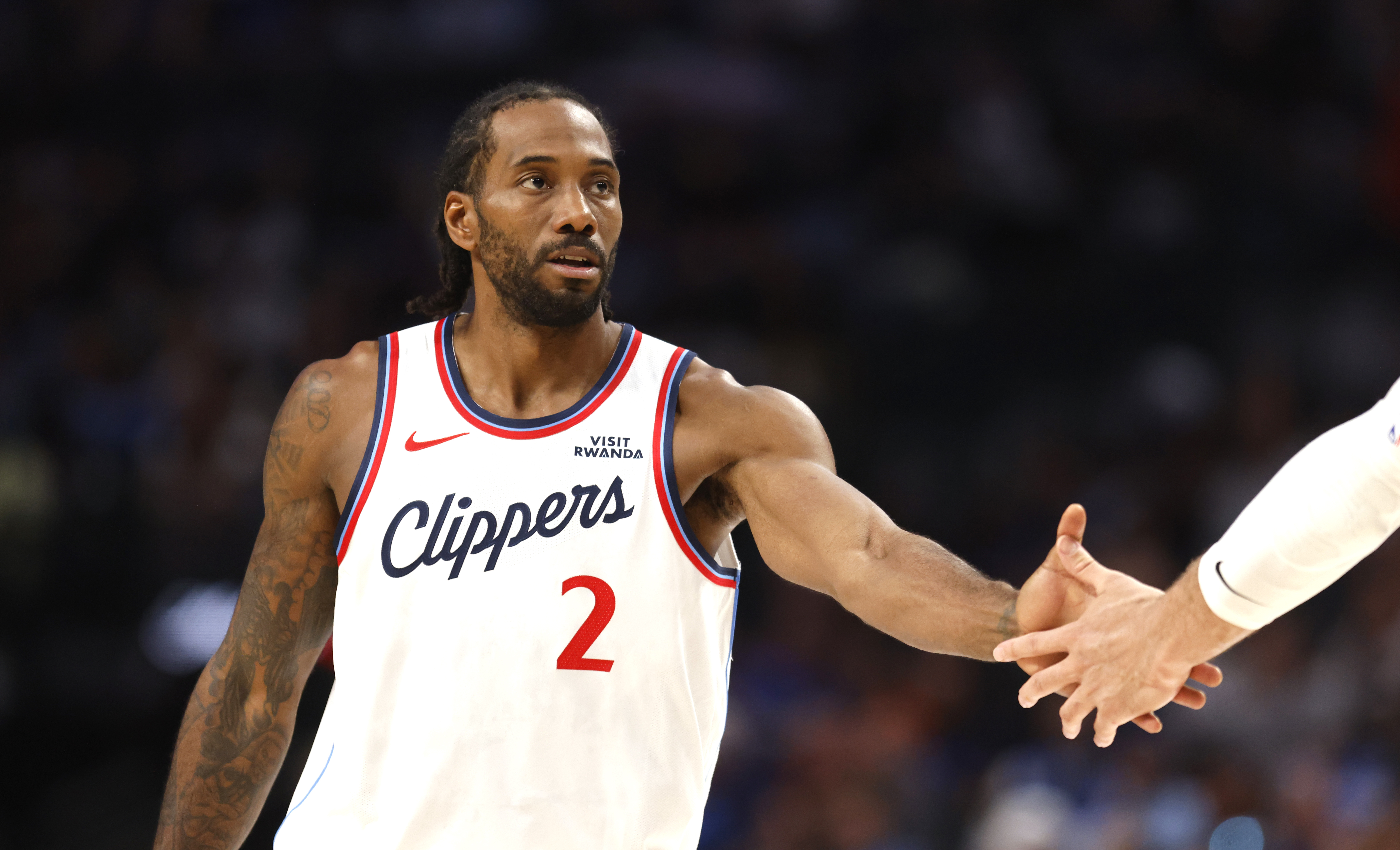
GettyDALLAS, TEXAS – MARCH 21: Kawhi Leonard #2 of the Los Angeles Clippers celebrates with a teammate during the second half against the Dallas Mavericks at American Airlines Center on March 21, 2026 in Dallas, Texas.
Last season, the Pistons blew away expectations. Cunningham arrived as a blossoming superstar, Duren announced himself as a franchise cornerstone and Detroit showed it may just be one major piece away from claiming the Eastern Conference mantle.
Perhaps making an offseason splash is something Pistons president Trajan Langdon needs to strongly consider.
In some ways, Cunningham’s situation mirrors Anthony Edwards’ in Minnesota. Both young, rising superstars on teams that can make noise in the playoffs. The Timberwolves realized they didn’t have enough to compete, so they landed LaMelo Ball from the Charlotte Hornets.
Maybe something similar needs to happen in Detroit. Perhaps star guard or wing next to Cunningham is what it will take to elevate the Pistons from a regular season force to a playoff powerhouse.
Landing Leonard from the Clippers might raise the Pistons to that level. Although he’s 35 years old, Leonard is coming off an All-NBA season after registering a career high 27.6 points per game and doing it on an uber-efficient 51.5% shooting from the floor.
Leonard is a proven winner and multi-time champion. He may be the superstar (and veteran) Detroit needs to put itself on equal footing with the NBA champion New York Knicks.
Adel Ahmad Adel is a writer with over five years of experience covering the NBA. His work has appeared on various media platforms, both national and local. More about Adel Ahmad

A game and a series that started so promising, ended up in an emotional loss for the Milwaukee Brewers as they fall to their rivals, the Chicago Cubs, 4-3 in 10 innings on Sunday afternoon.
Brandon Woodruff was the big positive. In his second start since coming back from the IL, Woodruff shoved once again, allowing just one hit over 5.2 scoreless innings. He was efficient and filled up the strike zone as he usually does. Woodruff ended the day with six strikeouts on his line and protecting a one-run lead.
That one run lead was provided by Gary Sanchez, who took a 1-1 fastball from lefty Ryan Rolison and tattooed it into the second deck in left field. It was Sanchez’s eighth home run of the season.
However, that was all the Brewers offense could really muster off Rolison and then old friend Bryse Wilson, who shut down the Crew’s offense over his 4.1 IP.
The Brewers did have a number of opportunities, though. Runners at the corners in the 3rd with one out, both Chourio and Turang strike out. In the 4th, Andrew Vaughn gets a leadoff triple, no one can even muster a sac fly to bring him home. Runners on first in the 6th, 7th, and 8th, no advancement. In the 9th, the Brewers had runners on 1st and 2nd with one out, a base hit can walk it off, and both Cooper Pratt and Joey Ortiz strike out.
“I think sometimes guy maybe try to do too much, and that’s where we try to preach ‘take what the game gives you and go back to taking pitches and handing it to the next guy’” offense and strategy coordinator Jason Lane said.
Meanwhile the Crew used up their top bullpen arms in those earlier leverage innings. Aaron Ashby spiked a curveball with a runner on 3rd to allow the Cubs to tie the game in the 7th. But then Abner Uribe and Trevor Megill got the jobs done in the 8th and 9th. But with few leverage arms left, the Brewers turned to Joel Kuhnel in the 10th.
Kuhnel was able to get the first two batters out at the bottom of the Cubs order. Then he just lost the strike zone. They intentionally walked Pete Crow-Armstrong, then Kuhnel hits Bregman, then walks Michael Busch to bring in a run. Then Seiya Suzuki rips a single to left to score two more and put the Cubs up 4-1.
The Brewers put together some big chances in the 10th. Christian Yelich singled home Ortiz, then Chourio walked and Turang singled, loading the bases for pinch-hitter Garrett Mitchell. Mitchell worked a walk and the Brewers were within a run, down 4-3, with the bases loaded and nobody out.
That’s exactly when it all went sideways. Jake Bauers, after seeing Mitchell get walked, swung at the first pitch and hit a shallow pop fly into left field that was nowhere near deep enough to score a run. Then Gary Sanchez, who homered in the 2nd, grounded into a tailor-made 5-4-3 double play to end the game.
Milwaukee was 2-for-12 with runners in scoring position and left 10 runners on base. Woodruff pitched well enough to win. The bullpen did well enough to win through nine innings. The offense just couldn’t give them enough.
The Brewers missed way too many opportunities to put this game away when they should have and that leaves them on the short end of this series where they had their top three arms in the rotation going. The lead over the Cubs sits at 5.5 games now and the Brewers will look to turn the page to the Reds series.

One person is dead and eight others are hurt in a string of weekend shootings across Minneapolis.
Police say the first shooting occurred Friday around 5 p.m. near North Humboldt and 26th avenues. A man was outside of his home when shots rang out, leaving him with multiple gunshot wounds.
Around 9:35 p.m. Friday, two men were shot outside in the area of north Lowry and Logan avenues.
Just after 12:30 a.m. Saturday, a man was found shot in an alley near Mortimer’s Bar and Restaurant off South Lyndale and Franklin avenues. He told police he was outside walking when he was hit.
Just before 12:50 a.m. Saturday, police say a man outside was shot near North Penn Avenue, just north of Highway 55, by someone driving by.
Around 1:50 a.m. Saturday, a man suffering from gunshot wounds showed up at Hennepin Healthcare, with police later determining he was shot in the area of North Lyndale and 45th avenues.
Just after 3:30 a.m. Saturday, a man showed up to Children’s Minneapolis hospital with a gunshot wound he said occurred when he was asleep inside his vehicle.
On Sunday around 1 a.m., a man was found laying on the ground near Bloomington Avenue and East 24th Street. He was brought to Hennepin Healthcare where he later died. Police say investigators “located evidence of gunfire, including a firearm recovered next to the man who died.”
On Sunday just before 1:30 a.m., a 15-year-old girl was shot in the area of Hennepin and Laurel avenues in downtown. Two boys, ages 14 and 15, were soon arrested in connection to the shooting.
And just before 1:50 a.m. Sunday, a man was found shot inside a business off Northeast Lowry Avenue and Fourth Street Northeast. Investigators believe the shooting began as an altercation in the business’s parking lot.
With the exception of the shooting of the 15-year-old girl, police say no arrests have been made in any of the cases. All surviving victims have injuries described by police as non-life threatening.
Anyone with information on any of these shootings can submit an anonymous tip online to Crime Stoppers, or call 1-800-222-TIPS (8477).
-

 Los Angeles, Ca1 hour ago
Climbers rescued from Tahquitz Rock in San Bernardino National Forest
-

 Detroit, MI2 hours ago
Report: Pistons Targeting 7-Time All-Star Wing to Pair With Cade Cunningham
-

 San Francisco, CA2 hours ago
6/28 Gamethread: Giants vs. Braves
-

 Dallas, TX2 hours ago
Dallas community gathers donations for Venezuela
-

 Miami, FL2 hours ago
Miami Heat Could Reunite With Playoff Hero This Offseason
-

 Boston, MA2 hours ago
Red Sox lefty makes latest rehab start, close to forcing tough decision
-

 Denver, CO2 hours ago
Firefighters say car crash caused large fire north of Denver International Airport
-

 Seattle, WA2 hours ago
PHOTOS: Thousands gather in downtown Seattle for city’s iconic Pride Parade

