Midwest
Bureaucrats hide true price of Obama Presidential Center as taxpayers hit with infrastructure bill

NEWYou can now listen to Fox News articles!
FIRST ON FOX: Former President Barack Obama once declared that his presidential center would be a “gift” to Chicago, but taxpayers are on the hook for hundreds of millions of dollars in hidden costs related to the beleaguered project.
A Fox News Digital investigation shows taxpayers are now stuck footing the bill for surging public infrastructure costs required to support the project — and no government agency can provide an accounting of the total public cost, despite months of queries and FOIA requests.
“Illinois Republicans saw this coming a mile away. Now, right on cue, Illinois Democrats are leaving taxpayers high and dry and putting them on the hook for hundreds of millions of dollars to support the ugliest building in Chicago,” Illinois GOP Chair Kathy Salvi told Fox News Digital. “Illinois’ culture of corruption is humming along with pay-to-play deals to their allies and friends while lying to Illinois voters.”
When the project was approved in 2018, Obama pledged to privately fund construction of the expansive 19.3-acre campus in historic Jackson Park through donations to the Obama Foundation – a commitment that remains in place as the center’s construction continues to be privately financed.
But the extensive infrastructure required to make the campus operationally viable — including redesigned roads, stormwater systems, and relocated utilities — is publicly financed, and without those changes, the center could not function.
At the time, projections placed public infrastructure costs at roughly $350 million, split between the state of Illinois and the city of Chicago.
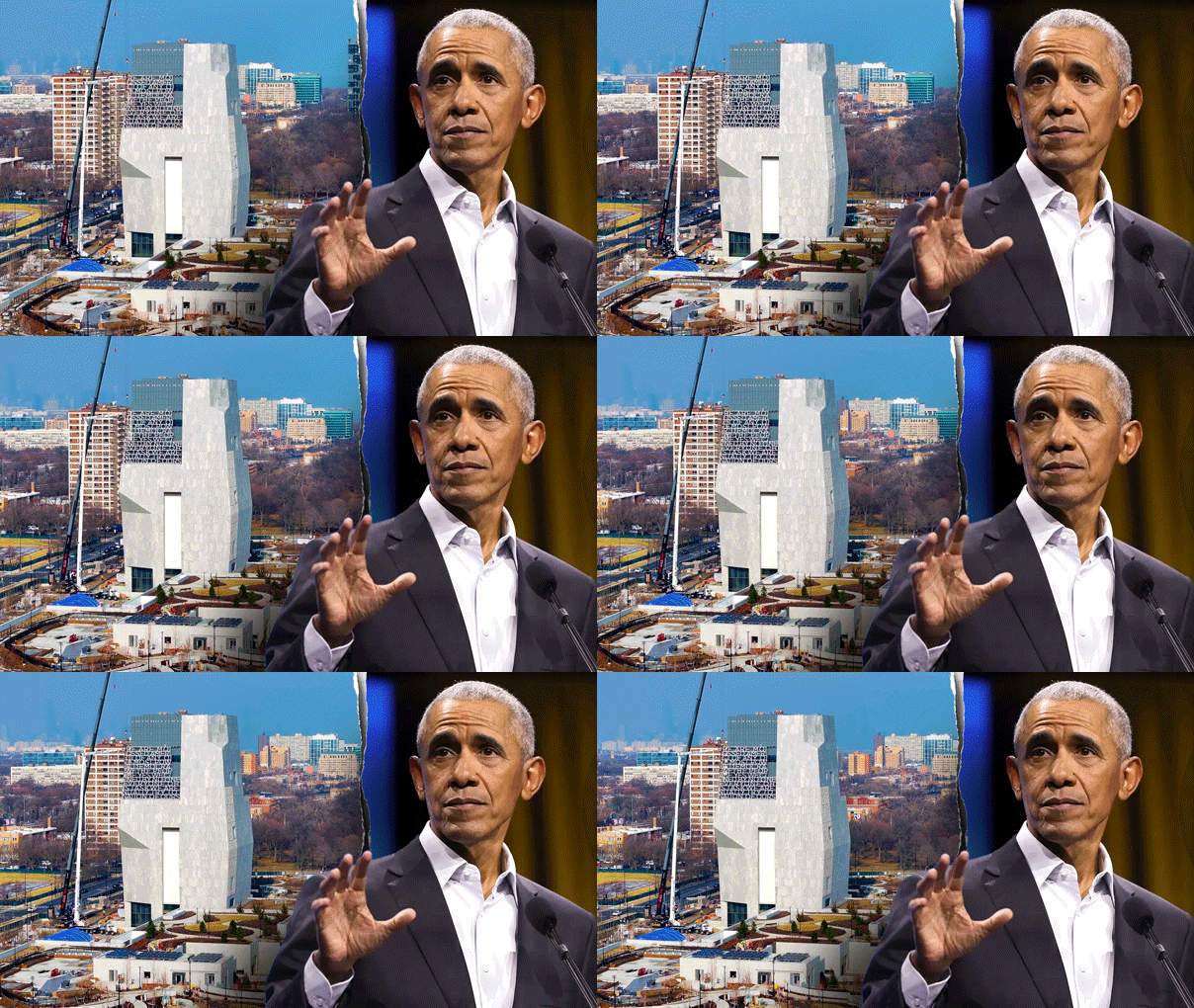
Former President Barack Obama once professed that his presidential center would be a “gift” to Chicago. Animated GIF showing the Obama Presidential Center under construction alongside a static image of former President Barack Obama. (Fox Flight Team; Getty)
Eight years later, the Illinois Department of Transportation (IDOT) told Fox News Digital that approximately $229 million in infrastructure spending was tied to the site, up from its earlier estimate of roughly $174 million.
The $229 million figure reflects state-managed spending, which may include federal transportation funds routed through IDOT.
Meanwhile, Chicago officials have failed to produce a reconciled total showing how much city taxpayers have committed or how current spending compares to the roughly $175 million discussed when the project was approved.
A paper trail without a total
Fox News Digital submitted records requests and press inquiries to every agency involved in the infrastructure work, including the Illinois Department of Transportation (IDOT), Chicago’s Department of Transportation (CDOT), the Office of Budget and Management (OBM), the Mayor’s Office and Gov. J.B. Pritzker’s administration.
Not a single office provided a unified, up-to-date accounting of total public infrastructure spending tied to the project. The investigation involved months of FOIA requests, partial disclosures and repeated follow-ups.
No single agency appears to oversee the full scope of the infrastructure work, and neither the state nor the city has assembled a reconciled accounting — a fragmentation that has made the overall public cost difficult to determine.
Instead, agencies provided partial figures, declined to clarify whether city and state totals overlap or insisted that no consolidated total exists.
The Illinois Attorney General’s Public Access Counselor (PAC) is reviewing whether multiple agencies complied with state transparency laws following Fox News Digital FOIA requests.
Exterior view of the Obama Presidential Center tower under construction in Chicago. (Fox 32 Chicago)
Construction costs soar
The center sits on 19 acres of historic public parkland carved out in a controversial transfer for just $10 under a 99-year agreement, making the question of public infrastructure spending particularly sensitive. Legal challenges to the land transfer, including lawsuits arguing the arrangement was not in the public interest, were ultimately dismissed, although the merits of the arguments were not adjudicated on.
The center — though commonly referred to as a presidential “library” — will not function as a traditional facility operated by the National Archives and Records Administration (NARA), and former President Obama’s official records will be maintained by NARA at a federal site in Maryland.
While the Obama Presidential Center in Chicago is expected to provide digital access to archival materials, it will not serve as a federally operated records repository.
Instead, the Chicago complex will be operated privately, without rent payments, by the Obama Foundation, the former president’s nonprofit organization, which oversees leadership programs and civic initiatives aligned with his values and policy priorities.
Construction costs for the facility itself have ballooned from early estimates of roughly $330 million to at least $850 million, according to the foundation’s 2024 tax filings, although these expenses are being borne by private donors.
Meanwhile, a $470 million reserve fund — known as an endowment — that the foundation promised to fill to protect taxpayers should the project go belly-up, has received only $1 million in deposits, Fox News Digital previously reported.
OBAMA LIBRARY, BEGUN WITH LOFTY DEI GOALS, NOW PLAGUED BY $40M RACIALLY CHARGED SUIT, BALLOONING COSTS
A before-and-after aerial graphic shows the footprint of the Obama Presidential Center in Jackson Park, including the removal of Cornell Drive and construction along Stony Island Avenue. (Fox News)
Roads removed, routes rebuilt
Taxpayers often fund routine improvements near major civic projects — such as turn lanes, utility hookups or upgraded traffic signals — but the scale of the work surrounding the Obama Presidential Center is far more extensive.
By comparison, other modern presidential libraries required only limited public infrastructure upgrades and did not involve the removal of a major roadway or the wholesale redesign of a historic park’s traffic pattern.
Much of the publicly financed work reshaped the roads and utilities that once ran through Jackson Park.
Cornell Drive — a four-lane roadway that bordered the center’s east side by the park’s lagoon — was permanently removed under the center’s site plan and enveloped by the campus. Traffic that once ran alongside the lagoon has been rerouted farther west, reducing the number of public roads directly adjacent to the complex and creating a more unified campus footprint around the center.
Crews also tore down trees, relocated water mains, sewer lines, and electrical infrastructure and installed new drainage systems tied to the facility’s structural needs as part of the public infrastructure project.
City and state officials say the changes were necessary to manage traffic and visitor demand. Critics argued the redesign altered long-standing park infrastructure to accommodate the foundation’s preferred layout.
What’s clear is that without those road closures, reroutes and utility relocations, the project would not function as designed.
The Obama Foundation, which is funding the center’s construction, defended the project in a statement to Fox News Digital.
“The Obama Foundation is investing $850 million in private funding to build the Obama Presidential Center and give back to the community that made the Obamas’ story possible,” said Emily Bittner, a spokesperson for the foundation.
“After decades of underinvestment on the South Side of Chicago, the OPC is catalyzing investment, from both public and private sources, to build economic opportunity for residents through jobs, housing, and public spaces and amenities.”
A map graphic shows the footprint of the Obama Presidential Center inside Jackson Park on Chicago’s South Side along Lake Michigan. (Fox News)
The number no one will state
IDOT, which controls the state’s funding for the corridor and signs off on major transportation contracts tied to the project, acknowledged approximately $229 million in state-managed infrastructure spending but did not produce a consolidated accounting reconciling that total across all project phases.
“With all the main parts of this aspect of the overall project awarded, to date the state via IDOT has contributed approximately $229 million,” an IDOT spokesperson told Fox News Digital in July in its latest release. “Approximate breakdown of these funds: $19 million in preliminary engineering; $24 million for construction engineering and $186 million for construction activities.”
The spokesperson said that the initial $174 million figure was from a “2017 was a preliminary cost estimate.”
CDOT, which carried out the roadway closures, traffic rerouting and utility relocation work inside Jackson Park, acknowledged Fox News Digital’s Oct. 7, 2025, FOIA request and took a statutory extension but never issued a final determination or produced the requested records. The department also did not provide a unified city total or clarify how Chicago’s capital allocations overlap with the state’s spending.
OBM, which oversees the city’s capital allocations, did not say whether the city’s $175 million estimate remains current and directed Fox News Digital to the Capital Improvement Plan. Chicago’s most recent 2024–2028 Capital Improvement Plan — the city’s multi-year infrastructure budget — lists more than $206 million allocated to roadway and utility work surrounding the project. However, much of that funding is labeled “state,” and neither state nor city officials could clarify how those allocations overlap with IDOT’s reported total.
In a FOIA response, OBM said it “does not have responsive records” showing any cost overruns, reallocations or a breakdown of spending across major components of the Obama Center infrastructure work.
The agency also could not explain how Chicago’s $206 million budget line relates to IDOT’s $229 million figure or how much of the city’s amount is actually paid by Chicago rather than the state.
Chicago’s 2024–2028 Capital Improvement Program lists $206,078,058 for “Obama Presidential Center & Jackson Park – Infrastructure Improvements,” with most funding labeled as state sources. (City of Chicago Capital Improvement Program)
Pritzker’s office gave conflicting responses and ultimately produced no records showing the state’s total infrastructure spending.
Meanwhile, Mayor Brandon Johnson’s office did not respond to repeated requests for the city’s total infrastructure spending tied to the project or for how much more Chicago expects to commit.
Without updated reconciliations from both levels of government, taxpayers still have no clear accounting of the financial obligations associated with the center.
What is clear is that Obama’s “gift” to Chicago comes with a hefty public price tag that has grown more complex — and without updated cost projections, the true total cost remains unknown.
Related Article

Read the full article from Here



Julie Thomas had been searching since January for a house that would give her more space for herself and her two dogs while moving her closer to work. After seeing several homes quickly snapped up, she recently went under contract for a home in Shelby Township.
“I’m very happy that we are at least working on one and that the offer was accepted,” she said. “I was definitely getting discouraged continuing to look. I’m obviously relieved from that aspect of it.”
Thomas, 25, is among Metro Detroit homebuyers experiencing a housing market in a transitional moment on multiple fronts. As the peak spring buying season begins, more listings are coming online and activity is picking up after a slower winter, even as mortgage rates have climbed back above 6%. At the same time, the average homebuyer is older than in past years, highlighting how affordability is shaping who is able to enter the market.
The median first-time homebuyer in 2025 was 40 years old, up from 30 in 2010, according to the National Association of Realtors, while Redfin reports a median age of 35. And older buyers aren’t slowing down. When including repeat buyers, those upgrading, downsizing or buying vacation homes, the median age of all U.S. homebuyers jumps to 59, up from 39 in 2010, according to Apollo chief economist Torsten Slok, who analyzed the NAR data.
Redfin puts the median age of repeat buyers at about 47. That means people aren’t just buying their first homes later. Older Americans are buying multiple times later in life instead of staying put.
Market has more showings, more buyers
The upcoming spring market is expected to bring increased activity after a winter of slower sales and moderated price increases. There were fewer homes sold in February in Metro Detroit, with year-over-year sales down and prices rising modestly.
“I would say it does feel that we are entering the very early stages of our spring market,” said Jeanette Schneider, president of RE/MAX of Southeastern Michigan. “We’re seeing more activity. There’s more showings being scheduled. There are more buyers out there. They’re looking, which is good. It’s something that we want to see at this time of the year.”
Home sale activity across Metro Detroit, including Wayne, Oakland, Macomb and Livingston counties, was down year-over-year with 2,660 transactions, down from 2,864 last year, according to the latest RE/MAX of Southeastern Michigan housing report. The median sales price was relatively stable, slipping to $297,500 from $300,000 in January, but up from $293,375 last year. Inventory levels remained between three and four months of supply, while homes continued to sell at a steady pace of about 40 days on market, according to the report.
Across a broader area covering 18 Michigan counties, new listings in February rose year-over-year, increasing 3.6% to 8,516 from 8,224, according to the latest Realcomp report. The report includes Genesee, Hillsdale, Huron, Jackson, Lapeer, Lenawee, Livingston, Macomb, Monroe, Montcalm, Oakland, Saginaw, Sanilac, Shiawassee, St. Clair, Tuscola, Washington and Wayne counties.
“I know that sales are down, but I do think that it’s positive to have the homes on the market increase for those that are searching for a home, to give them more opportunity to find what they’re looking for,” said Karen Kage, CEO of Realcomp II Ltd. “That’s been seriously missing, like last year and this year or the year before. And so it’s nice to have, nice to see that improving so that again, they have more to choose from, especially first-time homebuyers, it’s really nice that they have more options.”
The Realcomp report also notes that pending sales fell 7.5% to 6,327 from 6,842, and closed sales decreased 10.1% to 5,794 from 6,443. The median sale price increased 2.9% to $262,000 from $254,500, and homes spent an average of 52 days on the market, up slightly from 50 days a year ago. The report also found that about 26% of new listings and 34.9% of pending sales were both listed and pending in the same month.
“To see that many homes listed and sold, or at least under contract, in the same month is very encouraging,” Kage said.
Rates influence buyers
Mortgage interest rates have ticked back above 6% after briefly dipping below that level in late February for the first time since 2022, according to Freddie Mac, coinciding with the increase in the 10‑year Treasury yield.
“Despite the modest uptick, buyers are responding to rates in this range, with existing-home sales increasing 1.7% in February,” Sam Khater, Freddie Mac’s chief economist, said in a statement. “Purchase applications also increased this week, a welcome sign as buyers enter spring homebuying season with rates down more than half a percentage point compared to the same time last year.”
The mortgage rate environment has had an impact on buyer behavior. “And while interest rates have kind of gone back to right about 6%, they’ve been pretty stable,” Schneider said. “That also helps buyers feel confident in moving forward.”
Kristie Lohmann, a Realtor associate with RE/MAX First in Shelby Township, said seeing rates just under 6% has been encouraging, though they’re higher than the record lows of recent years.
“People that bought a home during COVID got the 3% interest, and they’re not going anywhere because they don’t want to pay more now,” she said. “If you want to do something and you can afford the higher payment, do it and hope the rates come down. But it’s still a factor buyers have to consider.”
Affordability is impacting who enters the housing market and when. Angie Sierra, a Southfield-based agent with RE/MAX City Centre, said the typical first-time buyer she sees is 35 to 40.
“I do see quite a bit of young homeowners as well,” she said. “I have a few college students that have purchased a home, but overall, the average is in the upper 30s to early 40s.”
Among those buyers is Erica Johnson, 35, and her fiancé, Stephaun Patterson-Lovelace Sr., 36, who recently purchased their first home in Garden City for $237,900 through a land contract. It’s a three-bedroom, one-bath house with a two-car garage, fenced backyard and space for their blended family of four children, ages 9 to 18. Johnson said the process was challenging but rewarding.
Given the average age of first-time homebuyers, Johnson, a pharmacy technician, said she was told that she and Patterson-Lovelace, an Xfinity technician, were “right where they needed to be” in terms of buying a house.
“So it feels really good to not have to worry about rent, to not have to worry about somebody else’s rules and all this other stuff,” she said. “We get our own, and we can stay pretty much as long as we want to. But then we also have equity in the house moving forward.”
First-timers face high prices for lots of work
The condition of homes is another challenge for buyers, particularly first-time buyers.
Lohmann noted that many properties come on the market in less-than-ideal shape, sometimes prompting buyers to pay high prices for homes that require significant work.
“I walk in some houses and say, ‘What are they asking for this house?’” Lohmann said. “They weren’t in the best condition, and I was kind of shocked what the seller was asking.”
A move-in-ready home can make all the difference for first-time buyers. That was the case for Thomas, the first-time homebuyer from Chesterfield Township, who began her search focusing on Sterling Heights, Shelby Township and Clinton Township to be closer to her job as a registered dietitian in Pontiac.
She said her search was challenging, with homes selling quickly and prices high relative to their condition.
“Being in it makes you realize just how expensive everything is for not much, whatever you’re going to get,” she said. “It can be discouraging for sure, thinking about the market and the economy and everything.”
Thomas found a home in Shelby Township that fit her budget, making an offer of $275,500. The three-bedroom, one-bath home includes a two-car garage, a fenced backyard, a shed, a fireplace and brand-new appliances.
The home is largely move-in ready, with the recent inspection helping her identify typical maintenance needs, she said: “It’s just too (great to) pass up.”
Buyers have to maintain realistic expectations, said Marcy Soufrine, an agent with Keller Williams, especially amid tight inventory and rising prices. That often means adjusting priorities.
“They’re willing to look at slightly smaller homes, different locations, or just wait for the right opportunity,” she said, adding that sellers are starting to prepare their homes for the spring market, which could add more options for buyers.
“I’ve been talking to more people who are thinking about putting their homes on the market in the next few months. They want to get an idea of what they need to do to get their homes ready and where we can price them,” she said. “Anyone that wants to list should do it before May, June, July, because when more homes hit the market at the same time, you have more competition.”
As for Johnson, she and her fiancé worked out a deal for seller financing to make their first home purchase possible. They plan to move in and gradually make improvements, including adding a bathroom in the basement.
“We basically can move in and just fix it up over time,” she said. “But it’s our house, and it’s something we have, and we can build on that.”
cwilliams@detroitnews.com

Milwaukee police chief negotiated big salary bump. Is fire chief next?
How an overlooked footnote impacts pay negotiations for Milwaukee’s fire chief.
A 25-year-old Milwaukee man has been identified as the fatal victim following a shooting that injured five people on the city’s north side.
Simeon I. Calvert was shot on March 21 a little after 11 a.m. at the intersection of North Darien and North 37th streets, according to the Milwaukee County Medical Examiner’s Office.
Calvert was transported to a hospital where he died in the operating room, the medical examiner said.
Four other people were injured in the shooting, ranging in age from 20 to 29 years old.
Police said March 23 that they have “persons of interest” in custody but continue to seek additional information.
The investigation is ongoing, police added, but it is believed that the incident was the result of an argument.
Anyone with any information about the incident is being asked to contact the Milwaukee Police Department at 414-935-7360. To remain anonymous while providing information, contact Crime Stoppers at 414-224-TIPS.
This story was updated to add new information.

Minneapolis police respond to a hit-and-run that left a woman seriously injured, (FOX 9)
MINNEAPOLIS (FOX 9) – A woman hit by a vehicle that fled the scene in Minneapolis over the weekend died Monday from her injuries, according to Police Chief Brian O’Hara.
Minneapolis hit-and-run crash
The backstory:
Police say they responded to reports of a hit-and-run crash involving a pedestrian at about 3:10 a.m. on Sunday in the 1600 block of Marshall Street Northeast.
Officers then found a woman in her 20s suffering from potentially life-threatening injuries. She was taken to the hospital.
Investigators say the woman was crossing Marshall Street while carrying a bag of food when she was struck by a speeding vehicle.
Driver still at large
What you can do:
Police say no arrests have been made in connection with the incident. The vehicle is described as a dark-colored sedan that was possibly driven by a man.
Anyone with information on the incident is asked to contact Minneapolis police by emailing policetips@minneapolismn.gov or calling 612-673-5845 to leave a voicemail.

Video: Passenger Jet and Fire Truck Crash at LaGuardia Airport, Leaving 2 Dead

Here’s what Metro Detroit homebuyers face heading into spring season

Preparations for SMART expansion to Healdsburg set to begin

Construction underway on Harold Simmons Park’s first attraction

‘Confident’ Bencic takes out Anisimova, eyes Gauff next in Miami

Florida High School Football Rankings: Top 25 teams – Oct. 21

How old is Bo Nix? What to know about Oregon quarterback ahead of 2024 NFL Draft

Cleary's 21 help Le Moyne down Central Connecticut State 69-64 in OT

99th annual Pony Swim held in Virginia

Indiana Members Credit Union announced as new anchor tenant at Bottleworks District

See TSA Wait Times at Major U.S. Airports

Senate hopeful with deep Dem ties slapped with scathing complaint targeting alleged family payout ‘scheme’

How the Iran war is about to hit your wallet

Suspect in slaying of Loyola University student was in the country illegally, officials say

Video: Plane Collides With Vehicle at LaGuardia Airport
-

 Detroit, MI5 days ago
Drummer Brian Pastoria, longtime Detroit music advocate, dies at 68
-

 Oklahoma1 week ago
Family rallies around Oklahoma father after head-on crash
-

 Georgia1 week ago
How ICE plans for a detention warehouse pushed a Georgia town to fight back | CNN Politics
-
 Science1 week ago
Federal EPA moves to roll back recent limits on ethylene oxide, a carcinogen
-

 Alaska1 week ago
Police looking for man considered ‘armed and dangerous’
-

 Movie Reviews5 days ago
‘Youth’ Twitter review: Ken Karunaas impresses audiences; Suraj Venjaramoodu adds charm; music wins praise | – The Times of India
-
 Science1 week ago
Long COVID leaves thousands of L.A. county residents sick, broke and ignored
-

 Education1 week ago
Video: Turning Point USA Clubs Expand to High Schools Across America