Midwest
Bodycam video reveals chaotic scene of deputy fatally shooting Sonya Massey, who called 911 for help

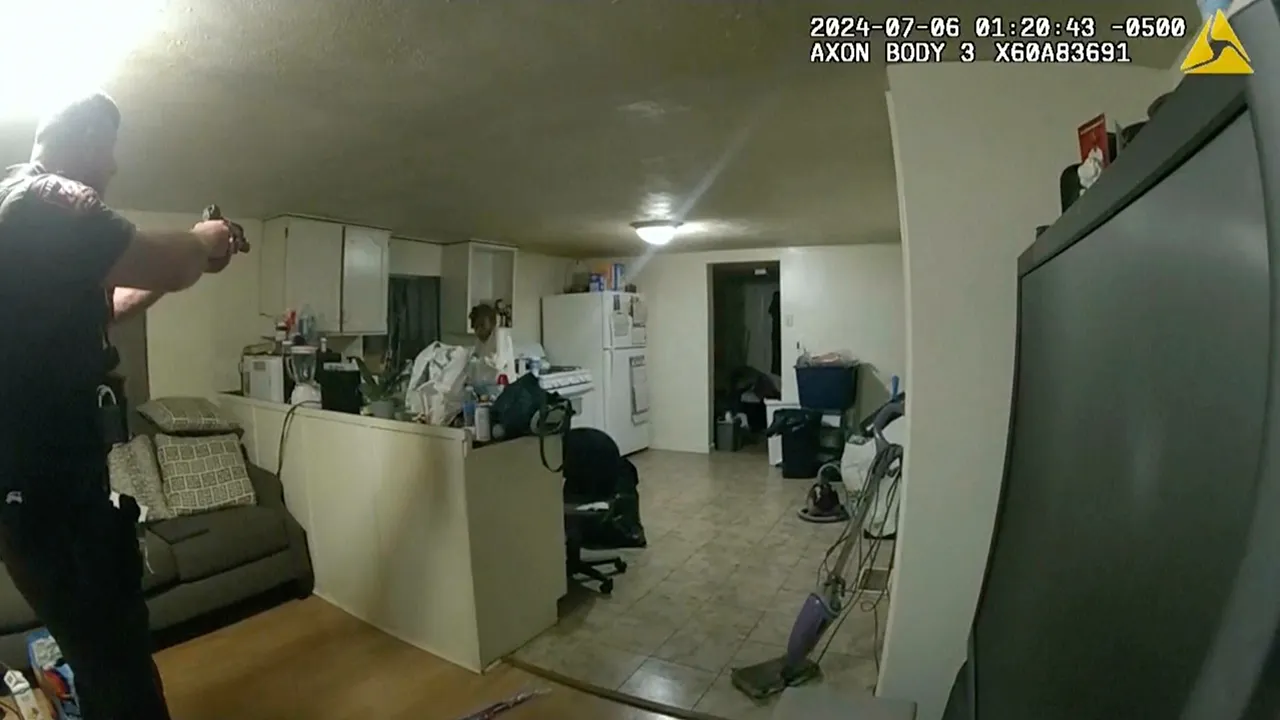
Sonya Massey ducked and apologized to an Illinois sheriff’s deputy seconds before he shot the Black woman three times in her home, with one fatal blow to the head, as seen in body camera video released Monday.
An Illinois grand jury indicted former Sangamon County Sheriff’s Deputy Sean Grayson, 30, who is white, last week. He has pleaded not guilty to charges of first-degree murder, aggravated battery with a firearm and official misconduct.
US POSTAL SERVICE LETTER CARRIER SHOT IN CHICAGO, OFFICIALS SAY
The video confirmed prosecutors’ earlier account of the tense moment when Grayson yelled from across a counter at Massey to set down a pot of hot water. He then threatened to shoot her, Massey ducked, briefly rose, and Grayson fired his pistol at her.
Authorities said Massey, 36, had called 911 earlier to report a suspected prowler. The video shows the two deputies responded just before 1 a.m. on July 6 at her home in Springfield, 200 miles (322 kilometers) southwest of Chicago. They first walked around the house and found a black SUV with broken windows in the driveway.
It took Massey three minutes to open the door after the deputies knocked, and she immediately said, “Don’t hurt me.”
She seemed confused as they spoke at the door, and she repeated that she needed help, referenced God and told them she didn’t know who owned the car.
Inside the house, deputies seemed exasperated as she sat on her couch and went through her purse as they asked for identification to complete a report before leaving. Then Grayson pointed out a pot sitting on a flame on the stove.
“We don’t need a fire while we’re here,” he said.
In this image taken from body camera video released by Illinois State Police on Monday, July 22, 2024, former Sangamon County Sheriff’s Deputy Sean Grayson, left, points his gun at Sonya Massey, who called 911 for help, before shooting and killing her inside her home in Springfield, Ill., July 6, 2024. (Illinois State Police via AP)
Massey immediately got up and went to the stove, moving the pot near a sink. She and Grayson seemed to share a laugh over her pan of “steaming hot water” before she unexpectedly said, “I rebuke you in the name of Jesus.”
“You better (expletive) not or I swear to God I’ll (expletive) shoot you in your (expletive) face.” He then pulled his 9mm pistol and demanded she drop the pot.
Massey said, “OK, I’m sorry.” In Grayson’s body camera footage, he pointed his weapon at her. She ducked and raised her hands.
Grayson was still in the living room, facing Massey and separated by a counter dividing the living room and kitchen. Prosecutors have said the separation allowed Grayson both “distance and relative cover” from Massey and the pot of hot water.
After Grayson shot her, Grayson discouraged his partner from grabbing a medical kit to save her.
“You can go get it, but that’s a headshot,” he said. “There’s nothing you can do, man.”
He added: “What else do we do? I’m not taking hot (expletive) boiling water to the (expletive) face”
Noting that Massey was still breathing, he relented and said he would get his kit, too. The other deputy said, “We can at least try to stop the bleeding.”
Grayson told responding police, “She had boiling water and came at me, with boiling water. She said she was going to rebuke me in the name of Jesus and came at me with boiling water.”
During a Monday afternoon news conference, the family’s lawyer, civil rights attorney Ben Crump, called Grayson’s “revisionist” justification “disingenuous.”
“She needed a helping hand. She did not need a bullet to her face,” Crump said of Massey.
Asked why Massey told Grayson, “I rebuke you in the name of Jesus,” Crump said she had undergone treatment for mental health issues. He noted that she invoked God’s name from the beginning of the encounter and asked for her Bible after the deputies stepped inside.
During Massey’s funeral on Friday, Crump said the video, which he and the family had already viewed, would “shock the conscience of America.”
Massey’s father, James Wilburn, demanded the county court system be completely open with its investigation and prosecution and transparent with the public.
“The only time I will see my baby again is when I leave this world,” Wilburn said. “And I don’t ever want anybody else in the United States to join this league.”
Grayson, who was fired last week, is being held in the Sangamon County Jail without bond. If convicted, he faces prison sentences of 45 years to life for murder, 6 to 30 years for battery and 2 to 5 years for misconduct.
His lawyer, Daniel Fultz, declined to comment Monday.
In a statement, President Joe Biden said he and first lady Jill Biden were praying for Massey’s family “as they face this unthinkable and senseless loss.”
“When we call for help, all of us as Americans – regardless of who we are or where we live – should be able to do so without fearing for our lives,” Biden said. “Sonya’s death at the hands of a responding officer reminds us that all too often Black Americans face fears for their safety in ways many of the rest of us do not.”
Massey’s death is the latest example of Black people killed in recent years by police in their homes.
In May, a Hispanic Florida sheriff’s deputy shot and killed Roger Fortson, when the Air Force senior airman opened the door of his home in Fort Walton Beach armed with a handgun pointed down. The deputy, Eddie Duran, was fired.
In 2019, a white Fort Worth, Texas, officer fatally shot Atatiana Jefferson through a rear window of her home after responding to a nonemergency call reporting that Jefferson’s front door was open. Aaron Dean, the former officer, was convicted of manslaughter and sentenced to nearly 12 years in prison.
In 2018, a white Dallas police officer fatally shot Botham Jean, who was unarmed, after mistaking his apartment for her own. Amber Guyger, the former officer, was convicted of murder and was sentenced to 10 years in prison.
Crump has represented families in each case as part of his effort to force accountability for the killings of Black people at the hands of police. Crump also has represented relatives of Earl Moore, a Springfield man who died after he was strapped face down on a stretcher in December 2022. Two emergency medical professionals face murder charges in that case.
Read the full article from Here


Some communities saw their bills rise 75% or more.
The median property tax bill for Chicago homeowners rose by a record last year, and some parts of the city saw much steeper increases than others.
The citywide median rise was 16.7%, according to a report from the Cook County Treasurer’s office on bills for tax year 2024.
Many poor communities in Chicago saw the largest increases. In 15 areas on the South and West sides, property taxes shot up 30% because of rising home values. In West Garfield Park, North Lawndale, Englewood, West Pullman and West Englewood, property tax bills rose 75% or more.
Chicago homeowners have suffered in recent years. While property taxes did increase in some Cook County suburbs in 2024, city homeowners felt the bulk of the pain. That’s because assessed values on downtown commercial buildings fell 7.2%, reducing taxes on those properties.
Lower commercial assessments don’t reduce what the city expects to collect in property taxes — it just means homeowners pay a larger share.
Other reasons for Chicago homeowners’ high bills this year included a 6.3% increase in the levy, or what taxing bodies request. That rise was driven by a larger request from Chicago Public Schools and a higher amount earmarked for Tax Increment Financing districts. TIF districts collected 10.4% more year over year in 2024, totaling over $1.3 billion.
For 2024 the total Cook County levy was $19.2 billion, up about 4.8% from the previous year. The Chicago-area inflation rate was closer to 3.5%.
Cook County property taxes have outpaced inflation for a long time. Since 1995, they’ve gone up 181%, from $6.8 billion in 1995 to $19.2 billion in 2024, according to the county treasurer. Adjusted for inflation, that’s a 48% increase. If property taxes had risen on pace with inflation, the 2024 levy would have been $13 billion rather than $19.2 billion.
This rising burden can’t continue. Since 2019, more than 1,000 Cook County homeowners — including 125 senior citizens — have lost their homes and all their equity over a property tax debt smaller than the price of a 10-year-old Chevy Impala.
The U.S. Supreme Court has found the practice of taking more than the tax owed to be unconstitutional, but the Illinois General Assembly has yet to change the law to stop it. Cook County Treasurer Maria Pappas delayed the property tax lien sale scheduled for last August, but it’s now set for March.
Of the Illinois residents who moved out in 2024, 95% went to lower-tax states. Lawmakers must reduce the property tax burden. They should cap how long TIFs can last and limit how many times they can be extended. Returning that money to general use would bring much-needed transparency and real property tax relief for Illinois residents.
Also, legislators are allowed to work as property tax appeal lawyers, enabling them to profit from ever-growing tax hikes. Imprisoned former Illinois House Speaker Mike Madigan did that, as did former Chicago Ald. Ed Burke. This practice should not be prohibited.
The best way to reduce the property tax burden is to reform its largest driver: public-sector pensions. In Chicago, 80% of property taxes go toward its growing pension debt. Rather than seeking to control spending, Gov. J.B. Pritzker recently signed a “pension sweetener” for Chicago police and firefighters that will increase liabilities by $11.1 billion.
Reforming the state constitution would allow for moderate pension changes, increasing the fiscal health of those systems and reducing the property tax burden on Chicago homeowners.
Until changes are made, Cook County homeowners will continue to see their property tax bills climb.

Central Indiana has seen a very wet start to March, with several rounds of rain and storms moving through the region over the past few days. In fact, the city of Indianapolis has already received more rain in the first four days of the month than it typically gets during the entire month of March.
So far this month, Indianapolis has recorded 3.90 inches of rainfall, which already exceeds the normal March monthly average of 3.79 inches. Much of that rain came during a widespread soaking on Tuesday, when a strong system pushed steady showers and thunderstorms across the state.
Some of the highest totals over the past three days have been recorded across central Indiana. Rain gauges show 5.86 inches in Marion County, 5.02 inches in Morgan County, 4.97 inches in Hancock County, 4.95 inches in Shelby County, 4.57 inches in Johnson County, and 4.26 inches in Hendricks County. These totals represent a significant amount of rainfall in a short period of time and have left many areas with saturated ground and standing water in low spots.

Despite the widespread rainfall, the impact on drought conditions has been somewhat uneven across the state. According to the latest drought monitor, the areas that received the heaviest rain over the past few days are largely the same areas that were already in relatively good shape in terms of moisture levels. Meanwhile, parts of northern Indiana that have been dealing with more persistent dryness have seen much lighter totals.
Cities such as Kokomo, Lafayette, and Muncie have generally picked up less rain compared to areas farther south. Forecast models suggest that pattern may continue over the next several days.
Additional rainfall is expected through Thursday, with another round possible around midday Saturday. Current projections show the best chance for another inch or more of rain focusing once again across the southern half of the state, while northern Indiana may see lower totals.
That means while the recent rain has certainly helped improve soil moisture in many areas, it may not fully address the lingering dryness farther north. For now, the pattern remains active, and Hoosiers should expect more wet weather before the system finally begins to move out later this weekend.

Wrestling-Women
March 5, 2026
Iowa women’s wrestling star Kylie Welker on competing for official NCAA championship
March 5, 2026
Kylie Welker chats with NCAA Digital’s Sophie Starkey about the success of Iowa women’s wrestling and the possibility of winning the inaugural NCAA sanctioned championship.

Deen: Avalanche Solve Roster Needs. What’s Next? | Colorado Hockey Now

A Character-Rich Family Home in Connecticut That Bridges Past and Present

Delaware Officials Highlight DTRN360, Innovative Behavioral Health Care Coordination Platform – State of Delaware News

Florida college Republicans group chat reveals racist texts: ‘Avoid the coloreds like the plague’

Amid tariff and trade confusion, Georgia posted record exports in 2025

Florida High School Football Rankings: Top 25 teams – Oct. 21

Cleary's 21 help Le Moyne down Central Connecticut State 69-64 in OT

How old is Bo Nix? What to know about Oregon quarterback ahead of 2024 NFL Draft

99th annual Pony Swim held in Virginia

Indiana Members Credit Union announced as new anchor tenant at Bottleworks District

Map: 4.9-Magnitude Earthquake Shakes Louisiana

Paxton vows he’s ‘staying in this race’ even if Trump backs Cornyn in Texas GOP clash

Which Kurdish groups is the US rallying to fight Iran?

Man accused of plot to assassinate Trump testifies Iran pressured him, says Biden and Haley were other possible targets

DHS defends McLaughlin against allegations husband’s company profited millions from ad contracts: ‘Baseless’
-

 World1 week ago
Exclusive: DeepSeek withholds latest AI model from US chipmakers including Nvidia, sources say
-

 Massachusetts1 week ago
Mother and daughter injured in Taunton house explosion
-

 Wisconsin4 days ago
Setting sail on iceboats across a frozen lake in Wisconsin
-

 Maryland5 days ago
AM showers Sunday in Maryland
-

 Florida5 days ago
Florida man rescued after being stuck in shoulder-deep mud for days
-

 Massachusetts3 days ago
Massachusetts man awaits word from family in Iran after attacks
-

 Denver, CO1 week ago
10 acres charred, 5 injured in Thornton grass fire, evacuation orders lifted
-

 Oregon6 days ago
2026 OSAA Oregon Wrestling State Championship Results And Brackets – FloWrestling