Lifestyle
Why Patricia Highsmith's most famous creature, Tom Ripley, continues to fascinate


Andrew Scott plays Tom Ripley in the new Netflix series, Ripley, drawn from Patricia Highsmith’s novel.
Lorenzo Sisti/Netflix © 2021
hide caption
toggle caption
Lorenzo Sisti/Netflix © 2021

Andrew Scott plays Tom Ripley in the new Netflix series, Ripley, drawn from Patricia Highsmith’s novel.
Lorenzo Sisti/Netflix © 2021
For a total psychopath, Tom Ripley is remarkably popular. As we near the 25th anniversary of the acclaimed Oscar-nominated big screen adaptation of Patricia Highsmith’s most infamous creation, The Talented Mr. Ripley, Netflix has released a striking new reimagining, simply titled Ripley. Sinister and visually stunning, the series reminds us why the book continues to influence popular culture.
Through seven decades, Highsmith’s novel, The Talented Mr. Ripley has grown in allure as a masterwork of American noir, boosted by – but distinct from – its adaptations. The core story is always the same: A wealthy man enlists fraudster Tom Ripley, his son’s distant acquaintance, to travel to Italy and woo his errant, playboy son back to the fold; but rather than returning Dickie to his family, an envious Tom disposes of him and assumes his identity. Other murders follow to cover the first.
This bloody-minded serial killer fantasist and antisocial social climber would become Patricia Highsmith’s best known and best loved creation. She published five Ripley novels in all from 1955 to 1991, the last a few years before her death. Since his debut, her all-American psychopath has inspired six screen adaptations, a play by Phyllis Nagy, and a musical staging. That legacy is a testament to Ripley’s complicated appeal – amoral, unassuming and audacious — and Highsmith’s scalpel-sharp writing. There’s something irresistible about an unapologetic grifter, who seizes the chance at a better life by stealing someone else’s. The text is rich enough to handle wildly different interpretations that feel true to the original and brilliant in their own right.
A window into Ripley’s roots
In the first Ripley novel, one childhood scene is especially vivid. When he was 12, and his parents long dead, Tom’s reluctant guardian Aunt Dottie made him get out of her car and run an errand on foot while stuck in traffic. When the cars started moving again, Tom was forced into “running between huge, inching cars, always about to touch the door of Aunt Dottie’s car and never being quite able to…” Instead of waiting, his aunt “had kept inching along as fast as she could go…” Worse, she taunted him, “yelling, ‘Come on, come on, slowpoke!’ out the window.” The memory ends with Tom in teary frustration and his aunt hurling a slur at him: “Sissy! He’s a sissy from the ground up. Just like his father!”
This story bubbles up into the memory of the adult con man Tom Ripley while he’s lying on a ship deck chair on the way to Europe. Buoyed in body and spirit by the luxury and abundance of his surroundings, Tom starts to plot a brighter future for himself. But he keeps returning to past indignities, and that cruel vignette stands out. Looking back from his comfortable perch, Ripley thinks, “It was a wonder he had emerged from such treatment as well as he had.” This isn’t justification, just a part of Ripley’s essence – Ripley as a vulnerable boy rather than cipher or leech or thief, a man whose emotional and physical deprivations curdle into resentment and violence.
Andrew Scott as Tom Ripley in the Netflix series Ripley.
Philippe Antonello/Netflix © 2023
hide caption
toggle caption
Philippe Antonello/Netflix © 2023
That window into Ripley’s roots is one reason I loved re-reading the novel in the lead up to a new adaptation. Highsmith illuminates the inner life of what she recognized as her “psychopath hero” with identification rather than judgment (Highsmith was openly enamored of her creation). That intense interiority is one reason Highsmith is often credited with helping reinvent and popularize the psychological thriller, a genre with roots in the 19th century, and why her influence persists despite a deservedly controversial reputation. Her debut novel became Hitchcock’s Strangers on a Train (1951) less than a year after publication, and her 1957 novel Deep Water appears on The Atlantic’s list of 100 Great American novels.
With Ripley, the narration lives outside of Tom but close enough for dissection. We learn that he’s a loner but not completely, that he gets antsy around people, only able to sustain a performance of normalcy for so long. He’s caught between a need for independence born of his smothering yet loveless upbringing and an aching desire for other people’s good regard.
In proximity to beauty and privilege but not of it, Tom’s neediness escalates. He’s ruthless and amoral, but human and self-conscious. He sobs! And he yearns.. Scene by masterful scene, sentence by sentence, with each disturbing thought and memory, Highsmith reveals how Ripley’s psyche veers out of bounds, a slow drip punctuated by shocking jumps. When Dickie and Tom give a taxi home to a local girl they bump into, and she thanks them, calling them the nicest Americans she’s ever met, Tom remarks to Dickie, “You know what most crummy Americans would do in a case like that—rape her.” It’s a sharp kick in the midst of banality.
Worse, when real violent thoughts finally result in action, Tom revels like a pig in mud in his stolen persona. Feeling “blameless and free,” he likens his confidence in Dickie’s shoes to how “a fine actor probably feels when he plays an important role on a stage with the conviction that the role he is playing could not be played better by anyone else.” The great beauty of Highsmith’s novel lies in moments like this, illuminating the dark recesses of a psyche spinning out of control.
A story ripe for retelling
A portrait this faceted begs for retelling and reinvention — it’s a dream role for an actor — but the text also defies total capture. Highsmith could make a two-act play out of the domestic symbolism and social psychological dynamics of Dickie purchasing a refrigerator.
The beauty of the 1999 movie and 2024 series interpretations of Ripley, despite this high bar, is that they’re fully formed artworks of their own.
Gwyneth Paltrow and Jude Law in the film The Talented Mr. Ripley.
Pictorial Press Ltd / Alamy Stock Photo
hide caption
toggle caption
Pictorial Press Ltd / Alamy Stock Photo
Netflix’s series has both the text and the sublimely entertaining 1999 movie with its constellation of Hollywood stars to live up to. Matt Damon and Jude Law were at the height of their powers as Tom Ripley and Dickie Greenleaf (Law earned a best supporting actor Oscar nomination), and Gwyneth Paltrow was incandescent and multidimensional as Dickie’s girlfriend Marge. They’re memorably supported by Cate Blanchette and Philip Seymour Hoffman as trust fund-babies abroad. Their production is gorgeously shot in the sun-drenched Amalfi coast and the Oscar nominated soundtrack beautifully amplifies the emotion and story. In Anthony Minghella’s screenplay, when the nastiness and violence emerge from Dickie as well as Tom it’s an arresting aberration against this deliberately effervescent, candy-colored backdrop.
The appeal of Minghella’s acclaimed and popular film has more than endured, but it’s not the only classic iteration of Ripley’s debut. The first significant big screen rendering was the 1960 French thriller Purple Noon, starring Alain Delon as a Ripley with beauty that rivals Dickie’s. There are three less celebrated adaptations of other Ripley novels. 2023’s Saltburn wasn’t a Ripley reimagining but its story of upper class ruin at the hands of an interloper seem to spring from a similar well. Plus, the film’s most audacious interlude reads as an homage to Jude Law and Matt Damon’s homoerotic bathtub scene, and the movie and discourse around added new heat to the Highsmith mystique.
Anthony Minghella, far left, director of the film “The Talented Mr. Ripley,” poses with cast members, from left, Matt Damon, Jude Law, Gwyneth Paltrow, Cate Blanchett and Philip Seymour Hoffman at the premiere of the film on Dec. 12, 1999, in the Westwood section of Los Angeles.
Chris Pizzello/AP
hide caption
toggle caption
Chris Pizzello/AP
Anthony Minghella, far left, director of the film “The Talented Mr. Ripley,” poses with cast members, from left, Matt Damon, Jude Law, Gwyneth Paltrow, Cate Blanchett and Philip Seymour Hoffman at the premiere of the film on Dec. 12, 1999, in the Westwood section of Los Angeles.
Chris Pizzello/AP
Despite all that history, the pedigreed new Netflix production successfully forges its own haunting vision of Ripley. Written and directed by Steve Zaillian (screenwriter of Schindler’s List and The Irishman), Ripley (mostly) benefits from having more space to breathe than the film – and from Andrew Scott’s unflinching performance.
Leaving the Hot Priest of Fleabag fame behind, Scott gives a harder, colder interpretation of the title role. Though significantly older than Highsmith’s 25-year-old antihero, the 47-year-old BAFTA winner Scott (All of Us Strangers, Sherlock) fully embodies the brooding and seething Ripley. Rather than charming and boyish, Netflix’s Tom Ripley is visibly creased and battered. Instead of Highsmith’s peevish 25-year-old, who notices with pleasure and opportunism physical resemblances with his privileged friend, Ripley and Dickie’s relationship is more clearly grifter and target. Ripley director Zaillan also advances the timeline to 1961, plunging Ripley into a more modern and edgy world.
Scott is well supported by Johnny Flynn (Emma) as a feckless Dickie, and Dakota Fanning, who delivers a mannered and pricklier Marge, the role that Gwyneth Paltrow made famous. If there’s one flaw, it’s that Ripley masters the style and techniques of Hitchcockian noir, without its momentum. This series’ slow deliberate pace and eerie quiet can sometimes feel like a slog.
Still, Ripley‘s performances and striking style elevate the series. Rendered in stark Black and white tones, each shot is as visually arresting as the best still photo. Anthropological and artistic, it’s the opposite of Anthony Minghella’s bright Italian playground presided over by Jude Law as a golden god. This approach transforms even the most ordinary scene —a cat on a bench in a Roman rooming house — into a foreboding tableau. The noirish visuals are the perfect look for this seedier and more cerebral thriller. So too are the peeling paint, decaying edifices, and too many steps on which the camera lingers. All together, the aesthetic looks like something out of an avant-garde European movie like Jean Cocteau’s La Belle et La Bête or a painting by Caravaggio. The series significantly expands on what Highsmith wrote about Tom’s relationship with high art, spinning the idea that he had “discovered an interest in paintings” from emulating Dickie into an obsessive identification with a 17th-century Italian painter known for his bloody and brutal canvases, interplay of shadow and light, and for murder. It’s an ingenious representation of Tom’s descent on screen.
With these inspired creative choices, the Anthony Minghella film and the Netflix series stand on their own. But if you have the inclination, the two major screen productions and the novel form a phenomenal triple bill.
A slow runner and fast reader, Carole V. Bell is a cultural critic and communication scholar focusing on media, politics and identity. You can find her on Twitter @BellCV.


Can you say no to a friend’s wedding?
Getty Images/Getty images
hide caption
toggle caption
Getty Images/Getty images
Are we spending too much on other people’s weddings?
Going to a friend’s weddings can be so fun and meaningful… but it can also really hurt your wallet. A survey by LendingTree found that 31% of people who had been to a wedding in the past five years had accrued debt to attend. So what’s driving up the cost of weddings for guests? And what makes it so hard to say no to these expenses?
Brittany breaks it down with Allyson Rees, senior analyst at trend forecasting firm WGSN, and Annie Joy Williams, assistant editor at The Atlantic.
This episode was produced by Liam McBain, with additional support from Corey Antonio Rose. It was edited by Neena Pathak. Our Supervising Producer is Cher Vincent. Our Executive Producer is Barton Girdwood. Our VP of Programming is Yolanda Sangweni.
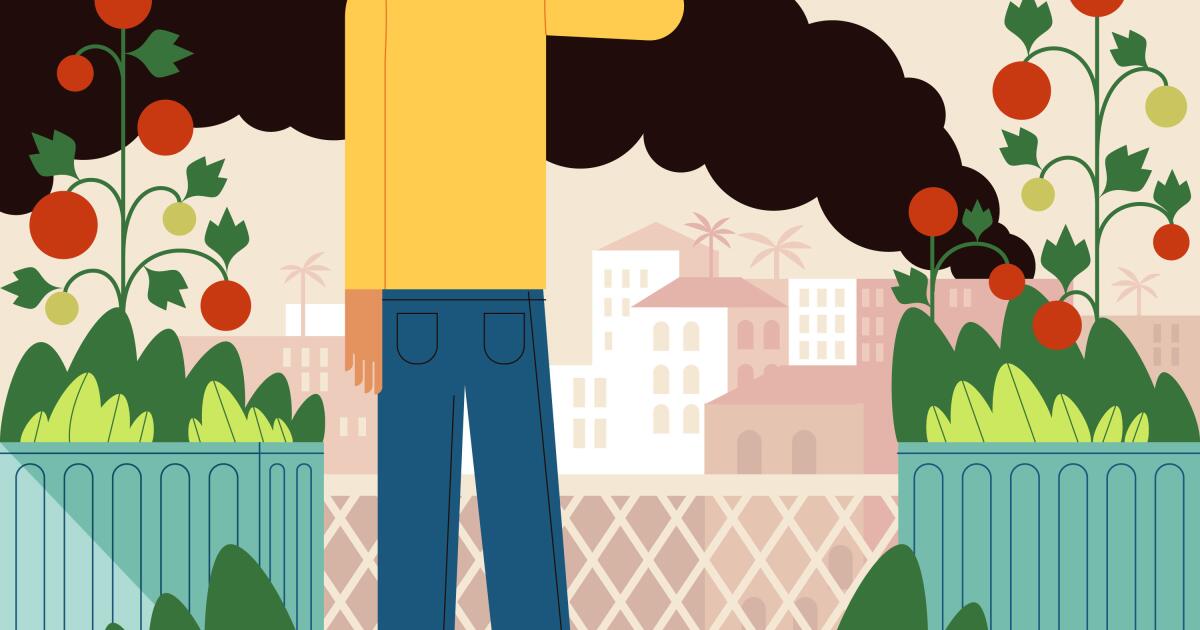
After the eight-day-long fire in a 500,000-square-foot Boyle Heights warehouse, eastern Los Angeles residents are contending with putrid smells, soot and potentially hazardous airborne chemicals after heavy plumes of smoke spread throughout the city. But those who grow food in nearby neighborhoods may also be wondering: How will the fires affect the plants and produce in my garden?
The Boyle Heights warehouse, owned by Lineage — a global temperature-controlled storage facility operator — housed 85 million pounds of frozen food and other products. In the days since the fire, local emergency visits for smoke inhalation and throat pain spiked while agencies still scramble to measure the amount of PM 2.5 — harmful fine particles — and heavy metals, like lead and arsenic, in the air.
According to researchers, any toxic airborne chemicals would likely stem from the charred foam insulation, metal exterior, burned solar panels and any lithium batteries that might have been present inside the warehouse.
After a fire, heavy metal particles can spread through ash and smoke over gardens and inhibit growth, said Olukayode Jegede, an agricultural toxicologist and assistant professor at UC Davis. Since the warehouse fire is so recent and cleanup has just begun, Jegede said the precise impact on gardens can’t be measured until comprehensive soil tests are conducted in the area.
While the L.A. city government hasn’t announced plans for soil testing, the Contaminant Level Evaluation and Analysis for Neighborhoods project at USC is offering free contaminant testing for Boyle Heights and East L.A. residents. Residents can collect soil samples and deliver them to Boyle Heights City Hall and other locations for an evaluation of lead, arsenic, chromium and mercury levels.
The good news is produce, plants and roots can still be preserved. According to Jegede, many of the soil tests conducted last year in the Altadena area after the Eaton fire showed that gardens and poultry were not as contaminated as one might expect.
“Quite a number of the soils we tested [in Altadena] were not really contaminated,” Jegede said. “We weren’t seeing many soils with concerning elevated levels of metal, so gardeners should not be too alarmed when these things happen.”
Nevertheless, there are several measures that gardeners can take to keep themselves, their children, plants and produce safe from potentially harmful contaminants stemming from the fire. Researchers, gardening experts and horticulturists offered some guidance on the handling, recultivation and cleanup that can keep you and your garden in good health.
How do I remove ash and contaminants from my garden?
Altadena horticulturist Leigh Adams said Boyle Heights plants and produce already live in a difficult environment, surrounded by industrial warehouses that spread contaminants daily.
“That area has been used industrially for 100 years, and the soil is impacted by many, many, many things,” Adams said. “Low-income neighborhoods and gardens usually don’t have a lot of resistance against dominant manufacturing.”
This means that the contamination of gardens in eastern L.A. won’t be as catastrophic as compared with those in Altadena, a more suburban environment, Adams said. But fallen ash still poses major health risks if ingested or inhaled.
An advisory from University of California Agricultural and Natural Resources last year recommended suiting up in an N95/KN95 mask, long sleeves, pants, close-toed shoes and gloves before attempting to deal with ash in the garden to limit exposure to potentially toxic contaminants. The advisory added that individuals should make sure all of this gear is cleaned thoroughly before bringing it back inside.
Once in the proper gear, Adams recommends removing the top two inches of topsoil from gardens, where the highest concentration of contaminants will settle after a fire. Using a plastic bag to collect the soil and disposing of it in the garbage — not green yard waste bins — will help to reduce the spread of airborne chemicals.
Gardeners with raised beds are advised to remove approximately six inches of soil, because excess ash can raise the pH level and prevent nutrients from soaking into the soil bed.
After this, watering the garden gently but plentifully will help to promote soil health and get rid of most of the ash present on plant leaves and stems. Adams said replacing the top two inches of soil with store-bought mulch or straw will help to contain any remaining ash and prevent it from spreading any further.
Experts say to avoid using leaf blowers if ash is present in the garden because they can send particles airborne. Doing so will increase the likelihood of heavy metal particles, which can carry lung irritants and carcinogens, being spread and inhaled.
A Boyle Heights resident keep a watchful eye on the fire at the 5,000-square-foot commercial building, which stores 85 million pounds of frozen food.
(Genaro Molina / Los Angeles Times)
Is it safe for me to eat produce from my garden?
Several studies, including one from the UC Cooperative Extension of Sonoma County, have shown that consuming produce in a fire-affected area poses minimal health risks.
Jegede said most root vegetables like potatoes and carrots, along with any fruit that has an outer layer, can be washed to remove potential contaminants, even if they were covered in ash. Peeling the outer layer of your produce can also help to reduce potential risks, he said.
Lettuce and other leafy foods with multiple layers pose a higher risk of contamination, but with a vigorous wash and peeling the outer layers, even the greens can be saved. The County of Los Angeles Department of Public Health recommends soaking leafy produce and fuzzy fruits like peaches in a 10% white vinegar and 90% water mixture.
Jegede said if the leaves or fruit are too delicate to wash or ash is still visible, it would be best to dispose of the produce.
How can I tell if my soil is contaminated?
After ridding your garden of visible ash, you might wonder how to tell if your plants will still thrive in the soil.
At-home soil tests that measure for alkaline, fertility and pH levels are widely available and can be purchased for $15 to $100 (for more detailed results) online. But Jegede said these tests can’t tell the full story of soil health.
Comprehensive soil testing is “something you can’t do properly at home,” Jegede said. “In labs, we are testing for metals like lithium and zinc, stuff that an at-home test will not show … If it comes to the point that you’re worried about your soil, I would just send it out to a lab.”
Wallace Laboratories in El Segundo, Babcock Laboratories in Riverside, Waypoint Analytical in Anaheim and other labs offer more detailed soil tests that measure heavy metal particles in addition to other fertility factors. Prices at Wallace Laboratories can range from $115 to $295 for a complete compost test.
The soil below two inches should be unharmed, Adams said, so long as new compost is set and plants are watered plentifully, which will promote natural biological cycles.
“What you’re doing is capping the soil, so that moisture stays in there, and instead of being dirt, it’s a living system called soil,” Adams said. “The more carbon we can get into our soil, the better.”
What can I do to help my soil recover?
For the last 12 years, Adams has been working with Metabolic Studio, a Los Angeles-based art and research hub focused on environmentalism, on methods for bioremediation, the practice of using additional fungi, plants and compost to decontaminate ash and break down contaminants.
Adams said straw, mushrooms, corn, rye and sunflowers are great bioremediators that can help to repair damage to soils. She said certain samples she’s worked on with Metabolic Studio have gone from testing at high heavy metal levels to nearly contaminant-free.
But for a more immediate fix, wash your produce, water your plants and have a little patience during ash cleanups. Your garden should look better in no time, Adams and Jegede said.

Inde Navarrette and Michael Johnston in Obsession.
Focus Features
hide caption
toggle caption
Focus Features
Two big horror films, Obsession and Backrooms, just smashed all box office expectations. So much of their success has been driven by Gen Z, which is now the biggest moviegoing demographic. But what makes a movie a Gen Z movie? Today we’re bringing you an episode of NPR’s It’s Been a Minute. Host Brittany Luse talks about this trend with Sam Adams and Reanna Cruz.
If you want to hear more about these movies, check out these episodes:
In ‘Obsession,’ love hurts. It really, really, really hurts.
‘Backrooms’ brings YouTube horror to the big screen
Zendaya brings ‘The Drama,’ we bring the spoilers
Connect with Pop Culture Happy Hour:
Letterboxd / Facebook
Our weekly newsletter
Support Pop Culture Happy Hour+
-

 South Dakota34 seconds ago
As travel costs rise, many families find summer adventures closer to home
-

 Tennessee8 minutes ago
In-N-Out’s fifth Tennessee location is opening soon. Here’s how many stores are planned
-

 Texas10 minutes ago
Triple-digit heat returns to North Texas before weekend storms bring relief
-

 Utah16 minutes ago
Planned 60-foot long Liberty Arch in Utah sparks patriotism, but also concerns
-

 Vermont23 minutes ago
Vermont offers money to replace diesel vehicles with electric
-

 Virginia25 minutes ago
Virginia reports 10 cases of cyclosporiasis
-

 Washington31 minutes ago
Washington law says to alert the public when doctors are accused of misconduct. It can take months
-

 Wisconsin38 minutes ago
Former Wisconsin judge to be sentenced after conviction in obstructing arrest of Mexican immigrant

