Lifestyle
When my mom died suddenly, there was only one place to mourn: Disneyland


My mother, Donna, died unexpectedly earlier this month. On a recent Tuesday morning, she got up as normal, and even went to the salon. That evening, she was in the hospital. Thirty-six hours later, she was gone. These have been among the most difficult weeks of my life.
I spent the first half of March at home near Chicago to grieve with my family and will likely be visiting often throughout the year to continue the process. I’ve never liked the past tense — grieved — as that implies a conclusion to something that changes us, alters our course and continues to define us. There is no neat bow for a box that can be comfortably closed and compartmentalized — here lies memories of a loved one.
And yet we survive, hopefully with something learned.
Upon returning to my adopted residence of Los Angeles, I did what I always do when down: I spent time with my cat, listened to records and then visited Disneyland, the so-called happiest place on earth. Pirates of the Caribbean was always my family’s first stop, and when I went on the ride, I tried to recall family trips — of my parents rushing to the attraction and of my brother attempting to take flash-free pictures, letting the calmly swaying boat take me back to an earlier, more uplifting time. But I mostly spent the day attempting to absorb the atmosphere. My mind needed happiness and joy, and environments that aim to comfort.
Like many in America, I grew up with parents who devoted the bulk of their vacation time to Disney’s theme parks. I’ve kept up the tradition — I write about theme parks for a living, but I also go to Disneyland often in my free time. So much so that one time later in life my mother even questioned it, perplexed by my desire to re-pilgrimage the park in times good or bad. Job promotion? Off to Disneyland. A breakup? Disneyland again. The recent devastating fires that struck our region? Disneyland was there for me.
The author at a young age with his mother, Donna, at Walt Disney World’s Epcot in the 1980s.
(The Martens Family)
“I wonder what we did to you that makes you go there so often,” my ma said a few years back on the phone while I sat in the lobby of Disney’s Grand Californian Hotel. I didn’t really answer — I laughed, probably sighed — but in hindsight, I wish I had been a bit more talkative. I would have reminded my mom of what she did, because in Disneyland I saw many of the lessons she attempted to impart.
So today, Ma, I’ll tell you what you did that makes me go to Disneyland so often. You instilled in me a belief in goodness. You inspired in me optimism, that I could and should do whatever I want and I am capable of achieving my goals. And somehow — despite all the worrying, and yes, my mom worried a lot — there was an idea that things would work out in the end, no pixie dust needed. She told me in early March that she hoped she lived long enough to read my first book, believing that goal of mine was an inevitability. That book will be dedicated to her.
My mom inspired in me optimism. Despite all the worrying, there was an idea that things would work out in the end, no pixie dust needed.
— Todd Martens
My mom never tired of my crazy dreams. When I said I wanted to be on “Saturday Night Live,” she drove me to weekly improv classes at Second City. And when I said I maybe wasn’t funny enough to be on “Saturday Night Live,” we switched to acting classes. And when I was tired of making errors in Little League, my mom encouraged me to maybe think about something else. I was scared to. My mom recognized my early tendency to avoid confrontation, and I was afraid my dad would be upset. But my mom sat me down and carefully explained what to say and how to be honest and express what I wanted. My dad, of course, wasn’t upset.
It was in moments such as these that this fairy-tale-loving kid saw my mom’s hopes and imagination. I’ve long believed we don’t go to theme parks to escape the world so much as to help make sense of it, for in Disneyland we see our cultural narratives and stories reflected back to us. An attraction such as Snow White’s Enchanted Wish isn’t simply about a happily ever after; throughout, we see hard work, perseverance and unexpected tragedies. What’s more, its recently refreshed ending centers Snow White’s reliance on community rather than her magical husband, and argues that true love comes only after we’ve put in the time and effort.
Alice in Wonderland takes the unpredictability of life and gives it a Technicolor whirl, assuring us our nightmares are really just dreams. Mr. Toad’s Wild Ride throws us deep into our vices in a statement of our own agency. It’s a Small World, via its whimsy and childlike wonder, makes clear we’re not really all that different, rendering the divisions and hate in the world temporarily meaningless. Pirates of the Caribbean shows the ways in which greed and gluttony turn us into caricatures, while the Haunted Mansion finds frivolity in the afterlife, reminding us to enjoy our time while we’re here.

The author, Todd Martens, left, and his mother, Donna, at a recent wedding in Chicago. Donna died unexpectedly this month.
(The Martens Family)
For at Disneyland, exaggerations are the norm, and if we let ourselves live in these abstracted worlds, we can sense their heightened emotions. And what I admired most about my mom, who worked most of her life as a preschool teacher, was both her ability to feel everything deeply and find new ways to spin what was happening around her. When my friends and I broke a small vase by hitting Wiffle balls inside the house on a rainy day, she didn’t scold. She suggested we switch to hitting a dust rag around the room, instead. Thus, Dust Ball was born.
One thing I’ll never forget is the way in which any global conflict when I was younger would pain her. She had a deep-rooted fear that war would lead to a draft and my older brother would be called into service. As a young child, I wasn’t aware that she had earlier lived through such moments with my father, nor did I fully understand what a draft was. I just saw my mom needed a hug.
As I got older, I saw this moment for what it was. I saw it as a sign of someone who cares, deeply. Someone who feels, immensely. Someone who fantasizes, brilliantly. I saw imagination. I saw concern. And I saw love. I also saw a way to look at life — to dream, to fear, to wonder, to hope, and when someone asks what’s wrong, to tell them and to accept that hug.
And so it was that I found myself at Disneyland just 48 hours after returning to L.A. I partly wanted to see some familiar faces. I also wanted to bask in the eternal power of fairy tales. All of the park has lessons to impart, even Star Wars: Galaxy’s Edge, where tales of good and evil are stand-ins for the haves and the have-nots — the pure rugged and close to nature while the oppressors are obsessed with image and mechanical and technological artifice.
I also just wanted to remind myself of those parental life lessons. Among the items I brought back to L.A. was one of my mom’s adult coloring books, a gift from my father that I placed on my coffee table and will forever cherish. I’ve thumbed through it daily since returning, smiling at her love of art and dedication to the coloring craft, but also to remember that every day I’ll have my mom’s guidance.
And that means to embrace, to worry, to wonder and to daydream. Because that is how we never stop living. And my mom will not stop living with me.

Lifestyle
Terry Tempest Williams on why women with big ideas get labeled ‘crazy’ : Wild Card with Rachel Martin
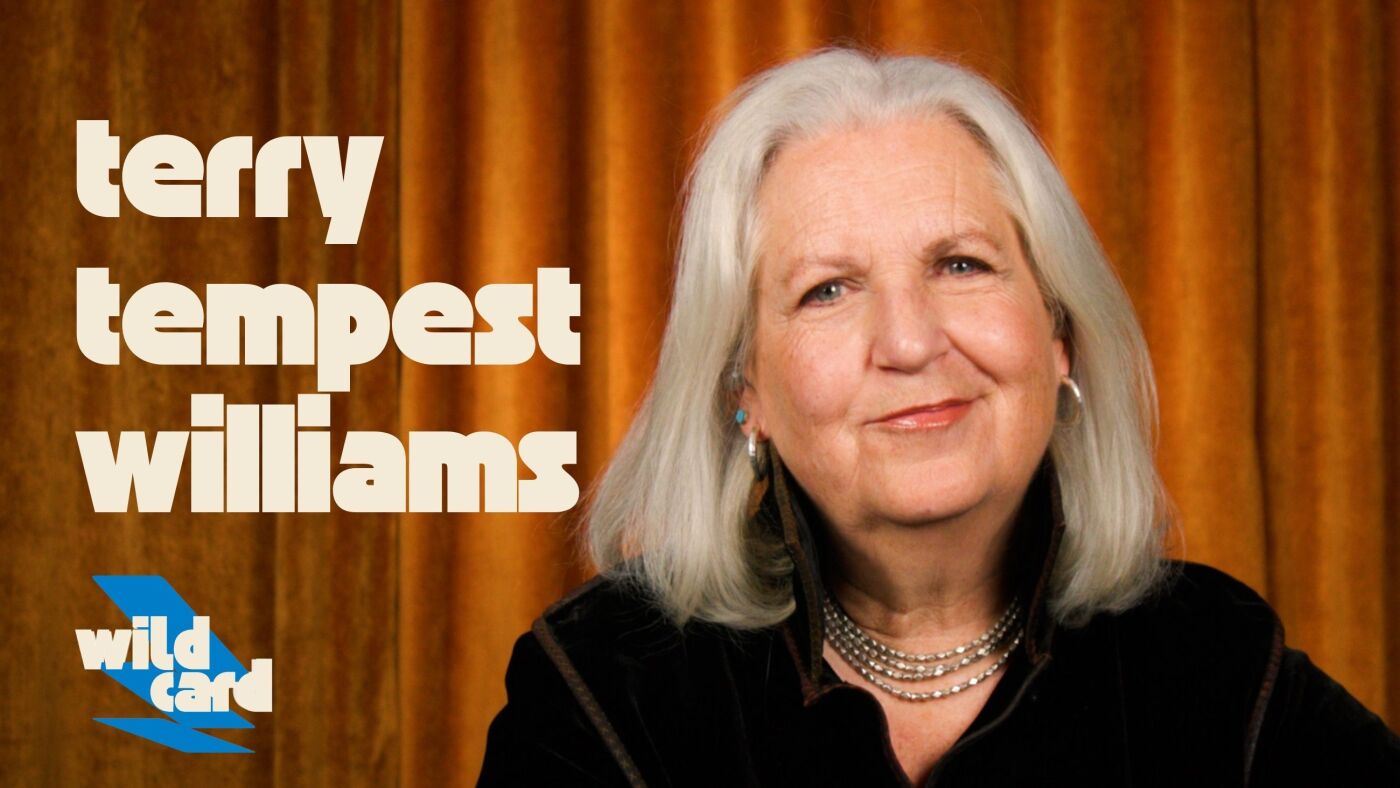
A note from Wild Card host Rachel Martin: I met Terry Tempest Williams about 25 years ago at a writer’s conference in Yosemite Valley. I was a young reporter who was there to do a story about how literature was addressing climate change and she made such a huge impression on me. I had never heard someone talk about the natural world the way Terry did and she had a spiritual depth I hadn’t encountered in my life at that point.
To this day, Terry’s writing always reorients me towards what is good, what is beautiful, and what is true. Her newest book is called “The Glorians.”

For its upcoming Los Angeles venue, experiential art firm Meow Wolf will focus on the art of storytelling, with a specific eye toward skewering our city’s moviemaking magic. To help bring that vision to life, Meow Wolf has entered into a creative partnership with Titmouse, one of L.A.’s most renowned independent animation houses.
The Hollywood-based studio behind popular series such as “Big Mouth” and “Star Trek: Lower Decks” will create animation that will be shown throughout the West L.A. venue, which is on target for a late 2026 opening at the Howard Hughes entertainment complex.
It’s a move that represents a shift for Santa Fe, N.M.-based Meow Wolf. Over the last decade-plus, the art collective has grown beyond its anything-goes, punk-meets-psychedelic roots into an organization with full-scale, maximalist installations in its hometown, Denver, Las Vegas, Houston and the Dallas suburbs. In the past, Meow Wolf kept most of its media in-house.
As part of its larger-than-life participatory art installations, Meow Wolf L.A. will feature a mix of live action and animation, the former filmed by Meow Wolf in its Santa Fe studio. Meow Wolf’s James Stephenson, a senior VP with the company and its creative director of emerging media, said the degree to which the L.A. exhibition will lean into various animation styles necessitated an outside partner. Titmouse’s work, in development by a number of directors with contrasting tones, will be shown on a variety of formats, ranging from cinema screens to full-room projections.
“I really believe in animation as an art form, and I know the Titmouse folks do too,” Stephenson says. “Animation is made by artists. It’s made by artists with their own hands. It’s something that is still very rooted in craft.”
Meow Wolf’s L.A. space is set in a former cinema complex, and will champion its location, taking guests on a journey through a converted movie house and beyond, into a sci-fi-inspired fantasyland with sentient spaceships and a 30-foot-tall mushroom tower. Meow Wolf creatives have spoken of the fantastical movie theater as one that will feature animated, self-aware candy before attendees enter the main exhibition space, making Titmouse’s work some of the first art guests will encounter. Titmouse co-founder Chris Prynoski has said the studio has lined up at least six directors for the exhibit.
An in-progress art installation destined for Meow Wolf L.A. at the art collective’s Santa Fe, N.M., headquarters. The L.A. exhibition will feature animation from Titmouse.
(Gabriela Campos / For The Times)
Titmouse, says Stephenson, is the right partner because “they’re known less for a house style, and more for a house vibe.” Over the years, Titmouse has been behind such diverse shows as “Scavengers Reign,” owning a Jean Giraud influence rooted in French and Spanish surrealism, the lively “Jentry Chau vs. the Underworld,” with an unique color palette that took inspiration from anime and Chinese mythology, the exaggerated comic book feel of Adult Swim’s “Metalocalypse,” and the approachable yet expressive tone of “Star Trek: Lower Decks.”
“Meow Wolf’s vibe is similar to Titmouse’s vibe,” Stephenson says. “It’s artist-first, artist-driven, independent and kinda edgy. They are always trying to find the edge of what’s possible. They try to see how far they can go, and it’s done for fun and in the spirit of taking risks.”
Prynoski says working with Meow Wolf will give Titmouse a sense of artistic freedom it doesn’t always have when delivering content for more traditional Hollywood partners. He says the multi-director approach is a callback to the early days of Warner Bros. Animation, when individual creators put their own stamp on Looney Tunes material.
“I use Bugs Bunny as an example,” Prynoski says. “You’ve got a Friz Freleng Bugs Bunny short. You’ve got a Chuck Jones Bugs Bunny short. You’ve got a Tex Avery Bugs Bunny short. They’re all different versions of Bugs Bunny, and people who are really paying attention can tell which director directed each one. Even though to the layman, these are all Bugs Bunny, but if you lined them up, they are drawing in different styles, sensibilities and techniques.”
Prynoski says that was a centerpiece of his pitch to Meow Wolf, noting that characters will reappear in multiple installations, each handled by a different artist. Meow Wolf L.A., in fact, will be the firm’s most character-driven exhibition, as guests will follow the storylines of three main protagonists throughout the space.
In announcing the partnership, Meow Wolf and Titmouse released an image from an animated work directed by Luca Vitale. It features a key character having a moment with a hummingbird and it’s done in an elegant, slightly anime-influenced style. It’s an image full of movement, reflecting a character in transition with inviting pastels and bold dashes.
“I like that image because I think it captures some of the sense of wonder that we want people to feel,” Stephenson says. “The character is having an encounter with the elusive nature of creativity and reality in a way that makes them have a different perspective of what’s possible.”
Other contributing animation directors to Meow Wolf L.A. include Space Dawg, Felix Colgrave, Alexander Vanderplank and Phimémon Martin, and Jun Ioneda.
Titmouse’s partnership with Meow Wolf will extend beyond the L.A. exhibition. The two will be working on the development of Meow Wolf New York, which is slated to open some time after Los Angeles, and are collaborating on a planned animated series, which Prynoski is spearheading.
Meow Wolf exhibits are the result of sometimes hundreds of disparate artists coming together in a shared space. Distilling that into a signature, singular style for a series could be a challenge. Stephenson pinpoints some guiding principles.
“You really need to feel the hand of the artist,” he says. “You need to feel a DIY aesthetic. You need to feel the materiality. Those are very specific to what we are.”

The Kennedy Center on June 28, with its facade signage still covered by a tarp and scaffolding.
Alex Wroblewski/AFP via Getty Images
hide caption
toggle caption
Alex Wroblewski/AFP via Getty Images
On Wednesday, a federal appeals court denied President Trump’s request to stop the removal of his name from Washington, D.C.’s Kennedy Center. The signage on the building has been covered with tarp and scaffolding since June 13, but in a court filing last month, the center’s current executive director said that Trump’s name has been removed.
In their decision, three judges from the U.S. District Court of Appeals for the District of Columbia Circuit said that the president had failed to prove that the arts center would be “irreparably injured” without Trump’s name attached to it.
NPR requested comment from the Kennedy Center, but did not receive an immediate reply.
This latest round of court decisions is part of the ongoing litigation filed by Rep. Joyce Beatty, D-Ohio, against President Trump and the board of the Kennedy Center. In a statement emailed Wednesday to NPR, Beatty said: “Today’s ruling again affirms that this administration’s efforts to rename the Kennedy Center were unlawful. His name no longer desecrates this sacred memorial, which belongs to the American people. Now it is time for the Trump administration to accept this, comply with the law, and take the tarps down.”
In previous court filings, Trump’s legal team had asserted that removing the president’s name from the arts complex, both on the physical building and in its digital materials, would inflict irreparable harm in both time and money already spent. In the denial, the three judges — Patricia Millett, Robert Wilkins and Gregory Katsas — wrote that since Trump’s name has already been removed, “a stay would not avert those harms.”
Furthermore, Trump had claimed that without his name attached, future fundraising would be threatened “and [will] contribute to the financial decline of the Center.” In response, the appeals judges wrote: “Appellants, however, have failed to support this assertion with any specific facts or evidence. They offer only the conclusory assertions of the Kennedy Center’s Executive Director that were made in a factually unsupported declaration.” The center’s current executive director, Matt Floca, specializes in physical plant management.
The presiding judge in the case, Christopher R. Cooper, has ordered that the center provide him a status report on the center’s operation and programming before the end of this month. As of Wednesday, the center’s calendar lists a small roster of programs, including outdoor free movie screenings, workshops for children, and five free live performances in July on its Millennium Stage. In the past, the Kennedy Center presented over 2,000 arts and education events each year, including free daily Millennium Stage performances.
-

 Louisiana5 minutes ago
Parasitic stomach illness that can cause explosive diarrhea rises in Louisiana
-

 Maine12 minutes ago
Is prison in play for Graham Platner?
-

 Maryland15 minutes ago
Office building in Glen Burnie evacuated after shift in parking garage floor
-

 Michigan19 minutes ago
Menominee, Michigan man arrested on sexual assault charges involving a minor
-

 Massachusetts27 minutes ago
Healey administration vows to appeal as Trump rejects Massachusetts blizzard aid request – The Boston Globe
-

 Minnesota29 minutes ago
Minnesota Looks to Add 1,100 Child Care Slots, With Melrose Among the 11 Funded Communities
-

 Mississippi35 minutes ago
Death of Mississippi teen Nolan Wells under investigation
-

 Missouri42 minutes ago
Missouri realtors hold statewide rally to vote no on Amendments 4 & 5

