Lifestyle
What's the best Pixar movie? Here's what our listeners said


We asked our listeners: What’s your favorite Pixar movie? Clockwise from left: Coco, Inside Out, Toy Story 3, WALL-E, Ratatouille and Finding Nemo
Pixar; Disney/Pixar; Alamy
hide caption
toggle caption
Pixar; Disney/Pixar; Alamy
In the 30 years since the release of Toy Story, Pixar has established a track record of producing critic- and audience-beloved stories. But let’s be real: There are distinct hierarchies within this catalog, and many people have very strong opinions about where each of these movies might fall, especially when it comes to the sequels. So we recently asked our Pop Culture Happy Hour listeners to help answer a (perhaps) impossible question: What is the best Pixar movie?
Each participant could vote for no more than three films. Evil, we know; just call us Emperor Zurg.
Below you’ll find their top 10 picks, based on more than 2,500 votes. A couple quick notes/caveats: Voting took place before Pixar’s latest feature Elio was released, so it didn’t factor into this ranking, though you can hear our thoughts in the podcast episode about that film here. And of the 28 features that were in the running, all but one sad, strange little film — 2022’s Lightyear — received at least one vote. It has our pity.
To infinity, and beyond!
10. Toy Story 3 (2010)
YouTube
Many fans claim this as the best of the franchise, so its place in the top 10 is almost a given. That final act is an emotional doozy, with our dear gang forced to reckon with their own mortality in the face of a trash-heap incinerator. (Or should I say, toytality? I’ll … see myself out.) And then, of course, there’s the lovely farewell to Andy, the boy who’s been the center of their worlds, especially Woody’s, for oh so long, but is now venturing off to college. It’s a fitting, beautiful conclusion to the series that started it all — or at least it should’ve been, if only Pixar weren’t so keen on tapping this well until it’s damn near arid. (Toy Story 5 is slated for 2026. *sigh*) —Aisha
9. Monsters, Inc. (2001)
YouTube
Is it blasphemous to say I think this should be ranked higher? Well, so be it. Put this thing up higher where it belongs or so help me! This remains one of Pixar’s most richly conceived premises to date, and it all comes together to create a vivid world full of memorable characters (Mike Wazowski!), clever sight gags and an ending that could have been cloying but instead will melt even the iciest of hearts. The way Sully’s face lights up when he returns to Boo’s bedroom closet door and she lets out an adorably ecstatic “Kitty!” is the stuff that dreams are made of. —Aisha
8. Ratatouille (2007)
YouTube
On paper, this should not work: A Parisian rat with a sophisticated palate helps a restaurant garbage boy rise through the kitchen’s ranks to become a renowned chef. But that outlandish premise makes the film’s creative feats even more impressive. Remy the rat is cute and endearing! You can’t help but set aside those gag reflexes and root for the little guy. And while this is one of many films that leans a little too heavily on the strongly unflattering depiction of a critic, even I can’t help but be moved by the moment ruthless restaurant connoisseur Anton Ego experiences the pure, nostalgia-fueled ecstasy of that ratatouille meal, as prepared by an epicurean rodent. —Aisha
7. The Incredibles (2004)
YouTube
We’re in the midst of a huge wave of live-action remakes of animated classics. And if those remakes have taught us one thing, it’s that animation can allow storytellers to work with remarkable efficiency: Just compare the runtimes of, say, the two versions of Lilo & Stitch or the two versions of How to Train Your Dragon. That might provide one sense of what makes The Incredibles one of the best superhero movies ever made: It’s not larded with confusing lore, clunky visual effects or overlong battle scenes, leaving writer-director Brad Bird to fill the screen with light-on-its-feet action, wild humor (“NO CAPES!”) and thoughtful commentary on how superheroes might struggle to balance heroism and supernatural abilities with the mundane realities of aging, assimilation and family life. —Stephen
5 (tie). Toy Story (1995)
YouTube
Toy Story gets — and deserves — plenty of credit for proof of concept: It’s the massive success that launched Pixar as a global phenomenon, demonstrated the power and possibility of computer animation, introduced iconic characters such as Woody and Buzz Lightyear, and set the stage for some of the best sequels in history. But it’s not just a template-setter; it’s also a dynamite standalone film, with warm and iconic performances (from Tom Hanks, Tim Allen, et. al) and a sweet story in which toys learn their true purpose. Those sequels hit so hard, and address such powerful themes, in part because they’re built atop some of the most powerful bedrock imaginable. —Stephen
5 (tie). Coco (2017)
YouTube
Two words: “Remember me.” And more: All of Pixar’s films have been about the strengths and cracks in family bonds in some way or another, but Coco‘s take is arguably the studio’s most complex and profound exploration of the subject. It sweetly and thoughtfully melds Mexican tradition with a plot that questions the stories we tell ourselves and pass on across generations. Visually, it’s a stunner, especially the rendering of the colorful, electrifying Land of the Dead. And of course there’s the music, and Miguel’s beautiful moment with Mama Coco near the film’s end, which rivals the opening scene in Up and the departure of Bing Bong in Inside Out as the ultimate Pixar tearjerker. —Aisha
4. Up (2009)
YouTube
After an old-timey newsreel feeds us a few big gulps of exposition, Up delivers the greatest eight-and-a-half minutes in Pixar’s history: the telling of two intertwined life stories that play out as funny, kind-hearted, empathetic, occasionally wrenching montage. In a frequently wordless scene that establishes Ellie and Carl’s different but wonderfully matched personalities, director Pete Docter oversees a master class in character development, movie scoring (by Michael Giacchino, who rightly won an Oscar), stakes-setting and seed-planting. As wild and swashbuckling as Up gets, it’s the callbacks and the memories of Ellie — all established in those eight-and-a-half minutes — that give the movie its resonance. And leave it to Pixar to create a sweet comic-relief dog (oh, Dug…) and then actually write him some of the funniest, most quotable jokes around. —Stephen
3. Finding Nemo (2003)
YouTube
A staple of movie theaters, DVD players and TV showrooms, Finding Nemo checked every box upon its release in 2003: With its shimmering, deep-blue color palette, it’s stunning to look at. It’s packed with jokes, action, perils and funny side characters. It’s exquisitely acted, particularly by leads Albert Brooks (as Marlon) and Ellen DeGeneres (as Dory, who got her own sequel 13 years later), as Finding Nemo weaves between underwater adventure and anxious meditations on grief, parenthood, responsibility, risk, found family and loss. More than two decades later, it hasn’t aged a day. —Stephen
2. WALL-E (2008)
YouTube
This was inevitable. It’s made many “best of” and “greatest” lists, including the 2012 Sight & Sound poll from the British Film Institute. Heck, it even became the first Pixar feature to enter into the Criterion Collection. But I’m sorry, folks: That opening sequence, stunner though it is, is doing an astronomical amount of heavy lifting here. The drop-off in quality for the rest of the film is jarring and, frankly, more than a little frustrating. Wall-E’s adorable, though. —Aisha
1. Inside Out (2015)
YouTube
On one hand, the stakes in Inside Out seem relatively modest: Will an 11-year-old girl named Riley make a bad decision in the wake of her family’s cross-country move? But its real story is about nothing less than the life of the mind — and the many factors and emotions that compel us to not only act the way we act, but feel the way we feel. Amy Poehler leads a brilliant cast as Joy, The Office‘s Phyllis Smith is a revelation as Sadness, Richard Kind gives quite possibly his Richard Kindiest performance as (sniffle) Bing Bong… everyone here is grand. But what really endures about Inside Out is the clarity it’s offered to a generation of kids — and their parents — about their own brains, and about the jobs our many emotions are there to do. —Stephen









Jane Austen ready to party for her 250th birthday at the Jane Austen Society of North America’s Annual General Meeting in Baltimore.
Melissa Gray/NPR
hide caption
toggle caption
Melissa Gray/NPR
In her six completed novels, Jane Austen excelled at love stories: Elinor and Edward, Lizzie and Darcy, Fanny and Edmund, Emma and Knightley, Anne and Wentworth, heck even Catherine and Tilney. As her fans celebrate the 250th anniversary of her birth, they’d like you to know it’s a mistake to simply dismiss her work as light, frothy romances. It’s full of intricate plots, class satire and biting wit, along with all the timeless drama of human foibles, frailties and resolve.

Tessa Harings (left) learns English country dance at the Jane Austen Society of North America’s 2025 Annual General Meeting
Melissa Gray/NPR
hide caption
toggle caption
Melissa Gray/NPR
“The basic reason why Austen is still popular today is because all of her characters are people we know in the world,” says Tessa Harings. She’s a high school teacher from Phoenix and one of the more than 900 attendees at the Jane Austen Society of North America’s Annual General Meeting, held in Baltimore this year. “We all know of someone who’s shy and aloof and needs to be brought into the crowd. We all know someone who’s quite witty, naturally. We all know someone who is a bit silly and always looking for attention.”

Colin Firth, properly memed from the 1995 BBC miniseries. His Darcy is a big favorite with the JASNA crowd.
hide caption
toggle caption
Shy and aloof? That could be Darcy. Naturally witty? Lizzie Bennet. Silly and looking for attention? Take your pick: baby sister Lydia or maybe the haughty Caroline Bingley or the unctuous Mr. Collins, all creations from what might be Austen’s most popular novel, Pride and Prejudice.
Her characters have permeated modern pop culture, even among people who’ve never opened her books. Harings says that’s one reason her students want to read these Regency-era novels. They want to understand the jokes in all those short videos and memes, like Mr. Collins making awkward dinner conversation.

He wants a wife, he compliments the potatoes. In Mr. Collin’s head, it makes sense.
hide caption
toggle caption
Her students enjoy the tension between Darcy and Lizzie: he’s very rich, so besotted by her against his will that he can hardly dance, glower and talk at the same time. Lizzie initially cannot stand him and refuses his first proposal, as shown in this soggy scene from the 2005 movie adaptation.
YouTube
Harings says Lizzie is her favorite Austen character. “She has such sharp, sarcastic wit and she’s so self-confident, despite the fact that she’s constantly being put down by the people around her for her supposedly lower position in life as the slightly less pretty of the mother’s two oldest daughters.”
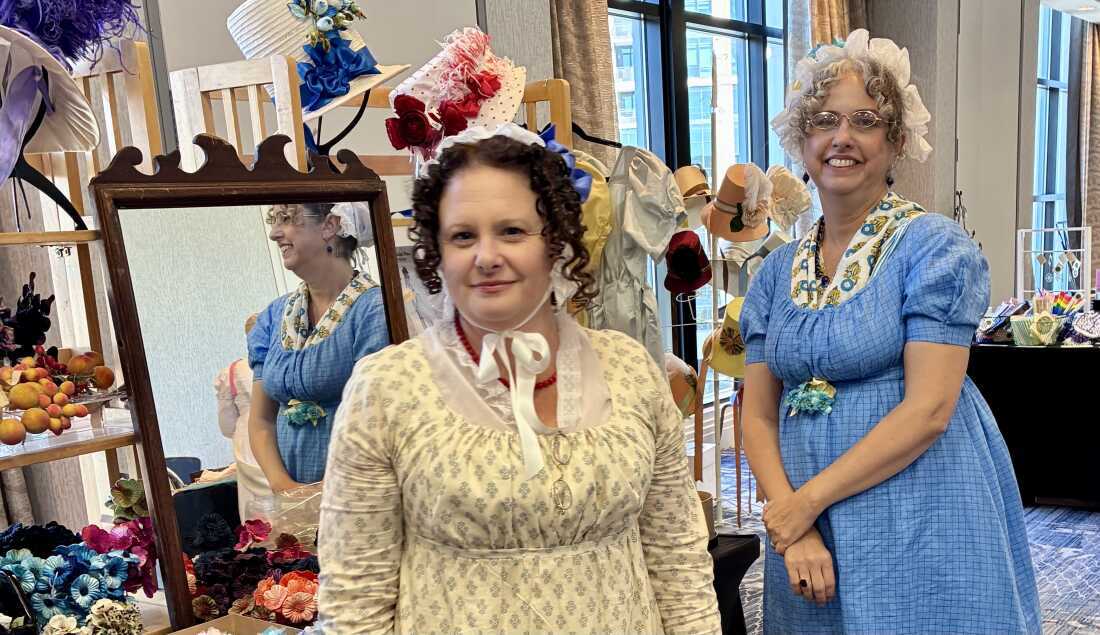
Milliner Dannielle Perry (right) and her assistant Mia Berg of Timely Tresses in their Regency-era togs.
Melissa Gray/NPR
hide caption
toggle caption
Melissa Gray/NPR
“When I was a teenager, I loved Lizzie and I wanted to be Lizzie,” says milliner Dannielle Perry of Oxford, N.C. She’s read and reread all of Jane Austen’s books and she loves how they change for her as she’s gotten older. She’s now more sympathetic toward Mrs. Bennet, Lizzie’s mom: a woman desperate to get her five daughters married, least they be penniless since they can’t inherit their father’s estate. “I feel sorry for her in a way I never did before,” Perry says. “She is sort of silly, but she’s lived with a man for 20 years who largely dismisses her and thinks she’s frivolous.”
Doctoral student Katie Yu, of Dallas, has this analysis of Mrs. Bennett and her husband, who seems mentally checked-out at best: “He’s not a great father. He’s always putting his wife down in front of his daughters, he’s putting his daughters down in front of his daughters.” Yu says Mr. Bennet married Mrs. Bennet because she was pretty, treats her as an inferior, and often ignores her. This is why Mrs. Bennet goes on about her nerves and “has the vapors” whenever she’s stressed: she’s trying to get his attention.
“But,” says Tessa Harings, “she still has a level of street smarts that she has to get her daughters married. And yes, she’s sincerely concerned about their future … she actually, of the two of them, is the more concerned and involved parent.”
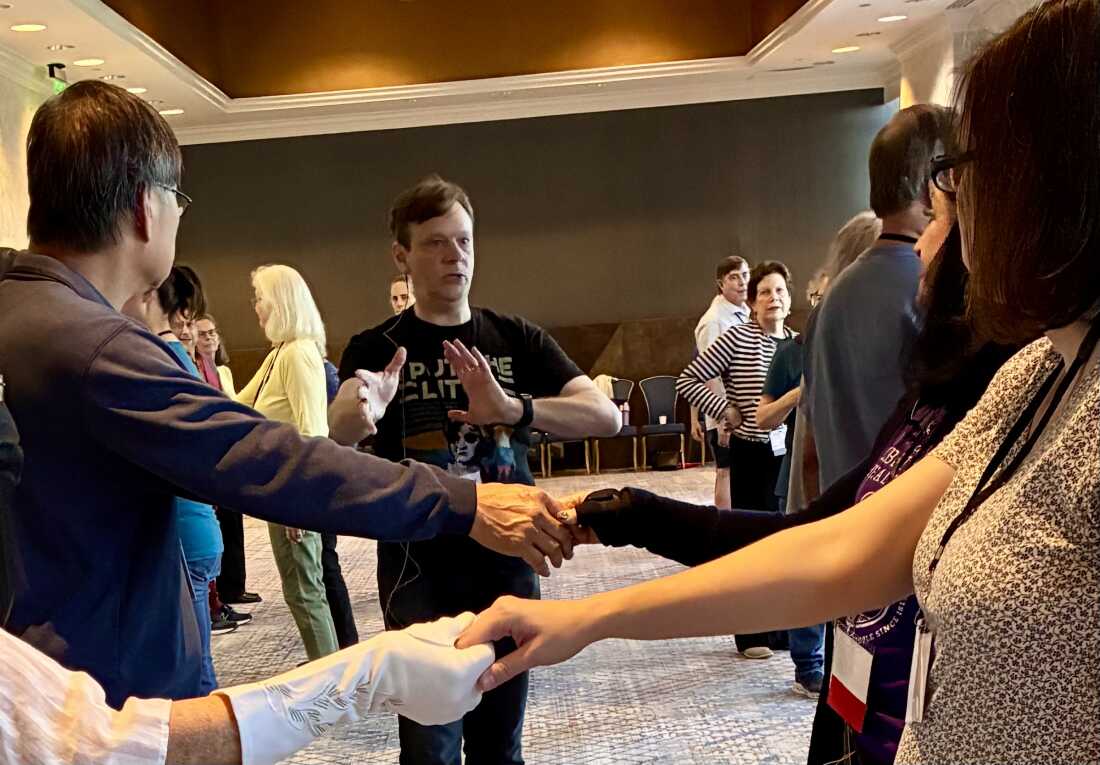
Tom Tumbusch explains 19th century dance moves to JASNA members.
Melissa Gray/NPR
hide caption
toggle caption
Melissa Gray/NPR
Dance instructor Tom Tumbusch, of Cincinnati, says men can learn a lot from Austen. “Modern men struggle to find good role models,” he says. “Reading Austen’s works can help them see the places where men can go wrong.” Mr. Bennet, for example. Or the libertine George Wickham who lies and runs off with the flighty Bennet sister, Lydia. Or maybe Willoughby from Sense and Sensibility, who leads Marianne Dashwood on, ghosts her and is later revealed to have abandoned an unmarried woman who gave birth to his child.
Oh, Marianne, he’s so not worth it!
On the other hand, Tumbusch says Jane Austen’s heroes can show men “how to be masculine in a constructive way,” like owning mistakes, taking responsibility and treating women with respect. It’s not just Darcy, who works behind the scenes getting Wickham to marry Lydia, it’s also Captain Wentworth from Persuasion. Tombusch says Wentworth does what men of his station should: he uses his own resources to help someone less fortunate, the poor, partially disabled widow Mrs. Smith. And in Sense and Sensibility, there’s the steadfast Col. Brandon. Hoping to make Willoughby’s rejection of Marianne less devastating to her, he exposes the libertine’s behavior. He rides hours to retrieve her mother when Marianne is near death. He patiently, oh-so-patiently, waits for her young, broken heart to mend.
All this while wearing a flannel waistcoat because he’s on the “wrong side of five and thirty” and needs to keep those ancient bones warm.

Before he rocked worlds as Snape, Alan Rickman made the earth move for viewers of the 1995 movie adaptation of Sense and Sensibility.
hide caption
toggle caption
JASNA president Mary Mintz, of McLean, Va., says though Jane Austen is largely known for her marriage plots, it’s really the human need for connection that grounds her stories. “She writes about the relationships between parents and children, between siblings or among siblings, she writes about relationships with friends. And she is really insightful. When you combine that with her knowledge of human psychology, it’s a great formula for success.”

Mintz is fascinated by Emma’s pivotal character, Miss Bates. She’s a spinster and member of the gentry class who lives with her elderly mother on an extremely limited income. She’s also a nervous chatterbox, “someone who can’t stop talking,” says Mintz. “I’ve known a lot of Misses Bates in my lifetime… people who seem insecure and feel as though they have to fill up silence, but are really good-hearted people.”
When Emma is rude to Miss Bates, she’s firmly chastised by her neighbor, Mr. Knightley. It becomes a turn-around moment in the story. Humbled, Emma apologizes. She also sees how she’s been wrong to meddle in the love life of Harriet Smith, a pretty teenager whose parents are unknown.
Mintz says there’s an interesting link between Bates and Harriet, if you put two and two together.
“In Jane Austen’s actual life, mothers and daughters often share the same name,” she explains. That pattern can be seen in many of her novels. “We don’t know who Harriet Smith’s natural mother is, but at one point Miss Bates is referred to as ‘Hetty,’ which could be a diminutive for ‘Harriet.’ “
That’s the first clue. The second clue occurs during that scene where Knightley sets Emma right. He says of Miss Bates, “she has sunk from the comforts she was born to.” He then draws a contrast between the spinster’s current station and her former one: “You, whom she had known from an infant, whom she had seen grow up from a period when her notice was an honour…”
YouTube
Emma’s father is quite wealthy, so why would Miss Bates’ notice have once been so esteemed? Mary Mintz asks, “Is because she had a child out of wedlock?”
And could that child be… Harriet Smith?
The mind: it boggles! A Jane Austen Easter egg! It’s just one example of how multi-dimensional her novels are and why so many people will continue loving, analyzing and discussing her work well into the next 250 years.

Jacob Fenston and Danny Hensel edited and produced this report.

Rob Reiner And Wife Michele
Throats Slit By Family Member
Published
|
Updated
Rob Reiner and his wife Michele had their throats slit by a family member, possibly after an argument inside their Los Angeles home, leading to their tragic deaths … TMZ has learned
It’s unclear what exactly triggered the violence, which went down Sunday afternoon in Brentwood … but we’re told one of Rob’s daughters found her parents dead and told police a family member had killed them. PEOPLE reports the couple’s son, Nick, is being questioned in connection with the murders.
Our sources also say the daughter told police the family member “should be a suspect” because they’re “dangerous.”
TMZ broke the story … Rob and Michele suffered lacerations consistent with knife wounds and LAPD’s Robbery Homicide Division is investigating the case.
broadcastify.com
Dispatch audio captures a firefighter calling for backup to the Brentwood mansion around 3:30 PM … though it doesn’t provide any further information about the circumstances in the abode.
Rob was 78. Michele was 68.

Sunday Puzzle
NPR
hide caption
toggle caption
NPR
On-air challenge
I’m going to read you some sentences. Each sentence conceals the name of a major U.S. city in consecutive letters. As a hint, the answer’s state also appears in the sentence. Every answer has at least six letters. (Ex. The Kentucky bodybuilders will be flexing tonight. –> LEXINGTON)
1. Space enthusiasts in Oregon support landing on Mars.
2. Contact your insurance branch or agent in Alaska.
3. The Ohio company has a sale from today to next Sunday.
4. The Colorado trial ended in a sudden verdict.
5. Fans voted the Virginia tennis matches a peak experience.
6. I bought a shamrock for decorating my house in Illinois.
7. All the Connecticut things they knew have now changed.
8. Can you help a software developer in Texas?
Last week’s challenge
Last week’s challenge came from Mike Reiss, who’s a showrunner, writer, and producer for “The Simpsons.” Think of a famous living singer. The last two letters of his first name and the first two letters of his last name spell a bird. Change the first letter of the singer’s first name. Then the first three letters of that first name and the last five letters of his last name together spell another bird. What singer is this?
Challenge answer
Placido Domingo
Winner
Brock Hammill of Corvallis, Montana.
This week’s challenge
This week’s challenge comes from Robert Flood, of Allen, Texas. Name a famous female singer of the past (five letters in the first name, seven letters in the last name). Remove the last letter of her first name and you can rearrange all the remaining letters to name the capital of a country (six letters) and a food product that its nation is famous for (five letters).
If you know the answer to the challenge, submit it below by Thursday, December 18 at 3 p.m. ET. Listeners whose answers are selected win a chance to play the on-air puzzle.

Australia announces strict new gun laws. Here’s how it can act so swiftly

Hollywood star endorses Republican for California governor after ‘devastating’ Newsom admin

FBI hunts Michigan woman accused of stealing nearly $30M while posing as aircraft heiress

US Border Patrol agent kills suspected cartel smuggler after ‘struggle’ near Texas riverbank

Florida mom says teens ‘lured’ 14-year-old daughter into woods before shooting, setting her on fire: report

Florida High School Football Rankings: Top 25 teams – Oct. 21

Cleary's 21 help Le Moyne down Central Connecticut State 69-64 in OT

How old is Bo Nix? What to know about Oregon quarterback ahead of 2024 NFL Draft

99th annual Pony Swim held in Virginia

Video: ‘It Didn’t Have to Happen This Way:’ U.Va. Faculty Call for Review of Police Response to Protests
Australia announces strict new gun laws. Here’s how it can act so swiftly

Video: Rob Reiner and His Wife Are Found Dead in Their Los Angeles Home

Biden officials go silent when asked about Afghan refugee program after guardsmen shooting

South Korea indicts ex-leader Yoon over power plot provoking North

BBC Verify: Videos show impact of mass drone attacks launched by Ukraine and Russia
-

 Alaska1 week ago
Howling Mat-Su winds leave thousands without power
-

 Texas1 week ago
Texas Tech football vs BYU live updates, start time, TV channel for Big 12 title
-

 Washington6 days ago
LIVE UPDATES: Mudslide, road closures across Western Washington
-

 Iowa1 week ago
Matt Campbell reportedly bringing longtime Iowa State staffer to Penn State as 1st hire
-

 Iowa2 days ago
How much snow did Iowa get? See Iowa’s latest snowfall totals
-

 Miami, FL1 week ago
Urban Meyer, Brady Quinn get in heated exchange during Alabama, Notre Dame, Miami CFP discussion
-

 Cleveland, OH1 week ago
Man shot, killed at downtown Cleveland nightclub: EMS
-
World1 week ago
Chiefs’ offensive line woes deepen as Wanya Morris exits with knee injury against Texans

