Lifestyle
What to know about the gender controversy sweeping Olympic boxing


Taiwan’s Lin Yu-ting, left, and Algeria’s Imane Khelif have competed in boxing competitions as women for years. But their presence in Paris is being scrutinized by some after they failed a vague gender eligibility test last year.
John Locher/AP and Aijaz Rahi/AP
hide caption
toggle caption
John Locher/AP and Aijaz Rahi/AP
NPR is in Paris for the 2024 Summer Olympics. For more of our coverage from the Games, head to our latest updates.
Women’s boxing is at the center of the latest Olympics controversy as critics take issue with the participation of two athletes — Imane Khelif of Algeria and Lin Yu-ting of Taiwan — who have failed gender eligibility tests in the past.
Both Khelif and Lin identify and have long competed as women, but were disqualified from the 2023 women’s world championships by the International Boxing Association (IBA) for what it called failure to meet “eligibility rules.”
Olympic organizers are defending their right to compete in Paris and questioning the validity of those unspecified tests and the fairness of their previous disqualification, which they said happened without due process.
“The current aggression against these two athletes is based entirely on this arbitrary decision, which was taken without any proper procedure — especially considering that these athletes had been competing in top-level competition for many years,” the International Olympic Committee said in a statement Thursday.

The conservative outcry started after Khelif won her match against Angela Carini of Italy on Thursday in somewhat dramatic fashion.
Carini quit just 46 seconds into the bout after Khelif’s punches dislodged her chinstrap and bloodied her shorts. After deciding to withdraw, she fell to her knees sobbing in the ring and refused to shake hands with Khelif.
“I have never been hit so hard in my life,” Carini tearfully told reporters afterward.
She said she had stopped fighting because of nose pain, but also said it wasn’t her place to pass judgment on whether Khelif should compete.

“If an athlete is this way, and in that sense it’s not right or it is right, it’s not up to me to decide,” Carini added.
Khelif didn’t speak to the media other than a quick comment to BBC Sport: “I’m here for the gold — I fight everybody.”
She is set to return to the ring Saturday for a quarterfinal matchup against Hungary’s Anna Luca Hamori.
Hamori has accepted the fight, saying she is “not scared” of Khelif. But the Hungarian Boxing Association is striking a different tone: The Associated Press reported on Friday that the organization is sending “letters of protest” about the matchup to the IOC and Hungary’s own Olympic committee.
On Friday, Lin emerged victorious in her preliminary-round fight against Uzbekistan’s Sitora Turdibekova, winning 5-0 by unanimous decision but without much fanfare in the crowd.
She is headed to the quarterfinals on Sunday, one victory away from her first Olympic medal.
Who is Lin?
Lin, 28, a two-time world champion, has been competing for over a decade.
According to her Olympic bio, Lin joined an athletics team as a child “to achieve good results in athletics and win awards to help out financially.” She switched to boxing in middle school.
She made her Olympic debut at the Tokyo Games, though left without a medal.
Still, the southpaw has won many other titles — including bronze in featherweight at the 2019 Women’s World Boxing Championships, gold at bantamweight in 2018 and gold in featherweight in 2022.
She also won a bronze medal at the 2023 world championships, but lost it after she was disqualified. It went to the opponent she had defeated in the quarterfinals, Bulgaria’s Svetlana Kamenova Staneva.
Who is Khelif?
Khelif, at 25 years old and 5’10”, has been competing since 2018. She entered Paris with a 9-5 professional record, according to the New York Times.
She made her first Olympic appearance at the Tokyo Games in 2021, where she lost in the quarterfinal round to Ireland’s Kellie Harrington (and didn’t face any false allegations about her gender at the time, as many of her defenders are now noting).
Khelif won the African and Mediterranean Championships in 2022 and reached the final of the IBA Women’s World Championships that same year. She took home silver, after a defeat by another Irish boxer, Katie Broadhurst.
Khelif also reached the finals of the 2023 world championships in New Delhi but was disqualified by organizers the day before they began in March.
Why were the athletes disqualified last year?
The IBA said in a statement at the time that Khelif and Lin had “failed to meet eligibility rules, following a test conducted by an independent laboratory.”
IBA President Umar Krevlev told Russian state media that it was “proven they have XY chromosomes” — which is seen in men, as opposed to the XX genotype of women.
It is medically possible for women to have male chromosomes, in rare cases. Separately, there are a number of health conditions — most notably, polycystic ovary syndrome — that can cause women to produce excess male hormones.
In a new statement released this week, the IBA clarified that Khelif and Lin had not undergone a testosterone exam, but were “subject to a separate and recognized test, whereby the specifics remain confidential.”
“This test conclusively indicated that both athletes did not meet the required necessary eligibility criteria and were found to have competitive advantages over other female competitors,” they wrote.
Why are they eligible for the Olympics?

Algeria’s Imane Khelif, right, walks beside Italy’s Angela Carini after winning their women’s 66kg preliminary boxing match on Thursday.
John Locher/AP
hide caption
toggle caption
John Locher/AP
The IBA is no longer the governing body of Olympic boxing.
The IOC — which had already overseen boxing competitions for the Tokyo Olympics — officially voted to derecognize it in June 2023, after a years-long dispute over the integrity of its bouts and judging and transparency of management.
Olympic officials took issue with how presidents from Uzbekistan and Russia ran the IBA, as well as the fact that its sole sponsor was a Russian state energy firm, according to the Associated Press.
The IOC has repeatedly defended the athletes’ right to compete in Paris, casting doubt on the process that disqualified them last year and pointing to their female legal identities.
“They are women in their passports and it’s stated that this is the case, that they are female,” spokesperson Mark Adams told reporters earlier this week. Notably, there is no right to change one’s legal gender under Algerian law.
In its Thursday statement, the IOC confirmed that all athletes participating in the boxing tournament “comply with the competition’s eligibility and entry regulations, as well as all applicable medical regulations.” It said it used the Tokyo boxing rules as the baseline for this year’s regulations.
It called Khelif and Lin, whom it did not identify by name, “the victims of a sudden arbitrary decision by the IBA.”
The IOC said it is “saddened by the abuse that the two athletes are currently receiving,” and stressed the need for National Boxing Federations to “reach a consensus around a new International federation” for boxing to be included in the 2028 Summer Olympics in Los Angeles.
On Friday, spokesperson Adams reminded reporters that the IOC stopped blanket sex testing in 1999, and that “even if there were a sex test that everyone agreed with, I don’t think anyone wants to see a return to some of the scenes.” He acknowledged that the situation has become a minefield.
“And unfortunately, as with all minefields, we want a simple explanation,” he added. “Everyone wants a black-and-white explanation of how we can determine this. That explanation does not exist, neither in the scientific community, nor anywhere else.”
For more about sex testing in elite women’s sports, check out the new podcast Tested, from NPR and the CBC.
What are critics and supporters saying?

Taiwan’s Lin Yu-ting, left, reacts after defeating Uzbekistan’s Sitora Turdibekova in their women’s 57 kg preliminary boxing match on Friday.
John Locher/AP
hide caption
toggle caption
John Locher/AP
After Khelif’s win, the backlash was swift, especially in conservative circles.
Author J.K. Rowling — who has been criticized for her transphobic views in recent years — falsely labeled her a man, in a tweet that has garnered over 400,000 likes. Former President Donald Trump shared a video of the match on Truth Social, writing in all caps, “I WILL KEEP MEN OUT OF WOMEN’S SPORTS!”
Riley Gaines, a widely-followed former collegiate swimmer who describes herself as a “leader defending women’s single-sex spaces,” tweeted that “men don’t belong in women’s sports.” Tesla CEO Elon Musk amplified her tweet, adding, “Absolutely.”
Vlogger-turned-WWE wrestler Logan Paul also slammed Khelif as a man, tweeting that the match was “the purest form of evil unfolding right before your eyes.” He later deleted his post and wrote, “I might be guilty of spreading misinformation along with the entirety of this app.”
Foreign officials have also weighed in.
Italy’s far-right Prime Minister Giorgia Meloni told the Italian news agency ANSA that the fight between Carini and Khelif was unfair.
“I think that athletes who have male genetic characteristics should not be admitted to women’s competitions,” she said, according to Reuters. “And not because you want to discriminate against someone, but to protect the right of female athletes to be able to compete on equal terms.”
Italy’s family and sports ministers have also voiced concerns about the lack of clarity around gender eligibility criteria, suggesting that uniform international criteria would assuage “suspicion” and protect athletes’ safety.
Algeria’s Olympic committee is defending Khelif, issuing a statement on Wednesday condemning what it called her “unethical targeting” with “baseless propaganda.”
“Such attacks on her personality and dignity are deeply unfair, especially as she prepares for the pinnacle of her career at the Olympics,” it added, per Reuters.
Meanwhile, Taiwanese officials have thrown their support behind Lin.
Pan Men-an, secretary-general for Taiwan’s presidential office, said on social media that it is wrong for the athlete to be “subjected to humiliation, insults and verbal bullying just because of your appearance and a controversial verdict in the past.”
Tsai Ing-wen, Taiwan’s first female president, wrote on X that Lin is “an athlete who is fearless in the face of challenges, whether they come from inside or outside the ring.”



Once rivals on the tennis court, Martina Navratilova, left, and Chris Evert have become close friends in retirement. They are pictured above at the French Open in 1986.
Trevor Jones/Getty Images Europe
hide caption
toggle caption
Trevor Jones/Getty Images Europe
Chris Evert and Martina Navratilova were the most successful women’s tennis champions of their generation. Both were 18-time Grand Slam tournament winners — and each other’s greatest rivals.
Evert, a Florida native, became a tennis star in her teens. Navratilova was born in communist Czechoslovakia, and emerged as a player after Evert was established. They first faced off during a match in Akron, Ohio, in 1973, when Evert was 18, and Navratilova was 16. Evert won, but Navratilova left an impression.
“I remember thinking to myself, holy cow, when this young girl gets into better shape, she is going to be a force to be reckoned with,” Evert says. “She had so much talent. Her hands were quick, she had a big first serve, she had a big forehand, and she just was so powerful.”

Two years later, on the day she lost a semifinals match to Evert at the U.S. Open, Navratilova defected to the U.S. In the years that followed, her tennis game improved. Though she and Evert had initially been friendly, the friendship cooled as their rivalry heated up.
“Playing Chris was difficult because how can you not like Chris? What’s not to admire?” Navratilova says. “She was like the epitome of cool.”
The new Netflix documentary Chris & Martina: The Final Set tells the story of how Evert and Navratilova re-established their friendship and how they both faced cancer in retirement. Evert was diagnosed with ovarian cancer in 2021; Navratilova was diagnosed with throat and breast cancer in 2022.
“I can’t get away from her,” Evert jokes. “We had a 15-year career, and then we got cancer at the same time. It really is freaky, but I always say: If I want someone to be in the trenches with me, it’s Martina because she has been so supportive and so understanding.”

Navratilova agrees: “We have such a level of trust that we know whatever we say to each other, it stays there. We give each other the best advice we know how to. And there is no ulterior motive, no playing games.”
At the time that this interview was taped, Evert and Navratilova were both in remission from cancer. But late last week, Evert disclosed she’d recently been diagnosed with a recurrence of ovarian cancer.

“We know whatever we say to each other, it stays there,” Martina Navratilova says of her friendship with Chris Evert.
Netflix
hide caption
toggle caption
Netflix
Interview highlights
On supporting each other through cancer
Evert: There are a lot of phone calls between us. … I don’t cook, but Martina would bake bread for me, and her wife Julia would cook, make some chicken soup. … I got a lot of food from Martina. She got a necklace from me.
Navratilova: I get jewelry from Chris, she gets food from me.
Evert: Martina’s and my relationship — because we’ve had one for 50 years — is not the type where we have to talk to each other every day to maintain the closeness. I always knew she was there. She always knew I was there if we needed to talk, and that was that.
On the weakness they experienced with cancer
Navratilova: Chris’ diagnosis and treatment was much more life-threatening than mine, percentage wise, but my treatment was more difficult physically. … I was in New York for seven weeks and I literally sat on a yoga mat, maybe half an hour of the seven weeks, and did some stretching. I couldn’t even do the down dog pose because I would have fallen down. I had absolutely zero strength left.
Evert: The chemo kicked my butt, let’s put it that way. … It left me very weak, very, very weak. After chemo I would have three or four days of intense nausea and I just would feel tingling in my body and it just wasn’t nice. I didn’t have the energy. To walk six blocks was a big deal for me. And it was foreign. You know, it felt like it wasn’t my body, for sure.
On watching the old footage of their matches together for the documentary
Navratilova: For me, it was fun watching with Chris, because we had different reactions to what happened on the court. But what impressed me is how well we played with those wooden rackets. Because you know what? Those rackets are not easy to play with. But you try to put yourself in there physically, what it was like, mentally, what it is like. And it’s like, “Oh, I should have gone down the line,” or, “I can’t believe I missed that shot.” Or “Chris, you had such a great pass.” It was amazing. So it was impressive. … I wish I could still have that six-pack, but anyhow.

Evert: I remember feeling genuinely happy for her. I remember it was her first Wimbledon. That’s always been her dream since she defected. Her family couldn’t be there to watch her. She was all alone. And I just was happy for it. And I knew that this was gonna be one of many for her to win.
On defecting to the U.S. in 1975 when she was 18 years old
Navratilova: I was thrilled to be in the States. I always loved American cars. And when you ordered a ham sandwich, you got, like, two inches of ham and two slices of bread. Whereas growing up, you had thick bread and one slice of ham. So I thought I was in heaven. And it was $2.30 for that sandwich. I still remember it. I couldn’t believe how much ham I was getting.
Lauren Krenzel and Nico Gonzalez Wisler produced and edited this interview for broadcast. Bridget Bentz, Molly Seavy-Nesper and Beth Novey adapted it for the web.


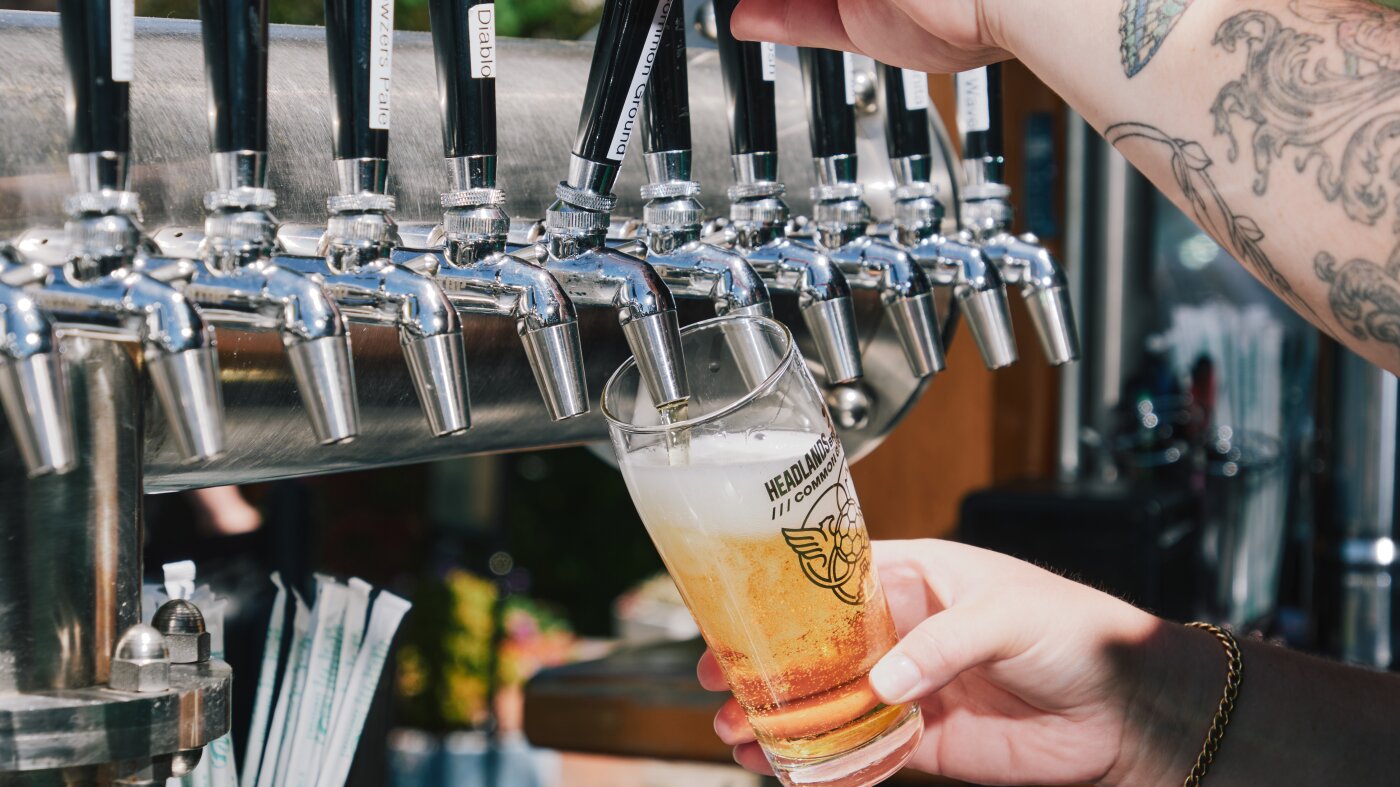
Headlands Brewing launched its World Cup-themed beer Common Ground ahead of the first World Cup game in June.
Justin Gellerson for NPR
hide caption
toggle caption
Justin Gellerson for NPR
The British betting company William Hill predicts that soccer fans will throw back more than 5 million pints of beer in stadiums and fan zones during this year’s World Cup. And that number doesn’t even account for the millions of pints being poured in bars as fans tune in to the global soccer event.
But while international soccer crowds are focusing on goals and penalties, a trio of craft breweries from the tournament’s three host nations are using the tournament to brew something increasingly rare: cross-border solidarity.

A shared recipe with local spin
The collaboration began months ago over a flurry of video chats and emails. The beermakers at Rey Árbol Brewing Co. in Mexico, Headlands Brewing in the United States, and Cabin Brewing Co. in Canada set out to design a single, unified recipe representing the brewing traditions of all three nations.
“It’s a Mexican lager,” said Alejandro Gomez, founder of Rey Árbol.
“That’s like a West Coast IPA,” said Ryan Frank, chief operating officer and brewmaster for Headlands.
“And up in Canada, most of our beers are hop driven,” said Haydon Dewes, co-founder of Cabin. “So we thought, let’s go for a dry-hopped Mexican lager.”
While all three breweries share the exact same recipe, each is giving the final product a distinct local spin, including unique, regionally designed labels. A four-pack of the U.S version costs $15.99. Frank said Headlands has produced about 130 cases of the limited-run brew.
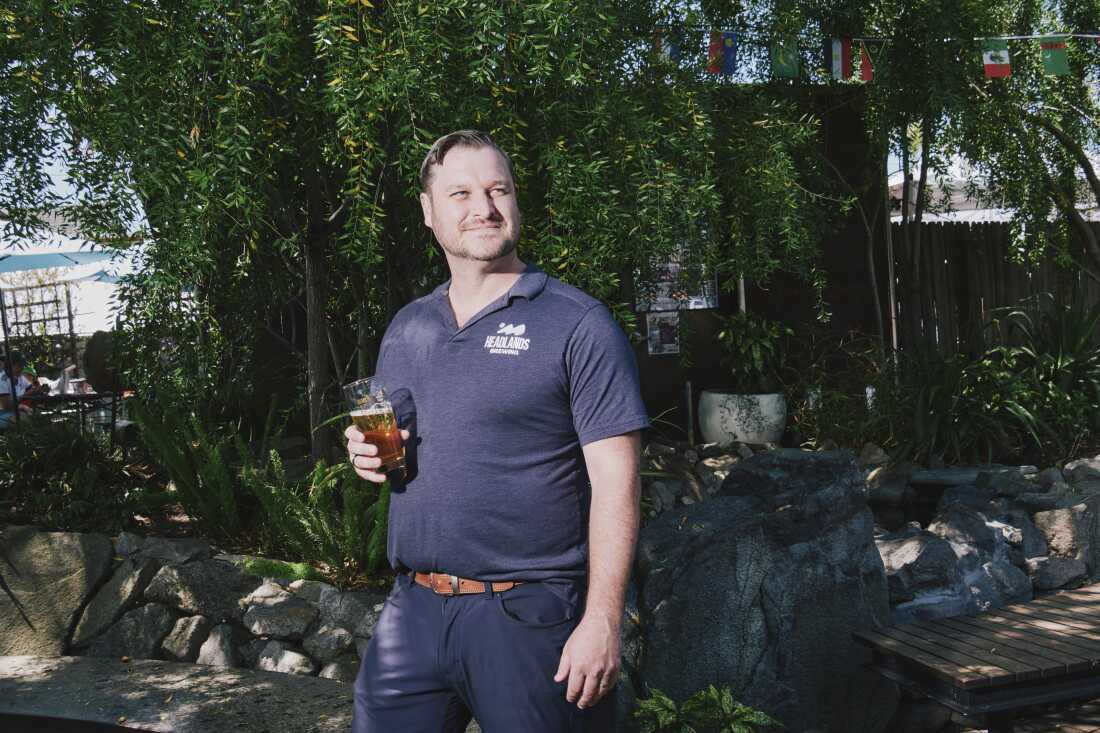
Headlands Brewing COO and brewmaster Ryan Frank drinks a Common Ground beer in Berkeley, Calif., on June 11.
Justin Gellerson for NPR
hide caption
toggle caption
Justin Gellerson for NPR
For the brewers, however, the project is less about marketing and more about connection: They named the multinational beer “Common Ground.”
“When I go to California or Canada, they will treat me like family,” Gomez said.
“It makes the world feel so much smaller,” said Dewes.
“It’s about building bridges and knowing what’s important in life,” said Frank. “And for us, that’s soccer and beer.”
Geopolitical friction in the taproom
The official rhetoric surrounding World Cup 2026 mirrors the brewers’ optimism, with promotional materials promising a tournament where billions are “united as individuals, united as billions.”
Yet this idealistic messaging stands in sharp contrast to a prickly geopolitical reality. Tensions between the U.S., Mexico and Canada have mounted over trade tariffs and auto manufacturing standards as the three nations renegotiate long-standing trade agreements.
The independent brewers behind Common Ground are feeling that friction firsthand through the rising costs of aluminum cans and raw ingredients.
“There are 15% tariffs slapped on any European-grown hops, which are really critical to some of our core brands,” Frank said.

Headlands Brewing brewmaster Ryan Frank and CEO Austin Sharp share a Common Ground beer in Berkeley, Calif., ahead of the first World Cup game on June 11.
Justin Gellerson for NPR
hide caption
toggle caption
Justin Gellerson for NPR
The political discord hasn’t just been confined to trade boards.
When signing an executive order to establish a White House Task Force for the World Cup in March 2025, President Trump suggested that cross-border hostilities might actually benefit the tournament. “Oh, I think it’s gonna make it more exciting,” the president said.
A bittersweet reminder
Tension on the soccer field is one thing; between nations, it’s another.
“It’s true that when it comes to the actual soccer, we’ve developed a very healthy, vibrant rivalry between the three countries,” said Andrés Martinez, the author of The Great Game: A Tale of Two Footballs and America’s Quest to Conquer Global Sport and co-director of Arizona State University’s Great Game Lab, which studies the intersection of sports, media and geopolitics. “But we’re also linked together in this very symbiotic relationship.”
Martinez said that when the U.S., Canada and Mexico initially launched their collaborative bid to host the World Cup back in 2017, the political climate was warmer.
“It was meant to showcase these tight bonds that had developed between the three countries,” Martinez said.

The makers of Common Ground used a shared recipe, but all created their own distinct packaging for the beer: Canada’s Cabin Brewing Co.; Mexico’s Rey Árbol Brewing Co.; the United States’ Headlands Brewing.
Cabin Brewing Company, Rey Árbol Brewing Company, Headlands Brewing
hide caption
toggle caption
Cabin Brewing Company, Rey Árbol Brewing Company, Headlands Brewing
But relations have soured since then, making cross-border business collaborations like Common Ground an anomaly rather than the norm for this tournament.
“To see craft beers across the three countries coming together like this, it’s a bittersweet reminder of what we were hoping to see a lot more of,” Martinez said.
Finding the real common ground
If trade wars and political posturing are looming large in Washington, D.C., Ottawa and Mexico City, they feel a world away at Headlands Brewing’s busy North Berkeley location.
As fans gathered to watch a crucial match between Mexico and South Africa at the start of the tournament, the sunny patio erupted into cheers and shrieks of “Goal!” when Mexico found the back of the net.

Headlands Brewing hosts a screening of the first World Cup game on June 11 in Berkeley, Calif.
Justin Gellerson for NPR
hide caption
toggle caption
Justin Gellerson for NPR
Hovering over a pint of the collaborative brew, soccer fan Roberto Mandujano reflected on the cross-border experiment.
“Three different ways, three different taste buds come together to make something cool,” he said.
When asked about the underlying political tensions between the host nations, Mandujano shrugged off the discord.
“We live in a world where everyone wants to make everything political,” Mandujano said. “But I think we’re all here for soccer. So I guess that’s the common ground.”
-

 Utah1 minute ago
Utah firefighter fears job loss after answering wildfire call
-

 Vermont6 minutes ago
Police searching for missing Troy woman
-
 Virginia13 minutes ago
Virginia to allow recreational marijuana to be sold in retail stores beginning in 2027
-
Washington16 minutes ago
Port Washington weekly vigils honor community members arrested by ICE
-

 Wisconsin21 minutes ago
3 dead after crash involving UTV, truck in western Wisconsin
-

 West Virginia28 minutes ago
Judge blocks West Virginia SNAP soda ban, restoring benefits for soft drinks
-
 Wyoming31 minutes ago
At 6,000-year-old crossing, Gov. Gordon OKs Wyoming’s first-ever designated pronghorn migration route
-
Crypto36 minutes ago
Consumer alert issued for Bitcoin cryptocurrency ATMs


