Lifestyle
This L.A. escape room explores corporate greed — and shows how corruptible you really are

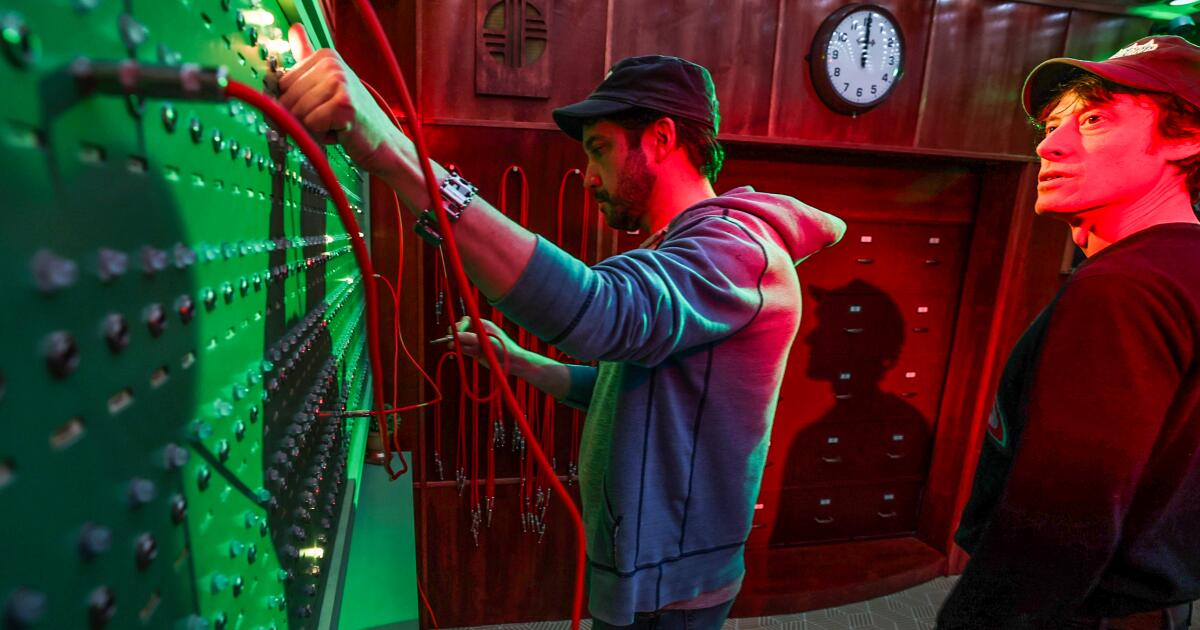
Word got out that there was a whistleblower wanting to meet. The company was suspicious, but this was the first overt notice that our place of work was corrupt. Should we investigate and see what ethics were being breached, or play dumb and stay loyal to the firm? We were divided.
I wanted to link with the informant — if something is amiss, we should know, even if it put our fast-rising career in jeopardy. But was that out of character for the avatar we had choosen?
This is the Ladder from Hatch Escapes, an interactive experience near Koreatown that explores corporate corruption. It opened this month and has become one of the most buzzed-about escape rooms in the country.
In 2018, Hatch Escapes debuted a highly regarded escape room in Lab Rat, a comedic horror show in which the roles of humans and test rodents are flipped. It’s a 60-minute game, with puzzles, an ending and, of course, a quest to break free. While it won praise for its mixing of digital and analog media, as well as its emphasis on storytelling, Lab Rat is still what many of us understand an escape room to entail.
The fictional Nutricorp is the center of the Ladder, a complex branching narrative that explores corporate greed.
(Robert Gauthier / Los Angeles Times)
Its follow-up, the Ladder, is not that.
For the past five years Los Angeles’ Hatch Escapes has been rethinking the escape room ground rules. The goal: to prove the an escape room is not mere entertainment but can, in fact, be experienced as a work of narrative art.
Think of the Ladder as a 90-minute interactive movie with puzzles, taking guests through five decades, beginning in the 1950s, in which they will play an exaggerated game of corporate life. Start in the mailroom, and work your way through secretarial and middle-management-themed areas, all the while mixing puzzles, games and choose-your-own-adventure-like choices.
You may find yourself playing a game of memory around digitally enhanced cocktail glasses, as our mid-level exec seemed more interested in company card perks than late nights with the books. Or perhaps you’ll choose to investigate a wall-long switchboard, listening to callers’ problems and trying to connect them with a solution. Elsewhere, in an area dedicated to the 1980s, Nintendo’s “Donkey Kong” gets remixed as “Bossy Kong,” with a suited villain rather than a gorilla trying to thwart our progress. The final room — the corner office — is group game chaos inspired by the popular collaborative video game “Spaceteam,” complete with fully animated windows overlooking a city.
That it incorporates a wide variety of games, puzzles, as well as film and animation — all of it designed to be in service of advancing a story — has made this escape room one that is redefining the medium.
The title screen for “Bossy Kong,” an ‘80s-themed video game in the Ladder.
(Robert Gauthier / Los Angeles Times)
Tommy Wallach plays “Bossy Kong.”
(Robert Gauthier / Los Angeles Times)
“The Ladder, in terms of North American escape rooms, is definitely one of the top five most-anticipated games of the moment, propbably top two or three,” said David Spira, co-founder of Room Escape Artist, a website dedicated to the art of puzzle making. “It’s probably the most ambitious escape room I’ve seen, in terms of narrative.”
If all goes according to plan, wits will be tested but so will morals, as participants are graded on puzzle acumen as well as personal choices. Play ethically, corruptly or spend your time playing with the mini-golf-turned-shuffleboard floor in a middle-management office; the Ladder offers an abundance of choices, so many that it’s impossible to discover all its content in a single play-through. It’s ambitious, and it’s counting on guests to come for the puzzles, and stay for the story, almost aiming to be more akin to a real-life video game than a traditional escape room.
“We wanted to build something that basically would allow a group of 10 people to never stop doing something effective,” says Tommy Wallach, who co-founded Hatch Escapes with Terry Pettigrew-Rolapp.
Its puzzles and games are all optional. And before it begins, guests are likely to be given a warning: The Ladder’s puzzles are hard.
Then it’s time to turn a doorknob, which will trigger one of the Ladder’s multiple digital screens and ask groups to pick a character to portray — my team opted for a young hotshot of a narcissist who appeared eager to double-cross. We didn’t play true to his temperament, however, choosing often to toe the company line rather than align with any unsavory actors. Story moments, for which all games and puzzles will pause, are delivered via screens. Think of them as akin to video game cut scenes — that is, cinematic instances in which players can set down the controller.
We discovered hidden rooms — in one moment, a wall will essentially disappear to reveal a film noir-like scene involving a subplot with the FBI, albeit only if a group solves a particular puzzle — and tried our hand at a host of digitally enhanced games, some of which use lighting cues to remake a room. You’ll definitely want to approach the Ladder as if it’s a playable movie, as a 1950s mail room, for instance, is presented in black-and-white, playing tricks with color and grayscale. While we rose through the company ranks, our ending — there are multiple, as one doesn’t win or lose, per se — didn’t see us becoming the next billionaire; we lived a more solitary life, complete with a cat.
Designers Tommy Wallach and Terry Pettigrew-Rolapp at Douchie’s Bar, inside a ‘70s-themed room of the Ladder.
(Robert Gauthier / Los Angeles Times)
After extended play-testing, the Ladder opened in early April. Wallach and Pettigrew-Rolapp are already in reflective mode. Each room (decade) features one core puzzle, which is directly tied to the narrative, as well as an abundance of mini-games. After about 15-20 minutes guests will move on, whether they solved the puzzle or not.
Did, Wallach and Pettigrew-Rolapp wonder, the team go too heavy on narrative? Will players follow the story line or opt to simply play games? And with so much to do in each decade, will guests want to come back to complete more, or will they feel overwhelmed?
“Our initial thought was that we’re trying to move this art form forward,” Wallach says. “We are doing that with this room, though not necessarily in exactly the way we thought we would. We thought we we’re going to try to get into more serious or better storytelling — more involved characters. I don’t think what’s the Ladder achieves. What it does achieve is trying to solve some other escape room problems. Replayability is one of them. Can we create something people want to come back to in the way people want to come back to Disneyland, because it’s not solved and done?”
It’s surprising to hear Wallach say the Ladder may not achieve all of its narrative goals. Storytelling, after all, is what helped build the Hatch Escapes reputation. In addition to Lab Rat, the company created the take-home “Mother of Frankenstein,” which is part novel and part puzzle tabletop game. Hatch is also home to the Scout Expedition-created exploratory, live-action game “The Nest,” a patient, interactive narrative in which participants discover one woman’s life story.
“When they came out with Lab Rat, it was the kind of game that across the country their reputation preceded them,” said Room Escape Artist’s Spira, who is based in New Jersey. “We knew we had to get back out to L.A. to play that game. It was pushing on a lot of boundaries that very few people were — they were pushing on narrative and building message into game play.”
While one could just play the Ladder and bypass a lot of the story, doing so would mean missing much of the nuance in the experience. Puzzles, for instance, build on one another, and characters in a switchboard game, which contains more than 100 cues, may appear later in another challenge — perhaps one in which a vintage computer coldly instructs us to decrease the corporation’s headcount. But the Ladder does raise an intriguing question: Do fans of puzzle games actually want more story?
Tommy Wallach demonstrates an escape room puzzle located in the Ladder.
(Robert Gauthier / Los Angeles Times)
It is, admits Wallach, difficult to do. Guests who come to play, for instance, may not be primed to watch multiple videos advancing a plot.
“The canvas is so small. You have so little time to develop characters. Getting people to stop and listen to a story is almost impossible,” Wallach says. “I’m empathetic to it, but you can’t tell a better story unless you give me some room to tell you a story. That balance is harder than expected.”
And the Ladder is counting on players to want to experience a little story with the game play. Part of the reason it took five years to construct is that the Ladder is custom-built and cost more than $1 million to complete. It’s a premium escape room experience, with per-player costs typically ranging from $75 to $95, depending on the day. “Everything is bespoke,” says Pettigrew-Rolapp. “There is literally nothing off the shelf. The scale of what we’re trying to accomplish required that, and there are no experts in this. Every person who worked on this had to learn as they go, because nobody has done this before.”
It’s early days, but the Ladder is finding its audience. It has been largely selling out about two weeks in advance, at the time of writing. Wallach is optimistic and confident.
He believes the adventure will continue to sell out. “It needs to sell out, but it will,” he said. “I really do just think it will,” Wallach says. “We see maybe a tenth per week of what a Broadway theater sees in a day, and those tickets are $200 per person and not $95. But we’re going to need a couple good years before we’re like, ‘Everything is wonderful again.’ ”
Hatch is already garnering national attention for offering a boundary-pushing experience. It’s a winning start, and likely means that the only company being run into the ground is the fictional one at the heart of the Ladder.


Since leaving office, former Vice President Mike Pence founded the policy and advocacy organization Advancing American Freedom.
Drew Angerer/Getty Images
hide caption
toggle caption
Drew Angerer/Getty Images

Since leaving office, former Vice President Mike Pence founded the policy and advocacy organization Advancing American Freedom.
Drew Angerer/Getty Images
Former Vice President Mike Pence played a key role in bringing President Trump to power in 2016. By putting his name on the Republican ticket, he helped reassure the Republican establishment and evangelical voters who were wary of Trump’s brash brand of populism.
Pence’s departure from Trump’s leadership of the Republican party began when Trump called on Pence to refuse to certify the results of the 2020 election — pressure Pence rejected.
“For four years, we had a close working relationship. It did not end well,” Pence wrote in his memoir So Help Me God, which was released in 2022.
In the years since leaving office, Pence has been advocating for an ideological restructure of the Republican party, and founded the policy and advocacy organization Advancing American Freedom. Pence builds on the theme of reimagining the Republican party in his new book What Conservatives Want, which provides a critique of the second Trump administration and what he terms the “populist right.”
In an interview with Morning Edition, Pence detailed to NPR’s Steve Inskeep his critique of the second Trump administration, shared his perspective on civil rights legislation and challenged Trump’s tariffs and other interventions in the economy.
Listen to the full interview by clicking on the blue play button above; and read highlights from the conversation below.
‘The populist right’ does not represent conservative beliefs
Pence believes that Trump has embraced “the populist right” over traditional conservatives in the Republican party.
The sale of economic American company U.S. Steel to Nippon Steel in Japan exemplifies this shift, Pence said.
In his first term, President Trump opposed the sale. But in his second term, he approved the sale and took a golden share — a class of shares in which a government can own a very small percentage of the company but has outsized voting rights.
Pence said that he was taken aback by Trump’s decision to take a golden share.
Free trade is essential to American conservatism
Pence takes umbrage with his former boss’ tariff-laden economic policy.
Pence said it violates conservatism’s bedrock belief in the power of free trade, and Trump has gone about granting exceptions to tariffs in an unfair way.
Granting waivers to large corporations from certain tariffs is “one of the lesser reported aspects of the tariff regime that’s been imposed by the administration,” Pence added.
Trump and Pence ran in 2020 on a mission to “drain the swamp,” rooting out government corruption and wasteful spending. However, Pence said Trump appears to have shifted from those goals.
“There’s maybe nothing more swampy than the battle over getting tariff waivers for big business,” Pence said.
Women’s rights on the right
There is a debate among the ultraconservative right about the role of women in civic life.
The concept of “household voting,” has become a familiar talking point for ultra-right-wing communities online. Supporters of “household voting” advocate that every American household should get one vote, the vote being that of the husband’s. This concept has been promoted by figures such as Abby Johnson, a prominent anti-abortion activist who spoke at the 2020 Republican National Convention. When asked about whether he supported household voting, Pence said he is not aligned
“It’s one person, one vote in this country. And people have bled and died for that principle throughout the years of our history,” Pence said.
He added that American families don’t need to be propped up by government programs to boost childbirth. “What American families need is an application of the kind of principles that will create higher wages, more opportunities, more jobs,” Pence said.
Should conservatives stand for civil rights?
Pence said he was an admirer of senator and one-time presidential candidate Barry Goldwater.
Notably, Goldwater voted against the Civil Rights Act of 1964.
“Should conservatives stand for civil rights?” asked Inskeep.
Pence responded that civil rights are important to conservatives, but that equality of opportunity is what legislation ought to enshrine, not equality of outcome.
Pence added that he stood by the Supreme Court’s decision to ban partisan gerrymandering on the basis of race, rendering ineffective a key provision of the Voting Rights Act of 1965.


Milly Alcock in Supergirl.
Warner Bros. Pictures
hide caption
toggle caption
Warner Bros. Pictures
Hollywood’s newest Supergirl is kind of a dirtbag — in the good way. Fearless and grumpy, Supergirl (Milly Alcock) sets out on a quest to support a new pal’s revenge journey and to make a point that should be clear by now: Never mess with a lady’s dog. Also featuring David Corenswet and Jason Momoa, is Supergirl a worthy follow up to Superman?
If you want more DC superhero action, check out these episodes:
‘Superman’ takes off and nails the landing
‘The Batman’ puts the emo in emote
Connect with Pop Culture Happy Hour:
Letterboxd / Facebook
Our weekly newsletter
Support Pop Culture Happy Hour+
-

 Lifestyle15 minutes ago
Former Vice President Mike Pence believes Washington is more ‘swampy’ under Trump
-

 Technology30 minutes ago
Prime Day’s final hours bring rare discounts on Philips Hue smart lights
-

 World33 minutes ago
Video shows gaping hole after small plane crashes into towering skyscraper
-

 Politics38 minutes ago
Warren tells Trump to ‘sign the damn bill’ as bipartisan housing package remains stalled in Washington
-

 Health45 minutes ago
Common food preservatives may raise blood pressure and heart risks, study suggests
-

 Sports47 minutes ago
Who is Alyssa Thomas? WNBA star suspended for punching Caitlin Clark in the throat
-

 Technology52 minutes ago
Fox News AI Newsletter: Waymo’s robotaxi recall
-
Business60 minutes ago
Cisco to lay off more than 400 workers in California


