Lifestyle
The L.A. laundromat offers something special and rare: a home away from home

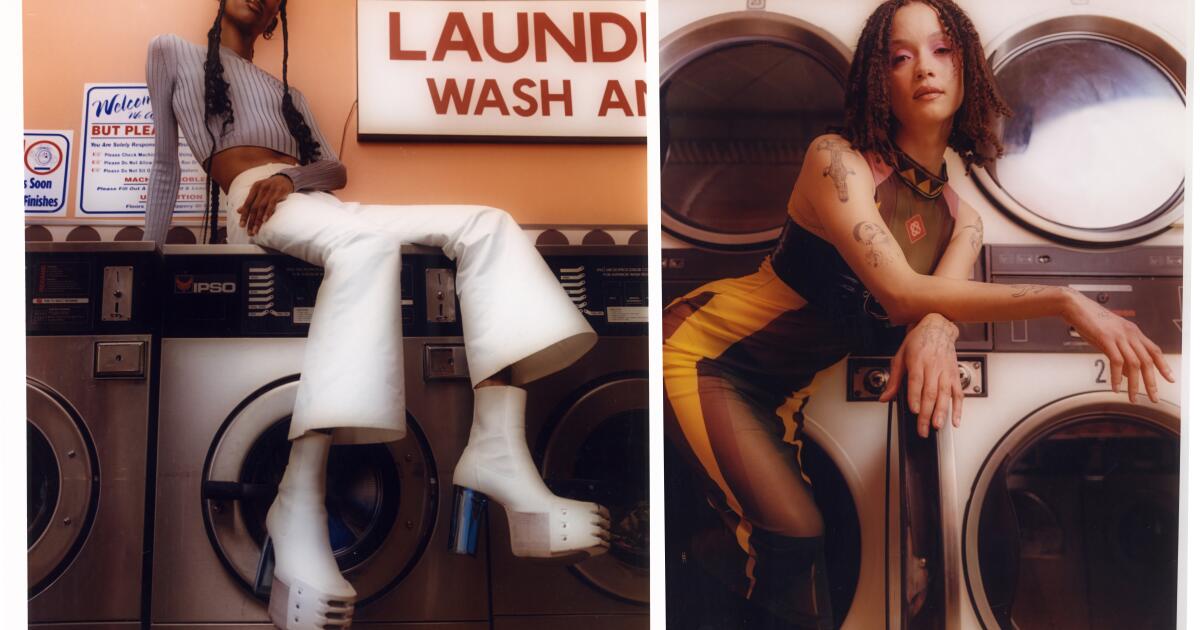
The laundromat is the perfect place to cry in public.
I’m here now, crying as I type this. I don’t care who sees me. I’m tucked away into one of the two-person benches between the silver three-load washers, tears welling up in my eyes near their tipping point. I make eye contact with a man who passes me by on his way to the sink. He looks slightly concerned. But even if I wasn’t partially hidden it wouldn’t matter. I feel safe here. It’s a place that puts intimacy on a rush order, past the point of faux social etiquette. I’m surrounded by people who see the color of my underwear as I pull it out of the dryer. What are a few tears at this point? We’re already well acquainted.
I’ve always been too internal for my own good. I cry in public often because of what’s happening in my imagination. And the laundromat — its familiar, sterile smell of cleaning products and metal, the constant chugging sound of water and hot air — is a place that feels particularly primed for me to slip into my subconscious mind, like sliding into a comfortable pool of Jell-O. I remember things I forgot. I romanticize the Krypto Villain stickers in the quarter vending machines. I sit and stare at people until it hurts. I fantasize about what their lives are like, or all the times they wore those nice faded jeans that they’re pulling out of the dryer while the static shocks their skin. I see a couple sitting under the food tent outside. Their knees point into each other’s while they’re eating, and by their body language alone I conclude that they are, of course, in love. I see a teenage boy shadow-boxing the washing machine in what I decide by a demeanor that I find all too familiar, is a bid for attention. I’m reminded of when I was 14 and needed attention.
An L.A. laundromat is always open, and always waiting for you.
The dryer whirs soft, the fluffy smell of chemical flora rises, the badass little kids with silver teeth run circles around their mom while she folds their Spiderman T-shirts. An image flashes in my mind of myself when I was small — curly hair, dirty Osirises and the fake tattoos I got from the quarter machine fading on my forearm, using the laundry cart like a bumper car or laying my head on a freshly baked mountain of clothes that was just piled into it from the dryer.
I love the laundromat. I’ll tell anyone who will listen. You will catch me at a party giving what might as well be a PowerPoint presentation about the joys of the laundromat. What most people see as an undesirable chore I see as a comfort zone. My own private version of the club, where fluorescent light floods from the ceiling and there’s always Amy Winehouse or Salt-N-Pepa playing over the loudspeaker. My local laundromat is open 24 hours — as all the good ones are — and any time of day or night, for the rest of my life, I know there is a place that is open and waiting for me (as long as I have a hoodie to wash). I’ve never had an in-unit washer and dryer in my many years of living on my own. And it never mattered. Because I have something rarer, more special: a home away from home.
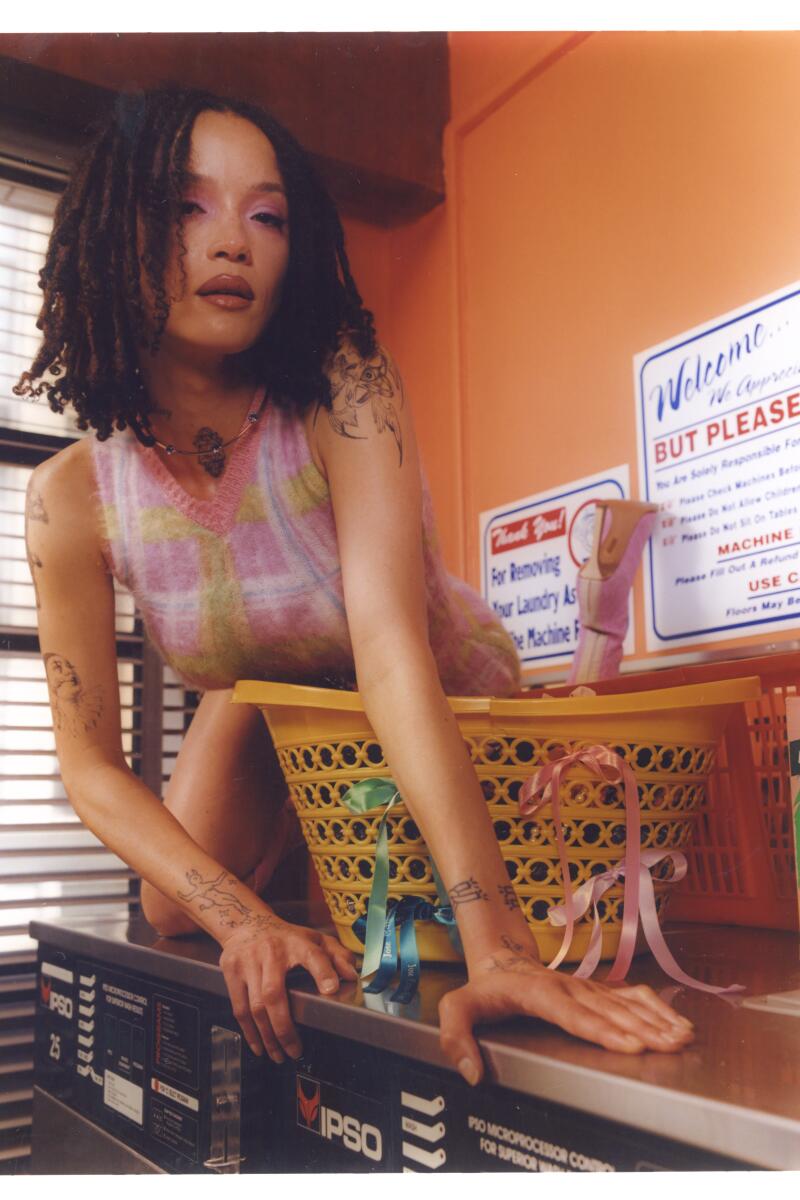
May wears Marni dress, Fendi pink boots.
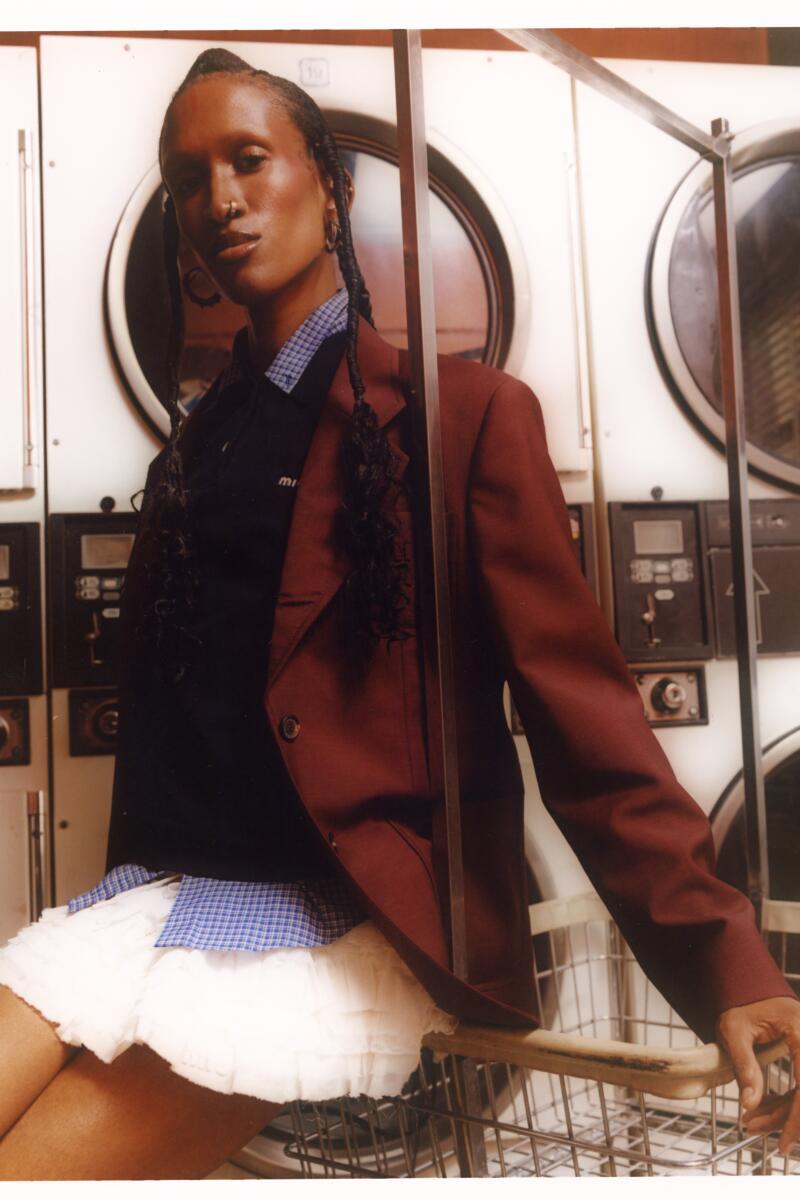
Maahleek wears Miu Miu, model’s own jewelry.
There’ve been rumblings on the internet lately about “third places” — spots people go to that are not their house, not their office, but a secret third thing. “These places are vanishing!” the TikTok feed will warn. Sociologist Ray Oldenburg coined the term “third place” in his 1989 book “The Great Good Place” and expanded on it in his 2001 book, “Celebrating the Third Place.” Oldenburg’s life’s work has been dedicated to explaining why informal gathering spaces matter, and in his writing he defined some characteristics of a true third place, including low barrier to entry, being a status leveler, somewhere that conversations happen and arguably most importantly, being a home away from home. This, Oldenburg writes, is the antidote to isolation, the lubricant of a healthy social balance. “Y’all got nowhere to hangout and it shows,” stated one TikTok creator, who made a series out of suggesting third places.
The experience of the laundromat spills beyond the confines of its walls into its surrounding areas. If you’re doing laundry in a neighborhood like mine, then you’re very lucky, and every single day there is someone selling food on the sidewalk out front. Last time I was there, it was the new-to-me Colombian spot, a Mexican empanada spot and a birria spot that sells it on top of pizza. The smell of soupy, red meat mixing with the unmistakable perfume of Suavitel and Zote shavings. On the weekends in winter, you’ll find the champurrado lady selling Styrofoam cups of the viscous, steaming drink out of the trunk of her minivan.
The parking lot is where all the good things happen. When I was in my early 20s, I used to put my load in and s**** a b**** with my bestie as I waited for the cycle to finish. It’s where I bought someone’s physical mixtape a couple months ago because I’m a recovering people-pleaser, and was in partial system shock from even seeing a physical mixtape. It’s where I can never find parking — even on a weekday evening — because as long as there are days to live there will be laundry to do.
The number of activities done there that have nothing to do with washing your clothes feels specific, in a lot of ways, to L.A. We do all of our photo shoots for our merch brands at laundromats (who among us?), throw experimental punk shows, come up with our best ideas. In my Notes app earlier this year I wrote: “Laundromat culture — places of business and life and love and food.”
I saw a post about a guy who lived in a renovated laundromat in Queens, which felt right to me — something to aspire to. In “The Great Good Place,” Oldenburg writes that third places should inspire the same fuzzy, warm glow of belonging as its inhabitants might find in their own homes. There should be a sense of ownership, of taking up space. I remember this when I Zelle the guy with the Colombian hat $6 for two potato and cheese empanadas. As I sit outside to eat them I notice a parked car with the driver and passenger seats reclined all the way back, two people with their feet up on the dash hold hands as they engage in a romantic, mutual endless scroll on their phones. “That’s beautiful,” I think. We make ourselves at home in places where we need to pass time. We find ways to be comfortable, to turn it into our living room.
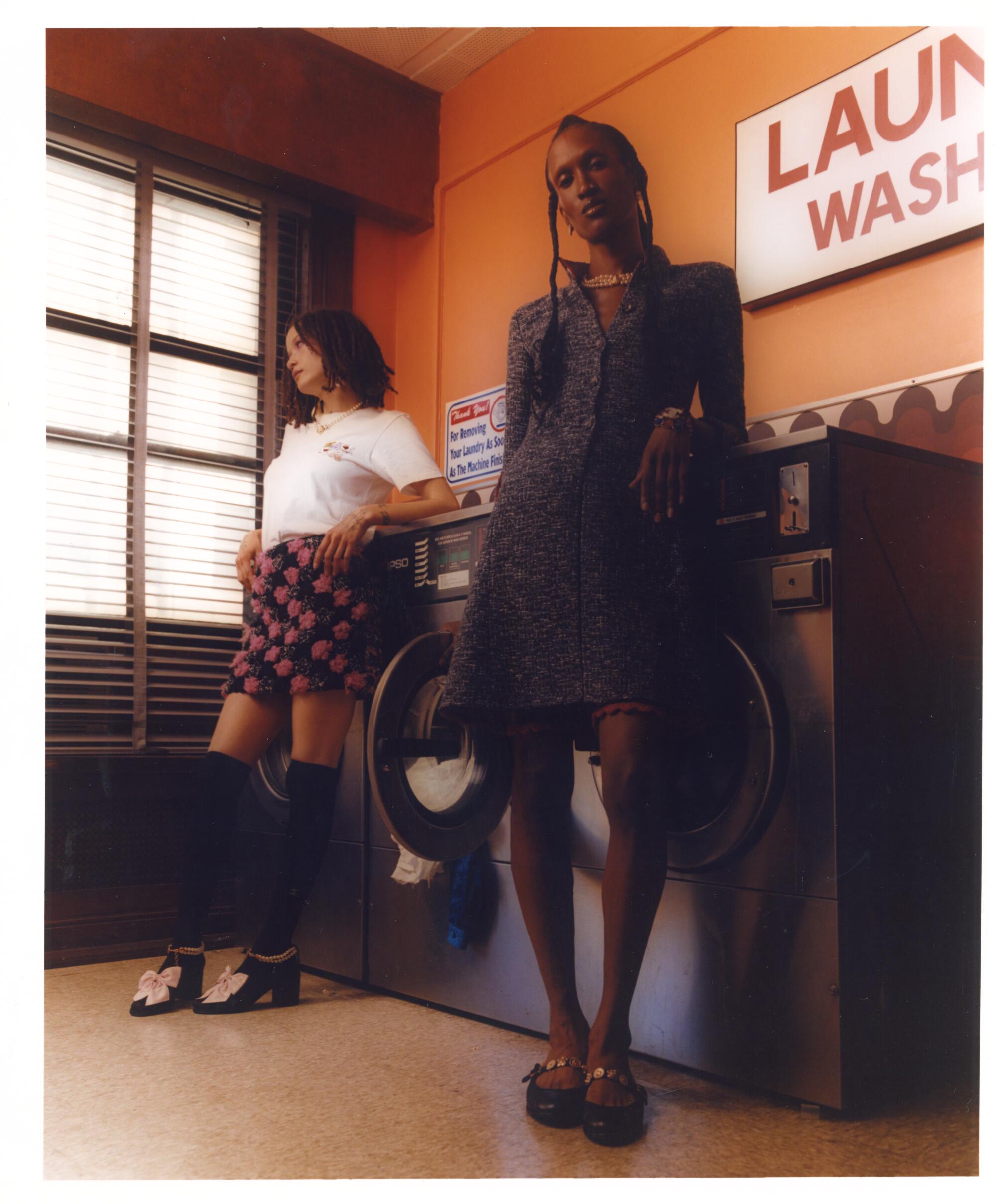
Maahleek and May wear Chanel.
When my mom comes to visit me she always takes a load of my laundry to wash at the laundromat I’m at now. (Yes, I’m 29, but her love language is “acts of service,” so sue me.) Every time, she comes back upstairs to my apartment with freshly folded T-shirts (and a blouse she shouldn’t have put in the dryer but did anyway) and regales me with a new story of an hourlong conversation she had with a stranger — the latest in her laundromat saga. I’m more the observant type. The interactions I usually have here are swift, but I still find them deeply meaningful. I notice a lady selling intricate gold-plated rings on one of the tables by the window, the natural light bouncing off the metal tray as the afternoon sun makes its descent. I ask her about them. All of these little moments fill me with the feeling of being human. There is so much talk about a need for connection, a need for community, but no one wants to spend an hour of their week philosophizing intense beauty in the mundane at their local laundromat, do they? That’s what I thought.
An important part of the laundromat experience is the massage chair. It’s the only spot that offers a soft surface to sit inside the actual building, and treating oneself feels right in a place like this. I sit in it long enough before it yells at me to put money in — I never get the actual massage, of course. I get up and relocate to a spot where I can watch the meticulous dance of a big family folding their clothes. They always have, like, 15 kids and 10 loads of laundry — an assembly line that communicates: We ain’t new to this. They quickly take up an entire counter and move with accuracy. I see one family bring a mega Tupperware container filled with hangers, attaching each of their nice button-up shirts like clockwork. It’s hypnotizing. I spot a long chartreuse dress with a flower detail that I would never wear but am deeply intrigued by. In the background, there are moments of intensity that bubble up and dissipate — a rush will be interspersed with serene moments — mimicking the flow of anything else in life.
And as soon as I slipped too deep, I’m jolted back to reality by two women arguing over a dryer, which is a normal interaction here. It went on for 15 minutes, each one of them throwing strays long after the initial confrontation was finished. Draaaaama, I thought. And I laugh to myself. Because that’s what happens when you’re comfortable, when you’re at home, when you’re with your family.
Production: Mere Studios
Models: Maahleek, May Daniels
Makeup: Selena Ruiz
Hair: Adrian Arredondo
Photo Assistant: Dillon Padgett
Styling Assistant: Deirdre Marcial


The Kennedy Center, the facade of which remains covered with a tarp, is seen in Washington, DC, on June 28, 2026. A US federal judge asked on June 24 for an explanation for why a tarpaulin continues to cover the facade of the Kennedy Center where President Donald Trump’s name was recently removed. District Judge Christopher Cooper gave the board of trustees of the performing arts venue until the end of July to explain “the purpose for and status of the tarp and scaffolding that Defendants have erected on the front portico of the Center.”
ALEX WROBLEWSKI/AFP via Getty Images
hide caption
toggle caption
ALEX WROBLEWSKI/AFP via Getty Images
More than two weeks ago, President Trump’s name was removed from the Kennedy Center facade though it is still covered by a tarp and the legal battle continues.
On Monday, a U.S. Department of Justice filing on behalf of the Kennedy Center included some surprises. The document was submitted in response to issues raised by lawyers for ex-officio board member Rep. Joyce Beatty of Ohio who is suing to remove President Trump’s name from the center and stop its closure for renovations.
Among the revelations, the Kennedy Center admitted that, during a board meeting on December 18, 2025, Beatty had been “muted and prevented from speaking.” It was at that meeting that the board voted to add President Trump’s name to the center. The filing later acknowledges the congresswoman was “prevented from voicing her opposition.”
The John F. Kennedy Center for the Performing Arts is a living memorial to its namesake. The guidelines for how the theatre complex spends federal dollars are very specific. Among other rules, it states that “no additional memorials or plaques shall be designated or installed.” Beatty argues adding Trump’s name runs afoul of those rules and that any change requires approval from Congress.
According to one of Beatty’s filings, “There was no advance notice in the agenda that the Board would be considering a name change,” a statement the Kennedy Center now does not deny. The center admits that, prior to voting, there was “no discussion about potential risks or downsides of the vote to adopt a secondary name for the Center.” Nor was there a board discussion “about any potential conflict of interest that might result from the vote.”
The center’s lawyers previously contended that if Trump’s name were to be removed, it would “lose money from donors who support” him and “impede the Center’s fundraising efforts.”
Closing for renovations
Earlier this year, Trump announced on social media that the Kennedy Center would close for two years for renovations. He wrote that he made the decision after “a one year review” with “Contractors, Musical Experts, Art Institutions, and other Advisors and Consultants.”
But, according to the center’s lawyers, Trump’s announcement “was made without presenting any plans, analyses, timelines, or funding information to his cotrustees and without any Board vote.”
The Kennedy Center has long denied reporting by The Washington Post that ticket sales plummeted after President Trump became the Center’s board chair. In Monday’s legal filing, the Center admits that, by October 2025, “nearly half of the Center’s tickets were going unsold.”


Paul Tremblay has made a career of pushing the horror genre – and the novel format – in strange and exciting new directions.
In his latest, Dead but Dreaming of Electric Sheep, the author offers an amalgamation of genre elements that can be best described as psychological-dystopian-science-fiction horror. It’s a mouthful, but the narrative does all of that and more in a way that defies categorization.
Julia Flang is a former semiprofessional gamer working two mediocre jobs she dislikes and living in a modest ranch house in a San Fernando Valley suburb with her retired uncle, whom she calls Uncle Fun. Julia likes movies and gaming but there’s little else going on in her life, so when her estranged mother, the CFO of a large tech company, contacts her with a possible job offer – a “once-in-a-lifetime thing” that pays handsomely just for doing the interview – she hesitantly agrees.

The job is relatively simple and perfect for someone with gaming skills: using a controller built into a phone to get a man, who is stuck in a vegetative state, from California to the East Coast. It will require her to learn how to control his body – walking, moving, sitting, standing, using his arms – so she can maneuver him out of the facility where he is located and into cars and planes and through crowded airports. A fan of movies, Julia decides to call the man Bernie – after the movie Weekend at Bernie’s. When the ethics of the job start to bother her, Julia realizes it’s too late and she must go through with it. However, she’s soon contacted by people interested in sabotaging the whole thing, people who, like her, don’t align with the shady interests of conglomerates and those set to make “gobs of money” from this new, somewhat inhuman technology.

As with every Tremblay novel, any synopsis barely scratches the surface. The novel’s chapters alternate between Julia and you (yes, you). Julia’s chapters are “normal” in the sense that they obey a chronological order and have action, basic descriptions of movement and places, and dialogue. The chapters in second person are like fever dreams from a shadow world; the desperate experiences of a man trapped inside his own body with no control of it, no clue what’s happening to him, and only a few fragmented memories of his life. Also, Tremblay uses a similarly fragmented style of storytelling (including words and sentences trapped in boxes and/or “moving” on the page) to keep things interesting but also confusing and creepy.
This novel operates on several different levels and – planes of existence? Bernie has a head full of AI that controls his body, but his consciousness is still there and struggling to regain control, struggling to remember things. There are monsters, leeches, mysterious rabbits, and eerie shadows in his world, but the true horror comes from the lack of control, from being moved around against his will and having no clue what comes next. Bernie is the embodiment of losing control to AI, and when taken together with the commentary of creativity and AI and the meta interludes in which the author takes a wrecking ball to the fourth wall and addresses readers, this is the best anti-Generative AI story horror has produced so far.
Despite the horror of it, this is a very funny novel. Julia is sarcastic and struggles to keep her comebacks in line, but the conversations she has and messages she writes are always entertaining. However, the humor is far from the crown jewel here. That title belongs to a plethora of big ideas Tremblay juggles. The nature of life, death, and consciousness, the evils of conglomerates, inhuman practices in the name of capitalism, and AI, and even what it means to be human are all explored here: “Is Bernie alive? Is he feeling pain? Is he experiencing everything as a prisoner looking through the bars of his body? Has his consciousness been winnowed to a metaphysical keyhole? Where does consciousness begin or end?” There are no definite answers here, but the way Tremblay infuses humanity, love, the importance of relationships, and humor throughout the narrative provides the kind of answers that can’t and don’t need to be spelled out.
A genre-bender full of big ideas that constantly switches between a world full of real or uncomfortably plausible nightmares and a bizarre hellscape in which loss of self, memory, and autonomy are only the tip of the proverbial iceberg, Dead but Dreaming of Electric Sheep is a horrific and terrifyingly disorienting novel that invites readers to consider a future that already started. Tremblay has always been an innovator, but this beautifully written collection of real and imagined grotesqueries cements him not only as one of the most original and exciting voices in horror but also as one of the smartest, most engaging authors in contemporary fiction.
Gabino Iglesias is an author, book reviewer and professor living in Austin, Texas. Find him on X, formerly Twitter, at @Gabino_Iglesias.

-

 Maryland2 minutes ago
Wes Moore’s military record: what’s known, what isn’t
-

 Michigan9 minutes ago
Whitmer says she will pull Michigan National Guard from D.C. if troops used in Trump’s Safe and Beautiful Mission
-

 Massachusetts12 minutes ago
Massachusetts dad on ‘adventure of a lifetime’ left fighting for his life in Fiji after noticing bug bite
-

 Minnesota17 minutes ago
Invasive ‘bloody red shrimp’ reach Lake Superior
-

 Mississippi25 minutes ago
Mississippi Lottery Mississippi Match 5, Cash 3 results for June 30, 2026
-

 Missouri27 minutes ago
Missouri Sports Betting May 2026: $256.4M Handle, Record $21.3M Revenue
-
Montana32 minutes ago
Montana Lottery Mega Millions, Big Sky Bonus results for June 30, 2026
-

 Nebraska39 minutes ago
Erstad joins Nebraska golf program

